AI Agent Competitive
Intelligence
Intelligence Journeys
AI Use Cases for Utilities
Private Broadband for Utilities

Automation

Network automation replaces manual configuration and operations with software-driven processes, ranging from scripted tasks to fully autonomous, self-optimizing networks. Driven by the complexity of 5G standalone, cloud-native architectures, and multi-vendor environments, operators are pursuing higher autonomy — often framed against the TM Forum’s autonomous networks levels — to cut costs, speed service delivery, and improve reliability. Automation increasingly relies on AI and closed-loop systems that sense, decide, and act with diminishing human intervention. For operators and enterprises, the practical path runs through incremental autonomy: automating well-defined tasks before attempting end-to-end self-operation. This channel covers network automation across RAN, core, and operations — including orchestration, closed-loop control, and the AI techniques behind autonomous networks — with analysis of where automation is delivering measurable results and how operators are progressing toward higher levels of autonomy.

The next wave of digital transformation will be defined by AI workloads riding on cloud and edge infrastructure over 5G networks, and that shift will change how networks are built, monetized, and secured. Generative and agentic AI move more compute into the network, creating persistent, uplink-heavy, low-latency flows rather than the mostly downlink, best-effort traffic of the smartphone era. Video from cameras, glasses, and sensors feeds models at the edge and in the cloud; results return in milliseconds to people and machines. That means tighter latency budgets, deterministic jitter control, and stronger guarantees for both throughput and reliability.

NTT DATA and AWS have signed a multi-year strategic collaboration aimed at accelerating cloud modernization and responsible agentic AI adoption, with clear implications for APAC enterprises and telecoms. The agreement expands joint go-to-market and delivery across four pillars: AI-driven cloud transformation, industry cloud solutions, AI-enabled managed services and customer experience, and sovereign cloud for regulated workloads. NTT DATA has created a dedicated AWS Business Group with close to 11,000 AWS-certified experts and plans to certify nearly 10,000 more in three years. APAC boards want measurable AI outcomes, but legacy estates, data fragmentation, and compliance obligations slow progress.
ServiceNow has named Anthropic’s Claude as the default model for its Build Agent and a preferred model across the ServiceNow AI Platform, signaling a shift from AI pilots to deeply embedded, production-grade automation. Embedding Claude into that fabric gives customers an on-ramp to agentic automation—systems that can reason over context, decide, and execute tasks—without stitching together point tools. Claude becomes the default model for ServiceNow Build Agent, an AI-assisted builder for apps and automations. Embedding Claude within the ServiceNow AI Platform enables access control, usage monitoring, and compliance aligned to enterprise policies. ServiceNow aims to cut implementation timelines for customers by roughly half by using Claude to accelerate configuration, adoption, and rollout.
Verizon exits 2025 with standout subscriber growth and a leaner 2026 investment plan that shifts dollars from network build to integration, efficiency and customer retention. Verizon posted more than 1 million net additions in the fourth quarter, including 616,000 postpaid phone net adds—the best showing since 2019—and 372,000 broadband net adds driven by 319,000 fixed wireless access (FWA) additions and the strongest Fios Internet quarter since 2020. After years of 5G coverage build, Verizon is pivoting to densification, fiber integration and operating efficiency, allowing capex to step down without undermining network competitiveness. Capital will concentrate on fiber-led convergence, FWA capacity, and experience-centric technologies that reduce churn and support revenue quality.
CEO Börje Ekholm indicated the company will keep trimming headcount after cutting roughly 5,000 positions over the last year. In Sweden, Ericsson has notified authorities and begun union talks that could affect about 1,600 roles, part of a multi‑year restructuring program. The move follows a 2023 plan to remove around 8,500 jobs worldwide—about 8% of its workforce—with further reductions last year in markets such as Spain and Canada. The rationale remains consistent: reset the cost base, protect profitability, and keep investment firepower for strategic bets amid a slower operator capex cycle.
Ericsson is signaling a strategic shift toward defence, mission-critical, and AI-era network architectures as traditional RAN spending stays flat. Management expects the global RAN market to remain flat in 2026, sustaining a multi-year trend that now pegs annual spend at roughly the low-$30 billions. Ericsson is building for a traffic mix shift where AI applications push uplink throughput and latency to the forefront. Defence, utilities, transport, and public safety are moving from proprietary systems to standards-based 3GPP networks.
This edition of TeckNexus Private Network: Innovation & Ecosystem Solutions spotlights the platforms, partnerships, and deployment models accelerating private 5G, LTE, and CBRS at scale. Through feature stories, executive interviews, and award-winning case studies, it reveals how collaboration is turning private networks into secure, production-ready ecosystems.
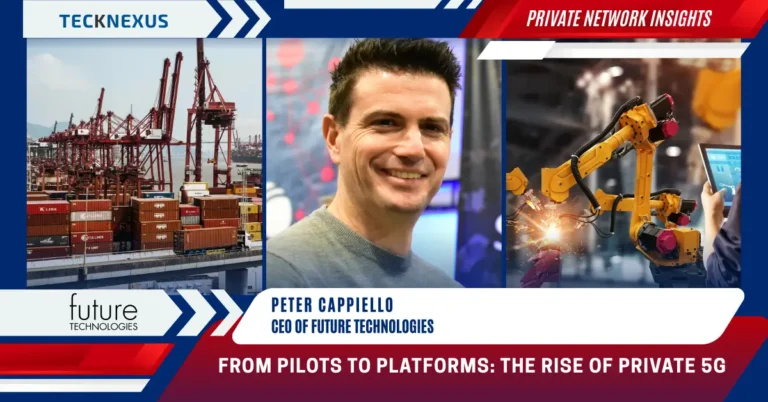
Private cellular networks are moving beyond pilots into mission-critical infrastructure. Derived from a conversation with Peter Cappiello, CEO of Future Technologies, this article explores how AI modernization, industrial scale, and hybrid network models are reshaping private LTE and 5G, often as an extension of existing enterprise networks—across energy, manufacturing, ports, and logistics.
Enterprises are moving fast to private 5G to digitize operations, but the payoff only materializes if security scales with the new connectivity footprint. Private 5G brings deterministic wireless to factories, hospitals, ports, and energy sites, connecting robots, AGVs, cameras, and critical control systems. Security must follow identities and workloads, not subnets. Adopt a Zero‑Trust approach aligned to NIST SP 800‑207 with a single source of truth for identity and policy. Shift from perimeter controls to context-driven segmentation. Build on open standards and APIs to avoid lock‑in and simplify operations. Security must be foundational, measurable, and auditable from day one.
AI-driven experiences are flipping the traffic mix, pulling more capacity demand toward the uplink than U.S. mobile networks have historically planned for. Generative and vision-based AI are shifting usage from predominantly downloads to more continuous and bandwidth-heavy uploads. Recent benchmarking shows U.S. 5G networks prioritize downlink KPIs more than peers in Asia, even as uplink usage climbs. RootMetrics’ drive testing in late 2025 found all three U.S. carriers set roughly one-fifth of their midband Time Division Duplex (TDD) frame resources for uplink. That gap becomes material as AI, livestreaming, and enterprise camera workloads expand. U.S. carriers continued to win experience awards in early 2026, even as their uplink allocations trailed global leaders.
The article examines:
The energy and thermal implications of rising compute density in data centers, Limitations of traditional air-based cooling at high rack power,
How direct-to-chip and immersion liquid cooling technologies improve heat transfer and energy performance,
Market, operational, and sustainability drivers influencing adoption in modern compute environments,
Broader implications for system architecture, infrastructure design, and future research directions.

Written as an objective, insight-led analysis rather than promotional content, the piece is designed to engage IEEE’s audience of computing researchers, systems engineers, and infrastructure strategists who are exploring how emerging cooling solutions intersect with future computing platforms and energy-aware design. The article is original and unpublished, and I’m happy to work with your editorial team to tailor it to IEEE Computer’s style and technical depth.

Frequently Asked Questions

What’s the difference between automation and AI in a telecom context?
Automation, in its traditional form, generally follows pre-defined rules and scripted logic: a specific condition triggers a specific, predetermined response, with no real interpretation or judgment involved beyond what was explicitly programmed in advance. AI adds the capacity to learn from data, recognize patterns that weren’t explicitly anticipated, and make more nuanced decisions about what action makes sense in a given situation, even one the system hasn’t seen in exactly that form before. In practice, most modern telecom systems combine the two: AI analyzes a situation and decides what should happen, while automation infrastructure actually executes that decision reliably and consistently across the network, a combination often described as the foundation for agentic AI.
What is ‘zero-touch’ network operation, and how close is the industry to achieving it?
Zero-touch network operation describes the long-term industry goal of running networks with minimal direct human intervention, where the network itself handles configuration, fault recovery, and optimization automatically and continuously. It’s a meaningful aspiration rather than a fully achieved reality; the industry is progressing toward it in stages, with specific functions, like automated fault detection or dynamic capacity adjustment, achieving meaningful levels of automation well before the broader vision of an entirely self-managing network becomes reality. Standards bodies including ETSI have working groups specifically dedicated to defining the requirements for zero-touch network and service management, reflecting that this remains an active area of ongoing standardization rather than settled, widely deployed technology.
Why is automation considered essential for managing modern 5G networks specifically?
5G networks are substantially more complex than earlier generations for several compounding reasons: they rely heavily on virtualized network functions running across cloud infrastructure rather than fixed dedicated hardware, they support network slicing, meaning managing multiple distinct virtual networks with different performance guarantees simultaneously, and they often combine equipment and software from multiple different vendors rather than one integrated supplier. Traffic patterns also shift constantly and unpredictably as device density and application types continue to grow. Attempting to manually manage this level of complexity at the scale of a national or global network simply isn’t realistic, making automation effectively a practical requirement for operating a modern 5G network reliably at all.
How does automation relate to network orchestration?
Automation and orchestration are closely related but distinct concepts. Automation generally refers to executing a specific task without manual intervention, like automatically restarting a failed process or adjusting a configuration parameter. Orchestration refers to the broader coordination of multiple automated tasks and virtualized network components across their full lifecycle, deciding where different network functions should run, how they should scale, and how they interact with each other to deliver a complete service. In practice, orchestration systems often rely on underlying automation capabilities to actually carry out the individual tasks they coordinate, providing higher-level coordination while automation provides the lower-level mechanism for reliably executing decisions.
What are the risks of relying heavily on automated network systems?
Heavy reliance on automated systems introduces specific risks alongside its clear efficiency benefits. If an automated system makes an incorrect decision, that error can potentially propagate quickly and broadly across the network before a human notices and intervenes, compared to a manual process where mistakes tend to be more contained. There’s also a risk of reduced visibility and understanding among human staff over time, since heavily automated systems can create a gap between what the network is actually doing and what engineers fully understand about why, particularly as AI-driven decision-making becomes more involved. Operators generally manage these risks by maintaining careful guardrails for automated actions, expanding autonomous scope gradually as confidence grows.
How has automation changed the day-to-day role of network engineers?
Automation has shifted network engineers’ day-to-day work away from repetitive, manual configuration and troubleshooting tasks and toward higher-level responsibilities like designing automation policies, overseeing AI-driven systems, and handling more complex or novel problems that automated systems aren’t yet equipped to resolve independently. Rather than manually configuring each new service or personally diagnosing every fault, engineers increasingly spend time defining the rules, guardrails, and escalation criteria that govern how automated systems behave, then stepping in directly for situations that fall outside those parameters. This represents a meaningful skills shift, with growing demand for engineers comfortable working with automation platforms and AI systems alongside traditional networking expertise.
What’s ‘closed-loop automation,’ and why does it matter?
Closed-loop automation refers to systems that don’t just execute an automated action once, but continuously monitor the result of that action, compare it against the intended outcome, and adjust automatically if the result doesn’t match expectations, creating a self-correcting cycle without requiring a human to manually verify and re-trigger each step. A closed-loop system managing network capacity, for example, might automatically increase resources in response to rising traffic, then continuously monitor whether that adjustment actually resolved the congestion, and make further automatic adjustments if it didn’t. This concept is considered a meaningful step toward the zero-touch network vision, since it moves automation beyond simple one-off actions toward genuinely self-managing behavior based on real-world feedback.

Partner Hubs

Download content, access intelligence tools, and hear from executives.

Partner Events

  • Network X Vienna 2026
Scroll to Top