AI Agent Competitive
Intelligence
Intelligence
Private Network
Intelligence
Intelligence
Intelligence Journeys
AI Use Cases for Utilities
Private Broadband for Utilities
Intelligence Tools
By Tool Type
▼
By Industry
▼
Access Type
▼
Monthly Trackers
▼
Resources
▼
Technology Hubs
▼
Partner Hubs
▼

Home » Automation » Page 8
Automation
Network automation replaces manual configuration and operations with software-driven processes, ranging from scripted tasks to fully autonomous, self-optimizing networks. Driven by the complexity of 5G standalone, cloud-native architectures, and multi-vendor environments, operators are pursuing higher autonomy — often framed against the TM Forum’s autonomous networks levels — to cut costs, speed service delivery, and improve reliability. Automation increasingly relies on AI and closed-loop systems that sense, decide, and act with diminishing human intervention. For operators and enterprises, the practical path runs through incremental autonomy: automating well-defined tasks before attempting end-to-end self-operation. This channel covers network automation across RAN, core, and operations — including orchestration, closed-loop control, and the AI techniques behind autonomous networks — with analysis of where automation is delivering measurable results and how operators are progressing toward higher levels of autonomy.
- Tech News & Insight
- December 26, 2025
- Hema Kadia
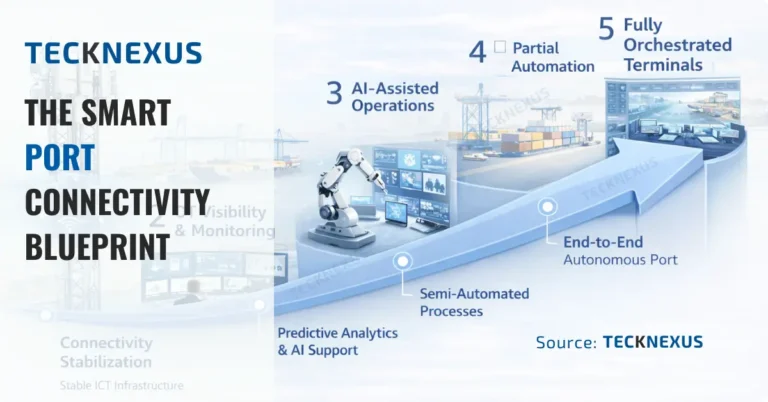
Private 5G and LTE networks are becoming essential to smart port strategies worldwide. This article explores how ports are deploying private wireless, edge computing, and AI to automate operations, improve safety, reduce emissions, and drive ESG goals. Learn from 10 real-world deployments of Private Networks for Ports that are shaping the future of Smart Ports.
- Tech News & Insight
- December 16, 2025
- Hema Kadia

Across roughly 2,000 decision-makers in telecom, data center, and large enterprises, a strong majority doubts that existing infrastructure will keep up with AI’s next wave. In the US, most respondents expect network buildouts to lag AI investment and call out near-term priorities such as optimizing bidirectional data flows, expanding fiber capacity, enabling real-time training feedback, and placing low-latency compute closer to users. In Europe, most enterprise leaders say current networks are not ready for broad AI adoption; many already report latency, throughput, and resiliency pain as data demands rise. The common thread is clear: without accelerated modernization, networks risk becoming the bottleneck that constrains AI outcomes.
- Tech News & Insight
- December 15, 2025
- Hema Kadia

Orange has signed a binding agreement to buy Lorca’s remaining 50% stake in MasOrange for 4.25 billion euros in cash, targeting completion in the first half of 2026 subject to customary approvals. The agreement transitions MasOrange from a 50:50 joint venture to a wholly owned subsidiary of Orange, consolidating governance and simplifying decision-making across mobile, fixed, and converged operations in Spain. At closing, MasOrange is expected to be fully consolidated into Orange’s accounts, including MasOrange debt that Orange plans to refinance at or after completion, providing flexibility to optimize the capital structure and cost of capital.
- Tech News & Insight
- December 9, 2025
- Hema Kadia

IBM has agreed to acquire Confluent for $31 per share in cash, signaling a decisive move to make real-time, governed data the backbone of generative and agentic AI across hybrid cloud environments. The transaction values Confluent at an enterprise value of roughly $11 billion, with closing targeted by mid-2026 pending shareholder and regulatory approvals. Together they aim to unify application, data, and AI pipelines across public clouds, private data centers, and edge locations—reducing integration friction and accelerating time to value for enterprise AI.
- Tech News & Insight
- December 9, 2025
- Hema Kadia

A strategic merger to accelerate standardized 5G NTN Cobham Satcom is merging its Network Division with Gatehouse Satcom to push 3GPP-based non-terrestrial networks from trials to scalable deployments. The combined entity will sit as a subsidiary within Cobham Satcom Group, led by Kenney Schmidt Christiansen, Gatehouse Satcom’s current CEO. Cobham Satcom will hold a majority stake and continue to serve maritime, government, and enterprise customers through its SAILOR, Sea Tel, EXPLORER, and TRACKER brands. The transaction requires standard regulatory approvals but positions both companies to offer an end-to-end 5G NTN platform spanning software, ground infrastructure, and terminals.
- Tech News & Insight
- December 9, 2025
- Hema Kadia

New data points to a step-change in cellular IoT adoption as 5G broadens into mid-tier and massive-scale use cases while 4G-era LPWA keeps expanding. Omdia forecasts cellular IoT connections to reach roughly 5.9 billion by 2035, driven by expanding addressable use cases across industrial automation, utilities, transportation, retail, and consumer-adjacent categories such as wearables. The growth profile is no longer tied only to premium 5G performance; instead, scaled adoption is coming from three complementary pillars: 5G RedCap for mid-tier performance at lower cost, 5G Massive IoT (evolving NB-IoT/LTE-M under a 5G core), and 4G LTE Cat-1bis for low-cost devices that still require voice or moderate throughput.
- Tech News & Insight
- December 9, 2025
- Hema Kadia

The administration plans an executive order to set a single national AI rulebook and override state-level frameworks, a move with immediate implications for telecom, cloud, and enterprise AI strategies. President Trump signaled he will sign an executive order establishing a uniform federal approach to AI governance that preempts state regulations. Reports indicate the order aims to reduce compliance friction by replacing diverse state rules with a lighter-touch national framework focused on competitiveness. State officials from both parties, safety advocates, and labor groups are preparing to fight the order, citing risks related to consumer harm, deepfakes, hiring bias, and child safety. On the other side, Silicon Valley leaders warn that 50-state compliance regimes could deter innovation and blunt national competitiveness.
- Tech News & Insight
- December 7, 2025
- Hema Kadia

The FAA has tapped Peraton as prime integrator for a multi‑year modernization of the National Airspace System (NAS), setting in motion a telecom-heavy refresh of networks, radios, and control systems at national scale. The FAA selected Peraton, owned by Veritas Capital, as the single program integrator to manage an initial $12.5 billion upgrade of the aging U.S. air traffic control system. Officials are targeting a three-year execution window to cut outages, improve efficiency, and reinforce safety across the NAS, with additional funding in the $19–20 billion range likely required to fully complete the plan.
- Tech News & Insight
- December 7, 2025
- Hema Kadia

The Indian government has floated draft rules that refine how mobile operators can share spectrum, aiming to boost spectral efficiency and accelerate 5G expansion under the new telecommunications regulatory framework. The draft rules seek to formalize spectrum sharing under the new regime, giving operators a clearer pathway to pool or share spectrum holdings while ensuring compliance with license conditions. In practical terms, telcos would gain a more predictable mechanism to use underutilized spectrum, improve coverage, and optimize capacity without always resorting to new auctions or heavy capex.
- Tech News & Insight
- December 7, 2025
- Hema Kadia

Work at local distribution points often triggers unintended service cuts, driving spikes in complaints, repeat truck rolls, and SLA penalties. By empowering on-site technicians to detect and remediate cuts instantly—rather than wait for back-office workflows—operators can compress mean time to repair, avoid secondary visits, and reduce inbound support volume. The result is fewer avoidable outages and a more predictable experience for consumers and businesses using fiber for VPN, SD-WAN, and cloud access. Previous collaboration (Lot 1) notified operators when their customers were impacted by nearby work, but the model was still largely reactive. Lot 2 integrates detection and authorization directly into technicians’ mobile tools.
- Tech News & Insight
- December 7, 2025
- Hema Kadia

This dispute underscores the weakness of today’s data-sharing “plumbing.” Scraping is brittle, hard to audit, and raises legal risk. The industry will likely move toward standardized, consent-driven APIs that let customers securely share specific data fields for comparison and switching. Telecom can borrow from open banking: OAuth 2.0 and OpenID Connect flows, fine-grained scopes, auditable logs, and tokenized access with time limits. TM Forum Open APIs and carrier-to-carrier data-sharing frameworks could underpin such exchanges, while CTIA and GSMA initiatives provide governance. Done right, portability can be fast for consumers and compliant for operators.
Frequently Asked Questions
What’s the difference between automation and AI in a telecom context?
Automation, in its traditional form, generally follows pre-defined rules and scripted logic: a specific condition triggers a specific, predetermined response, with no real interpretation or judgment involved beyond what was explicitly programmed in advance. AI adds the capacity to learn from data, recognize patterns that weren’t explicitly anticipated, and make more nuanced decisions about what action makes sense in a given situation, even one the system hasn’t seen in exactly that form before. In practice, most modern telecom systems combine the two: AI analyzes a situation and decides what should happen, while automation infrastructure actually executes that decision reliably and consistently across the network, a combination often described as the foundation for agentic AI.
What is ‘zero-touch’ network operation, and how close is the industry to achieving it?
Zero-touch network operation describes the long-term industry goal of running networks with minimal direct human intervention, where the network itself handles configuration, fault recovery, and optimization automatically and continuously. It’s a meaningful aspiration rather than a fully achieved reality; the industry is progressing toward it in stages, with specific functions, like automated fault detection or dynamic capacity adjustment, achieving meaningful levels of automation well before the broader vision of an entirely self-managing network becomes reality. Standards bodies including ETSI have working groups specifically dedicated to defining the requirements for zero-touch network and service management, reflecting that this remains an active area of ongoing standardization rather than settled, widely deployed technology.
Why is automation considered essential for managing modern 5G networks specifically?
5G networks are substantially more complex than earlier generations for several compounding reasons: they rely heavily on virtualized network functions running across cloud infrastructure rather than fixed dedicated hardware, they support network slicing, meaning managing multiple distinct virtual networks with different performance guarantees simultaneously, and they often combine equipment and software from multiple different vendors rather than one integrated supplier. Traffic patterns also shift constantly and unpredictably as device density and application types continue to grow. Attempting to manually manage this level of complexity at the scale of a national or global network simply isn’t realistic, making automation effectively a practical requirement for operating a modern 5G network reliably at all.
How does automation relate to network orchestration?
Automation and orchestration are closely related but distinct concepts. Automation generally refers to executing a specific task without manual intervention, like automatically restarting a failed process or adjusting a configuration parameter. Orchestration refers to the broader coordination of multiple automated tasks and virtualized network components across their full lifecycle, deciding where different network functions should run, how they should scale, and how they interact with each other to deliver a complete service. In practice, orchestration systems often rely on underlying automation capabilities to actually carry out the individual tasks they coordinate, providing higher-level coordination while automation provides the lower-level mechanism for reliably executing decisions.
What are the risks of relying heavily on automated network systems?
Heavy reliance on automated systems introduces specific risks alongside its clear efficiency benefits. If an automated system makes an incorrect decision, that error can potentially propagate quickly and broadly across the network before a human notices and intervenes, compared to a manual process where mistakes tend to be more contained. There’s also a risk of reduced visibility and understanding among human staff over time, since heavily automated systems can create a gap between what the network is actually doing and what engineers fully understand about why, particularly as AI-driven decision-making becomes more involved. Operators generally manage these risks by maintaining careful guardrails for automated actions, expanding autonomous scope gradually as confidence grows.
How has automation changed the day-to-day role of network engineers?
Automation has shifted network engineers’ day-to-day work away from repetitive, manual configuration and troubleshooting tasks and toward higher-level responsibilities like designing automation policies, overseeing AI-driven systems, and handling more complex or novel problems that automated systems aren’t yet equipped to resolve independently. Rather than manually configuring each new service or personally diagnosing every fault, engineers increasingly spend time defining the rules, guardrails, and escalation criteria that govern how automated systems behave, then stepping in directly for situations that fall outside those parameters. This represents a meaningful skills shift, with growing demand for engineers comfortable working with automation platforms and AI systems alongside traditional networking expertise.
What’s ‘closed-loop automation,’ and why does it matter?
Closed-loop automation refers to systems that don’t just execute an automated action once, but continuously monitor the result of that action, compare it against the intended outcome, and adjust automatically if the result doesn’t match expectations, creating a self-correcting cycle without requiring a human to manually verify and re-trigger each step. A closed-loop system managing network capacity, for example, might automatically increase resources in response to rising traffic, then continuously monitor whether that adjustment actually resolved the congestion, and make further automatic adjustments if it didn’t. This concept is considered a meaningful step toward the zero-touch network vision, since it moves automation beyond simple one-off actions toward genuinely self-managing behavior based on real-world feedback.