

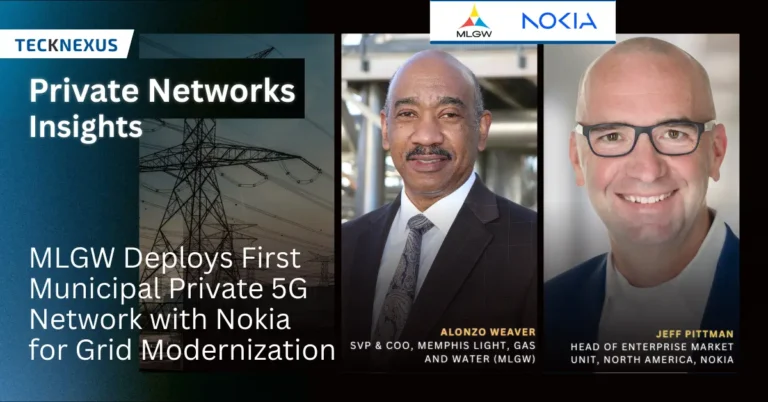
This article is based on a conversation with Alonzo Weaver, Senior Vice President & Chief Operating Officer of Memphis Light, Gas and Water (MLGW), and Jeff Pittman, Head of Enterprise Market Unit for North America at Nokia Mobile Networks.
As utilities across North America confront aging infrastructure, rising cybersecurity risks, and accelerating electrification, Memphis Light, Gas and Water (MLGW) has taken a decisive step forward. By deploying the first full-scale standalone private 5G network operated by a U.S. municipal utility, MLGW is redefining how multi-service utilities modernize operations, strengthen resilience, and prepare for a more dynamic energy future.
The deployment, delivered in partnership with Nokia, supports MLGW’s electric, gas, and water services under a unified, mission-critical communications platform. More than a technology upgrade, the initiative reflects a strategic rethinking of how connectivity underpins grid modernization.
Private 5G as a Foundation for Grid Modernization
At the core of MLGW’s strategy is a recognition that the future grid will be more complex, distributed, and data-driven than ever before. As Weaver explains, modern grid operations require a communications foundation capable of supporting real-time decision-making, advanced cybersecurity, and the integration of clean and distributed energy resources.
Private 5G provides that foundation. It enables real-time grid management, supports stringent security requirements, and allows MLGW to integrate distributed energy resources and clean energy technologies across its service territory. In doing so, the network aligns directly with MLGW’s long-term vision for how the grid must operate to remain reliable, flexible, and secure.
Modernizing Infrastructure Across Electric, Gas, and Water
MLGW’s private 5G deployment is tightly integrated with its broader infrastructure modernization efforts, including the utility’s I2RI program. The initiative spans upgrades to substation breakers, transformers, and protective relays—assets that increasingly rely on reliable, low-latency communications to operate effectively.
Beyond the electric grid, similar investments are underway across gas and water systems. SCADA deployments at gas stations and regulatory facilities, along with enhanced communications for water wells and pumping stations, are helping unify operations across all three services. The result is a more resilient, interoperable infrastructure designed to support long-term operational convergence.
A Purpose-Built Platform for Utility Operations
From Nokia’s perspective, the MLGW deployment reflects a broader evolution in how private wireless is being adopted by critical infrastructure operators. Drawing on decades of experience supporting utilities through fixed and wired networks, Nokia has expanded its portfolio to address the growing demand for private cellular solutions built specifically for mission-critical environments.
The solution deployed at MLGW integrates Nokia’s scalable standalone 5G core, its AirScale radio access network, and the MantaRay Network Management System, alongside a comprehensive cybersecurity framework. Designed end-to-end, the architecture prioritizes ultra-low latency, high availability, and strong security—requirements that are non-negotiable for utility operations.
MLGW’s Private 5G Deployment: A First for U.S. Municipal Utilities
MLGW’s network stands out not only for its technical scope, but also for its significance to the broader utility sector. As Pittman notes, this deployment represents the first full-scale, standalone private 5G network operated by a U.S. municipal utility serving electric, gas, and water customers.
The project demonstrates that private wireless is no longer confined to pilots or limited trials. Instead, it is capable of delivering carrier-grade, mission-critical infrastructure at scale. For municipalities nationwide, MLGW’s experience now serves as a reference model for how private 5G can support secure and efficient modernization.
Cybersecurity and Grid Resilience Through Private 5G
Security and reliability were foundational considerations in the network’s design. Rather than treating cybersecurity as an overlay, Nokia embedded security controls across every layer of the architecture. This includes intrusion prevention systems, advanced threat intelligence, and certificate-based access management.
From an operational standpoint, the private network enhances grid resilience by enabling real-time monitoring and proactive fault detection. High availability and dedicated bandwidth ensure that field crews can be coordinated effectively, assets can be controlled remotely, and service restoration can proceed quickly—even during severe conditions.
Equally important is the inherent isolation of a private network. By maintaining granular control over data traffic and access points, MLGW reduces its attack surface and strengthens protection against external threats.
Expanding Utility Network Reach with 600 MHz Private 5G
Spectrum selection played a critical role in enabling the network’s reach and scalability. By deploying Band n71 (600 MHz), MLGW achieved deep coverage across its municipal footprint, reaching approximately 99% of Shelby County’s population.
The low-frequency spectrum not only supports wide-area, mission-critical coverage, but also provides a scalable foundation for connecting thousands of devices over time. As operational needs evolve, the network is positioned to support emerging use cases such as edge computing, distributed energy resource integration, and advanced remote operations.
Transforming Day-to-Day MLGW Utility Operations with Private 5G
For MLGW, the operational impact of private 5G is already clear. Real-time communications with fault indicators, switches, meters, and other field devices enable faster identification of outages and more accurate root-cause analysis.
Unified connectivity across electric, gas, and water systems further enhances situational awareness. As the nation’s largest three-service utility, MLGW benefits from improved coordination and visibility across its entire operational landscape—capabilities that are increasingly essential as customer expectations continue to rise.
Boosting Community Resilience with Real-Time Utility Data
The benefits of private 5G extend beyond internal operations to the communities MLGW serves. Enhanced operational visibility allows the utility to respond more effectively to severe weather events, which are a recurring challenge in the Memphis region.
Whether dealing with storms that bring down trees or ice events that strain infrastructure, faster response and restoration directly translate into improved safety and reliability for customers. In this way, private 5G becomes not just a technology investment, but a tool for strengthening community resilience.
Enabling a Flexible, Two-Way Grid with Private 5G
Looking ahead, MLGW sees private 5G as a critical enabler of future grid capabilities. As electric vehicle adoption grows and customers deploy home energy storage and solar generation, the grid must accommodate two-way flows of energy and data.
By enabling secure, real-time communications with distributed resources, the network allows MLGW to dispatch assets when needed and build cooperative relationships with customers who invest in clean energy technologies. This flexibility will be essential for maintaining grid stability as usage patterns continue to evolve.
MLGW and Nokia’s Strategic Collaboration for 5G Grid Innovation
Delivering a project of this scale required close collaboration from concept through execution. MLGW and Nokia worked together on spectrum selection, network design, and site deployment, aligning technical decisions with operational priorities.
That partnership model, grounded in shared commitment and hands-on collaboration, was instrumental in bringing the deployment to fruition—and provides a blueprint for similar initiatives across the utility sector.
Private 5G: A Catalyst for Utility Digital Transformation
As utilities across North America navigate digital transformation, private 5G is emerging as a foundational technology. It supports automation, predictive maintenance, EV infrastructure, and resilient grid operations, while enabling new operating models built on real-time intelligence.
With its landmark deployment, MLGW has positioned itself at the forefront of this transformation. And as private 5G adoption accelerates, collaborations like the one between MLGW and Nokia are likely to play a defining role in shaping the future of utility infrastructure.