
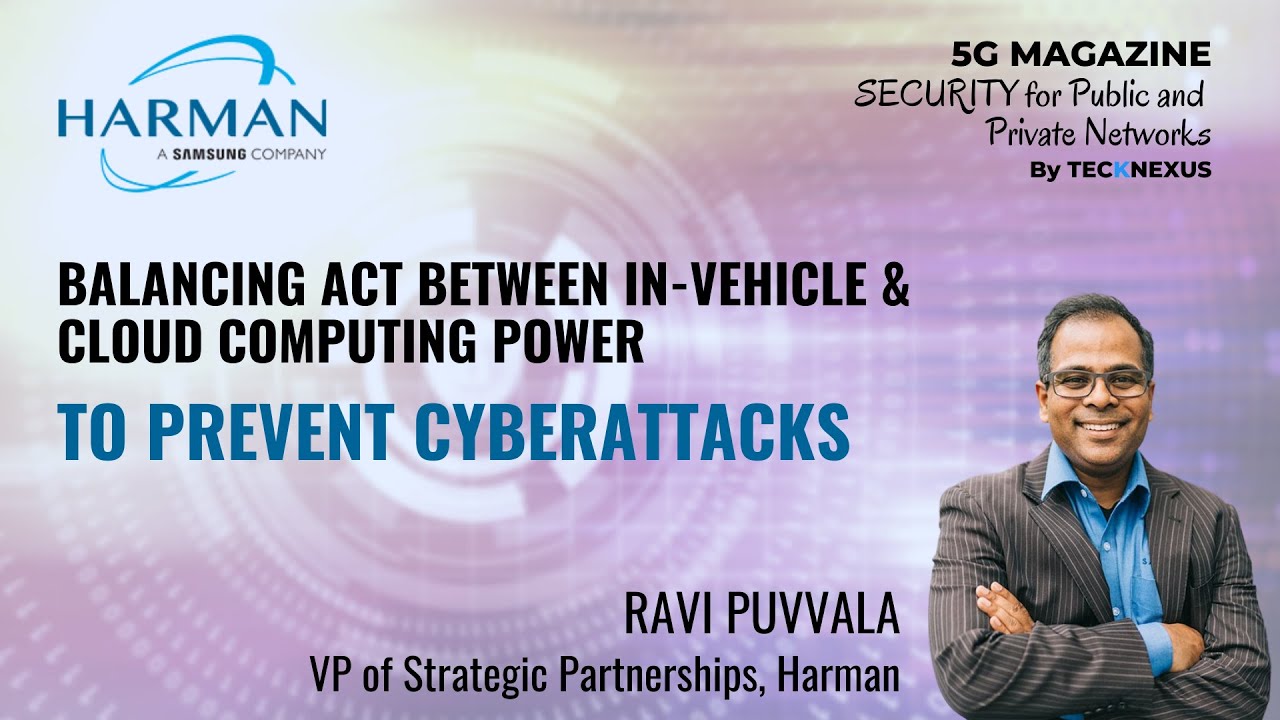
Securing Connected Vehicles: Harman’s Cybersecurity Pathway

Explore Harman’s innovative strategies in fortifying cybersecurity for connected vehicles, led by VP Ravi Puvvala. Navigate through their approach in tackling regulatory challenges, investing in in-vehicle and edge platform security, and deploying unified cybersecurity architectures to safeguard the future of automotive connectivity and ensure compliant, secure, and future-proof operations in the evolving digital vehicular landscape.

Introduction: Ravi Puvvala

Ravi Puvvala, with his vast expertise and innovative leadership as the Vice President of Strategic Partnerships at Harman, is sculpting a new era in the realm of connected vehicle platforms. His journey, from his foundational work at Savari to his strategic role at Harman, has been embellished with pioneering advancements, particularly in cybersecurity innovation, 5G telematics platforms, and connected infrastructures. He has also been pivotal in steering multi-access edge computing platforms towards a secure and connected automotive future.

Harman: Transitioning to Software-Defined Connected Vehicles

The journey towards software-defined cars is not merely an evolution; it’s a full-scale paradigm shift that encompasses numerous aspects of the automotive industry, from technological advancements to the reshaping of market segments and business models. Ravi, through his pivotal role at Harman, anticipates that by the year 2025, connectivity will be an intrinsic feature in 90% of cars. This comprehensive shift, which involves a technological transition from CAN and FlexRay interfaces to Ethernet, signifies a thorough transformation. It permeates through every aspect of in-vehicle experiences, from the integration of streaming applications like Spotify and Netflix to the exploration of augmented reality through windshields and the advent of virtual reality gaming and metaverse applications.

Navigating through Regulatory Challenges

For auto OEMs, the navigation through various regulations, including the UNISA R155 and R156, has become a defining factor that shapes the operational landscape. These regulations, which mandate cybersecurity management systems and software update management systems, respectively, are set to be enforced from July 2022 for new vehicle types and from July 2024 for all new vehicles. However, regulatory navigation is not solely about compliance. It’s also a journey that involves the strategic deployment of technologies and services while balancing adherence, innovation, and technological deployment in a manner that satisfies various compliance and regulatory standards.

Harman: The Intricacies of Cybersecurity Investment

In an era where cybersecurity threats are becoming increasingly sophisticated, strategic investment in cybersecurity becomes a pivotal element that requires a meticulous approach. This involves fortifying in-vehicle computing resources, with a specific focus on endpoint detection through platforms like ECUs, TCUs, domain controllers, and zonal controllers. Harman, under Ravi’s leadership, is pioneering a shift towards becoming a managed cybersecurity service provider, emphasizing edge platforms to balance the cybersecurity scales in favor of automakers. This approach facilitates not only regulatory compliance but also ensures secure software services deployment, all while protecting the OEM’s liability and risk.

Harman’s Unified Cybersecurity Strategy

Harman is crafting a meticulous cybersecurity strategy, which involves converging various security operations into a unified architecture and developing an Open eXtended Detection and Response (XDR) platform. This platform is engineered to monitor an entire vehicle attack surface, normalize and fuse various types of events and enriched data, deploying AI and ML techniques for incident correlation. This, combined with an automated, intelligent response, crafts a singular, powerful platform to protect connected vehicles against cyber threats and minimize the OEM’s liability and risk.
Conclusion: Crafting a Future-Proof Path in Cybersecurity

As the automotive industry ventures further into the digital, connected era, the challenges and opportunities magnify. Ravi Puvvala, with his intricate understanding of the complexities and potentials in this domain, guides Harman through a path where regulatory compliance, strategic investment, and innovative deployment of cybersecurity measures converge. The journey ahead for the automotive industry, as it explores the realms of connectivity, automation, and digital experiences, will undeniably require a meticulous, balanced, and future-proof strategy, something that leaders like Ravi and companies like Harman are intricately weaving together.

Private 5G in South Korea is reshaping manufacturing by enabling autonomous robots, real-time quality control, and AI-driven operations. This video podcast explains how dedicated spectrum, practical deployment models, and flexible pricing help factories justify Private 5G over Wi-Fi, plus insights on scaling ROI and future AI-native networks.
TV 2 Denmark, in collaboration with Cumucore, has deployed a private 5G network to support wireless camera workflows and high-quality live broadcasting. By moving away from commercial networks, the broadcaster has gained agility, speed, and control over its production infrastructure. This shift highlights how 5G enables flexible, secure, and efficient content creation—especially critical for live events, remote coverage, and temporary venues.
Private networks are transforming industries like smart cities, manufacturing, and utilities by enhancing connectivity, automation, and data utilization. NTT Data and Nokia are leading this transformation, offering advanced private 5G solutions that improve operational efficiency, security, and sustainability. Private networks enable real-time decision-making through technologies like Edge AI and digital twins while addressing deployment challenges with models like Network as a Service (NaaS). In smart cities, these networks optimize traffic management, energy monitoring, and public safety, delivering citizen-centric value. Learn how private networks drive digital transformation and operational excellence across sectors.
Ericsson and Epiroc are transforming mining with private 5G networks, enabling real-time data access, enhanced safety, and automation. Their solutions address challenges in both above-ground and underground operations, offering scalable, sustainable technologies like AI, robotics, and machine learning to optimize mining processes. Learn how this partnership is shaping the future of mining.

Your Brand. Our Intelligence Tools.

Capture leads at the point of evaluation. Talk to Us →

Sponsored by Palo Alto Networks
⚡ Utilities ⏱ 8 min ✓ Free
This tool is built and hosted by TeckNexus.
Launch Tool →
Whitepaper
This whitepaper explains how utilities can use secure AI-enabled private mobile networks to modernize operations, support distributed intelligence, improve resilience, and strengthen cybersecurity across critical infrastructure. It covers AI applications, private network advantages, zero trust principles, multilayered security architecture, and governance considerations for AI-ready utility environments....
Whitepaper
Non-terrestrial networks are rapidly evolving from experimental satellite systems into an increasingly important part of the global 5G connectivity landscape. This eBook, developed by Radisys in collaboration with TeckNexus, explores how 3GPP standardization, satellite architecture innovation, and software-driven network design are reshaping NTN deployment models. It examines the transition from...
Whitepaper
Private cellular networks are transforming industrial operations, but securing private 5G, LTE, and CBRS infrastructure requires more than legacy IT/OT tools. This whitepaper by TeckNexus and sponsored by OneLayer outlines a 4-pillar framework to protect critical systems, offering clear guidance for evaluating security vendors, deploying zero trust, and integrating IT,...
Private Network Solutions - TeckNexus

Subscribe To Our Newsletter

Tech News & Insight

Feature Your Brand in Upcoming Magazines

Showcase your expertise through a sponsored article or executive interview in TeckNexus magazines, reaching enterprise and industry decision-makers.

Scroll to Top

Map your security gaps to real threat scenarios – including Salt Typhoon, Volt Typhoon, AI data poisoning, rogue devices, and unencrypted OT traffic.

Take the free 8-minute assessment built for utility operators evaluating AI-enabled private mobile networks. Get a readiness score across five critical domains, see where your gaps are, and receive a prioritized action plan for what to fix first.

Free • 8 minutes • Built for private network security