Introduction
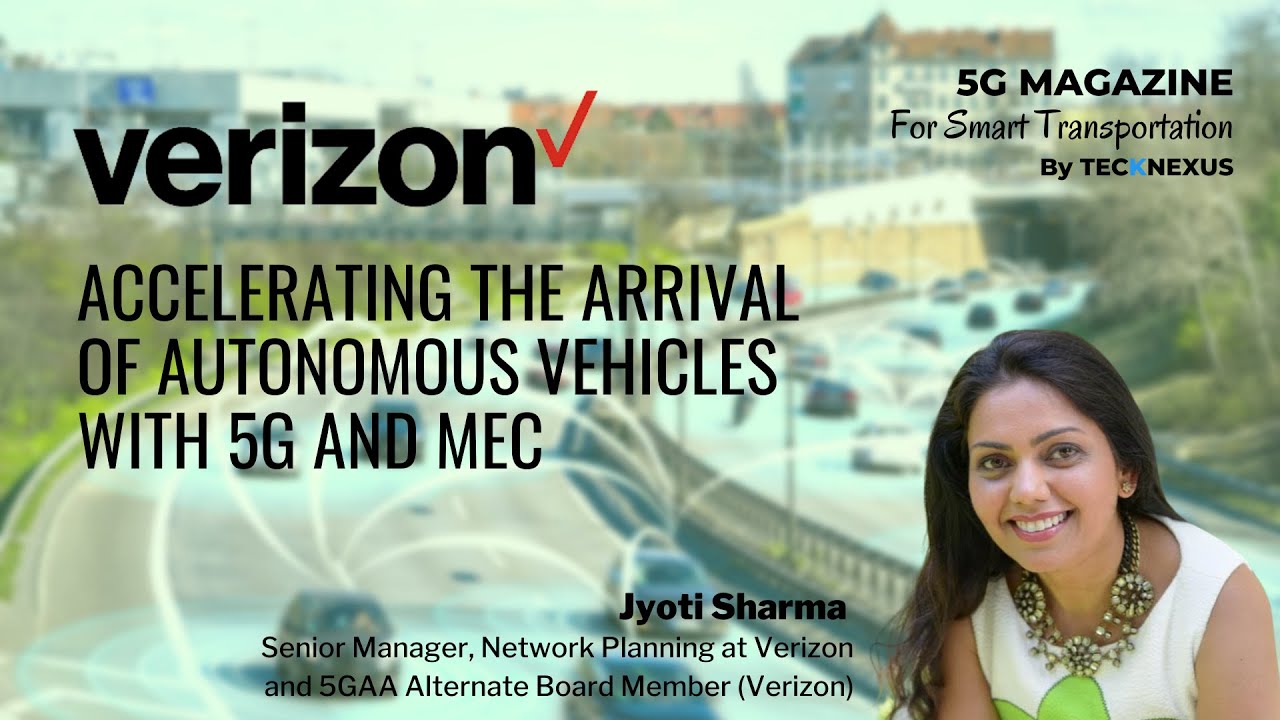
I’m delighted to be here. My name is Jyoti Sharma, and I’m a part of network planning at Verizon. My main role revolves around crafting the overarching strategy for connected and autonomous vehicle technology, particularly focusing on V2X. We collaborate extensively with other ecosystem partners to design trials and proof of concepts. Additionally, I’m proud to serve as an alternate board member of the 5G Automotive Association.
Transportation Transformation
We’re currently witnessing a massive transformation in the transportation sector. This sector envisions a future that’s seamlessly connected, autonomous, electric, and shared. As this shift is happening, we’re also introducing the fifth generation of cellular communication standards based on 3GPP. Coupled with this are emerging technologies such as multi-access edge computing, hyper-precise location services, and CV2X. These innovations will be instrumental for the transportation industry to realize its ambitious goals. The aim is to roll out the vehicles of the future that are not only safer and greener but also more efficient.

Safety-First: Vision Zero
One of the primary objectives across various Departments of Transportation is achieving ‘Vision Zero’, which translates to zero road fatalities. To this end, numerous safety use cases have been developed. One prominent example is the pedestrian safety use case, which we recently showcased in Virginia in collaboration with the Virginia DOT and BTTI. This use case provides alerts to vehicles regarding the presence of pedestrians and vice versa, thereby reducing potential accidents, especially those involving pedestrians or cyclists. This demonstration was conducted on Verizon’s commercial 5G network, harnessing edge computing and hyper-precise location technologies.
Traffic Efficiency & Commute Enhancements
In addition to safety, there’s also a pressing need to improve traffic efficiency. Consider the common scenario where an emergency vehicle is approaching, and drivers are often unsure of how to respond. Through our technology, drivers can receive alerts well in advance, instructing them to give way. This ensures smooth movement for the emergency vehicle. Additionally, envision a commute where you encounter green lights all the way from your home to your workplace, especially as we readjust to post-pandemic traffic conditions. This technology holds the potential to make commutes not just faster but also more enjoyable.
These mentioned use cases are just the tip of the iceberg. The 5G Automotive Association has outlined over 200 potential use cases developed jointly by mobile network operators and automakers. We’ve prioritized a select few that are most compatible with 5G, edge computing, and V2X technologies. The future of transportation is promising, and with continued collaboration, we’re poised to make significant strides.
As vehicular technology advances, the roads today are home to numerous vehicles equipped with 4G LTE. While 4G has been instrumental in driving various use cases, the future is gearing towards 5G, promising a spectrum of enhanced capabilities.
The Role of 4G vs. 5G
4G LTE has undeniably played a pivotal role in vehicular communication and will continue to be a significant part of the vehicular ecosystem. But 5G, with its myriad of advantages, promises to redefine this landscape. At Verizon, we refer to the multifaceted advantages of 5G as its “eight currencies.” Beyond just offering higher data rates, 5G promises lower latency, increased reliability, enhanced throughput, and much more. Our focus on deploying 5G, especially on a mid-band spectrum, ensures coverage, capacity, and the full gamut of 5G benefits.
Practical Applications of 5G
To give a practical example, consider the vulnerable road user scenario. Here, vehicles stream videos of pedestrians over the 5G uplink to the Multi-access Edge Computing (MEC) system, which then sends back alerts. With countless vehicles on the road streaming vast amounts of data, the bandwidth and capacity offered by 5G are crucial. These mission-critical scenarios demand ultra-low latency, making 5G an indispensable resource. The stringent requirements of these advanced use cases are beyond the capabilities of 4G LTE, emphasizing the need for 5G.
Challenges Ahead
Venturing into this new vertical is not without its challenges. Unlike typical consumer-oriented applications like streaming movies, vehicular communication is mission-critical. Among the numerous potential use cases, identifying and prioritizing those that can make an immediate impact is a challenge. While we’ve addressed many technical challenges over the past few years, preparing our networks for commercial deployment and scaling these solutions pose a different set of hurdles. The ambition is to have 96% of cars on the road connected to 5G by 2030, and handling the massive data streams from these vehicles will be a monumental task.
Conclusion
While the technical expertise within Verizon and our collaborative efforts with partners give us confidence in overcoming technical barriers, the real challenges lie in commercialization, scaling, and navigating the regulatory environment. The road ahead is challenging, but the promise of 5G in transforming vehicular communication is undeniable.
Related Content