Intelligence Journeys
AI Use Cases for Utilities
Private Broadband for Utilities

Europe

Anthropic's Mythos model, launched under Project Glasswing in April 2026, has exposed critical fault lines in how allied governments coordinate on AI safety and access. The White House controls who receives access beyond U.S. borders, with the European Commission told it must seek U.S. permission before any access is granted. For European enterprises and telecom operators, this creates a structural challenge: holding regulatory authority over AI through the EU AI Act while lacking direct visibility into the frontier models they are tasked with overseeing.
Eight French organisations — including Capgemini, Orange, EDF, Iliad and Scaleway — have formally united under the AION consortium to bid for an EU AI Gigafactory designation, backed by approximately €10 billion in committed investment. The bid targets EuroHPC's live call for proposals, closing June 23, 2026, and is designed to demonstrate France's ability to anchor the full AI value chain. For telecom and enterprise IT leaders, AION signals a structural repositioning of European operators as sovereign AI infrastructure enablers, not merely connectivity providers.

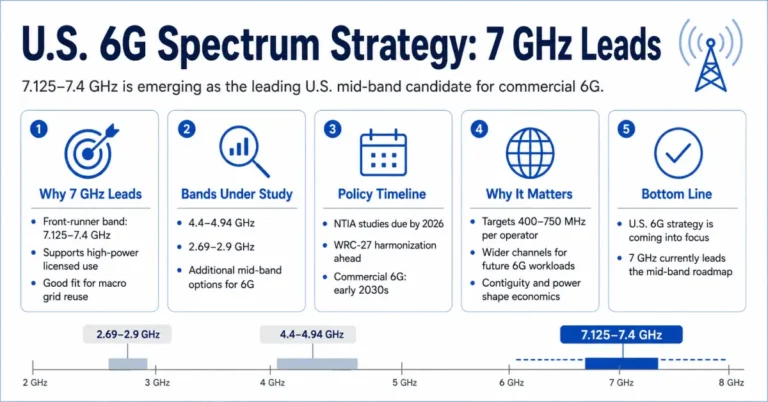
Washington and industry have synchronized timelines and targets to identify, clear, and harmonize the mid-band spectrum that will underpin commercial 6G deployments in the early 2030s. The Administration’s National Security Presidential Memorandum on 6G directs NTIA to reallocate 7.125–7.4 GHz for full‑power, licensed commercial use and to study federal relocation to 7.4–8.4 GHz where feasible; it also orders immediate feasibility studies in 2.69–2.9 GHz and 4.4–4.94 GHz. The 7.125–7.4 GHz range is the U.S. front‑runner for high‑power licensed 6G, with NTIA studying federal relocation to clear contiguous bandwidth and enable 400–750 MHz per operator in a single swath.
The NVIDIA-IREN partnership, announced May 7, 2026, commits both companies to jointly deploying up to 5 gigawatts of NVIDIA DSX-aligned AI factory infrastructure across IREN's global data center pipeline. A five-year, $3.4 billion managed GPU cloud services contract anchors the deal, alongside a warrant granting NVIDIA rights to purchase up to 30 million IREN shares. The Sweetwater campus in Texas serves as the reference implementation for NVIDIA's DSX architecture, signaling a new phase of vertically integrated, gigawatt-scale AI infrastructure planning that is reshaping competitive dynamics across hyperscalers, telecom operators, and enterprise IT.
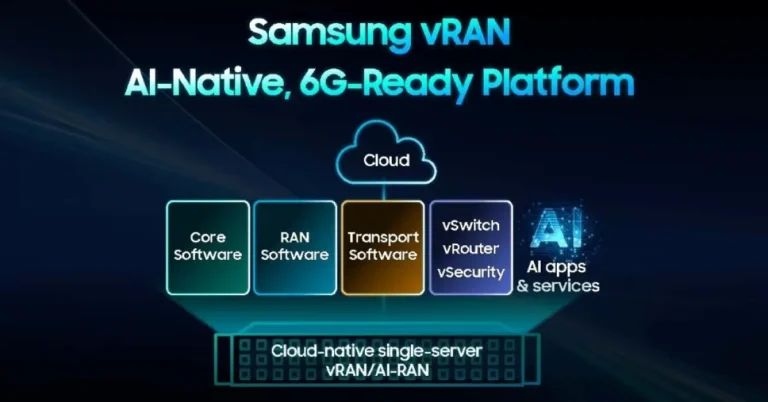
Samsung Electronics and Qualcomm Technologies have jointly validated Power Class 1 capability for 5G Fixed Wireless Access on a virtualized RAN architecture — a combination the industry has not demonstrated before. Testing showed up to ten times higher uplink throughput at the cell edge and up to 40% greater coverage range versus Power Class 1.5. With field trials already underway on a U.S. Tier-1 operator network and commercial availability targeted for 2027, this milestone signals a meaningful shift in uplink performance, coverage economics, and vRAN capability for operators and enterprise buyers alike.
T-Mobile CEO Srini Gopalan admitted during Q1 2026 earnings that its T-Satellite direct-to-device service is seeing far less usage than projected, largely because T-Mobile's terrestrial network leaves few coverage gaps for consumers. With 1.8 million free beta sign-ups failing to translate into strong paid engagement, and Apple's free Globalstar satellite messaging compressing the addressable market, T-Mobile is pivoting toward enterprise connectivity. Its new SuperBroadband offering pairs 5G with Starlink LEO broadband, targeting businesses in healthcare, retail, and energy that require resilient, always-on connectivity across distributed locations.
P‑CAL’s secure mesh provided resilient communications across a complex yard, validating control loops and telemetry in the presence of interference, variable traffic density and human activity. As deployments scale, many terminals will adopt hybrid connectivity: private 5G for wide‑area mobility and interference resilience, Wi‑Fi/Wi‑Fi 6E/7 for indoor assets, and mesh for redundancy in hard‑to‑reach zones. This mirrors global port trends, where operators are rolling out private 5G to support autonomous trucks, AI‑driven analytics, drones and mobile cranes. Expect edge compute (MEC) on‑premises to host perception, fleet orchestration and video intelligence with strict latency and data‑sovereignty requirements.
Vodafone Business and Google Cloud expanded their $1 billion, ten-year partnership with two launches aimed squarely at small and mid-sized businesses: a managed detection and response service and an agentic AI concierge. Vodafone Business and Google Cloud are packaging hyperscaler security analytics and agentic AI into carrier-delivered services that SMBs can adopt quickly. The launch markets, technology choices, and managed wrap indicate a pragmatic path to better protection and always-on customer engagement. Leaders should pilot now with tight KPIs, validate compliance early, and build an integration roadmap that scales across markets as the offer expands through Europe.
Deutsche Telekom is weighing a structural overhaul that would collapse its 53% ownership of T-Mobile US into a single, unified company spanning both sides of the Atlantic. Reports indicate Deutsche Telekom is exploring an all-stock transaction in which a new holding company would acquire both Deutsche Telekom and T-Mobile US, with current shareholders of each ending up as owners of the combined entity. The new group could pursue dual listings in the U.S. and Europe, eliminating today’s parent–subsidiary setup and aligning governance, strategy, and capital allocation under one roof.
The European Commission has approved Orange’s plan to acquire the remaining stake in MasOrange, signaling limited competitive impact and clearing the path for full control in Spain. Orange will purchase the roughly 50% it does not already own in MasOrange from the Lorca consortium for about €4.3 billion. MasOrange was created in 2024 by combining Orange Spain and MásMóvil, and the new deal converts the joint venture into a wholly owned Orange subsidiary. The Commission used its simplified merger review, indicating no structural change in market concentration. Closing is expected before July 2026, after which MasOrange will be integrated into Orange’s operations and financial reporting.
European regulators have cleared the path for Telecom Italia (TIM) to offload its global wholesale arm, Sparkle, advancing a restructuring with implications for sovereignty, subsea capacity, and wholesale competition. The European Commission has approved the acquisition of Sparkle by Italy’s Ministry of Economy and Finance (MEF) and infrastructure provider Retelit, valuing the asset at €700 million and granting joint control to the two buyers. TIM had initially targeted closing in late 2025, but now guides to completion in the first half of 2026. Brussels found the deal would not materially distort competition in the relevant wholesale markets.
March 2026's roundup: GSMA, Google Cloud, Huawei, and AWS all converge on an "agentic telco" framing at MWC Barcelona, SoftBank and SK Telecom build proprietary telecom-specific AI models and infrastructure, and physical AI reaches airports, drones, and network edge sites — with AI-RAN and connectivity infrastructure covered separately in our companion Advanced Connectivity Insights, March 2026.

Partner Hubs

Download content, access intelligence tools, and hear from executives.

Partner Events

  • M360 ASEAN
  • FutureNet Asia 2026
  • Network X Vienna 2026
Scroll to Top