Smarter Port Operations Begin with Private 5G at Port of Tyne
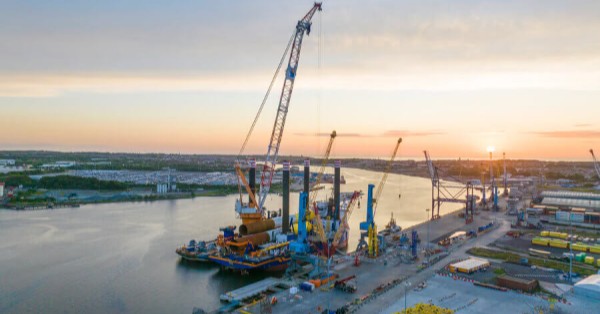
The Port of Tyne, one of the UK’s busiest deep-sea gateways, has successfully deployed a private 5G network to optimize and secure operations across its 620-acre site. With support from BT and Ericsson, the port now leverages mobility-driven, sensor-based, and video-enabled processes, resulting in measurable gains in safety and efficiency.
Connectivity Challenges in High-Traffic Port Environments
Managing a dynamic, high-traffic port environment is no small feat. The Port of Tyne spans both sides of the River Tyne near Newcastle and regularly changes its operational layout to accommodate various cargo and vessel types. Traditional wireless networks—such as Wi-Fi and older mobile technologies—fell short in delivering the reliable coverage, capacity, and mobility required. Cabling was expensive and inflexible, and dead zones threatened real-time data collection and worker safety.

How Private 5G Transformed Port of Tyne’s Operations
The port partnered with BT and Ericsson to deploy a private 5G solution tailored for industrial use. The network runs on BT spectrum with an on-premise core and radio infrastructure provided by Ericsson.
With this foundation, the port introduced several mission-critical applications, including:
- Real-time video analytics
- Sensor-driven monitoring
- Remote-controlled machinery
- AI-powered road condition detection
- Drone-based stock control
These services operate across more than 3km of berths and dock space, supporting both daily workflows and long-term planning.
Early Results: Private 5G Driving Efficiency and Safety at the Port
Operational improvements became evident within the first year:
- Live container scanning: Speeds up cargo processing.
- PPE and access monitoring: Enhances worker safety and security.
- Emission and road analysis: Informs environmental and infrastructure planning.
- Remote-controlled shovels (CatCommand): Reduces human exposure to hazardous ship holds.
Additionally, AI-enabled cameras mounted on vehicles now detect road surface issues before they become serious hazards, showcasing a strong use of Artificial Intelligence at the edge.
Why Private 5G Was the Right Fit for Port of Tyne’s Digital Strategy
The choice of a dedicated private 5G network was driven by the need for:
- Ultra-low latency
- High device density support
- Mobility across a sprawling industrial site
- Edge Computing integration for real-time decisions
By combining 5G with on-site compute, the port ensures fast, local data processing—essential for automation and safety-critical use cases.
Key Benefits of Private 5G for Port Efficiency and Safety
The network has delivered multiple advantages:
- Improved safety: Through PPE detection and access control.
- Better situational awareness: Via real-time video and sensor data.
- Operational agility: With mobile, flexible connectivity.
- Enhanced asset utilization: Enabled by connected drones and AI.
- Future-readiness: Supporting additional IoT and automation deployments.
What Port of Tyne’s 5G Deployment Means for the Maritime Industry
This implementation sets a clear example for other ports and transportation hubs. It shows how high-performing private wireless networks can support digital transformation in environments that are traditionally complex and hazardous. The Port of Tyne’s shift also reflects broader industry trends toward Edge Computing, AI, and sustainability.
How BT and Ericsson Enabled a Secure Private 5G Network
BT delivered the spectrum and network deployment, while Ericsson provided the core infrastructure and RAN components. Together, they ensured low-latency coverage and enterprise-grade security across the estate.
Tamsin Warren, Head of Technology and Transformation at Port of Tyne says, “After a full year of operating on private 5G, we’ve seen firsthand how reliable wireless connectivity strengthens our day-to-day operations. From safety-critical activities to logistical environments, the network has given us consistent, real-time visibility across our whole site. It’s helping our teams to work more safely and make better decisions with the live data to move us forward to becoming one of the UK’s smartest and greenest ports.”
Brian Jackson, Director Surveillance & Smart Solutions, BT says, “Over the past year, Ericsson’s private 5G network has delivered the performance Port of Tyne needs in an environment that changes constantly. By combining BT spectrum with Ericsson’s dual 4G and 5G infrastructure, the port has a dependable platform for the technologies it relies on today, as well as those it plans to adopt in the future.”
Manish Tiwari, Head of Enterprise 5G, Ericsson, says: “Port of Tyne is demonstrating how private 5G can support complex industrial operations that depend on mobility, safety, and real-time visibility. The results from the first year demonstrate what a wireless network with predictable low latency, strong security, and support for high mobility can unlock — laying the groundwork for continued digital development across the port.”
Collaboration Driving 5G Innovation at Port of Tyne
- Ericsson: Delivered dual 4G and 5G infrastructure.
- BT: Supplied spectrum and end-to-end integration.
- Caterpillar (CatCommand): Brought remote-control solutions for machinery.
- AI vendors: Enabled predictive insights through camera and sensor data.
Each partner contributed to building a future-ready operational model.
Port of Tyne 5G Current Deployment Status and Rollout Timeline: From Planning to Expansion
The network has been live and operational for over a year, supporting a wide range of use cases daily. Current usage spans real-time analytics, security, and remote control, with plans underway to further scale across other operational areas.
- Planning & assessment: Completed prior to 2023
- Deployment: Rolled out in phases across 2023–2024
- Full operations: Ongoing since late 2024
- Future expansions: Expected in 2026, including additional AI tools and automation capabilities
Port of Tyne Leads the Way in Smart Port Transformation with 5G
The Port of Tyne shows how UK ports can navigate the digital shift with confidence. With Private Networks, Edge Computing, and Artificial Intelligence in place, the port is already proving that smart logistics aren’t a future concept—they’re today’s reality. And with consistent performance from its private 5G system, the port is well-positioned to become one of the UK’s smartest and most sustainable maritime hubs.