

AI Agent Competitive
Intelligence
Intelligence
Private Network
Intelligence
Intelligence
Intelligence Journeys
Utilities Private Broadband Planning
AI Use Case Planning for Utilities
Intelligence Tools
By Tool Type
▼
By Industry
▼
Access Type
▼
Resources
▼
Technology Hubs
▼
Partner Hubs
▼
Monthly Trackers
▼


Home » 6G
6G
6G is the next generation of cellular technology, still in research and standardization rather than commercial use. 3GPP is targeting its first complete specifications around early 2029, with commercial deployments widely expected near 2030, making the current period one of design choices rather than rollouts. Early work centers on new spectrum including upper-mid-band and sub-terahertz frequencies, AI-native architecture built into the standard from the start, integrated sensing and communication, and native non-terrestrial integration. For operators and enterprises, 6G matters now because decisions about 5G-Advanced investment, spectrum, and architecture increasingly anchor to the 6G timeline. This channel follows 6G standardization, research milestones, spectrum debates, and vendor positioning as the industry moves from concept toward a defined standard, with analysis aimed at planning rather than hype.
- Tech News & Insight
- October 5, 2026
- Hema Kadia

September 2026's roundup: Verizon, T-Mobile US and Telstra run AI across national networks, AI-RAN moves into national contracts and field results, the economics and portability of AI agents come into focus, and agent safety moves from principles to working controls.
- Tech News & Insight
- October 5, 2026
- Hema Kadia
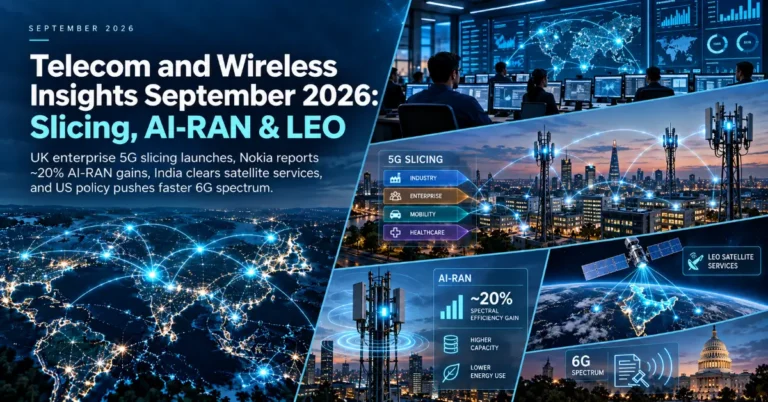
September 2026's roundup: Vodafone Business launches the UK's first national 5G+ slicing service for enterprises, Nokia reports about 20% AI-RAN spectral efficiency gains across eight operators, India clears Starlink, Eutelsat OneWeb and Jio for satellite services, and US policy moves to speed 6G spectrum.
- Partner Event
- October 2, 2026
- Hema Kadia

Start: Nov 04, 2026
End: Nov 05, 2026
Venue: Times Square, New York
Location: New York, US
End: Nov 05, 2026
Venue: Times Square, New York
Location: New York, US
- Tech News & Insight
- September 29, 2026
- Hema Kadia

After a three-year evaluation, Cargill made private 5G its manufacturing connectivity standard, turning up more than 50 sites across the US, Europe, and Latin America in roughly 10 months with Celona's 5G LAN platform, at a fraction of the cost of comparable Wi-Fi deployments.
- Tech News & Insight
- September 3, 2026
- Hema Kadia
August 2026's roundup: EE launches the UK's first commercial 5G slicing service as India's regulator moves first to mandate per-slice tariffs and disclosed speeds, AI-RAN validation reaches SoftBank's live Japanese network, satellite operators from AST SpaceMobile to Elveo Mobile jockey for direct-to-device position, and Charter's completed Cox mega-merger reshapes the US cable map.
- Tech News & Insight
- August 6, 2026
- Hema Kadia
July 2026's roundup: Hughes Network Systems nears bankruptcy as SpaceX files to launch 100,000 satellites, Nokia's AI-RAN commercial deployments trail Ericsson's 15+ by a full order of magnitude, the FCC finalizes a $6.3B C-band incentive package and closes AT&T's $23B EchoStar spectrum deal, and fiber capital and industrial 5G both keep expanding globally.
- Partner Event
- July 7, 2026
- Hema Kadia

Start: Sep 22, 2026
End: Sep 23, 2026
Venue: Marina Bay Sands, Singapore
Location: Singapore
End: Sep 23, 2026
Venue: Marina Bay Sands, Singapore
Location: Singapore
- Tech News & Insight
- July 3, 2026
- Hema Kadia
June 2026's roundup: agentic AI moves from pilot to operational core across telecom networks, satellite consolidates through Rocket Lab's $8B Iridium acquisition and SpaceX's $75B IPO, AI-RAN's GPU divide matures into shipping products, US spectrum auctions return after a four-year hiatus, and telecom M&A accelerates globally.
- Tech News & Insight
- July 2, 2026
- Hema Kadia

June 2026 showed agentic AI scaling from pilot to platform: industry-wide standards momentum, AI-RAN field trials from Nokia, Amdocs and KDDI, and fresh capital across data centers on three continents. This full roundup covers every deployment, partnership, funding round and governance move from the month, with tools to prioritise AI use cases and plan the network around them.
- Tech News & Insight
- June 23, 2026
- Hema Kadia

T-Mobile CTO John Saw's 'kinetic token' framework describes how Physical AI — robots, autonomous vehicles, industrial automation — changes what networks must do. The public telco debate that followed misses the most immediate implication: industrial private 5G networks are already, structurally, kinetic token infrastructure.
- Tech News & Insight
- June 17, 2026
- Aiva Strelca
European consortium of 19 partners will develop AI-driven cyber threat intelligence, automated response, and resilient security capabilities for next-generation connectivity.
Download from External Sources
- SK Telecom Whitepaper
- Bharat’s(India) 6G Vision
- 5GPP – The 6G Architecture Landscape
- NTT Docomo
- Samsung
- Ericsson
- The 5G Infrastructure Association (5GIA)
- 6GChannel
- Next Generation Mobile Networks (NGMN)
- Next G Alliance (NGA)
- IEEE – Survey on Explainable AI for 6G O-RAN
- IMDEA – Orchestration Procedures for the Network Intelligence Stratum in 6G Networks
- MDPI – Role of Optical Transport Networks in 6G and Beyond
- 6G Use Cases & Analysis (NGMN)
- Next G Alliance Report: Channel Measurements and Modeling for Joint/Integrated Communication and Sensing
Frequently Asked Questions
Is 6G available yet, or is it still just a concept?
6G is not available anywhere yet, though it is more concrete than a vague concept. The ITU published its IMT-2030 framework in 2024, defining broad target capabilities like higher data rates, denser device support, improved mobility, and better positioning accuracy. Since then, 3GPP has moved into a structured study phase inside Release 20, where multiple working groups are testing candidate technologies and collecting performance data rather than writing final specifications. The first concrete 6G specifications are expected as part of Release 21, with the actual spec-work timeline decided around mid-2026 and completion targeted for late 2028. Commercial 6G networks are expected to follow around 2030, consistent with how each prior wireless generation has taken roughly a decade from initial vision to first deployment.
What makes 2026 specifically a pivotal year for 6G standardization?
Until 2026, most 6G work centered on defining use cases, requirements, and a broad technology vision, deciding what 6G should be capable of rather than how to build it. That changes this year. 3GPP officially launched its technical studies under Release 20 in mid-2025, and that work, lasting roughly 18 to 21 months, is the phase where engineers actually test and validate candidate technologies, like sub-terahertz spectrum use, integrated sensing, and AI-native architecture, that could become part of the formal standard. Industry commentators describe this as moving from ‘what could be possible’ to ‘what will actually be built.’ The decision on Release 21’s actual specification timeline is expected around June 2026, making this year the hinge point between conceptual 6G and engineering-stage 6G.
How is 6G different from 5G-Advanced, and why does that distinction matter?
5G-Advanced is best understood as a mid-generation upgrade: improved uplink performance, more sophisticated MIMO antenna techniques, and early sensing capabilities, built on top of existing 5G infrastructure and falling under later 3GPP releases within the 5G specification family. 6G is a wholly new generation with its own dedicated 3GPP release track, expected to be engineered from the ground up around AI-native operation, integrated sensing, and quantum-resistant security rather than having those capabilities added later. Major equipment vendors, including Ericsson, Huawei, and Nokia, all describe 5G-Advanced as the technical and commercial foundation 6G will be built on, even though each vendor frames that relationship somewhat differently. For operators, the practical takeaway is that 5G-Advanced spending happening now is not throwaway investment.
What are the core technology pillars defining the 6G vision?
Standards bodies and vendor roadmaps converge on four recurring themes. First, AI-native architecture, meaning intelligence is embedded directly into the network’s design rather than bolted on afterward, enabling self-optimizing radios and predictive resource allocation. Second, sensing-enabled networks, where the radio signal itself becomes a sensing instrument able to detect object position and motion alongside its communication role, sometimes called integrated sensing and communication. Third, quantum-secure design, building resistance to future quantum-computing attacks into the network’s cryptography from day one. Fourth, sustainability and energy efficiency as a core design requirement, reflecting the industry’s growing focus on the environmental cost of running ever-denser, ever-faster networks.
Which countries and companies are shaping the direction of 6G research?
6G standardization happens primarily through 3GPP, a global body, but national priorities still shape the conversation. The U.S., China, Japan, South Korea, and the Gulf Cooperation Council countries are widely expected to be early commercial adopters, following the same pattern seen with 5G rollout leadership. On the vendor side, Ericsson, Nokia, and Huawei are the most vocal about their 6G research, each publishing detailed roadmaps, while companies like Qualcomm and Samsung contribute heavily on the chipset and device side. Government-backed research programs, including the U.S.’s NextG Alliance and various EU-funded initiatives, also shape early requirements, though the technical specifications are ultimately decided through the 3GPP process rather than any single country acting alone.
Will 6G require entirely new spectrum bands?
Likely, at least in part. 6G research is actively exploring frequencies in the sub-terahertz range, well above the millimeter-wave bands used in today’s high-band 5G, because higher frequencies offer dramatically more available bandwidth for very high data rates. Like 5G before it, though, 6G is expected to operate across a mix of bands, including some lower and mid-band spectrum already used for 4G and 5G, to balance very high speeds in dense urban areas with broader, more reliable coverage elsewhere. Spectrum allocation is decided by national regulators in coordination with the ITU, so exact bands available for 6G will likely vary by country once the standard solidifies, similar to how 5G spectrum allocation differs between the U.S., Europe, and Asia today.
What’s the realistic timeline between now and a commercial 6G network?
Based on the current 3GPP roadmap: technical studies under Release 20 continue through 2026, with the specification approach for Release 21 decided around mid-2026; Release 21 itself, containing the first actual 6G specifications, is targeted for completion around late 2028; and the first commercial deployments are expected to follow in 2030, consistent with the roughly decade-long cycle seen between 4G’s debut and 5G’s 2019 launch. Industry voices caution against expecting a single dramatic ‘6G launch moment,’ since releases beyond Release 21 will continue refining the standard for years afterward, much like 5G has continued evolving through 5G-Advanced well after its initial rollout.
Will I need to replace my phone or network equipment once 6G launches?
Not immediately, and likely not all at once. Given that commercial 6G isn’t expected before 2030, current-generation 5G and 5G-Advanced devices and infrastructure will remain useful and supported for years to come. Historically, generation transitions have been gradual: new networks launch in limited markets and frequency bands first, older devices continue working on existing infrastructure that typically stays operational for a decade or more after a new generation’s debut, and new devices supporting the latest generation arrive over time as chipsets and handsets catch up. Enterprises and operators investing in 5G-Advanced infrastructure today are generally building on technology expected to carry forward into the 6G era rather than be discarded.




Telco AI Agent Leadership

