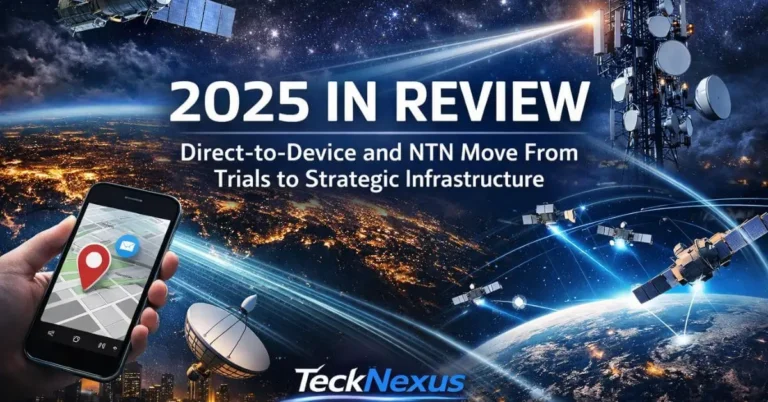
Direct-to-device (D2D) satellite connectivity crossed a critical threshold in 2025. What had long been discussed as an experimental extension of mobile coverage moved decisively into the realm of commercial reality. Across North America, Europe, and select global markets, operators, satellite providers, and ecosystem partners shifted focus from feasibility trials to live services, ecosystem scale, and long-term competitive positioning.
The significance of this transition goes beyond emergency connectivity or rural coverage. In 2025, D2D and broader non-terrestrial network (NTN) strategies became tightly linked to how operators define network completeness, service resilience, and future differentiation. As covered throughout the year in TeckNexus’s ongoing Satellite and NTN coverage, the conversation evolved from whether satellite-to-device would work to how it would be monetized, governed, and integrated into mainstream mobile architectures.

From Pilot Projects to Nationwide D2D Satellite Services
At the start of 2025, most D2D activity remained anchored in testing, pilots, and beta programs. Operators demonstrated satellite-based messaging, regulators evaluated spectrum coexistence, and vendors refined radio and core integrations. Progress was steady but incremental.
That dynamic changed once the first nationwide commercial D2D services went live. Messaging-based satellite connectivity transitioned from a future roadmap item into a tangible customer experience. Importantly, these launches reframed D2D not as a niche capability but as a competitive benchmark. Once live services existed, the absence of satellite-to-device coverage became visible to customers, policymakers, and enterprise stakeholders alike.
As highlighted in multiple TeckNexus analyses throughout 2025, this moment altered operator decision-making. Satellite connectivity was no longer a marketing differentiator—it became a strategic coverage layer expected to complement terrestrial networks in edge, rural, maritime, and disaster scenarios.
D2D Satellite Connectivity Expands Beyond Emergency Use Cases
Early D2D deployments focused primarily on narrowband messaging, particularly for emergency and remote-use cases. While this functionality delivered immediate value, 2025 demonstrated that satellite-to-device connectivity could support more than last-resort communications.
As services expanded, application-level integrations began to emerge, including basic data-driven applications and location-aware services. This shift mattered for two reasons. First, it validated that D2D could support practical, everyday use cases rather than remain confined to crisis scenarios. Second, it set expectations for continued evolution toward voice and data capabilities in the years ahead.
TeckNexus coverage throughout the year emphasized that the long-term value of D2D lies not in replacing terrestrial networks, but in extending them—creating a seamless coverage fabric that blends cellular and satellite connectivity under a unified service experience.
NTN and D2D Architectures Diverge: Messaging vs Broadband Paths
One of the defining patterns of 2025 was the emergence of distinct architectural approaches to D2D and NTN.
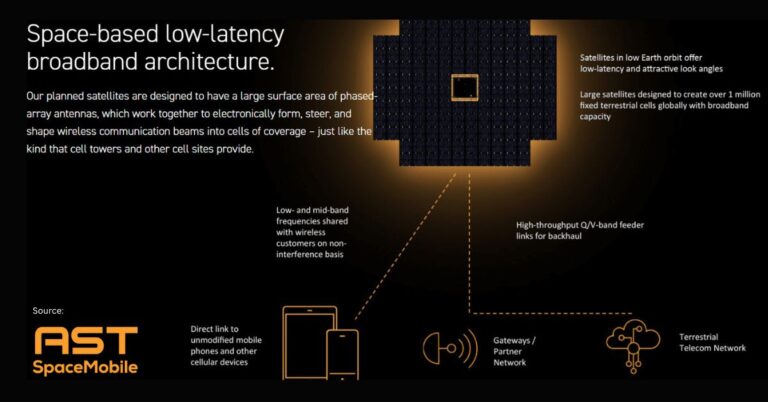
Some players pursued a messaging-first strategy, prioritizing rapid commercialization, regulatory simplicity, and broad device compatibility. Others focused on a broadband-oriented vision, betting that higher-capacity satellite links could eventually enable voice and data services that rival terrestrial performance in specific scenarios.
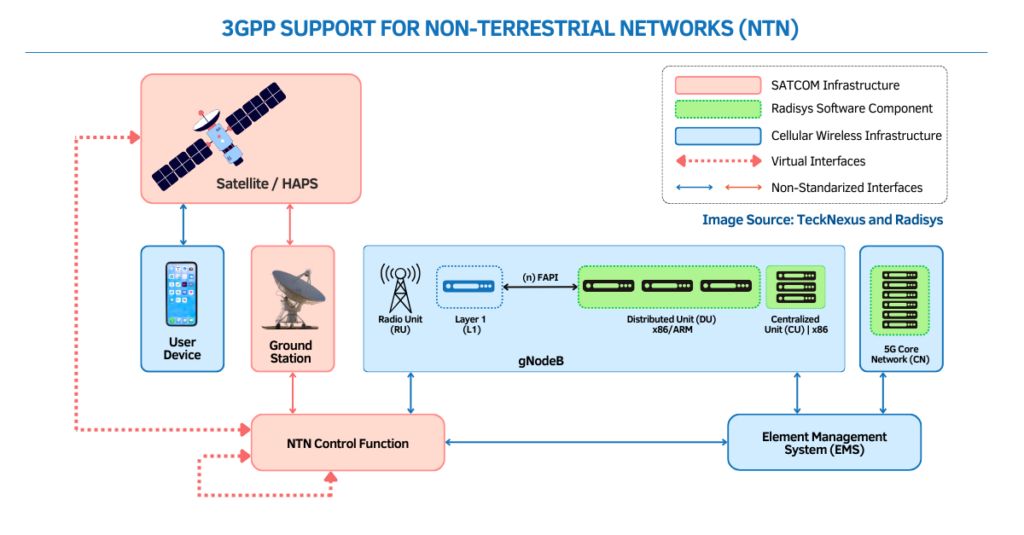
Alongside these technical choices, spectrum strategy emerged as a critical differentiator. Access to globally coordinated spectrum, coexistence with terrestrial bands, and alignment with 3GPP NTN standards became central to long-term viability. As discussed in TeckNexus reporting, spectrum decisions made in 2025 will shape competitive positioning well into the second half of the decade.
Just as importantly, ecosystem strategy mattered. Vertically integrated models promised speed and control, while standards-based approaches emphasized interoperability, operator choice, and long-term scalability. The market did not converge on a single model in 2025—but the contours of competition became far clearer.
North America Leads Global Rollout of D2D Satellite Services
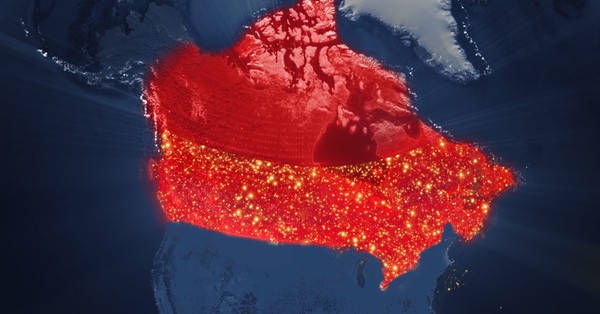
North America emerged as the most active D2D market in 2025, driven by a combination of geographic scale, competitive intensity, and regulatory momentum. Once commercial services were launched, competitive pressure accelerated rapidly.
For mobile operators, satellite-to-device connectivity became part of the broader narrative around nationwide coverage quality. As several TeckNexus articles explored during the year, D2D shifted from being a “nice-to-have” innovation to a baseline expectation for premium network positioning.
This shift had ripple effects across roadmaps, partnerships, and investment priorities. Operators that moved early gained not just technical experience but also valuable insights into customer behavior, usage patterns, and service economics—advantages that may prove difficult to replicate quickly.
Europe Navigates Regulatory Hurdles in D2D Satellite Expansion
Europe’s D2D journey in 2025 followed a different trajectory. Rather than a single dominant path, the region reflected a balancing act between innovation, regulatory complexity, and strategic autonomy.
European operators advanced partnerships and pilot deployments while navigating a fragmented spectrum landscape and diverse national regulatory frameworks. As covered in TeckNexus’ European NTN reporting, there was also a clear emphasis on avoiding over-reliance on any single satellite provider.
This focus on sovereignty and ecosystem diversity led to joint ventures, alternative satellite partnerships, and renewed interest in standards-based NTN architectures. While progress was sometimes slower than in North America, the long-term implications may be significant—particularly as Europe aligns D2D strategies with broader digital sovereignty and industrial policy goals.
Cable Providers and New Entrants Join D2D Satellite Ecosystem
One of the more understated but important developments of 2025 was the entry of cable operators and non-traditional players into the D2D ecosystem. By integrating satellite messaging into mobile offerings, these providers signaled that D2D is not exclusively a mobile network operator concern.
TeckNexus coverage highlighted that for cable operators, D2D services are less about immediate revenue generation and more about customer retention, brand positioning, and perceived network completeness. In a highly competitive mobile environment, satellite connectivity strengthens the value proposition without requiring massive infrastructure investment.
This trend also underscored a broader shift: D2D is becoming a horizontal capability that spans mobile, cable, enterprise, and public-sector use cases, rather than a vertical niche within satellite communications.
D2D Monetization in 2025: Revenue Follows Capability
Despite the momentum of 2025, monetization remained a nuanced challenge. As several TeckNexus analyses noted, near-term revenue expectations for D2D services are modest. Emergency messaging and basic connectivity alone are unlikely to drive substantial standalone revenue streams.
Instead, the primary economic value today lies in retention, upsell, and competitive parity. D2D helps operators defend market share, enhance premium plans, and strengthen enterprise and public-sector relationships.
The more transformative revenue opportunities—voice, data services, IoT integration, and enterprise applications—are still emerging. 2025 made clear that monetization will follow capability maturity, not precede it.
2025 D2D and NTN Takeaways: Strategy, Spectrum, and Scale
Across regions and ecosystems, several themes consistently surfaced in TeckNexus’ 2025 NTN coverage:
- D2D is now table stakes for comprehensive network strategies
- Ecosystem partnerships matter more than isolated innovation
- Spectrum and standards decisions will define long-term winners
- Commercial execution matters as much as technical ambition
Perhaps most importantly, 2025 demonstrated that satellite connectivity is no longer peripheral to mobile strategy. It is becoming an integral layer of modern network design.
D2D in 2026: From Messaging to Voice, Data, and Edge Integration
As the industry enters 2026, attention is shifting toward the next phase of D2D and NTN evolution. Voice services, higher-capacity data, broader device compatibility, and deeper core network integration are all on the horizon.
At the same time, satellite-to-device connectivity is increasingly intersecting with other strategic priorities, including private networks, AI-enabled operations, and edge computing. TeckNexus expects NTN to play a growing role in industrial, maritime, logistics, and critical infrastructure use cases where resilience and coverage continuity are paramount.
What began as an experiment has become infrastructure. In 2025, direct-to-device connectivity proved it could move from promise to practice. In the years ahead, the challenge will be turning that foundation into sustainable, scalable value across the global connectivity ecosystem.
Explore More TeckNexus Coverage
🔗 Satellite & Non-Terrestrial Networks (NTN)