Security

Network and connectivity security spans the technologies and practices that protect networks, devices, and data from a growing range of threats — from supply-chain and signaling attacks to threats against private networks, IoT, and critical infrastructure. As networks become more software-defined, distributed, and open, the attack surface expands, and security shifts from a perimeter model toward zero-trust, identity-based, and AI-assisted defense. For operators and enterprises, security is now central to private networks, 5G standalone, edge, and IoT decisions rather than an afterthought. Regulation and nation-state activity have raised the stakes further. This channel covers security across telecom and enterprise connectivity — private and public network security, zero trust, IoT and OT, and the threats shaping the landscape — with analysis aimed at teams securing modern, distributed networks against evolving risk.


SoftBank Corp. delivered its strongest nine-month performance on record and lifted full-year guidance, underscoring a strategic shift from connectivity-only services to network-enabled platforms in AI, cloud, and edge. Through the first nine months of fiscal 2025 (April–December 2025), SoftBank reported revenue of ¥5.2 trillion, up 8% year over year, and operating income of ¥884 billion, also up 8%, with net income attributable to owners rising 11% to ¥485.5 billion. Management raised full-year targets to ¥6.95 trillion in revenue, ¥1.02 trillion in operating profit, and ¥543 billion in net income, signaling confidence heading into the March 31, 2026 year end.
LG Uplus is moving from rule-based automation to closed-loop autonomy, using AI agents and digital twins to accelerate toward a fully autonomous network by 2028. Its core platform, the AI Orchestration Nexus (AION), is already automating repetitive operations and has contributed to a reported 70% reduction in customer complaints about network quality—an early signal that the approach is translating into measurable outcomes. The company plans to showcase these capabilities at MWC Barcelona 2026, underscoring growing operator interest in operational AI as 5G matures and traffic patterns become more volatile.
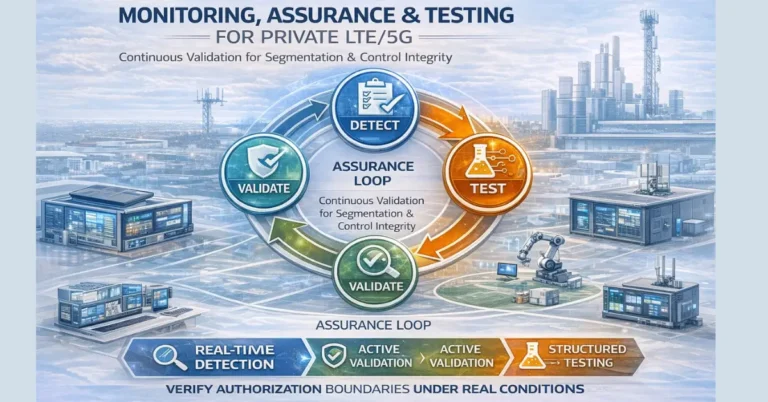
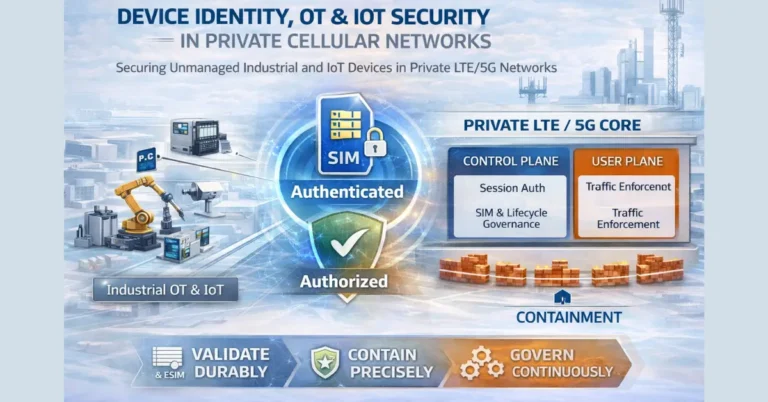
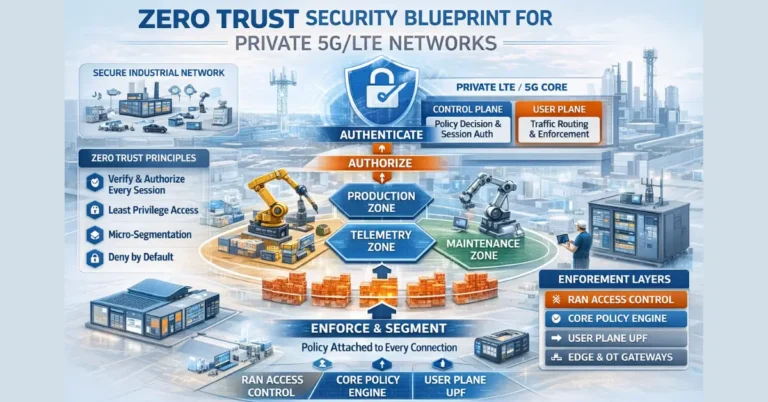
Private LTE and 5G networks introduce new security challenges as they become the foundation for industrial automation, critical infrastructure, and enterprise campuses. Unlike Wi-Fi and traditional IT networks, private cellular environments blend telecom infrastructure, IT systems, and operational technology, creating distinct threat surfaces across the RAN, core, edge, devices, and management planes. This article establishes a security-first architectural lens for private LTE/5G, explaining who needs it, where risks emerge, and what secure-by-design looks like before moving into Zero Trust and implementation frameworks.
Singapore has confirmed an attempted cyber‑espionage campaign against its national telecom backbone, highlighting a rising class of APT activity aimed at network devices and virtualized cores rather than traditional IT endpoints. Singapore’s Cyber Security Agency (CSA) and Infocomm Media Development Authority (IMDA) disclosed that all four major operators—Singtel, StarHub, M1 and Simba Telecom—were targeted by UNC3886 in incidents last year. The threat actor gained limited access to segments of telco systems and exfiltrated a small volume of network‑related technical data. There was no service disruption, no personal data exposure and, critically, sensitive and segregated systems (including 5G networks) were not compromised.
Imec is scaling its R&D footprint and inaugurating a NanoIC pilot line to accelerate sub‑2nm and 3D system innovation under a roughly €2.5 billion European semiconductor push. Imec, the Leuven-based semiconductor research hub, is expanding lab capacity and bringing a new NanoIC pilot line online to speed learning cycles for logic beyond 2nm and advanced 3D integration. The goal is clear: shorten the path from materials and device research to system‑level demonstrators that de-risk future foundry nodes and packaging flows. For vendors and operators, this is about getting sooner access to manufacturable building blocks—ultra‑efficient logic tiles, memory stacks, and optical I/O—that cut TCO and footprint across networks and data centers.
Virgin Media O2 has broadened its partnership with Zinkworks to deploy AI-driven monitoring and automation across its mobile footprint, designed to spot anomalies earlier, resolve incidents faster, and prevent customer-impacting outages. The rollout targets multiple network domains and operational workflows, advancing the operator’s move toward autonomous operations with engineers maintaining full oversight. The capabilities span radio access, core network systems, and network operations centers, combining real-time telemetry with intelligent automation. The stack runs on Google Cloud and taps services such as Vertex AI and Gemini to analyze patterns, orchestrate responses, and augment decision-making for operations teams.
Deutsche Telekom and T-Systems have switched on a sovereign, NVIDIA-powered AI factory in Munich’s Tucherpark, positioning Germany as a serious contender in industrial AI infrastructure. The new facility brings nearly 10,000 NVIDIA Blackwell GPUs online, including DGX B200 systems and NVIDIA RTX Pro Server GPUs, delivering up to 0.5 exaFLOPS of AI compute for training, fine-tuning, and large-scale inference. Operated by T-Systems on German soil, the platform targets industry, research, startups, and the public sector with strict controls for data protection, security, and availability. Early customers include Agile Robots, which is combining vision, robotics, and foundation models, and PhysicsX, which applies AI to technical simulation.
Microsoft’s AI QuickStart, backed by IMDA and UOB, aims to turn generative AI intent into production outcomes in weeks, not years. AI QuickStart targets “Digital Leaders” in Singapore—SMEs and larger non-ICT enterprises that have already built basic digital capabilities and can fund transformation—by offering a fast, structured path to deploy enterprise AI. Each engagement is designed to finish within three months with a cost cap of up to S$20,000 per project, covering cloud, compute, and professional services, which directly addresses executive concerns over unpredictable pilot spend and elongated proofs-of-concept.
Colombia has cleared a milestone consolidation: Tigo has taken operational control of Movistar, creating a second national-scale incumbent to challenge Claro. The Superintendence of Industry and Commerce (SIC) approved the integration through Resolution 94169 of 2025, capping months of scrutiny and pushback from rivals and ISPs. The merger compresses Colombia’s competitive field at a time when 5G rollouts, fiber densification, and cloud-native cores demand scale. It creates a stronger counterweight to Claro, but also raises real concerns about a two-horse race and the downstream effects on MVNOs, ISPs, and enterprise buyers.
Liberty Global and Google Cloud have signed a five-year agreement to deploy AI at scale across Liberty Global’s European footprint and to advance hybrid cloud, autonomous networks, and new go-to-market plays. The partnership spans roughly 80 million fixed and mobile connections across Liberty Global’s operating companies, including Virgin Media O2 in the UK, Telenet in Belgium, VodafoneZiggo in the Netherlands, Virgin Media in Ireland, and Sunrise in Switzerland. On the network side, the companies will co-develop AI-first programs aimed at reliability, security, scalability, and cost efficiency. Commercially, the parties will target SMEs with a joint portfolio that combines connectivity with cloud, cybersecurity, and AI services.
Positron closed a $230 million Series B at a reported $1 billion valuation, co-led by Arena Private Wealth, Jump Trading, and Unless, with strategic capital from Qatar Investment Authority (QIA). Positron is focused on inference silicon rather than training, aligning with a market shift from building ever-larger foundation models to deploying them at scale. Its first-generation Atlas chip, manufactured in Arizona, is designed around high-speed memory throughput and is claimed to match Nvidia H100-class performance at under one-third the power for select inference workloads.
Amdocs is launching aOS, an agentic operating system for telecom, to move CSPs from AI pilots to production-scale, cross-domain automation. Amdocs’ aOS targets that gap with a multi-agent architecture that automates complex workflows while keeping humans in the loop for policy and final decisions. At the foundation is a “Cognitive Core” that manages telco-specific knowledge, agent libraries, and guardrails. aOS pricing will lean on outcome-based SLAs, tying spend to measurable business impact such as resolution rates, handle-time reductions, activation velocity, or assurance KPIs. aOS is Amdocs’ bid to make agentic AI the connective tissue of telco operations.

Frequently Asked Questions

What’s the biggest emerging security risk for telecom networks right now?
Quantum computing’s eventual ability to break current encryption standards is the dominant emerging concern, often described through the framing of ‘harvest now, decrypt later,’ where adversaries collect encrypted data today, intending to decrypt it once sufficiently powerful quantum computers exist in the future. This matters particularly for telecom given how much sensitive data flows across networks protected by encryption standards quantum computers could eventually defeat. Alongside this longer-term quantum concern, the more immediate, near-term risk involves the expanded attack surface created by 5G’s heavy reliance on cloud-native, virtualized infrastructure and exposed APIs, which gives attackers considerably more potential entry points than older, more closed network architectures presented.
Are telecom networks actually doing anything about quantum threats yet, or is it theoretical?
It’s moving from theoretical to practical. Thales demonstrated that existing deployed 5G SIM and eSIM cards can be upgraded to quantum-safe protection without service disruption, proving that mobile networks can evolve their security through crypto agility rather than requiring an entirely new generation of hardware. Operators including BT, SK Telecom, Orange, and Deutsche Telekom are running live quantum-safe networking trials, with Deutsche Telekom specifically demonstrating quantum teleportation over a meaningful distance of commercial fiber in early 2026. These aren’t purely academic exercises; they represent genuine, if still early, steps toward preparing live commercial telecom infrastructure for the eventual quantum threat.
What is post-quantum cryptography (PQC), and is there a deadline for adopting it?
Post-quantum cryptography, commonly abbreviated PQC, refers to encryption algorithms specifically designed to resist attacks from future quantum computers, in contrast to the encryption algorithms most networks currently use, which quantum computers are expected to eventually break. Regulatory pressure is real and increasingly specific: the NSA’s CNSA 2.0 standard mandates quantum-safe algorithms for new national security system acquisitions by January 2027, and the European Commission is pushing critical infrastructure sectors, including telecom, toward post-quantum readiness by 2030. These deadlines, while initially focused on government systems, are widely expected to influence broader commercial telecom security planning timelines as well, since telecom is frequently classified as critical national infrastructure.
Is AI making telecom networks more or less secure?
It cuts both ways. On the defensive side, AI dramatically speeds up threat detection by spotting unusual patterns across enormous volumes of network traffic far faster than manual monitoring, and it increasingly powers automated incident response. On the risk side, AI agents given meaningful operational access to network systems represent a genuinely new kind of attack surface; if an agent’s decision-making can be manipulated, or its access misused, the consequences could be more severe than a typical software vulnerability, since the agent is specifically designed to take autonomous action on live infrastructure rather than simply process and report information.
Are 5G networks more vulnerable than older networks, or more secure?
5G’s expanded use of cloud-native, virtualized infrastructure and exposed APIs creates a larger attack surface than older, more closed network architectures, since there are simply more distinct software components and potential entry points for an attacker to target. At the same time, 5G’s architecture also enables faster patching, since updating virtualized software is generally quicker than physically replacing hardware, network slicing isolation, which can contain a security incident within one affected slice, and AI-based monitoring capabilities that weren’t practically possible on older, less data-rich legacy hardware. The honest assessment is that 5G is both more exposed in certain ways and better equipped to detect and respond to threats quickly in others.
What is ‘harvest now, decrypt later,’ and why does it matter even before quantum computers are powerful enough to break encryption?
‘Harvest now, decrypt later’ describes a strategy where an adversary intercepts and stores encrypted data today, even without the current ability to break that encryption, specifically betting that future quantum computers will eventually be powerful enough to decrypt it retroactively. This matters even before such quantum computers actually exist, because any sufficiently sensitive data encrypted today using standard, currently-vulnerable algorithms could theoretically be exposed years from now once quantum decryption capability matures, meaning organizations handling especially long-lived sensitive data face exposure risk regardless of how far away the quantum threat currently seems. This is precisely why regulators are pushing for PQC adoption now, well before quantum computers are actually capable of breaking current encryption.
What role do network APIs play in expanding or reducing telecom security risk?
Network APIs, which let third-party developers access specific carrier capabilities like location data or SIM status, introduce both new monetization opportunities and new security considerations operators need to manage carefully. Each exposed API represents a potential new entry point that needs rigorous authentication and monitoring, since a poorly secured API could potentially expose sensitive subscriber data to unauthorized parties. At the same time, well-designed network APIs can actually improve security in certain ways, for instance by giving banks access to fraud-prevention signals like SIM swap detection. The net security impact of network APIs ultimately depends heavily on how rigorously operators implement access controls and ongoing monitoring.
How are telecom operators securing IoT devices specifically, given how many are deployed?
Securing the enormous number of IoT devices connected to telecom networks presents distinct challenges compared to securing a smaller number of more capable, actively managed devices like smartphones. Operators increasingly rely on network-level security measures, like specialized IoT-focused firewalls and traffic monitoring tuned to detect unusual behavior, rather than depending entirely on each individual device having strong built-in security, since many IoT devices have limited processing power for running sophisticated security software directly. Some operators also offer dedicated, isolated network slices specifically for IoT traffic, helping contain the potential impact if a vulnerability in one device category is exploited, preventing that compromise from spreading into the rest of the network.
Security in Private 5G Networks: A Practical Guide for Enterprises

As enterprises move deeper into digital transformation, private 5G has emerged as a pragmatic answer to a specific problem: how to deliver controlled, reliable, and secure wireless connectivity where public networks fall short. Unlike public 5G, a private network is built around the needs of a single organization, offering tailored capacity, customization, and coverage in environments that defeat conventional wireless.

That value is clearest in demanding settings. Industrial operations that depend on low-latency machine-to-machine communication, and businesses spread across large campuses, both gain from a network they own and control.

But control cuts both ways. The same architecture that makes private 5G powerful also makes security a first-order design question rather than an afterthought. In a threat landscape that grows more sophisticated each year, securing a private 5G deployment is not a feature to bolt on later. It is part of the build.

The right approach is grounded and comprehensive. It accounts for the current threat environment, the vulnerabilities inherent to the technology, and the critical business functions the network supports. For most enterprises, the real question is not whether to adopt private 5G, but how to stand up a security posture that is resilient, adaptable, and matched to the risks this technology introduces.

Is Private 5G the Most Secure Option?

Security is the headline advantage cited for private 5G, but the honest answer is more nuanced than "yes." Private 5G is not automatically the most secure connectivity option in every dimension. What it offers is the strongest balance of security, flexibility, and scale, which is why it fits enterprises that need both protection and reach.

What makes private 5G secure

The security of private 5G starts with its architecture. In its most secure form, the network is fully isolated from the public network, hosted and managed on-site, and operated entirely by the enterprise. That isolation removes the network from the open internet and the vulnerabilities that come with it. On top of it, private 5G layers advanced encryption, strict access controls, and close monitoring of network traffic. Together these create a framework that is far less exposed to unauthorized access and external threats. Network slicing adds another dimension. By carving the network into separate virtual segments, each with its own security policy, an enterprise can match controls to the sensitivity of the data flowing through each slice.

What are the Best Practices for Securing Enterprise Private 5G?
  • Strong private 5G security comes from layering deliberate practices on top of the network’s built-in features. Enterprises should start by building security directly into the network architecture. This begins with strict access control, including SIM-based authentication paired with role-based access, so only authorized users, devices, and applications can connect. Advanced encryption should be applied to data at rest and in transit, supported by disciplined encryption key management. Network slicing can further strengthen security by creating separate, secure virtual networks for different operations, teams, or use cases. Regular audits and ongoing compliance checks are also essential to ensure the network continues to meet relevant industry standards and regulatory requirements. In addition, 5G-specific security controls should be integrated with the enterprise’s existing security infrastructure, with careful planning around the unique requirements of private 5G environments.
  • Effective private 5G security also depends on how threats and people are managed. Enterprises should deploy advanced threat detection capabilities to identify breaches or abnormal behavior early, and they should support those tools with a clear incident response plan that enables teams to act quickly when an issue occurs. Staff training is equally important. Employees and operational teams need to understand 5G security protocols, device access rules, and incident escalation processes. Security awareness should become part of normal operations, not an occasional training exercise. Enterprises should also work closely with service providers, technology vendors, and system integrators under a clear shared-responsibility model, so every party understands its obligations and meets the enterprise’s security standards.
  • Organizations should also recognize the limits of private 5G’s “secure by design” foundation. Private 5G is not immune to attack, and built-in security should be treated as a starting point rather than a complete defense. A strong posture requires additional layers, including continuous monitoring, real-time threat detection, and an end-to-end view across every component of the network. This is especially important at the points where IoT, OT, and enterprise IT systems intersect. Regular software updates and patching are non-negotiable, as outdated systems can quickly become weak points. Physical security also matters, particularly for network equipment located in Radio Access Network areas, edge sites, and other operational environments.
  • Private 5G gives enterprises a level of control that public networks cannot provide, and that control is the source of both its security advantages and its responsibilities. The technology is not secure by default in every dimension, but with isolation, encryption, slicing, continuous monitoring, and a disciplined operational posture, it can deliver a strong combination of security, flexibility, and scalability. For enterprises weighing connectivity options, the question is less about whether private 5G can be secure and more about whether the organization is ready to build, operate, and maintain the security posture that makes it so.
How it compares to other options

A fair comparison puts private 5G alongside private LTE, Ethernet, and WiFi rather than against public 5G alone:

Feature Private 5G Private LTE Ethernet (Wired) WiFi
Isolation Full isolation possible Full isolation possible Inherently isolated Shared medium, less isolated
Encryption Advanced encryption Less advanced than 5G Depends on protocol Less robust
Access control SIM-based authentication SIM-based authentication Physical and protocol-based SSID and password
Network control Full on-site control Full on-site control Full control, limited flexibility Less control, more exposure
Network slicing Supported Not supported Not applicable Not supported
Edge computing integration Seamless, enhances security Possible, less integrated Possible, can be very secure Less integrated
Traffic monitoring Easier, software-defined Harder than 5G Easier, fixed pathways Harder
Attack surface Reduced by isolation Reduced by isolation Minimal, no wireless access Larger, wireless access
Physical security High, controlled environment High, controlled environment Very high, hard to tap Lower, easier to intercept
Scalability High, with slicing Scalable, no slicing Limited Scalable but less secure

The table makes the trade-off clear. Ethernet is exceptional on physical security and isolation, but it cannot match private 5G for flexibility, mobility, or scale, particularly when supporting large fleets of IoT devices and mobile users. Private LTE is secure but lacks 5G capabilities like network slicing. WiFi is convenient and widely deployed, but its shared medium leaves it more exposed to interference and eavesdropping.

No single option wins on every axis. The right choice depends on what the enterprise needs to protect and how dynamic its environment is. For organizations that need strong security without sacrificing scale and mobility, private 5G is usually the best fit.

Partner Hubs

Download content, access intelligence tools, and hear from executives.

Partner Events

  • M360 ASEAN
  • FutureNet Asia 2026
  • Network X Vienna 2026
Scroll to Top