Security

Network and connectivity security spans the technologies and practices that protect networks, devices, and data from a growing range of threats — from supply-chain and signaling attacks to threats against private networks, IoT, and critical infrastructure. As networks become more software-defined, distributed, and open, the attack surface expands, and security shifts from a perimeter model toward zero-trust, identity-based, and AI-assisted defense. For operators and enterprises, security is now central to private networks, 5G standalone, edge, and IoT decisions rather than an afterthought. Regulation and nation-state activity have raised the stakes further. This channel covers security across telecom and enterprise connectivity — private and public network security, zero trust, IoT and OT, and the threats shaping the landscape — with analysis aimed at teams securing modern, distributed networks against evolving risk.

AT&T is deepening ties with Amazon by pairing its national fiber assets with AWS cloud and AI tooling while adding low Earth orbit connectivity from Amazon’s satellite network to fill coverage gaps for business customers. The collaboration has two pillars: cloud modernization on AWS and satellite-enabled reach via Amazon’s LEO network, with AT&T also supplying fiber capacity into AWS data centers to bolster high-performance infrastructure. Amazon’s LEO constellation will deliver fixed broadband connectivity for AT&T Business customers in areas where terrestrial options are limited, enabling primary service in hard-to-reach sites and resilient backup for SD‑WAN architectures.
A new partnership between Telefónica Tech and Fermax brings managed 4G IoT connectivity to video door entry systems across Spain, France, and Portugal, turning access control into a connected service. Fermax, a long-standing leader in video door entry and access control, has selected Telefónica Tech to connect its new generation of panels via mobile networks. Telefónica Tech is delivering managed IoT connectivity through its Kite platform, providing centralized visibility and real-time control of devices equipped with 4G modules and non-removable SIM-IoT cards.
Boingo Wireless is integrating Globalstar’s XCOM RAN to accelerate private 5G across airports, stadiums, hospitals, convention centers, transit hubs, and military bases. Globalstar said Boingo will add XCOM RAN, a software-defined private 5G platform built around the Supercell architecture, to its private network portfolio. A highlighted approach is overlaying XCOM RAN on existing distributed antenna system (DAS) infrastructure to preserve DAS coverage advantages while boosting capacity and performance. Enterprises are moving beyond pilot projects to operational private 5G in high-traffic, RF-challenged environments. This aligns with rising demand for low-latency, secure connectivity for IoT, video, automation, and mission-critical operations.
The merger creates a $1.25 trillion private giant that fuses launch, satellites, and AI, but the strategic logic goes beyond orbiting data centers. SpaceX brings rockets, Starship scale, and the world’s largest NGSO broadband network via Starlink. xAI brings models, AI R&D, and a brand in the hottest capital market category. Together, they present a single story to investors: own the stack from compute to constellation to connectivity, on and off Earth. Consolidation gives Musk freedom to reallocate cash flows and simplifies the roadshow pitch.
A long-term partnership between NVIDIA and Dassault Systèmes aims to make physics-grounded “world models” and virtual twins a mission-critical system of record for engineering, manufacturing, and the sciences. This collaboration moves beyond today’s project-level twin pilots toward industry-scale models that capture both geometry and behavior, validated against real physics and trusted industrial knowledge. The goal: use virtual environments not just to visualize, but to design, verify, and operate products and factories before steel is cut or code is deployed. The companies outlined a shared architecture spanning design, simulation, and operations.
AT&T has closed its $5.75 billion cash deal to acquire Lumen’s consumer fiber business across 11 states, reshaping competitive dynamics in U.S. fiber-to-the-home and sharpening Lumen’s enterprise focus. The transaction moves more than 1 million fiber subscribers and over 4 million enabled fiber locations, including the Quantum Fiber brand and related consumer access networks, into AT&T’s portfolio. AT&T’s fiber home internet footprint now spans 32 states, adding major metros such as Denver, Seattle, and Salt Lake City where it can bring multi-gig services to market at scale.
ABB has unveiled Automation Extended, an evolution of its distributed control systems designed to let plants add digital capabilities without disrupting mission-critical operations. The program extends ABB’s established DCS portfolio—Ability System 800xA, Symphony Plus, and Freelance—by introducing a framework to layer analytics, AI, and IoT capabilities on top of existing control assets. The core promise is modernization without downtime: operators can keep trusted control systems running while progressively adopting new functionality. Security and interoperability are central themes, with ABB positioning an open, modular ecosystem that scales across industrial domains and preserves prior investments.
Airspan plans to supply a 5G Air-to-Ground (ATG) system for Space Compass’s High-Altitude Platform Station (HAPS) program, using an aircraft operating around 16–18 km to act as a stratospheric node for maritime monitoring. The end-to-end solution—airborne radios and antennas, onboard 5G processing, and a complete ground-based 5G RAN, core, and management stack—targets secure command-and-control plus real-time sensor data exchange between the HAPS and ground stations up to roughly 300 km away. After lab and pre-flight work, the team intends to validate the system on a light aircraft in 2026, followed by stratospheric trials in 2027.
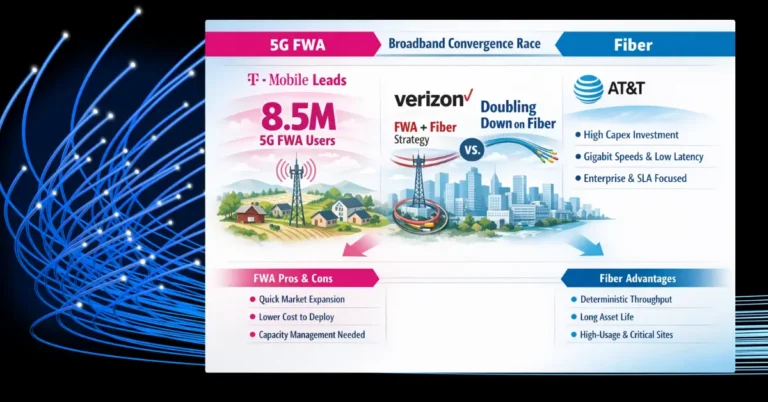
The operators that control both dense fiber and performant 5G, and that package them coherently, will set the pace for the next telecom cycle. AT&T’s targets—more fiber passings, higher bundle attach, and measured wireless growth—put it squarely in the camp that sees integrated networks as the winning model. If the company executes on build cadence and cross-sell while keeping experience clean, expect continued share gains in fiber markets and a tougher environment for single-asset competitors. For buyers, the practical takeaway is to lean into converged sourcing now to lock in economics and resiliency as these footprints expand.
ServiceNow has named Anthropic’s Claude as the default model for its Build Agent and a preferred model across the ServiceNow AI Platform, signaling a shift from AI pilots to deeply embedded, production-grade automation. Embedding Claude into that fabric gives customers an on-ramp to agentic automation—systems that can reason over context, decide, and execute tasks—without stitching together point tools. Claude becomes the default model for ServiceNow Build Agent, an AI-assisted builder for apps and automations. Embedding Claude within the ServiceNow AI Platform enables access control, usage monitoring, and compliance aligned to enterprise policies. ServiceNow aims to cut implementation timelines for customers by roughly half by using Claude to accelerate configuration, adoption, and rollout.
France’s three other mobile network operators—Bouygues Telecom, Free-iliad and Orange—have reopened negotiations with Altice to carve up most of SFR, reviving a complex deal that could reshape competition, capex and customer experience across the market. The operators confirmed they are conducting due diligence with Altice after re-engaging in early January 2026, stressing that legal and financial terms remain undecided and that there is no assurance of a transaction. A successful transaction would compress the French market from four to three MNOs, with material consequences for pricing power, 5G/fiber investment, vendor ecosystems and enterprise buyers. Consolidation momentum is building across Europe, evidenced by recent approvals of large transactions with stringent remedies. Altice has been under sustained pressure to reduce debt following restructurings and asset sales.
CEO Börje Ekholm indicated the company will keep trimming headcount after cutting roughly 5,000 positions over the last year. In Sweden, Ericsson has notified authorities and begun union talks that could affect about 1,600 roles, part of a multi‑year restructuring program. The move follows a 2023 plan to remove around 8,500 jobs worldwide—about 8% of its workforce—with further reductions last year in markets such as Spain and Canada. The rationale remains consistent: reset the cost base, protect profitability, and keep investment firepower for strategic bets amid a slower operator capex cycle.

Frequently Asked Questions

What’s the biggest emerging security risk for telecom networks right now?
Quantum computing’s eventual ability to break current encryption standards is the dominant emerging concern, often described through the framing of ‘harvest now, decrypt later,’ where adversaries collect encrypted data today, intending to decrypt it once sufficiently powerful quantum computers exist in the future. This matters particularly for telecom given how much sensitive data flows across networks protected by encryption standards quantum computers could eventually defeat. Alongside this longer-term quantum concern, the more immediate, near-term risk involves the expanded attack surface created by 5G’s heavy reliance on cloud-native, virtualized infrastructure and exposed APIs, which gives attackers considerably more potential entry points than older, more closed network architectures presented.
Are telecom networks actually doing anything about quantum threats yet, or is it theoretical?
It’s moving from theoretical to practical. Thales demonstrated that existing deployed 5G SIM and eSIM cards can be upgraded to quantum-safe protection without service disruption, proving that mobile networks can evolve their security through crypto agility rather than requiring an entirely new generation of hardware. Operators including BT, SK Telecom, Orange, and Deutsche Telekom are running live quantum-safe networking trials, with Deutsche Telekom specifically demonstrating quantum teleportation over a meaningful distance of commercial fiber in early 2026. These aren’t purely academic exercises; they represent genuine, if still early, steps toward preparing live commercial telecom infrastructure for the eventual quantum threat.
What is post-quantum cryptography (PQC), and is there a deadline for adopting it?
Post-quantum cryptography, commonly abbreviated PQC, refers to encryption algorithms specifically designed to resist attacks from future quantum computers, in contrast to the encryption algorithms most networks currently use, which quantum computers are expected to eventually break. Regulatory pressure is real and increasingly specific: the NSA’s CNSA 2.0 standard mandates quantum-safe algorithms for new national security system acquisitions by January 2027, and the European Commission is pushing critical infrastructure sectors, including telecom, toward post-quantum readiness by 2030. These deadlines, while initially focused on government systems, are widely expected to influence broader commercial telecom security planning timelines as well, since telecom is frequently classified as critical national infrastructure.
Is AI making telecom networks more or less secure?
It cuts both ways. On the defensive side, AI dramatically speeds up threat detection by spotting unusual patterns across enormous volumes of network traffic far faster than manual monitoring, and it increasingly powers automated incident response. On the risk side, AI agents given meaningful operational access to network systems represent a genuinely new kind of attack surface; if an agent’s decision-making can be manipulated, or its access misused, the consequences could be more severe than a typical software vulnerability, since the agent is specifically designed to take autonomous action on live infrastructure rather than simply process and report information.
Are 5G networks more vulnerable than older networks, or more secure?
5G’s expanded use of cloud-native, virtualized infrastructure and exposed APIs creates a larger attack surface than older, more closed network architectures, since there are simply more distinct software components and potential entry points for an attacker to target. At the same time, 5G’s architecture also enables faster patching, since updating virtualized software is generally quicker than physically replacing hardware, network slicing isolation, which can contain a security incident within one affected slice, and AI-based monitoring capabilities that weren’t practically possible on older, less data-rich legacy hardware. The honest assessment is that 5G is both more exposed in certain ways and better equipped to detect and respond to threats quickly in others.
What is ‘harvest now, decrypt later,’ and why does it matter even before quantum computers are powerful enough to break encryption?
‘Harvest now, decrypt later’ describes a strategy where an adversary intercepts and stores encrypted data today, even without the current ability to break that encryption, specifically betting that future quantum computers will eventually be powerful enough to decrypt it retroactively. This matters even before such quantum computers actually exist, because any sufficiently sensitive data encrypted today using standard, currently-vulnerable algorithms could theoretically be exposed years from now once quantum decryption capability matures, meaning organizations handling especially long-lived sensitive data face exposure risk regardless of how far away the quantum threat currently seems. This is precisely why regulators are pushing for PQC adoption now, well before quantum computers are actually capable of breaking current encryption.
What role do network APIs play in expanding or reducing telecom security risk?
Network APIs, which let third-party developers access specific carrier capabilities like location data or SIM status, introduce both new monetization opportunities and new security considerations operators need to manage carefully. Each exposed API represents a potential new entry point that needs rigorous authentication and monitoring, since a poorly secured API could potentially expose sensitive subscriber data to unauthorized parties. At the same time, well-designed network APIs can actually improve security in certain ways, for instance by giving banks access to fraud-prevention signals like SIM swap detection. The net security impact of network APIs ultimately depends heavily on how rigorously operators implement access controls and ongoing monitoring.
How are telecom operators securing IoT devices specifically, given how many are deployed?
Securing the enormous number of IoT devices connected to telecom networks presents distinct challenges compared to securing a smaller number of more capable, actively managed devices like smartphones. Operators increasingly rely on network-level security measures, like specialized IoT-focused firewalls and traffic monitoring tuned to detect unusual behavior, rather than depending entirely on each individual device having strong built-in security, since many IoT devices have limited processing power for running sophisticated security software directly. Some operators also offer dedicated, isolated network slices specifically for IoT traffic, helping contain the potential impact if a vulnerability in one device category is exploited, preventing that compromise from spreading into the rest of the network.
Security in Private 5G Networks: A Practical Guide for Enterprises

As enterprises move deeper into digital transformation, private 5G has emerged as a pragmatic answer to a specific problem: how to deliver controlled, reliable, and secure wireless connectivity where public networks fall short. Unlike public 5G, a private network is built around the needs of a single organization, offering tailored capacity, customization, and coverage in environments that defeat conventional wireless.

That value is clearest in demanding settings. Industrial operations that depend on low-latency machine-to-machine communication, and businesses spread across large campuses, both gain from a network they own and control.

But control cuts both ways. The same architecture that makes private 5G powerful also makes security a first-order design question rather than an afterthought. In a threat landscape that grows more sophisticated each year, securing a private 5G deployment is not a feature to bolt on later. It is part of the build.

The right approach is grounded and comprehensive. It accounts for the current threat environment, the vulnerabilities inherent to the technology, and the critical business functions the network supports. For most enterprises, the real question is not whether to adopt private 5G, but how to stand up a security posture that is resilient, adaptable, and matched to the risks this technology introduces.

Is Private 5G the Most Secure Option?

Security is the headline advantage cited for private 5G, but the honest answer is more nuanced than "yes." Private 5G is not automatically the most secure connectivity option in every dimension. What it offers is the strongest balance of security, flexibility, and scale, which is why it fits enterprises that need both protection and reach.

What makes private 5G secure

The security of private 5G starts with its architecture. In its most secure form, the network is fully isolated from the public network, hosted and managed on-site, and operated entirely by the enterprise. That isolation removes the network from the open internet and the vulnerabilities that come with it. On top of it, private 5G layers advanced encryption, strict access controls, and close monitoring of network traffic. Together these create a framework that is far less exposed to unauthorized access and external threats. Network slicing adds another dimension. By carving the network into separate virtual segments, each with its own security policy, an enterprise can match controls to the sensitivity of the data flowing through each slice.

What are the Best Practices for Securing Enterprise Private 5G?
  • Strong private 5G security comes from layering deliberate practices on top of the network’s built-in features. Enterprises should start by building security directly into the network architecture. This begins with strict access control, including SIM-based authentication paired with role-based access, so only authorized users, devices, and applications can connect. Advanced encryption should be applied to data at rest and in transit, supported by disciplined encryption key management. Network slicing can further strengthen security by creating separate, secure virtual networks for different operations, teams, or use cases. Regular audits and ongoing compliance checks are also essential to ensure the network continues to meet relevant industry standards and regulatory requirements. In addition, 5G-specific security controls should be integrated with the enterprise’s existing security infrastructure, with careful planning around the unique requirements of private 5G environments.
  • Effective private 5G security also depends on how threats and people are managed. Enterprises should deploy advanced threat detection capabilities to identify breaches or abnormal behavior early, and they should support those tools with a clear incident response plan that enables teams to act quickly when an issue occurs. Staff training is equally important. Employees and operational teams need to understand 5G security protocols, device access rules, and incident escalation processes. Security awareness should become part of normal operations, not an occasional training exercise. Enterprises should also work closely with service providers, technology vendors, and system integrators under a clear shared-responsibility model, so every party understands its obligations and meets the enterprise’s security standards.
  • Organizations should also recognize the limits of private 5G’s “secure by design” foundation. Private 5G is not immune to attack, and built-in security should be treated as a starting point rather than a complete defense. A strong posture requires additional layers, including continuous monitoring, real-time threat detection, and an end-to-end view across every component of the network. This is especially important at the points where IoT, OT, and enterprise IT systems intersect. Regular software updates and patching are non-negotiable, as outdated systems can quickly become weak points. Physical security also matters, particularly for network equipment located in Radio Access Network areas, edge sites, and other operational environments.
  • Private 5G gives enterprises a level of control that public networks cannot provide, and that control is the source of both its security advantages and its responsibilities. The technology is not secure by default in every dimension, but with isolation, encryption, slicing, continuous monitoring, and a disciplined operational posture, it can deliver a strong combination of security, flexibility, and scalability. For enterprises weighing connectivity options, the question is less about whether private 5G can be secure and more about whether the organization is ready to build, operate, and maintain the security posture that makes it so.
How it compares to other options

A fair comparison puts private 5G alongside private LTE, Ethernet, and WiFi rather than against public 5G alone:

Feature Private 5G Private LTE Ethernet (Wired) WiFi
Isolation Full isolation possible Full isolation possible Inherently isolated Shared medium, less isolated
Encryption Advanced encryption Less advanced than 5G Depends on protocol Less robust
Access control SIM-based authentication SIM-based authentication Physical and protocol-based SSID and password
Network control Full on-site control Full on-site control Full control, limited flexibility Less control, more exposure
Network slicing Supported Not supported Not applicable Not supported
Edge computing integration Seamless, enhances security Possible, less integrated Possible, can be very secure Less integrated
Traffic monitoring Easier, software-defined Harder than 5G Easier, fixed pathways Harder
Attack surface Reduced by isolation Reduced by isolation Minimal, no wireless access Larger, wireless access
Physical security High, controlled environment High, controlled environment Very high, hard to tap Lower, easier to intercept
Scalability High, with slicing Scalable, no slicing Limited Scalable but less secure

The table makes the trade-off clear. Ethernet is exceptional on physical security and isolation, but it cannot match private 5G for flexibility, mobility, or scale, particularly when supporting large fleets of IoT devices and mobile users. Private LTE is secure but lacks 5G capabilities like network slicing. WiFi is convenient and widely deployed, but its shared medium leaves it more exposed to interference and eavesdropping.

No single option wins on every axis. The right choice depends on what the enterprise needs to protect and how dynamic its environment is. For organizations that need strong security without sacrificing scale and mobility, private 5G is usually the best fit.

Partner Hubs

Download content, access intelligence tools, and hear from executives.

Partner Events

  • M360 ASEAN
  • FutureNet Asia 2026
  • Network X Vienna 2026
Scroll to Top