Fiber

The European Commission has approved Orange’s plan to acquire the remaining stake in MasOrange, signaling limited competitive impact and clearing the path for full control in Spain. Orange will purchase the roughly 50% it does not already own in MasOrange from the Lorca consortium for about €4.3 billion. MasOrange was created in 2024 by combining Orange Spain and MásMóvil, and the new deal converts the joint venture into a wholly owned Orange subsidiary. The Commission used its simplified merger review, indicating no structural change in market concentration. Closing is expected before July 2026, after which MasOrange will be integrated into Orange’s operations and financial reporting.
European regulators have cleared the path for Telecom Italia (TIM) to offload its global wholesale arm, Sparkle, advancing a restructuring with implications for sovereignty, subsea capacity, and wholesale competition. The European Commission has approved the acquisition of Sparkle by Italy’s Ministry of Economy and Finance (MEF) and infrastructure provider Retelit, valuing the asset at €700 million and granting joint control to the two buyers. TIM had initially targeted closing in late 2025, but now guides to completion in the first half of 2026. Brussels found the deal would not materially distort competition in the relevant wholesale markets.
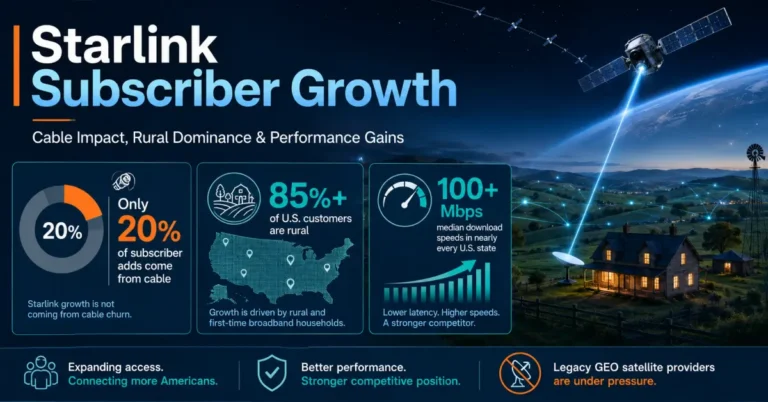
US Mobile and Starlink have launched limited-time bundles that combine Starlink residential service with US Mobile’s unlimited mobile plans under a single account and bill. Entry pricing starts at $47 per month, which effectively blends a $30 Starlink residential tier (targeted around 100 Mbps) with a $17 US Mobile base unlimited plan. Higher Starlink speed tiers are available at $77 per month for a 200 Mbps option and $117 per month for a “Max” service that targets 400 Mbps or more. Compared with Starlink’s typical standalone rates of $50, $80, and $120 for the same speed tiers, the bundles represent meaningful savings for households that want both mobile and home internet.
AT&T’s new collaboration with Cisco and NVIDIA signals a decisive shift from cloud-centric AI to network-driven edge intelligence for enterprise operations. Enterprises want real-time decisioning without shipping sensitive data to distant clouds, and operators need a scalable way to deliver it. By combining AT&T’s dedicated IoT core with Cisco’s mobility services platform and NVIDIA-powered AI infrastructure, the trio is packaging deterministic connectivity, near-device inference, and policy enforcement into a single, operator-grade platform. The promise: lower latency, tighter data control, and a path to production for AI at industrial scale.
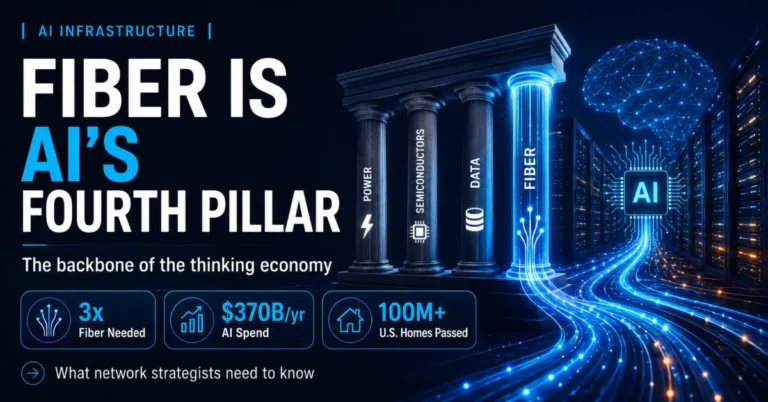
AT&T’s five-year, $250 billion U.S. network commitment sets the tone for the next phase of fiber, 5G, and satellite convergence as traffic, AI workloads, and resilience requirements climb sharply. The 2026–2030 window aligns with the industry’s transition into 5G-Advanced (3GPP Release 18/19), the scaling of edge AI, and increased cloud traffic between homes, enterprises, and hyperscalers. Data growth is no longer linear, and the cost of downtime is rising. Large, front-loaded builds in fiber and 5G Radio Access Network (RAN), paired with new satellite overlays, are how national carriers will chase coverage, performance, and reliability targets simultaneously.
Lyttelton Port Company (LPC) introduced a private 5G network with 2degrees and Ericsson Enterprise Wireless Solutions to improve safer, more resilient port operations across difficult “metal canyon” container lanes and wide outdoor yards. The deployment supports asset tracking, job dispatch, safety alarms, and video streaming, with Ericsson Cradlepoint routers on straddle carriers using private 5G as primary and 2degrees’ public mobile network as backup. With 434,000 containers handled in FY2025, LPC is also planning next steps like wind/stormwater sensors and drone inspections feeding AI tools.
American Tower’s latest outlook puts a hard number on a trend most operators feel on the ground: the network needs to double by the end of the decade to absorb 5G, fixed wireless access, and AI-driven traffic. Mobile data growth remains the primary engine for new network investment. As 5G adoption scales and fixed wireless access expands, capacity pressure is shifting from coverage to throughput. The next leg comes from AI. New applications—from on-device inference to computer vision at the edge—demand more bandwidth, tighter latency, and stronger uplink. That profile is different from today’s downlink-heavy usage and will stress radios, backhaul, and site power.
KDDI and Nokia validated quantum-safe optical transport at KDDI’s new Sakai Data Center, a facility built to support real-time AI training, inference, and analytics. The demonstration used Nokia’s 1830 Photonic Service Switch with C+L band capabilities for capacity scaling and the 1830 Security Management Server for centralized key and policy control. The goal is clear: deliver high-throughput, low-latency, and line-rate encrypted data center interconnect (DCI) that is resilient against both today’s threats and tomorrow’s quantum-era risks. Encrypting at the optical layer removes the performance penalties of application or IP-layer encryption and avoids fragmenting security by workload.
A new partnership between Infosys and Anthropic brings agentic AI into regulated, process-heavy industries, with telecom squarely in scope. Infosys will integrate Anthropic’s Claude models and Claude Code with its Topaz portfolio to build and operate enterprise-grade AI solutions across telecom, financial services, manufacturing, and software engineering. The collaboration emphasizes agentic AI—systems that can plan, call tools, and execute multi-step workflows with oversight—delivered with the controls, auditability, and policy enforcement that regulated sectors demand. Pairing Infosys’s domain depth with Claude’s reasoning and long-context capabilities gives operators a path to pragmatic automation that respects regulatory, safety, and transparency requirements.
India’s AI agenda increasingly spans silicon, data platforms, models, and applications, with an intent to catalyze domestic innovation and contribute to global ecosystems. For telecom leaders, the message is clear: AI is not a bolt-on capability but a system-level transformation that touches RAN, core, transport, cloud, and the enterprise edge. The AI economy runs on connectivity—low-latency access to data, assured bandwidth, location-aware processing, and programmable control. The operators that can fuse connectivity, compute, and data into a cohesive platform will set the pace for India’s next wave of digital growth.
Boldyn Networks is rolling out a neutral host 5G upgrade at Silverstone that shifts the circuit from seasonal stopgaps to a year-round, high-capacity mobile platform for fans, teams, and broadcasters. The architecture spans 25 locations, with 57 sectors engineered across 87 DAS zones to handle concentrated traffic and maintain performance under crowd pressure. The design anticipates surges in uplink and signaling, supports concurrent sessions at scale, and smooths throughput across hotspots. A permanent, multi-operator 5G foundation unlocks new revenue, better service metrics, and more efficient event delivery. When connectivity works, dwell time, spend, and satisfaction rise.
India is moving to anchor a larger slice of global AI compute by pairing policy incentives with large-scale private capital and renewable power. New Delhi has outlined plans to attract more than $200 billion for AI infrastructure over the next two years, positioning the country as a production base for compute, data, and advanced applications rather than a pure consumer market. The policy stack aims to reduce friction for export-oriented AI services while widening access to shared compute for startups and enterprises. Adani Group plans to invest $100 billion through 2035 to build renewable-powered, AI-optimized data centers across India.
Sponsored by Palo Alto Networks
⚡ Utilities ⏱ 8 min ✓ Free
This tool is built and hosted by TeckNexus.
Launch Tool →
Whitepaper
Neutral host, network slicing, and autonomous ground vehicles look like three unrelated topics — but they share the same hidden security risk. See what 100 airport deployments reveal about securing the components with the broadest reach across the network....
Whitepaper
Airports are deploying AI surveillance, biometrics, and autonomous vehicles faster than most networks can secure them. See what 100 real-world airport deployments reveal about the airside/landside security gap — and the 4-layer framework built to close it....
Scroll to Top