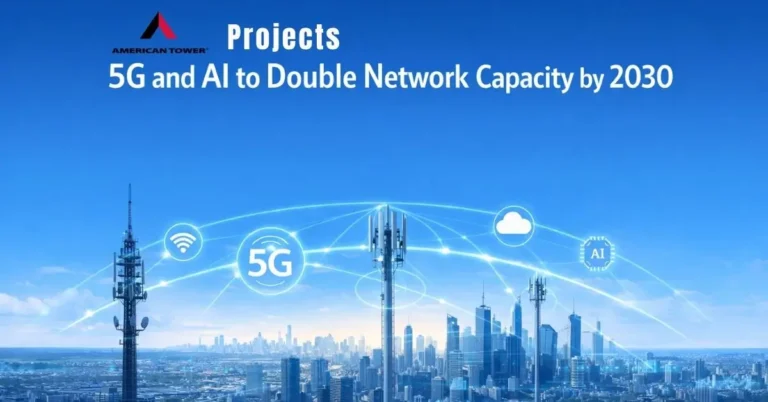
5G and AI demand: why networks must double by 2030
American Tower’s latest outlook puts a hard number on a trend most operators feel on the ground: the network needs to double by the end of the decade to absorb 5G, fixed wireless access, and AI-driven traffic.

5G, FWA, and AI: demand drivers straining capacity
Mobile data growth remains the primary engine for new network investment. As 5G adoption scales and fixed wireless access expands, capacity pressure is shifting from coverage to throughput. The next leg comes from AI. New applications—from on-device inference to computer vision at the edge—demand more bandwidth, tighter latency, and stronger uplink. That profile is different from today’s downlink-heavy usage and will stress radios, backhaul, and site power. The practical takeaway: operators will need more spectrum efficiency, more sites, and smarter traffic placement to keep experience consistent.
From coverage to capacity: preparing for 6G
In the U.S., the 5G build has moved past initial coverage into capacity augmentation. That means densification in mid-band, targeted small cells, and upgrades that anticipate 5G-Advanced and eventual 6G. Internationally, the pattern is similar but staggered. Europe started slower, yet demand for new sites is accelerating as mid-band rollouts deepen. In many emerging markets, 4G remains the revenue workhorse, while 5G is lighting up in dense metros with clear growth runway. The strategy thread across regions is consistent: scale now for 5G capacity while laying the groundwork for 6G-era features.
Regional 5G outlook: U.S. densifies, Europe accelerates, emerging markets scale selectively
Different market maturities shape how operators sequence spectrum, sites, and spend over the next three to five years.
United States: 5G mid-band densification now
Carriers that finished initial 5G coverage are now boosting capacity with mid-band like C-band and 3.45 GHz, complemented by small cells in traffic hotspots. Expect more multi-band radios, Massive MIMO optimization, and uplink enhancements aligned to 3GPP Release 18/19. The driver is not only video and FWA, but also enterprise use cases and early AI-enabled services that raise uplink and jitter sensitivity. Tower and rooftop assets near fiber and power will see premium demand, and neutral-host models can reduce time-to-capacity for second and third tenants.
Europe: accelerating 5G capacity and new sites
European networks are catching up on 5G capacity, especially in 3.5 GHz corridors. Operators are adding new macro sites where coverage gaps persist and infilling with small cells as traffic hotspots emerge. Spectrum fragmentation and local permitting remain constraints, but sustained demand is driving newbuild activity with Tier‑1 carriers. Power availability and fiber-ready backhaul increasingly determine where new sites go first, and where open RAN or vendor diversification strategies can be piloted at scale.
Emerging markets: 4G growth, targeted 5G metros
Outside mature markets, 4G is still expanding and monetizing. 5G is rolling out in dense urban areas where device mix and enterprise opportunities justify the spend. As these portfolios mature, lease-up potential remains high. The investment imperative is disciplined: prioritize high-traffic corridors, align spectrum refarming to 5G-Advanced timelines, and ensure microwave or fiber backhaul can scale to gigabit-class performance.
Network design and capex to double capacity by 2030
Doubling capacity is not only about more sites—it requires coordinated upgrades across RAN, transport, power, and edge compute.
RAN densification and spectrum efficiency
Operators should plan for tighter inter-site distances in urban zones, exploiting mid-band efficiencies and selectively adding mmWave for extreme hotspots and FWA. Features in 5G-Advanced—uplink enhancements, coordinated multipoint, and AI-assisted RAN optimization—can lift spectral efficiency without new spectrum. Refarming legacy 3G/4G carriers and deploying multi-band Massive MIMO help smooth the path to higher capacity while improving coverage uniformity.
Backhaul, power resiliency, and site readiness
Fiberized backhaul and high-availability power are emerging bottlenecks. Where fiber is impractical, high-capacity microwave with carrier aggregation and XPIC can bridge, but power resiliency still needs upgrades. Site modernization—efficient rectifiers, lithium-based batteries, and smart energy management—lowers opex and supports higher radio loads. Towercos that can bundle power-as-a-service and high-capacity backhaul will move earlier in operators’ build queues.
Edge computing and AI traffic placement at the mobile edge
As AI inference shifts closer to users and devices, mobile edge computing will carry more stateful, low-latency sessions. That favors sites with space, power, and cooling for micro edge nodes, and transport engineered for deterministic latency. Enterprises deploying computer vision, digital twins, or quality control analytics will seek colocation near radio sites or regional edges to cut round-trip delay and backhaul costs.
Open RAN, neutral-host, and network sharing models
O-RAN Alliance interfaces and virtualized RAN give operators options to scale capacity with vendor mix flexibility, especially for small cells and rural macros. Neutral-host and multi-operator sharing can accelerate indoor and venue coverage where single-operator ROI is thin. Expect more site sharing and power/backhaul pooling as capex tightens and ESG targets press for lower energy per bit.
American Tower outlook: demand signals for 5G and AI capacity
The company’s financials reflect durable demand for macro, rooftop, and adjacent infrastructure as 5G scales and AI use cases form.
Portfolio scale and 2025 financial performance
American Tower closed Q4 2025 with roughly 150,000 communications sites. Quarterly revenue reached about $2.73 billion, up mid‑single digits year over year, while quarterly profit was approximately $837 million and lower versus the prior year. For full‑year 2025, revenue was about $10.64 billion, up just over 5%, with net profit around $2.63 billion, up in the mid‑teens. Capital expenditures were approximately $592 million in Q4 and $1.7 billion for the year, highlighting continued investment in newbuilds, upgrades, and power and backhaul enhancements.
2026 guidance and investor implications
For 2026, the company guides property revenues of roughly $10.44–$10.59 billion and net profits of $2.94–$3.02 billion. The outlook assumes steady lease-up in the U.S., faster organic growth internationally as portfolios mature, and ongoing 5G capacity work that sets the stage for 5G‑Advanced and future 6G. For operators and vendors, that signals a stable build cadence, with capacity-led deployments dominating planning cycles.
Next steps for operators and enterprises
The next 24–36 months will separate those who plan capacity surgically from those who chase traffic reactively.
Actions for MNOs and neutral-host providers
Prioritize densification in mid-band with clear thresholds for adding small cells and targeted mmWave. Align RAN roadmaps to 3GPP Release 18/19 features that improve uplink and latency. Pre-qualify sites for power and fiber to cut cycle time. Use neutral-host and sharing models to expand indoor and venue economics, and instrument energy consumption to track cost per bit.
Actions for enterprises and cloud providers
Co-design edge locations with operators and towercos near high-value workflows. Validate that uplink capacity and SLA targets match AI and video analytics needs. Where spectrum flexibility is key, explore private 5G with roaming integration and ensure backhaul can scale as inference loads rise.
Watchlist: 5G-Advanced, spectrum, permitting, and AI apps
Track 5G‑Advanced feature availability, mid-band refarming timelines, and local permitting reforms that can unlock site supply. Watch the maturity of open RAN in dense urban deployments and the pace of AI application adoption that shifts traffic to the edge. These will determine how fast networks must scale—and where the next billion dollars of capex should go.