AI at the Core of Modern Telecom OSS Networks
Unifying Operational Excellence, Revenue Growth, and Guest Experience
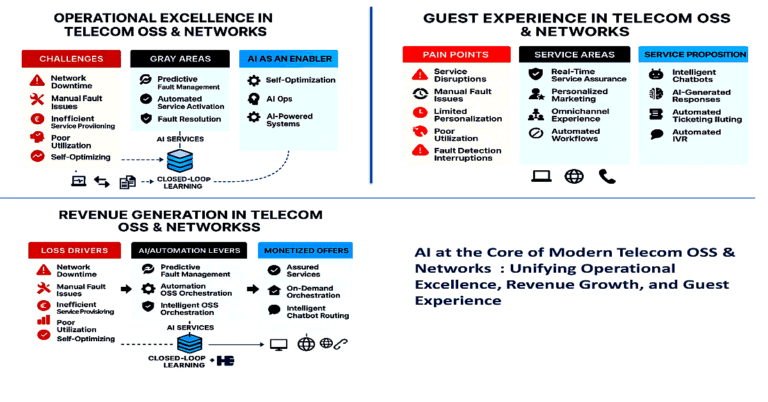
Telecom operators are navigating one of the most complex transitions in the industry’s history. Legacy OSS environments must be modernized at the same time that networks become increasingly software-defined, multi-vendor, and cloud-native. Customer expectations continue to rise, service-level agreements grow stricter, and margins remain under persistent pressure. Meanwhile, operators are expected to improve operational efficiency, unlock new revenue streams, and deliver seamless, personalized customer experiences—all without increasing cost structures.
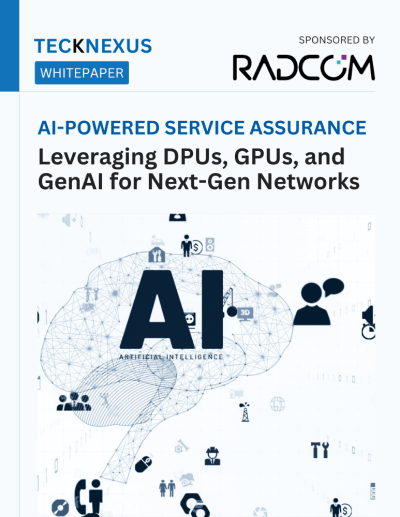
Treating these challenges as isolated transformation initiatives often leads to fragmented investments and suboptimal outcomes. Network modernization programs, digital customer experience projects, and monetization strategies frequently operate in silos, competing for budget and attention. The strategic breakthrough lies in placing Artificial Intelligence (AI) at the core of OSS and network operations—not as an incremental overlay, but as a pervasive capability embedded across data, automation, and experience layers.

When implemented holistically, AI enables a single, closed-loop operating model that simultaneously drives Operational Excellence, Revenue Generation, and Guest (Customer) Experience, allowing each improvement to reinforce the others.
Operational Excellence: From Reactive Operations to Autonomous Networks
Traditional OSS operating models are largely reactive. Fault management depends on static thresholds and alarms, root cause analysis is manual and time-consuming, and service provisioning requires significant human intervention. These approaches struggle in modern telecom environments, where faults propagate rapidly across domains and services, and where the pace of change has outgrown manual control.
Operational excellence in the AI era is defined by autonomy, prediction, and continuous optimization. Instead of responding to incidents after impact, AI-driven OSS anticipates issues, recommends or executes corrective actions, and learns from outcomes to improve future performance.
At the foundation of this model lies a unified data fabric. Network telemetry, alarms, logs, configuration and inventory data, service orders, and customer care interactions are ingested in real time. Streaming pipelines feed a scalable lakehouse architecture and feature store, while a topology graph captures relationships across services, resources, devices, and sites. This combination provides the contextual intelligence required to understand how localized events affect end-to-end services and customers.
On top of this foundation, AI services transform data into operational decisions. Predictive fault management applies supervised learning and anomaly detection to identify incidents before they escalate. Topology-aware root cause analysis uses graph reasoning and causal inference to pinpoint the most likely fault sources across domains. Automated service activation validates service intent against live network state, ensuring that desired configurations are feasible before execution. Reinforcement learning agents recommend or execute remediation playbooks such as configuration rollbacks, traffic re-routing, or elastic capacity scaling. Closed-loop AI Ops continuously tune thresholds, scaling rules, and quality-of-service parameters based on real-world outcomes.
An intent-based orchestration layer sits at the center of this architecture. Operators express what outcome they want—such as restoring service quality or activating a new enterprise connection—while the system determines how to achieve it across RAN, Core, Transport, and IT environments. Policy guardrails ensure safe autonomy through risk controls, approval workflows, blast-radius limits, and automated rollback validation.
The impact on operations is significant. Operators typically see a 30–50% reduction in Mean Time to Detect and Repair, faster provisioning cycles, and materially lower operating costs through reduced manual intervention and truck rolls. Change success rates improve as intent validation and simulation reduce human error, while compliance and auditability are strengthened through traceable, policy-driven automation.
Revenue Generation: Monetizing Network and Operational Intelligence
As connectivity becomes increasingly commoditized, sustainable growth depends on moving beyond bandwidth-based pricing. AI-powered OSS enables operators to transform internal operational intelligence into differentiated, monetizable services that customers are willing to pay a premium for.
One of the most powerful levers is the exposure of network intelligence through APIs. Real-time and predictive service health indicators—such as SLA risk, congestion forecasts, or degradation probability—can be offered to enterprise customers as premium “assured” service tiers. These capabilities shift the value proposition from best-effort connectivity to outcome-based assurance.
On-demand orchestration further expands monetization opportunities. Enterprises can request bandwidth boosts, service upgrades, or slice modifications through self-service portals, with AI validating feasibility and automatically activating changes. Event-driven billing models align revenue directly with usage, performance, and automation outcomes, enabling pay-per-quality or pay-per-action pricing.
AI also enables richer productization of OSS capabilities. Predictive assurance supports premium fault management offerings with guaranteed detection and resolution windows. Autonomous service orchestration can be packaged for wholesale and partner ecosystems, reducing onboarding friction and operational overhead. AI-driven chatbot traffic routing lowers cost to serve by resolving routine issues digitally, while freeing human agents to focus on consultative sales and complex enterprise interactions.
Growth analytics amplify these revenue streams. Machine learning models predict upgrade propensity based on incident history, utilization patterns, and customer behavior. Price elasticity models forecast conversion rates across different premium tiers, enabling more effective pricing strategies. SLA risk forecasting supports dynamic discounts or surge pricing aligned to predicted service quality.
The cumulative impact is substantial. Operators generate new recurring revenue from premium assurance and on-demand services, reduce churn and SLA penalty leakage, lower service delivery costs, and increase attach and upsell rates by offering the right service at the right moment.
Guest Experience: Proactive, Personalized, Omnichannel
Customer experience has become one of the strongest differentiators in telecom. Customers judge providers not only on uptime, but on transparency, responsiveness, and relevance. Fragmented channels, delayed communication, and generic offers erode trust and satisfaction.
AI-centric OSS enables a shift from reactive customer support to proactive experience orchestration. A customer intelligence layer unifies product holdings, network quality metrics, incident history, tickets, and digital interactions into a single, continuously updated profile. Real-time context—such as current service health, latency, congestion, or proximity to an outage—feeds experience decisions across channels.
AI-driven proactive assurance detects impending issues before customers are impacted. Instead of waiting for complaints, the system notifies customers in advance, provides estimated resolution times, auto-creates tickets, and applies temporary workarounds such as alternate routing or bandwidth reallocation. This transparency significantly improves trust and satisfaction.
Personalized marketing engines use real-time context to recommend upgrades or add-ons aligned to actual customer pain points rather than generic campaigns. Omnichannel large language models deliver consistent, intent-aware responses across mobile apps, web portals, IVR systems, and agent assist tools. Automated ticketing and IVR leverage natural language understanding to improve first-contact resolution, while intelligent handoff ensures smooth escalation when human intervention is required.
These capabilities translate into measurable improvements. Net Promoter Score and Customer Satisfaction increase due to faster resolution and proactive communication. First-contact resolution improves as AI handles routine issues more effectively. Average handle time declines, digital containment rises, and offer acceptance rates increase through contextual relevance.
Trustworthy AI as a Foundational Requirement
Placing AI at the core of OSS and network operations requires trust, transparency, and governance. Operators must establish robust ModelOps practices for lifecycle management, performance monitoring, drift detection, and bias checks. Explainability is essential—autonomous actions must be understandable and auditable by operations teams and regulators alike.
Policy guardrails and human-in-the-loop controls are critical for high-risk actions, ensuring that autonomy is introduced responsibly. Data minimization and privacy-by-design principles protect sensitive customer information and support regulatory compliance. Trustworthy AI is not a constraint on innovation; it is the foundation that enables AI to scale safely across mission-critical telecom operations.
Conclusion
Making AI the core of OSS and network operations transforms telecom operators from reactive service providers into proactive, adaptive digital platforms. With a shared data fabric, intent-based orchestration, and trustworthy AI, Operational Excellence, Revenue Generation, and Guest Experience no longer compete for priority. Instead, they reinforce one another within a single closed-loop system—where every operational improvement strengthens growth, resilience, and customer trust.
In an industry defined by scale, complexity, and constant change, AI is no longer optional. It is the operating model that enables telecoms to compete, differentiate, and grow in the digital era.