Introduction
You’ve decided a private network makes sense for your operation. Now comes the harder question: how should it be deployed?

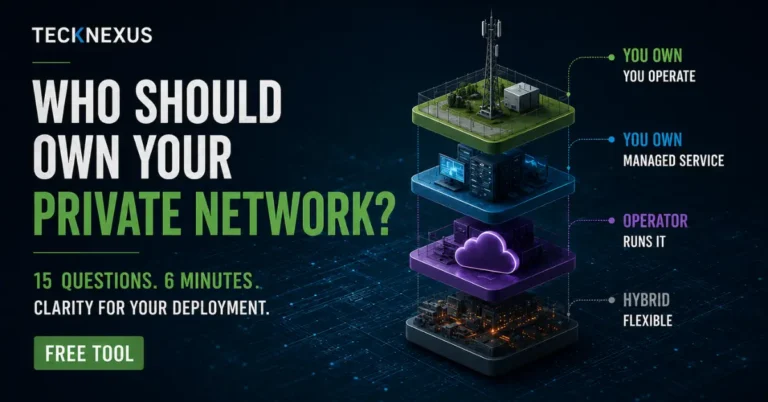
Should you own the infrastructure outright and run it with an internal team? Should you own the assets but hand operations to a managed service provider? Should a mobile operator run the network on your behalf? Does your data stay fully on-premises, or is cloud connectivity acceptable?
These decisions shape your capital exposure, your vendor dependencies, your operational risk, and your ability to scale. Get the architecture wrong and you’ll spend years either locked into the wrong model or re-engineering a network that doesn’t match how your organisation actually works.
The TeckNexus Private Network Architecture Selector is a free, vendor-neutral tool that cuts through this complexity in 15 questions.
What is the architecture selector?
The Private Network Architecture Selector is an interactive decision tool — independently built and operated by TeckNexus — that helps enterprise decision-makers determine the right deployment architecture for their private network.
It covers the structural decisions that sit beneath technology choice: ownership, operations, data sovereignty, vendor engagement sequence, and integration approach.
At the end, you receive a structured recommendation that includes:
- Your recommended deployment architecture — with clear rationale
- Who should own what (spectrum, infrastructure, operations)
- Where your data should sit (fully on-premises, edge, hybrid cloud)
- How to structure vendor and operator engagement
- Deployment model considerations specific to your environment
- Your next steps in the planning process
Free. Vendor-neutral. No sales pitch embedded in the output.
Methodology, scoring, and outputs are owned entirely by TeckNexus. No vendor funds, influences, or accesses individual results.
Who should use it?
The Architecture Selector is built for:
- Enterprise IT leaders and CIOs making foundational decisions about network ownership and operating model
- OT and operations teams responsible for industrial connectivity infrastructure
- Procurement and sourcing teams who need to know whether to issue an RFP to a vendor, an operator, or a systems integrator — and in what sequence
- Strategy and digital transformation teams structuring multi-year connectivity roadmaps
- Finance and risk teams evaluating CapEx vs OpEx trade-offs for network investment
It works across all major industry verticals — manufacturing, mining, ports, utilities, logistics, transportation, healthcare, and enterprise campus — and applies globally.
What the 15 questions cover
The selector works across four key decision domains:
- Operational Environment & Requirements: What environment are you deploying in? What devices and use cases need connectivity? What are your latency and availability requirements? These answers establish the baseline constraints that rule out certain architectures immediately.
- Data Sovereignty & Integration: Is your OT data fully air-gapped? Can cloud connectivity be part of your architecture? How tightly integrated are your IT and OT systems? Data sovereignty and integration requirements are among the strongest drivers of architecture choice — this section captures them precisely.
- Ownership & Commercial Model: Do you want to own the infrastructure or subscribe to it? Do you have internal capability to operate a private network, or will you rely on a managed service? What is your CapEx vs OpEx preference? The architecture must match your organisation’s operating model — not just the technology specification.
- Strategic & Vendor Engagement: What is your deployment timeline? How do you plan to engage vendors — direct, via operator, or through a systems integrator? Should you run a pilot first, or is this a production-ready commitment? These answers shape how the recommendation structures your next steps.
The four architecture models the tool evaluates
Without revealing the methodology, the Architecture Selector evaluates your responses across the main deployment model categories that define how private networks are actually built:
- Enterprise-owned and operated — full control, internal capability, maximum data sovereignty
- Enterprise-owned, vendor-managed — asset ownership with outsourced operations
- Operator-led network sharing — using a mobile operator’s spectrum and infrastructure with dedicated capacity
- Fully managed private network service — OpEx model, vendor or operator handles end-to-end
The recommendation identifies which model fits your constraints — and explains why others were ruled out for your specific situation.
Why are architecture decisions often made too late
Most enterprise teams focus almost entirely on technology selection — LTE vs 5G, spectrum options, vendor shortlists — and defer the architecture conversation until RFP stage. This creates problems:
Vendor engagement gets sequenced incorrectly. If you issue an RFP before deciding whether an operator or a vendor integrator should lead, you’ll get incompatible responses that are difficult to evaluate.
CapEx/OpEx assumptions get locked in too early. Architecture determines whether a deployment is primarily a capital investment or a service subscription — and this has significant internal budget implications that need to be addressed before procurement.
Data sovereignty conflicts surface late. Discovering that a chosen deployment model doesn’t meet your data governance requirements after vendor selection is expensive to unwind.
The Architecture Selector surfaces these decisions early — when they’re still easy to resolve.
How to access it
The tool is free and takes approximately 6 minutes to complete.
→ Launch the Private Network Architecture Selector
Use the technology and architecture selectors together
Technology selection and architecture selection are closely related but distinct decisions. The recommended workflow:
- Start with the Technology Selector — determine whether private LTE, 5G, CBRS, or another approach is right for your environment. → Private Network Technology Selector
- Then use the Architecture Selector — determine who should own what, how operations should be structured, and how to engage the market.
Running both gives you a complete pre-procurement foundation: technology direction and deployment model — before you engage a single vendor.
What comes after your recommendation?
Architecture recommendations are most valuable when validated against real deployment evidence — how similar organisations in your vertical have actually structured their deployments, what ownership models are most common, and what operational patterns have proven successful.
TeckNexus Industry Intelligence Platforms provide this evidence layer — 25+ decision cards per vertical built from analysis of 1,000+ real enterprise private network deployments.
- Manufacturing Intelligence Platform
- Mining Intelligence Platform
- Ports Intelligence Platform
- Airports Intelligence Platform
→ View All Intelligence Tools and Platforms
Related Tools
- Private Network Technology Selector — Determine the right technology (private LTE, 5G, CBRS) before deciding how to deploy it. 17 questions, 8 minutes, free.
- Private Network Security Assessment for Utilities — For utility operators, this 5-section assessment maps your security readiness and delivers a prioritised action plan tailored to your threat environment.
The Private Network Architecture Selector is independently developed and operated by TeckNexus. No vendor funds, influences, or has access to individual results. Anonymised, aggregated data may be used for benchmark reporting.