Intelligence Journeys
AI Use Cases for Utilities
Private Broadband for Utilities

Spectrum

American Tower’s latest outlook puts a hard number on a trend most operators feel on the ground: the network needs to double by the end of the decade to absorb 5G, fixed wireless access, and AI-driven traffic. Mobile data growth remains the primary engine for new network investment. As 5G adoption scales and fixed wireless access expands, capacity pressure is shifting from coverage to throughput. The next leg comes from AI. New applications—from on-device inference to computer vision at the edge—demand more bandwidth, tighter latency, and stronger uplink. That profile is different from today’s downlink-heavy usage and will stress radios, backhaul, and site power.
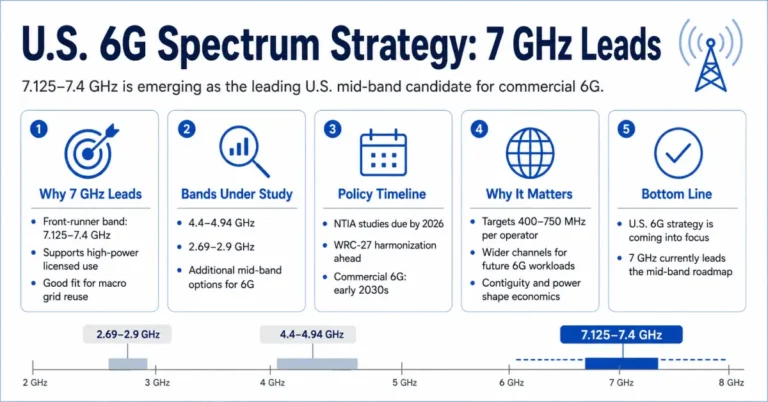
Samsung Electronics, working with KT Corporation and Keysight Technologies, has demonstrated 3 Gbps peak downlink in outdoor tests using an ultra‑dense antenna system and X‑MIMO in the 7 GHz band. The field trial took place at Samsung’s Seoul R&D Campus and pushed eight concurrent spatial streams from a base station to a single user device. The key enabler was a radio unit that packs roughly four times the antenna elements of today’s 5G massive MIMO gear into a similar physical footprint. Shorter wavelengths at 7 GHz make that density feasible without expanding the radio size.
KDDI and Nokia validated quantum-safe optical transport at KDDI’s new Sakai Data Center, a facility built to support real-time AI training, inference, and analytics. The demonstration used Nokia’s 1830 Photonic Service Switch with C+L band capabilities for capacity scaling and the 1830 Security Management Server for centralized key and policy control. The goal is clear: deliver high-throughput, low-latency, and line-rate encrypted data center interconnect (DCI) that is resilient against both today’s threats and tomorrow’s quantum-era risks. Encrypting at the optical layer removes the performance penalties of application or IP-layer encryption and avoids fragmenting security by workload.
India’s AI agenda increasingly spans silicon, data platforms, models, and applications, with an intent to catalyze domestic innovation and contribute to global ecosystems. For telecom leaders, the message is clear: AI is not a bolt-on capability but a system-level transformation that touches RAN, core, transport, cloud, and the enterprise edge. The AI economy runs on connectivity—low-latency access to data, assured bandwidth, location-aware processing, and programmable control. The operators that can fuse connectivity, compute, and data into a cohesive platform will set the pace for India’s next wave of digital growth.
OpenAI is reportedly building a portfolio of AI-native devices, signaling a push beyond software and into ambient, multimodal computing that will touch homes, workplaces, and networks. Multiple reports indicate OpenAI has over 200 people developing a family of AI-enabled hardware, with a smart speaker expected to debut first. Early guidance points to a price in the $200–$300 range and a ship window no earlier than February 2027. The device is said to include a camera to capture contextual information about users and surroundings—an explicit bet on multimodal AI that fuses voice, vision, and environment for richer interactions.
Ericsson and Mistral AI are aligning telecom-grade engineering with customizable foundation models to push AI deeper into network operations and RAN automation. The pairing marries Mistral AI’s fast-evolving model stack with Ericsson’s domain expertise across radio, cloud-native networking, and service management. For European operators, it signals a path to AI capabilities that respect data residency, security, and compliance expectations under the EU AI Act without ceding control to generic, hyperscaler-led platforms. The outcome operators want is simple: measurable gains in performance, efficiency, and resiliency with governance baked in.
Boldyn Networks is rolling out a neutral host 5G upgrade at Silverstone that shifts the circuit from seasonal stopgaps to a year-round, high-capacity mobile platform for fans, teams, and broadcasters. The architecture spans 25 locations, with 57 sectors engineered across 87 DAS zones to handle concentrated traffic and maintain performance under crowd pressure. The design anticipates surges in uplink and signaling, supports concurrent sessions at scale, and smooths throughput across hotspots. A permanent, multi-operator 5G foundation unlocks new revenue, better service metrics, and more efficient event delivery. When connectivity works, dwell time, spend, and satisfaction rise.
Ericsson has introduced an agentic rApp delivered as a cloud service on Amazon Web Services (AWS), aiming to speed operators’ shift from manual automation toward truly autonomous networks. By offering an “Agentic rApp as a Service” on AWS, Ericsson is packaging policy-driven and AI-assisted RAN optimization as a managed, cloud-delivered capability. Agentic capabilities bring reasoning, planning, and action-taking to operations. Running rApps on AWS offers elasticity, global reach, and faster release cadence. The goal: faster onboarding, lower integration friction, and a more repeatable path to closed-loop assurance across multi-vendor 4G/5G networks.
SpaceX’s anticipated 2026 IPO is not just a space-launch story; it is a capital and scale inflection that could reorder parts of the mobile and broadband value chain. Market chatter pegs SpaceX’s IPO valuation around the trillion-plus mark with a potential multibillion-dollar primary raise, a war chest that would dwarf most rivals’ balance sheets. For telecom, the same cash advantage accelerates Starlink’s network deployment, ground infrastructure, and device partnerships—compressing the window for incumbents to respond. Starlink reports more than 9,000 satellites in orbit, 9.2 million paying customers, and over $10 billion in annual revenue.
The plan centers on Visakhapatnam, a port city on India’s east coast, as a tightly coupled zone for data centers, subsea cable landings, power, water, and the digital supply chain. State leadership wants the cluster to be more than rack space. It aims to bring in server assemblers, power and cooling vendors, and specialized logistics to create end-to-end capability. The city is also being pitched as a landing point for new subsea systems toward Singapore, which would diversify India’s international connectivity beyond Chennai and Mumbai and lower latency into Southeast Asia.
Charter introduced Spectrum Invincible WiFi, a package built around its Advanced Wi‑Fi 7 router paired with an integrated backup battery and an embedded 5G cellular pathway. The system automatically rides through local power interruptions for up to eight hours and, if the wired broadband link drops, switches to cellular with unlimited data until the primary connection returns. The offer targets households running multigig internet and dozens of smart devices, and is positioned as a simple add-on for existing Spectrum customers. Home connectivity has become mission‑critical for work, school, security and telehealth while weather-related disruptions and grid instability are rising.
FWA is capex-light and fast to deploy, especially in mid-band-rich markets, which makes it ideal for quick share gains, addressable market expansion, and rural or underserved pockets. Its constraint is shared capacity: as mobile traffic grows, operators must manage prioritization, peak congestion, and plan mix to preserve experience. Fiber demands higher upfront capital but delivers deterministic throughput, low latency, and long asset life that underpins premium ARPU, enterprise SLAs, and wholesale opportunities. Expect operators to steer FWA toward segments with favorable traffic profiles and use fiber for high-usage clusters and enterprise-critical sites.

Partner Hubs

Download content, access intelligence tools, and hear from executives.

Partner Events

  • M360 ASEAN
  • FutureNet Asia 2026
  • Network X Vienna 2026
Scroll to Top