Mobility

ABB has unveiled Automation Extended, an evolution of its distributed control systems designed to let plants add digital capabilities without disrupting mission-critical operations. The program extends ABB’s established DCS portfolio—Ability System 800xA, Symphony Plus, and Freelance—by introducing a framework to layer analytics, AI, and IoT capabilities on top of existing control assets. The core promise is modernization without downtime: operators can keep trusted control systems running while progressively adopting new functionality. Security and interoperability are central themes, with ABB positioning an open, modular ecosystem that scales across industrial domains and preserves prior investments.
Airspan plans to supply a 5G Air-to-Ground (ATG) system for Space Compass’s High-Altitude Platform Station (HAPS) program, using an aircraft operating around 16–18 km to act as a stratospheric node for maritime monitoring. The end-to-end solution—airborne radios and antennas, onboard 5G processing, and a complete ground-based 5G RAN, core, and management stack—targets secure command-and-control plus real-time sensor data exchange between the HAPS and ground stations up to roughly 300 km away. After lab and pre-flight work, the team intends to validate the system on a light aircraft in 2026, followed by stratospheric trials in 2027.
The operators that control both dense fiber and performant 5G, and that package them coherently, will set the pace for the next telecom cycle. AT&T’s targets—more fiber passings, higher bundle attach, and measured wireless growth—put it squarely in the camp that sees integrated networks as the winning model. If the company executes on build cadence and cross-sell while keeping experience clean, expect continued share gains in fiber markets and a tougher environment for single-asset competitors. For buyers, the practical takeaway is to lean into converged sourcing now to lock in economics and resiliency as these footprints expand.
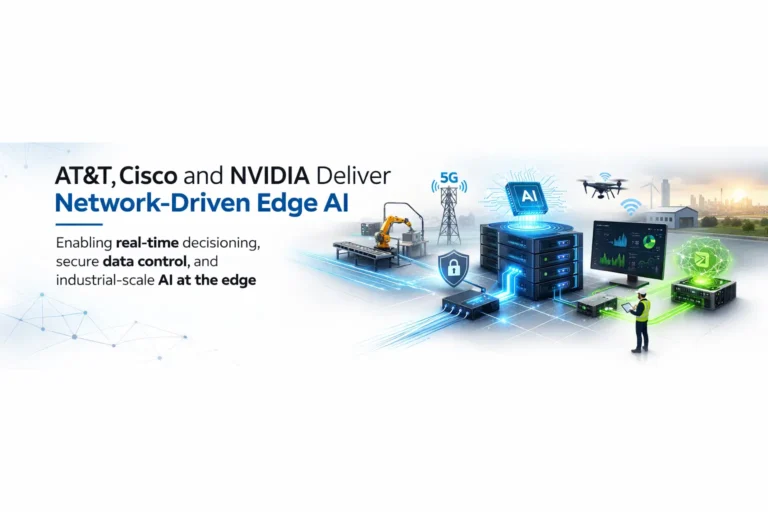
The next wave of digital transformation will be defined by AI workloads riding on cloud and edge infrastructure over 5G networks, and that shift will change how networks are built, monetized, and secured. Generative and agentic AI move more compute into the network, creating persistent, uplink-heavy, low-latency flows rather than the mostly downlink, best-effort traffic of the smartphone era. Video from cameras, glasses, and sensors feeds models at the edge and in the cloud; results return in milliseconds to people and machines. That means tighter latency budgets, deterministic jitter control, and stronger guarantees for both throughput and reliability.
Verizon exits 2025 with standout subscriber growth and a leaner 2026 investment plan that shifts dollars from network build to integration, efficiency and customer retention. Verizon posted more than 1 million net additions in the fourth quarter, including 616,000 postpaid phone net adds—the best showing since 2019—and 372,000 broadband net adds driven by 319,000 fixed wireless access (FWA) additions and the strongest Fios Internet quarter since 2020. After years of 5G coverage build, Verizon is pivoting to densification, fiber integration and operating efficiency, allowing capex to step down without undermining network competitiveness. Capital will concentrate on fiber-led convergence, FWA capacity, and experience-centric technologies that reduce churn and support revenue quality.
TeraWave combines 5,280 low Earth orbit satellites with 128 medium Earth orbit satellites—5,408 spacecraft in total—tied together via optical inter-satellite links. The design targets global coverage with two distinct performance tiers: up to 144 Gbps symmetrical RF links per enterprise customer using Q/V-band in LEO, and optical links in MEO delivering up to 6 Tbps for high-throughput trunking between hubs. Blue Origin positions the service for point-to-point private links and enterprise-grade internet access, with an initial target of up to 100,000 customers. The company intends to launch on its own New Glenn vehicles and leverage reusable engines to scale deployment.
BlueBird 7 is slated to lift off in late February from Launch Complex 36 at Cape Canaveral Space Force Station on the New Glenn-3 mission. It is AST SpaceMobile’s first payload on New Glenn and the second satellite in its next-generation “Block 2” campaign, following BlueBird 6. BlueBird 7 mirrors BlueBird 6 and carries a deployable array of about 2,400 square feet—the company positions it as the largest commercial communications aperture in low Earth orbit. The design, backed by thousands of patent and patent-pending claims, is engineered to deliver peak downlink rates up to 120 Mbps directly to standard, unmodified devices for voice, data, and video.
A European 6G-XR consortium led by Capgemini, Ericsson, i2CAT and Vicomtech demonstrated holographic calling and edge-anchored XR services on live standalone 5G, signaling how networks will evolve to support immersive collaboration at 6G scale. The team executed end-to-end trials of real-time holographic communication and distributed XR experiences spanning edge nodes across Barcelona and Madrid. To keep spatial media stable under cell load, the partners implemented proactive congestion detection and an on-demand quality mechanism that prioritizes holographic traffic. Notably, the consortium has referenced IMS Data Channel as a vehicle to anchor real-time holographic streams within operator service frameworks.
LG Electronics has won a CES 2026 Best of Innovation Award for its AI-powered in-vehicle experience, redefining how drivers and passengers interact with mobility through Affectionate Intelligence. The solution combines immersive displays, in-cabin sensing, and on-device AI to transform the vehicle cabin into a more intuitive, human-centered space.
Rogers Communications has moved from beta to a commercial footprint for satellite-to-mobile in Canada, extending basic connectivity and select apps to consumer smartphones while adding an industrial IoT tier for remote operations. The new Rogers Satellite service enables a curated set of popular apps to work beyond terrestrial coverage, including WhatsApp calling, Google Maps, AccuWeather, X, and CalTopo on most modern smartphones. In parallel, Rogers introduced satellite-to-mobile for IoT businesses, targeting asset tracking along highways and rail, as well as sensor telemetry in forestry, mining, and other resource sectors where terrestrial cellular is sparse.
The latest 3GPP cycle consolidates 5G-Advanced (Release 18), sets the agenda for Release 19, and frames early 6G studies, with direct implications for operator investment, enterprise use cases, and vendor roadmaps. Release 18, the first phase of 5G-Advanced, is moving from standards completion into implementation, bringing carrier-grade enhancements in spectral efficiency, energy savings, and mobility performance. Release 19 now builds on these foundations, prioritizing further RAN efficiency, XR and video delivery at scale, richer analytics/exposure in the core (NWDAF, NEF/CAPIF), and enterprise-grade reliability across private and public networks.
Reliance Jio’s path to a mid-2026 IPO is increasingly intertwined with the timing and magnitude of India’s next mobile tariff hike. Domestic brokers argue Jio has a tactical reason to push back on near-term tariff increases: hikes tend to accelerate Bharti Airtel’s revenue market share (RMS) gains more than Jio’s, narrowing the lead at the worst possible time for an IPO. Airtel has been the key beneficiary of previous price actions, chipping away at Jio’s RMS advantage by almost two percentage points since mid-2024. On current assumptions, Jio is informally pegged around $153 billion, implying an EV/EBITDA multiple near the low teens.

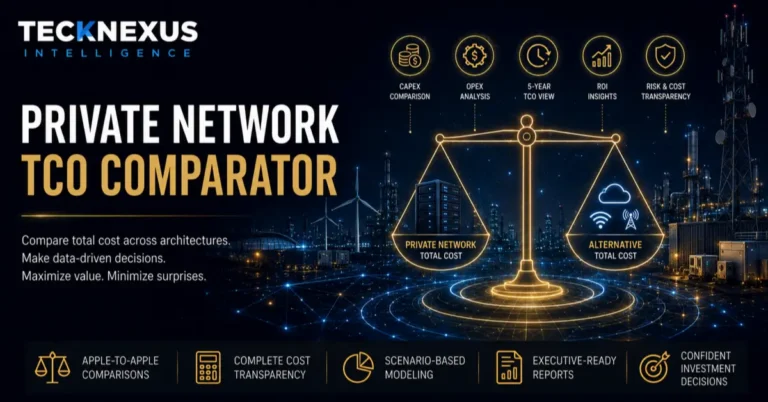
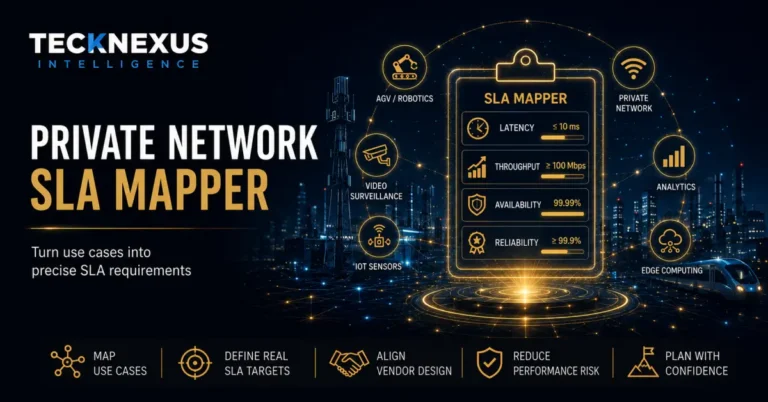
Your Brand. Our Intelligence Tools.

Capture leads at the point of evaluation. Talk to Us →

Sponsored by Palo Alto Networks
⚡ Utilities ⏱ 8 min ✓ Free
This tool is built and hosted by TeckNexus.
Launch Tool →
Whitepaper
This whitepaper explains how utilities can use secure AI-enabled private mobile networks to modernize operations, support distributed intelligence, improve resilience, and strengthen cybersecurity across critical infrastructure. It covers AI applications, private network advantages, zero trust principles, multilayered security architecture, and governance considerations for AI-ready utility environments....
Whitepaper
Non-terrestrial networks are rapidly evolving from experimental satellite systems into an increasingly important part of the global 5G connectivity landscape. This eBook, developed by Radisys in collaboration with TeckNexus, explores how 3GPP standardization, satellite architecture innovation, and software-driven network design are reshaping NTN deployment models. It examines the transition from...
Whitepaper
Private cellular networks are transforming industrial operations, but securing private 5G, LTE, and CBRS infrastructure requires more than legacy IT/OT tools. This whitepaper by TeckNexus and sponsored by OneLayer outlines a 4-pillar framework to protect critical systems, offering clear guidance for evaluating security vendors, deploying zero trust, and integrating IT,...
Scroll to Top