Private Network Site Survey Readiness Checklist for Utilities and Energy
Confirm your utility site is ready before commissioning an RF survey — including OT/IT segmentation, critical infrastructure compliance, EMI environment, and hazardous zones.
You'll need: site access knowledge and an OT contact. Produces: a readiness score, utilities-specific survey checklist, required-documents list, and field validation sequence.
Map your private mobile network security gaps to real threat scenarios - Salt Typhoon, Volt Typhoon, AI data poisoning, rogue devices, unencrypted OT — with a prioritised action plan.
You'll need: your security posture picture and OT environment basics. Produces: a tiered score and prioritised action plan.
25+ decision cards covering smart grid modernization, field communications, outage response, grid automation, DER integration, and utility operations strategies backed by real evidence from global private network deployments.
Select oil and gas use cases and input operational parameters to estimate the financial and productivity impact of deploying a private 5G network across field and refinery operations.
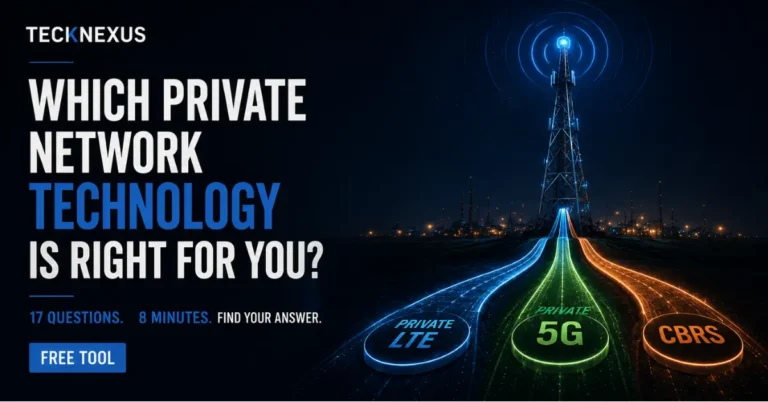
Get a consultant-grade technology recommendation from 17 questions across region, vertical, devices, spectrum, and commercial model — including what was ruled out and why.
You'll need: your site profile, device mix, and commercial preferences. Produces: a recommendation with rationale and vendor guidance, plus a PDF report.
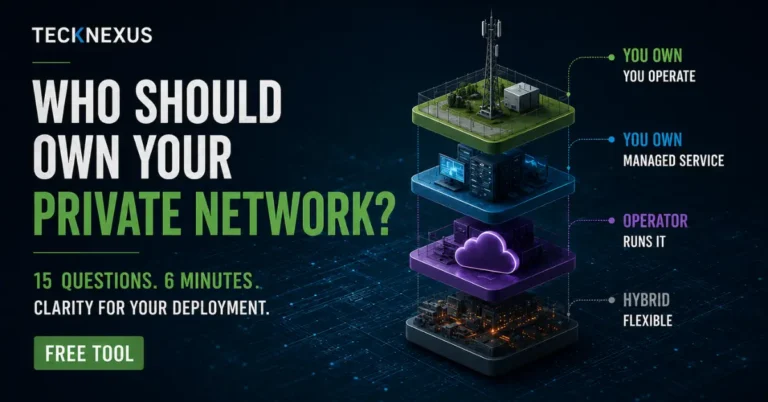
Determine the right deployment architecture — SNPN, enterprise RAN, managed breakout, or hybrid — from 15 questions.
You'll need: your operating-model preferences and data constraints. Produces: an architecture recommendation with responsibility matrix and vendor engagement sequence, plus a PDF report.
Build a structured, weighted vendor evaluation framework before you issue the tender - calibrated to your vertical, use cases, architecture, and procurement priorities.
You'll need: your vertical, use cases, architecture direction, and compliance requirements. Produces: a weighted scorecard, vendor question bank, red flags, proof points, and evaluation process guide.
Independent 5-year TCO comparison across Wi-Fi, CBRS, private LTE, and private 5G - hardware, installation, spectrum, management, and operating costs, calibrated by region and site type.
You'll need: your site count, region, and deployment environment. Produces: a side-by-side 5-year TCO comparison.
AI Data Center Interconnect (DCI) Bandwidth Planner
See what scale-up and scale-out bandwidth an AI deployment actually demands — before the RFP is written, based on published accelerator interconnect generations.
You'll need: your AI deployment scale assumptions. Produces: a DCI demand model by traffic pattern.
Benchmark your network security posture across threat awareness, architecture, detection and response, AI and automation, and governance - including signalling and inter-roaming threats.
You'll need: a picture of your current security operations. Produces: a 5-dimension maturity benchmark.
Benchmark your SIM provisioning, device lifecycle management, and operational readiness — and see exactly where automation would save the most time and cost.
You'll need: a picture of your current provisioning process. Produces: a maturity benchmark with an automation-savings view.
Compare total cost of ownership across private wireless connectivity options. Input operational parameters to model TCO over a multi-year period and identify the lowest-cost architecture for your environment.
Side-by-side comparison tool for private wireless technology options - LTE, 5G, Wi-Fi, and CBRS - across key performance, cost, and operational dimensions to support technology selection decisions.
Deployment-backed analysis of CBRS total cost of ownership across multiple industries. Provides real-world ROI benchmarks from live CBRS deployments — useful for validating business cases and comparing against vendor estimates.
Quick-estimate tool for private 5G deployment costs. Input site size, device count, and coverage requirements to get an indicative infrastructure cost range - useful for early-stage budget planning.
Estimate the sustainability impact of deploying private wireless — including energy efficiency gains, carbon reduction, and ESG reporting metrics - across industrial and enterprise environments.
Model the total cost of ownership of deploying Celona's 5G LAN solution versus existing Wi-Fi or wired infrastructure. Useful for enterprise and industrial sites evaluating CBRS-based private 5G.
Search US licensed spectrum availability by frequency, geography, and licensee. Essential for US-based private network spectrum planning and CBRS/PAL availability checks.
Compare on-premises infrastructure costs against AWS cloud deployment. Useful for modelling edge AI and private network core cloud migration scenarios.
Model infrastructure costs for on-premises vs Azure cloud. Relevant for enterprises evaluating hybrid private network and AI workload deployments on Azure edge.
Use structured tools built from real deployment evidence to select technologies, prioritise use cases, and build the business case — without weeks of research or expensive consulting.
📡For Vendors
Get found by the right buyers
Reach enterprise decision-makers at the moment they are evaluating. List your tools, co-develop assessments, or sponsor intelligence that positions you alongside credible, vendor-neutral content.
🔭For Telcos & Implementers
Stay ahead of buyer priorities
Understand what enterprise buyers are evaluating, where deployment decisions are heading, and how your deployment approaches align with what the market actually needs.
TeckNexus · Get Involved
Add Your Tool. Shape the Platform.
Whether you want to list a tool in our directory, co-develop an assessment, or discuss a sponsorship arrangement — fill in the form below to get started.
Deciding how to structure your private network deployment is as important as picking the technology. TeckNexus's free Architecture Selector asks 15 questions and tells you who should own what, where your data sits, and how to engage vendors — vendor-neutral and free.
AI is reshaping utility operations, but many deployments still depend on public or legacy networks not designed for mission-critical OT, uplink-heavy telemetry, or cyber-resilient grid automation. This article explains why private mobile networks are becoming essential for secure AI-enabled utilities, reducing exposure to threats like Salt Typhoon and Volt Typhoon while supporting reliable, low-latency grid operations.
AI is moving from the data center to the substation — and the attack surface is expanding with it. Anterix, GE Vernova, and Palo Alto Networks lay out why private mobile networks are the only communications foundation that keeps pace with both the opportunity and the threat.
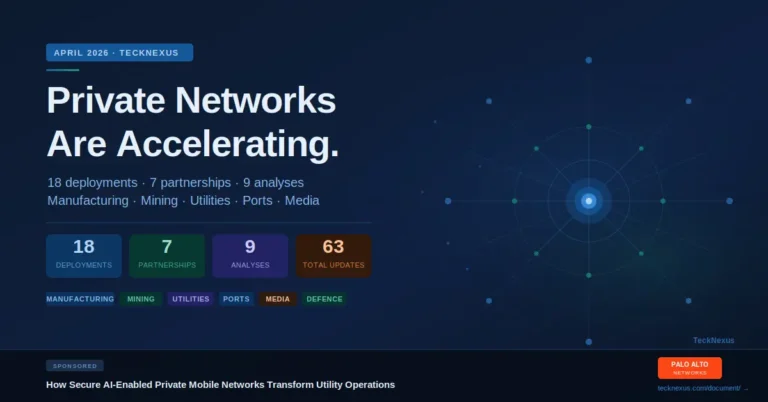
April 2026 was one of the most active months on record for private 5G and LTE. Across factory floors, mine sites, stadiums, utility grids, and remote film locations, the private network ecosystem moved on every front simultaneously. This month's update covers 18 deployment updates, 7 partnerships, 9 industry analyses, 14 feature updates, 4 spectrum and policy developments, and 3 award updates.
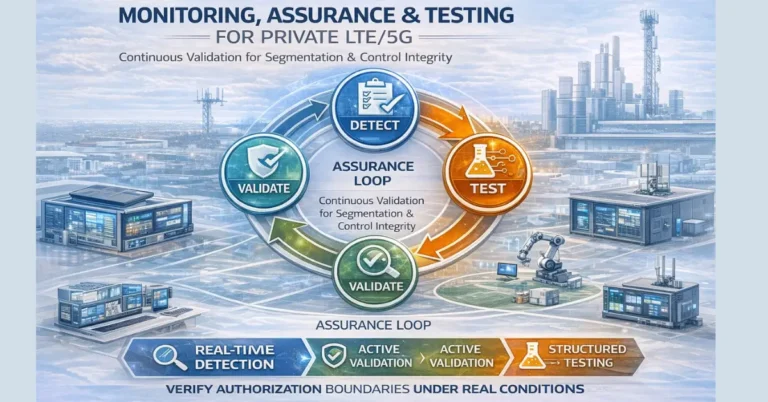
Private LTE and 5G security does not fail because of flawed architecture—it fails when enforcement controls degrade silently. This guide explains how enterprises implement continuous monitoring, assurance, and testing loops across control-plane signaling, user-plane routing, identity governance, and industrial OT environments. Learn how to validate segmentation integrity, detect policy drift, test Zero Trust enforcement, and produce audit-ready evidence across multi-site private cellular deployments.
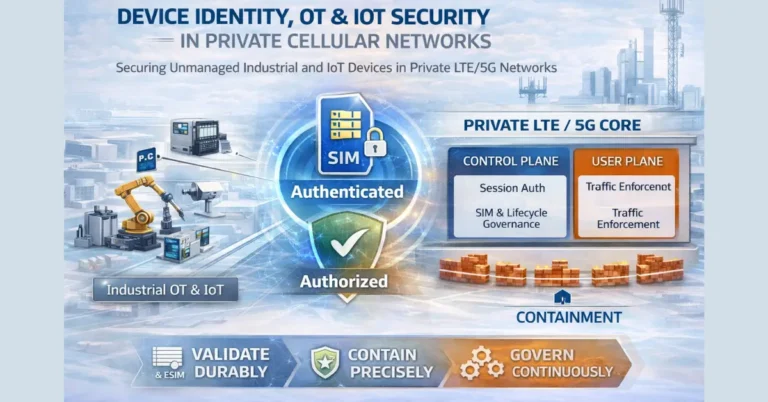
Private LTE and 5G networks strengthen authentication at the transport layer—but device identity, lifecycle governance, and OT/IoT realities determine whether containment holds. This in-depth guide explains SIM and eSIM authentication models, service-profile authorization, identity drift risks, industrial gateway mediation, and Zero Trust containment strategies across multi-site private cellular deployments.
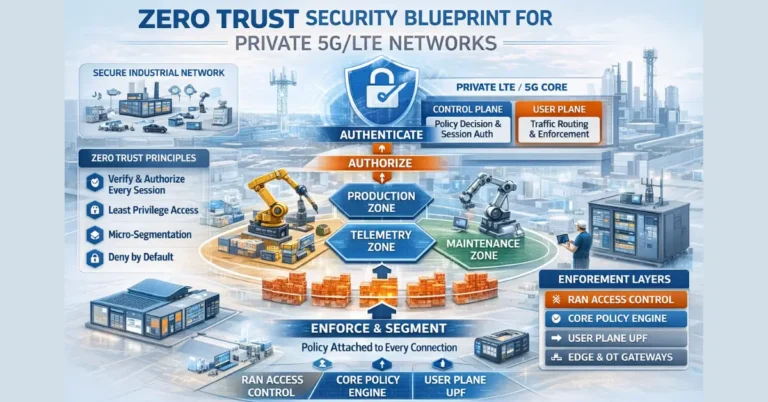
This Zero Trust security blueprint for Private LTE and 5G networks explains how session-based authorization, control-plane policy decisions, and user-plane enforcement create deterministic micro-segmentation across industrial and OT environments. Mapping private cellular architecture to NIST SP 800-207, the article details how operational zones, service profiles, and containment principles protect production-critical systems under mobility and scale.
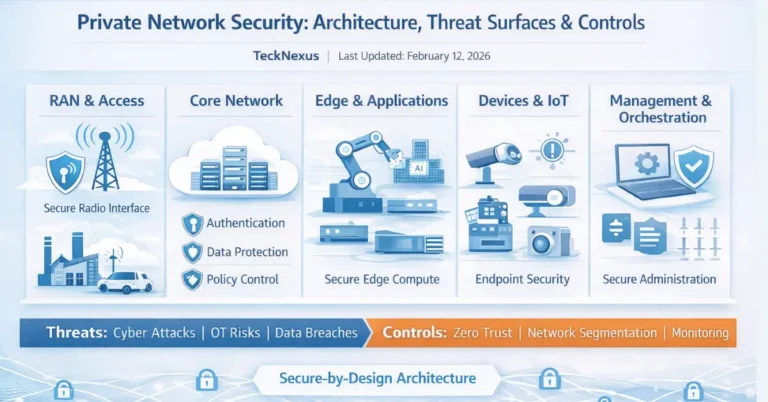
Private LTE and 5G networks introduce new security challenges as they become the foundation for industrial automation, critical infrastructure, and enterprise campuses. Unlike Wi-Fi and traditional IT networks, private cellular environments blend telecom infrastructure, IT systems, and operational technology, creating distinct threat surfaces across the RAN, core, edge, devices, and management planes. This article establishes a security-first architectural lens for private LTE/5G, explaining who needs it, where risks emerge, and what secure-by-design looks like before moving into Zero Trust and implementation frameworks.
This edition of TeckNexus Private Network: Innovation & Ecosystem Solutions spotlights the platforms, partnerships, and deployment models accelerating private 5G, LTE, and CBRS at scale. Through feature stories, executive interviews, and award-winning case studies, it reveals how collaboration is turning private networks into secure, production-ready ecosystems.
Frequently Asked Questions
About our tools, how they are built, and how to get involved.
TeckNexus Independent Tools
TeckNexus independent tools are assessments, selectors, ROI calculators, and AI prioritisation tools developed entirely by TeckNexus. The methodology, scoring logic, and outputs are owned by TeckNexus — no vendor funds, influences, or has visibility into individual results. They are free to complete. Accessing the full output and PDF report requires registration.
No. TeckNexus owns the methodology, scoring, and output logic for all independent tools. No vendor has paid to influence recommendations or results. If a vendor is referenced in an output — for example, as a category of solution — it is because the evidence supports it, not because of a commercial relationship.
Registration allows TeckNexus to generate and deliver a personalised PDF report, track your results if you return, and — with your permission — notify you of updated benchmarks or relevant intelligence. Registration is free. Your data is not shared with any vendor without your explicit consent.
Individual submission data is held by TeckNexus and not shared with any third party without your explicit consent. Aggregated and anonymised data may be used to produce industry benchmark reports. No personally identifiable information is included in any published output.
All tools labelled TeckNexus in the directory — including the Private Network Technology Selector, Private Network Architecture Selector, AI Use Case Prioritisers (Manufacturing, Mining, Ports, Airports, Utilities), and the Private Network ROI Calculators (Manufacturing, Mining). More tools are added regularly.
Co-Developed & Sponsored Tools
Co-developed tools are built by TeckNexus in partnership with an industry sponsor. The sponsor co-funds development and is clearly disclosed on the tool. TeckNexus owns the methodology, platform, and output logic — the sponsor does not influence scoring or results. These tools are free for users to complete.
Your contact details may be shared with the named sponsor — but only with your explicit consent at the point of form submission. Your results and individual response data are not shared. The consent step is clearly presented before submission.
No. Sponsorship funds the development and hosting of the tool — it does not influence the methodology, scoring, or outputs. TeckNexus retains full editorial control. Sponsored tools go through the same methodology review as independent tools.
Yes. TeckNexus works with vendors, operators, and industry bodies to co-develop tools that serve enterprise decision-makers. Use the partner enquiry form on this page to tell us what you have in mind — tool category, target vertical, and what you are trying to achieve. We will get back to you to discuss fit and next steps.
Third-Party Tools (Curated Directory)
Third-party tools are ROI calculators, TCO models, decision aids, and planning resources produced by vendors, operators, or industry bodies. They are included in the TeckNexus directory because they offer genuine utility to enterprise decision-makers — but they are clearly labelled as vendor-produced. TeckNexus curates the directory and does not endorse any individual tool or vendor.
Tools are assessed for relevance, utility, and credibility. We look for tools that offer meaningful input fields and substantive outputs — not marketing calculators with fixed results. Listing is not paid placement. Any vendor can submit a tool for consideration using the form on this page.
Standard directory listings are unpaid. TeckNexus does not accept payment to influence which third-party tools are listed or how they are described. Separate commercial arrangements exist for co-developed and sponsored tools, which are clearly labelled as such.
Use the tool submission form at the bottom of this page. You will need to provide tool details, vendor information, and confirm that you are authorised to submit on behalf of the organisation. TeckNexus reviews all submissions before listing.
Vertical Intelligence Platforms (Paid)
Each Vertical Intelligence Platform is a structured set of 25+ decision cards built from TeckNexus analysis of real enterprise private network deployments. They cover a specific industry — Manufacturing, Mining, Ports, Airports — and are organised into six sections: vertical overview, business priorities and use cases, private wireless strategy, proof and ecosystem, decision framework, and deployment readiness. They are updated continuously as new deployments emerge.
A subscription to one vertical gives you access to all 25+ decision cards for that industry, continuous updates as new deployments are analysed, and the ability to share access across your team. Each card is structured around a specific decision — use case selection, vendor shortlisting, deployment model, ROI prioritisation — so you can navigate directly to what you need.
A research report gives you a snapshot at a point in time. The Vertical Intelligence Platform is continuously updated and structured around decisions, not narrative. Instead of reading a 60-page PDF, you navigate directly to the card relevant to your current question — vendor selection, use case validation, deployment model — and get evidence-backed guidance without the research overhead.
No. Each vertical is subscribed to separately at $1,200 per year. This keeps pricing proportionate to what you actually need. If you require multiple verticals, contact us to discuss multi-vertical access.
Yes. Each vertical has a sample platform available — accessible from the tool cards on this page. The sample gives you a representative selection of decision cards so you can assess the depth and format before committing.
The platforms are built for enterprise technology and operations teams evaluating private network investment, vendors building go-to-market strategies for specific industries, and consultants or system integrators advising clients on deployment options. They are also used by telcos and managed service providers tracking enterprise buyer priorities by vertical.
Your Brand. Our Intelligence Tools.
Capture leads at the point of evaluation. Talk to Us →
40+ independent tools to size networks, prioritize AI use cases, and model ROI — grounded in deployment evidence, across manufacturing, mining, ports, airports & utilities.
We use cookies to ensure that we give you the best experience on our website. If you continue to use this site we will assume that you are happy with it.OkPrivacy policy