AI Agent Competitive
Intelligence
Intelligence Journeys
AI Use Cases for Utilities
Private Broadband for Utilities

Automation

Network automation replaces manual configuration and operations with software-driven processes, ranging from scripted tasks to fully autonomous, self-optimizing networks. Driven by the complexity of 5G standalone, cloud-native architectures, and multi-vendor environments, operators are pursuing higher autonomy — often framed against the TM Forum’s autonomous networks levels — to cut costs, speed service delivery, and improve reliability. Automation increasingly relies on AI and closed-loop systems that sense, decide, and act with diminishing human intervention. For operators and enterprises, the practical path runs through incremental autonomy: automating well-defined tasks before attempting end-to-end self-operation. This channel covers network automation across RAN, core, and operations — including orchestration, closed-loop control, and the AI techniques behind autonomous networks — with analysis of where automation is delivering measurable results and how operators are progressing toward higher levels of autonomy.

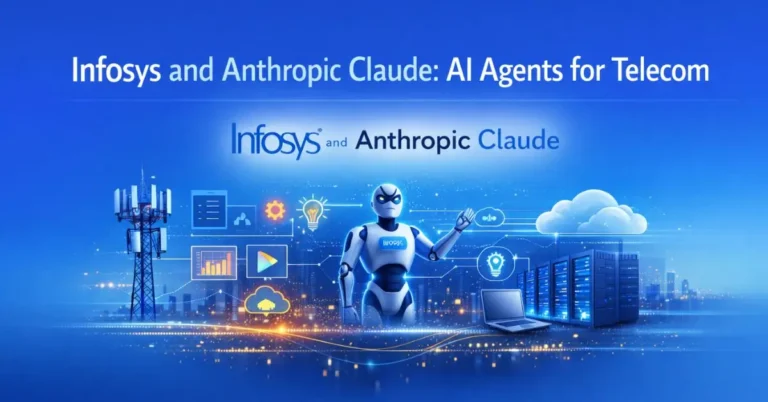
A new partnership between Infosys and Anthropic brings agentic AI into regulated, process-heavy industries, with telecom squarely in scope. Infosys will integrate Anthropic’s Claude models and Claude Code with its Topaz portfolio to build and operate enterprise-grade AI solutions across telecom, financial services, manufacturing, and software engineering. The collaboration emphasizes agentic AI—systems that can plan, call tools, and execute multi-step workflows with oversight—delivered with the controls, auditability, and policy enforcement that regulated sectors demand. Pairing Infosys’s domain depth with Claude’s reasoning and long-context capabilities gives operators a path to pragmatic automation that respects regulatory, safety, and transparency requirements.
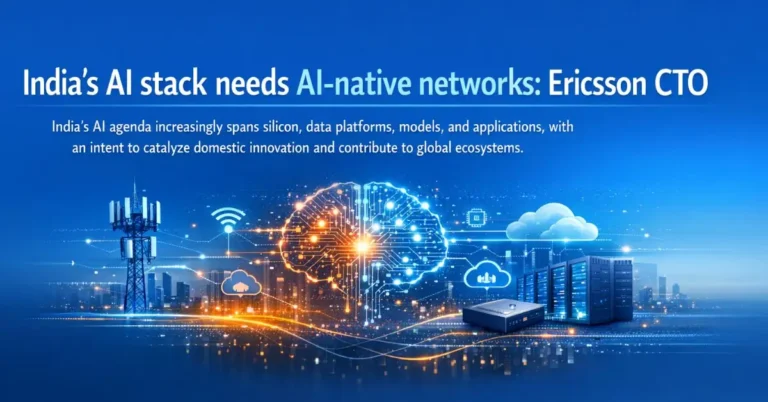
India’s AI agenda increasingly spans silicon, data platforms, models, and applications, with an intent to catalyze domestic innovation and contribute to global ecosystems. For telecom leaders, the message is clear: AI is not a bolt-on capability but a system-level transformation that touches RAN, core, transport, cloud, and the enterprise edge. The AI economy runs on connectivity—low-latency access to data, assured bandwidth, location-aware processing, and programmable control. The operators that can fuse connectivity, compute, and data into a cohesive platform will set the pace for India’s next wave of digital growth.
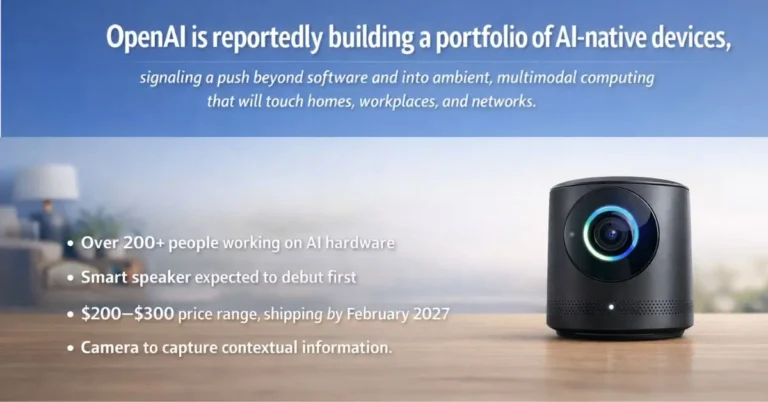
OpenAI is reportedly building a portfolio of AI-native devices, signaling a push beyond software and into ambient, multimodal computing that will touch homes, workplaces, and networks. Multiple reports indicate OpenAI has over 200 people developing a family of AI-enabled hardware, with a smart speaker expected to debut first. Early guidance points to a price in the $200–$300 range and a ship window no earlier than February 2027. The device is said to include a camera to capture contextual information about users and surroundings—an explicit bet on multimodal AI that fuses voice, vision, and environment for richer interactions.
Ericsson and Mistral AI are aligning telecom-grade engineering with customizable foundation models to push AI deeper into network operations and RAN automation. The pairing marries Mistral AI’s fast-evolving model stack with Ericsson’s domain expertise across radio, cloud-native networking, and service management. For European operators, it signals a path to AI capabilities that respect data residency, security, and compliance expectations under the EU AI Act without ceding control to generic, hyperscaler-led platforms. The outcome operators want is simple: measurable gains in performance, efficiency, and resiliency with governance baked in.
Ericsson has introduced an agentic rApp delivered as a cloud service on Amazon Web Services (AWS), aiming to speed operators’ shift from manual automation toward truly autonomous networks. By offering an “Agentic rApp as a Service” on AWS, Ericsson is packaging policy-driven and AI-assisted RAN optimization as a managed, cloud-delivered capability. Agentic capabilities bring reasoning, planning, and action-taking to operations. Running rApps on AWS offers elasticity, global reach, and faster release cadence. The goal: faster onboarding, lower integration friction, and a more repeatable path to closed-loop assurance across multi-vendor 4G/5G networks.
A new cross-industry consortium is forming to codify how trusted technology should be built, operated, and governed across borders. On February 13, 2026, fifteen companies spanning cloud, networks, semiconductors, software, and AI launched the Trusted Tech Alliance during the Munich Security Conference. The goal: define verifiable, provider-agnostic practices for a trustworthy technology stack—from connectivity and cloud infrastructure to chips, software, and AI—so customers and governments can rely on secure, resilient services regardless of where solutions are developed or deployed. Trust, sovereignty, and resilience are now gating factors for growth as AI scales and geopolitical risk reshapes supply chains.
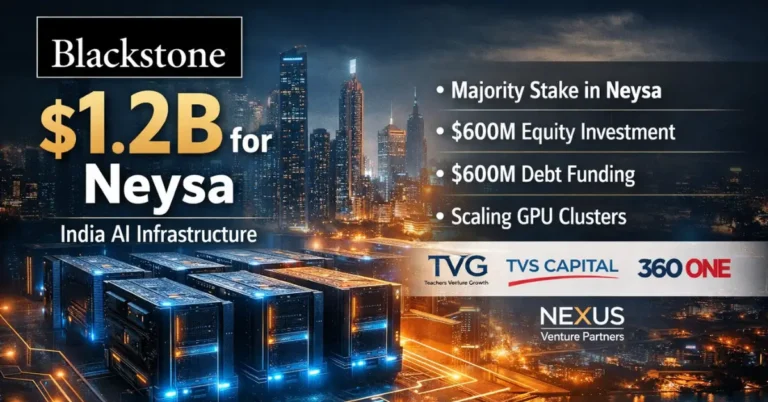
Blackstone will take a majority stake in Neysa through up to $600 million in primary equity, alongside Teachers’ Venture Growth, TVS Capital, 360 ONE Asset, and Nexus Venture Partners; the company also plans up to $600 million in debt to accelerate buildout. The raise is a step change from Neysa’s earlier $50 million and positions the Mumbai-headquartered startup to scale domestic GPU clusters for enterprises, public sector agencies, and AI developers.
The plan centers on Visakhapatnam, a port city on India’s east coast, as a tightly coupled zone for data centers, subsea cable landings, power, water, and the digital supply chain. State leadership wants the cluster to be more than rack space. It aims to bring in server assemblers, power and cooling vendors, and specialized logistics to create end-to-end capability. The city is also being pitched as a landing point for new subsea systems toward Singapore, which would diversify India’s international connectivity beyond Chennai and Mumbai and lower latency into Southeast Asia.
Anthropic’s latest financing round resets the competitive map for enterprise AI and raises the stakes for telecom, cloud, and large-scale IT buyers planning agentic automation. Anthropic closed a $30 billion Series G at a $380 billion post-money valuation, led by GIC and Coatue with participation from D. E. Shaw Ventures, Dragoneer, Founders Fund, ICONIQ, and MGX, alongside a broad cohort that includes Accel, General Catalyst, Jane Street, and the Qatar Investment Authority. The raise follows sustained commercial momentum and arrives as competitive intensity with OpenAI deepens, signaling that AI platform consolidation and scale economics will define the next phase of the market.
SoftBank Corp. delivered its strongest nine-month performance on record and lifted full-year guidance, underscoring a strategic shift from connectivity-only services to network-enabled platforms in AI, cloud, and edge. Through the first nine months of fiscal 2025 (April–December 2025), SoftBank reported revenue of ¥5.2 trillion, up 8% year over year, and operating income of ¥884 billion, also up 8%, with net income attributable to owners rising 11% to ¥485.5 billion. Management raised full-year targets to ¥6.95 trillion in revenue, ¥1.02 trillion in operating profit, and ¥543 billion in net income, signaling confidence heading into the March 31, 2026 year end.
LG Uplus is moving from rule-based automation to closed-loop autonomy, using AI agents and digital twins to accelerate toward a fully autonomous network by 2028. Its core platform, the AI Orchestration Nexus (AION), is already automating repetitive operations and has contributed to a reported 70% reduction in customer complaints about network quality—an early signal that the approach is translating into measurable outcomes. The company plans to showcase these capabilities at MWC Barcelona 2026, underscoring growing operator interest in operational AI as 5G matures and traffic patterns become more volatile.
Virgin Media O2 has broadened its partnership with Zinkworks to deploy AI-driven monitoring and automation across its mobile footprint, designed to spot anomalies earlier, resolve incidents faster, and prevent customer-impacting outages. The rollout targets multiple network domains and operational workflows, advancing the operator’s move toward autonomous operations with engineers maintaining full oversight. The capabilities span radio access, core network systems, and network operations centers, combining real-time telemetry with intelligent automation. The stack runs on Google Cloud and taps services such as Vertex AI and Gemini to analyze patterns, orchestrate responses, and augment decision-making for operations teams.

Frequently Asked Questions

What’s the difference between automation and AI in a telecom context?
Automation, in its traditional form, generally follows pre-defined rules and scripted logic: a specific condition triggers a specific, predetermined response, with no real interpretation or judgment involved beyond what was explicitly programmed in advance. AI adds the capacity to learn from data, recognize patterns that weren’t explicitly anticipated, and make more nuanced decisions about what action makes sense in a given situation, even one the system hasn’t seen in exactly that form before. In practice, most modern telecom systems combine the two: AI analyzes a situation and decides what should happen, while automation infrastructure actually executes that decision reliably and consistently across the network, a combination often described as the foundation for agentic AI.
What is ‘zero-touch’ network operation, and how close is the industry to achieving it?
Zero-touch network operation describes the long-term industry goal of running networks with minimal direct human intervention, where the network itself handles configuration, fault recovery, and optimization automatically and continuously. It’s a meaningful aspiration rather than a fully achieved reality; the industry is progressing toward it in stages, with specific functions, like automated fault detection or dynamic capacity adjustment, achieving meaningful levels of automation well before the broader vision of an entirely self-managing network becomes reality. Standards bodies including ETSI have working groups specifically dedicated to defining the requirements for zero-touch network and service management, reflecting that this remains an active area of ongoing standardization rather than settled, widely deployed technology.
Why is automation considered essential for managing modern 5G networks specifically?
5G networks are substantially more complex than earlier generations for several compounding reasons: they rely heavily on virtualized network functions running across cloud infrastructure rather than fixed dedicated hardware, they support network slicing, meaning managing multiple distinct virtual networks with different performance guarantees simultaneously, and they often combine equipment and software from multiple different vendors rather than one integrated supplier. Traffic patterns also shift constantly and unpredictably as device density and application types continue to grow. Attempting to manually manage this level of complexity at the scale of a national or global network simply isn’t realistic, making automation effectively a practical requirement for operating a modern 5G network reliably at all.
How does automation relate to network orchestration?
Automation and orchestration are closely related but distinct concepts. Automation generally refers to executing a specific task without manual intervention, like automatically restarting a failed process or adjusting a configuration parameter. Orchestration refers to the broader coordination of multiple automated tasks and virtualized network components across their full lifecycle, deciding where different network functions should run, how they should scale, and how they interact with each other to deliver a complete service. In practice, orchestration systems often rely on underlying automation capabilities to actually carry out the individual tasks they coordinate, providing higher-level coordination while automation provides the lower-level mechanism for reliably executing decisions.
What are the risks of relying heavily on automated network systems?
Heavy reliance on automated systems introduces specific risks alongside its clear efficiency benefits. If an automated system makes an incorrect decision, that error can potentially propagate quickly and broadly across the network before a human notices and intervenes, compared to a manual process where mistakes tend to be more contained. There’s also a risk of reduced visibility and understanding among human staff over time, since heavily automated systems can create a gap between what the network is actually doing and what engineers fully understand about why, particularly as AI-driven decision-making becomes more involved. Operators generally manage these risks by maintaining careful guardrails for automated actions, expanding autonomous scope gradually as confidence grows.
How has automation changed the day-to-day role of network engineers?
Automation has shifted network engineers’ day-to-day work away from repetitive, manual configuration and troubleshooting tasks and toward higher-level responsibilities like designing automation policies, overseeing AI-driven systems, and handling more complex or novel problems that automated systems aren’t yet equipped to resolve independently. Rather than manually configuring each new service or personally diagnosing every fault, engineers increasingly spend time defining the rules, guardrails, and escalation criteria that govern how automated systems behave, then stepping in directly for situations that fall outside those parameters. This represents a meaningful skills shift, with growing demand for engineers comfortable working with automation platforms and AI systems alongside traditional networking expertise.
What’s ‘closed-loop automation,’ and why does it matter?
Closed-loop automation refers to systems that don’t just execute an automated action once, but continuously monitor the result of that action, compare it against the intended outcome, and adjust automatically if the result doesn’t match expectations, creating a self-correcting cycle without requiring a human to manually verify and re-trigger each step. A closed-loop system managing network capacity, for example, might automatically increase resources in response to rising traffic, then continuously monitor whether that adjustment actually resolved the congestion, and make further automatic adjustments if it didn’t. This concept is considered a meaningful step toward the zero-touch network vision, since it moves automation beyond simple one-off actions toward genuinely self-managing behavior based on real-world feedback.

Partner Hubs

Download content, access intelligence tools, and hear from executives.

Partner Events

  • Network X Vienna 2026
Scroll to Top