Network Slicing

Network slicing partitions a single physical network into multiple virtual networks, each tuned for specific performance, latency, or reliability requirements, all running on shared infrastructure. It depends on 5G standalone’s flexible, software-defined core, and is a key enabler of differentiated services — dedicated slices for enterprises, critical communications, or specific applications — and therefore a route to new operator revenue. In practice, slicing has advanced more slowly than early expectations, constrained by standalone deployment pace, operational complexity, and unproven demand. For operators, the question is which customers will pay for guaranteed, differentiated connectivity; for enterprises, whether a slice beats a private network. This channel tracks network slicing standards, deployments, and commercial models, with analysis of where slicing is delivering real services and where it remains a capability waiting for a market.

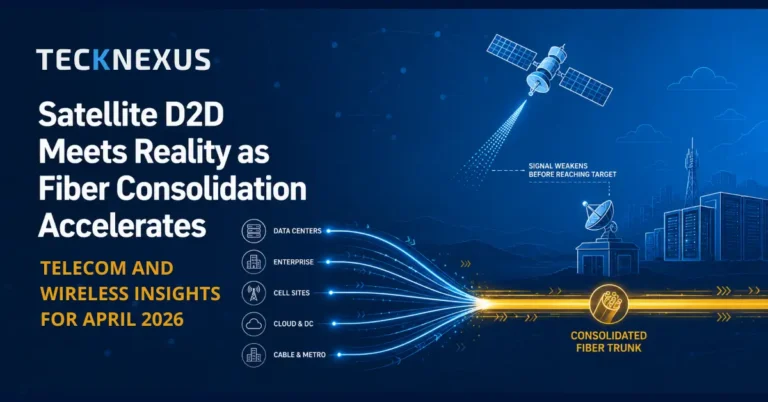
AT&T’s five-year, $250 billion U.S. network commitment sets the tone for the next phase of fiber, 5G, and satellite convergence as traffic, AI workloads, and resilience requirements climb sharply. The 2026–2030 window aligns with the industry’s transition into 5G-Advanced (3GPP Release 18/19), the scaling of edge AI, and increased cloud traffic between homes, enterprises, and hyperscalers. Data growth is no longer linear, and the cost of downtime is rising. Large, front-loaded builds in fiber and 5G Radio Access Network (RAN), paired with new satellite overlays, are how national carriers will chase coverage, performance, and reliability targets simultaneously.
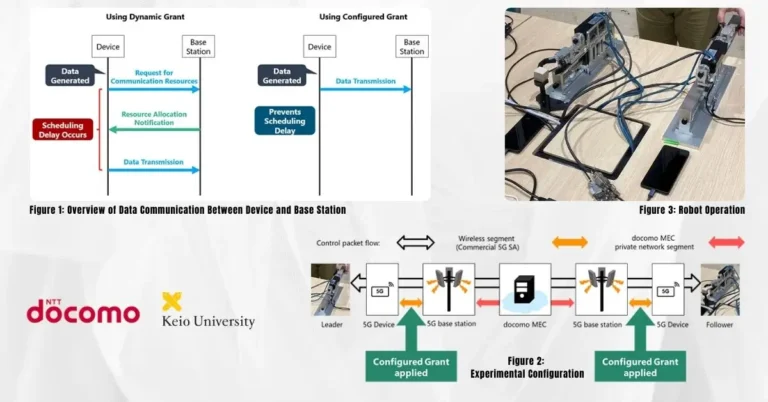
NTT DOCOMO and Keio University have validated that commercial 5G Standalone (SA) can stably support haptic-grade robot teleoperation using network slicing and configured grant—turning years of URLLC theory into practical results. By pairing 3GPP-configured grant scheduling with a low-latency slice and Keio’s Real Haptics technology, DOCOMO showed that public 5G SA can carry force and tactile feedback with the determinism required for safe, precise manipulation. The KPIs demonstrate material improvements in latency stability, force fidelity, and motion smoothness—indicators that the control loop is resilient enough for practical tasks.
A new collaboration between GSMA Foundry and Singapore’s National University Health System (NUHS) aims to operationalize connected health at scale, with Ericsson and Singtel anchoring the 5G foundation. Healthcare digitization has moved from pilots to production, but most sites still struggle with deterministic connectivity, secure data exchange and workflow integration. The program combines private 5G with digital twin, XR, IoT and ambient AI to improve outcomes and operational resilience across care pathways. Early focus areas include 5G-enabled remote surgical assistance with ultra-reliable, low-latency links; immersive XR training and simulation that compress learning curves; autonomous and semi-autonomous robotics for logistics and point-of-care tasks; and AI-guided imaging such as vein visualization.
Deutsche Telekom’s early live results showing up to 65% energy savings in its 5G core spotlight a pragmatic path to cut opex and carbon as traffic surges and standalone 5G scales. Operators have wrung out much of the easy efficiency from hardware refreshes; the next gains come from software-driven, demand-aware control. DT is applying that logic to the core, shifting components to run only when needed rather than idling at full power. The results are enabled by DT’s “Horizontal Telco Cloud,” a unified, standards-based platform that replaces fragmented stacks with one common layer for core services. Initial live-network tests have been completed, with broader rollout planned and further detail expected at MWC Barcelona 2026.
Nokia and Amazon Web Services (AWS) are bringing agentic AI to 5G-Advanced network slicing, moving closed‑loop, intent-based services from PowerPoint to live pilots with du and Orange. The partners unveiled an agentic AI-powered slicing solution that fuses Nokia’s RAN-to-core slicing, AirScale radio, and MantaRay SMO with AWS’s Bedrock AI platform and EKS Hybrid Nodes to turn external context—events, traffic, maps, weather—and live network KPIs into real-time policy decisions. The result is adaptive, premium slices provisioned when and where they’re needed, without manual reconfiguration.
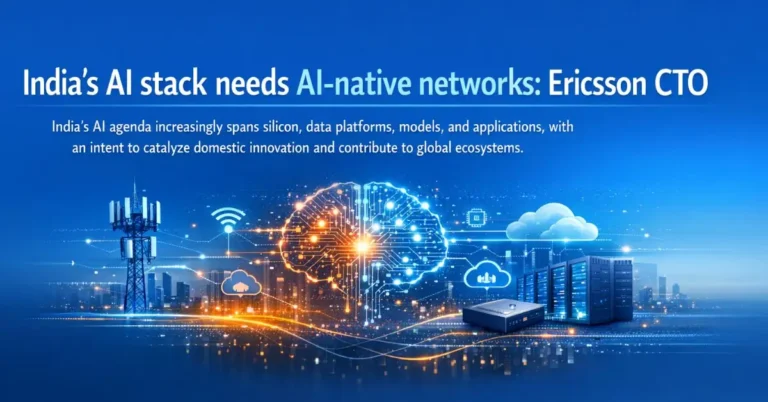
India’s AI agenda increasingly spans silicon, data platforms, models, and applications, with an intent to catalyze domestic innovation and contribute to global ecosystems. For telecom leaders, the message is clear: AI is not a bolt-on capability but a system-level transformation that touches RAN, core, transport, cloud, and the enterprise edge. The AI economy runs on connectivity—low-latency access to data, assured bandwidth, location-aware processing, and programmable control. The operators that can fuse connectivity, compute, and data into a cohesive platform will set the pace for India’s next wave of digital growth.
Boldyn Networks is rolling out a neutral host 5G upgrade at Silverstone that shifts the circuit from seasonal stopgaps to a year-round, high-capacity mobile platform for fans, teams, and broadcasters. The architecture spans 25 locations, with 57 sectors engineered across 87 DAS zones to handle concentrated traffic and maintain performance under crowd pressure. The design anticipates surges in uplink and signaling, supports concurrent sessions at scale, and smooths throughput across hotspots. A permanent, multi-operator 5G foundation unlocks new revenue, better service metrics, and more efficient event delivery. When connectivity works, dwell time, spend, and satisfaction rise.
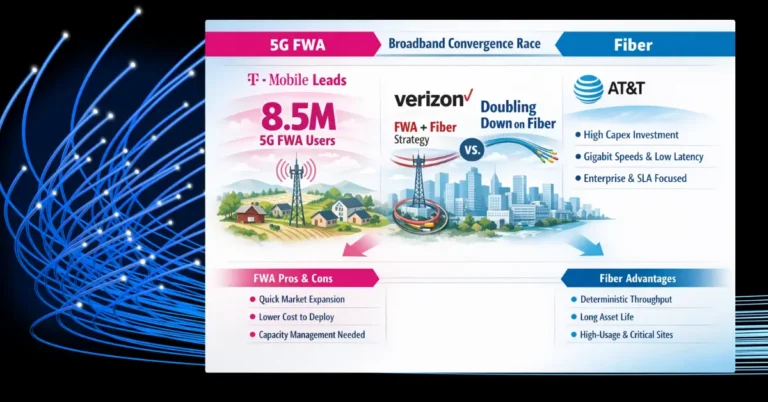
FWA is capex-light and fast to deploy, especially in mid-band-rich markets, which makes it ideal for quick share gains, addressable market expansion, and rural or underserved pockets. Its constraint is shared capacity: as mobile traffic grows, operators must manage prioritization, peak congestion, and plan mix to preserve experience. Fiber demands higher upfront capital but delivers deterministic throughput, low latency, and long asset life that underpins premium ARPU, enterprise SLAs, and wholesale opportunities. Expect operators to steer FWA toward segments with favorable traffic profiles and use fiber for high-usage clusters and enterprise-critical sites.
SoftBank Corp. delivered its strongest nine-month performance on record and lifted full-year guidance, underscoring a strategic shift from connectivity-only services to network-enabled platforms in AI, cloud, and edge. Through the first nine months of fiscal 2025 (April–December 2025), SoftBank reported revenue of ¥5.2 trillion, up 8% year over year, and operating income of ¥884 billion, also up 8%, with net income attributable to owners rising 11% to ¥485.5 billion. Management raised full-year targets to ¥6.95 trillion in revenue, ¥1.02 trillion in operating profit, and ¥543 billion in net income, signaling confidence heading into the March 31, 2026 year end.
LG Uplus is moving from rule-based automation to closed-loop autonomy, using AI agents and digital twins to accelerate toward a fully autonomous network by 2028. Its core platform, the AI Orchestration Nexus (AION), is already automating repetitive operations and has contributed to a reported 70% reduction in customer complaints about network quality—an early signal that the approach is translating into measurable outcomes. The company plans to showcase these capabilities at MWC Barcelona 2026, underscoring growing operator interest in operational AI as 5G matures and traffic patterns become more volatile.
Virgin Media O2 has broadened its partnership with Zinkworks to deploy AI-driven monitoring and automation across its mobile footprint, designed to spot anomalies earlier, resolve incidents faster, and prevent customer-impacting outages. The rollout targets multiple network domains and operational workflows, advancing the operator’s move toward autonomous operations with engineers maintaining full oversight. The capabilities span radio access, core network systems, and network operations centers, combining real-time telemetry with intelligent automation. The stack runs on Google Cloud and taps services such as Vertex AI and Gemini to analyze patterns, orchestrate responses, and augment decision-making for operations teams.
Colombia has cleared a milestone consolidation: Tigo has taken operational control of Movistar, creating a second national-scale incumbent to challenge Claro. The Superintendence of Industry and Commerce (SIC) approved the integration through Resolution 94169 of 2025, capping months of scrutiny and pushback from rivals and ISPs. The merger compresses Colombia’s competitive field at a time when 5G rollouts, fiber densification, and cloud-native cores demand scale. It creates a stronger counterweight to Claro, but also raises real concerns about a two-horse race and the downstream effects on MVNOs, ISPs, and enterprise buyers.

Frequently Asked Questions

What is network slicing in simple terms?
It’s the ability to carve a single physical 5G network into multiple virtual, independently configured slices, each with its own guaranteed performance characteristics for speed, latency, and reliability, so an operator can sell different service tiers off the same infrastructure rather than building separate networks for each use case. Each slice behaves, from the customer’s perspective, like a dedicated network tailored to their specific needs, even though it’s actually running on shared physical infrastructure alongside other slices serving completely different customers simultaneously. This is conceptually similar to how a single physical server can run multiple virtual machines that each behave like an independent computer, applied instead to network connectivity.
Is network slicing actually commercially available, or still experimental?
It has moved from pilot to early commercial deployment. Major carriers including T-Mobile, Verizon, Reliance Jio, and Singtel have launched commercial slicing-based offers for specific use cases, and telecom operators are described as the primary enablers of slicing technology, expected to hold roughly 62 percent of the market in 2026. That said, the industry consistently describes network slicing as being in the early stages of commercialization, meaning successful pilots are still being converted into broader, more scalable commercial offerings rather than slicing having become a fully mature, universally available product.
What’s a real-world example of network slicing in use?
Singtel partnered with Tencent Games to launch a dedicated low-latency network slice for cloud gaming in Singapore, described as the first nationwide gaming-specific network slice in the world, letting users play without downloading games or needing high-end hardware. Verizon Business launched a dedicated fixed wireless access slice for enterprise customers with guaranteed performance, extending slicing beyond mobile use cases into business broadband. Nokia and the UAE operator du were reportedly first in the industry to deploy autonomous network slicing, which automates the creation and management of slices rather than requiring extensive manual configuration.
Why does network slicing require 5G Standalone (SA)?
True dynamic, end-to-end network slicing depends on a 5G core built independently of 4G, known as 5G Standalone or SA architecture, since SA provides the flexibility and granular control needed to create, manage, and guarantee performance across multiple isolated virtual networks simultaneously. Non-standalone 5G, which still relies on a 4G core for certain control functions, can support some slicing-like capabilities but generally not with the same flexibility, automation, or end-to-end performance guarantees that SA enables. This is one of the main reasons operators have prioritized SA core upgrades specifically as a foundation for unlocking more advanced monetization opportunities like network slicing.
How big is the network slicing market expected to get?
Forecasts vary considerably depending on the specific market research firm, but most analyses put network slicing’s growth rate above 40 percent annually through the late 2020s, driven primarily by telecom operators monetizing differentiated connectivity for industries like healthcare, automotive, gaming, and manufacturing. Asia Pacific is generally described as leading global adoption given its large population base and diverse industrial use cases, while North America is often projected as the fastest-growing region given strong infrastructure investment. These projections should be treated with appropriate caution though, since the underlying market remains in an early commercialization phase.
Who actually manages and creates network slices in practice?
In practice, network slices are created and managed through orchestration software that translates a specific business requirement, such as guaranteed low latency for a particular customer’s application, into the actual technical configuration needed to deliver it across the relevant network infrastructure. This orchestration layer handles tasks like allocating the right combination of radio, transport, and core network resources to a given slice, monitoring whether it’s actually delivering its promised performance, and adjusting resource allocation dynamically as conditions change. More advanced, automated approaches, sometimes called autonomous network slicing, aim to handle much of this process automatically rather than requiring extensive manual configuration by network engineers each time.
What technical challenges have slowed broader network slicing adoption?
Several technical challenges have slowed broader adoption beyond the foundational requirement of upgrading to 5G Standalone infrastructure. Ensuring consistent performance guarantees across a slice that may span multiple different network domains, from radio access through transport and core, requires sophisticated end-to-end orchestration and assurance capabilities that have taken time to mature. Interoperability across different vendors’ equipment adds further complexity for operators running multi-vendor networks. There’s also a more fundamental business challenge: defining a manageable, scalable set of standard slice types that cover most customer needs, rather than requiring a fully custom-built slice for every individual customer, which would be operationally impractical at scale.
How is network slicing different from older approaches like VPNs or dedicated lines?
Older approaches like traditional VPNs or dedicated leased lines could provide a degree of network differentiation and security for specific customers, but they generally required separate, often physically distinct infrastructure or fixed, manually provisioned configurations that were slow and expensive to set up and change. Network slicing achieves a broadly similar goal, providing differentiated, somewhat isolated connectivity for a specific customer, but does so dynamically and through software, on top of shared underlying 5G infrastructure, without requiring separate physical infrastructure for each customer. This makes slicing considerably faster and cheaper to provision than traditional dedicated infrastructure approaches, while still providing meaningful performance guarantees and isolation.

Partner Hubs

Download content, access intelligence tools, and hear from executives.

Partner Events

  • M360 ASEAN
  • FutureNet Asia 2026
  • Network X Vienna 2026
Scroll to Top