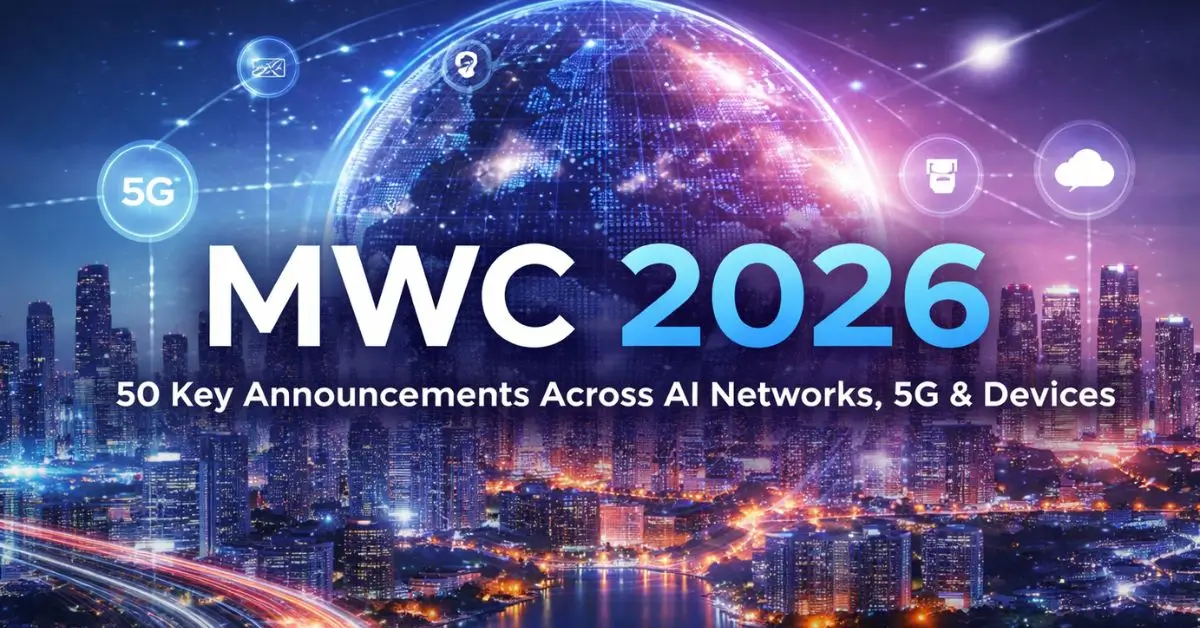
Mobile World Congress (MWC) 2026 returned to Barcelona from March 2–5, bringing together telecom operators, device manufacturers, infrastructure vendors, startups, developers, and policymakers to showcase the latest innovations shaping global connectivity. Hosted at Fira Gran Via, the annual event remains the world’s largest gathering focused on mobile networks, digital infrastructure, and emerging technologies across the telecom and technology ecosystem.

Across the opening days of MWC 2026, a clear shift emerged in how the industry is positioning the future of connectivity. Telecom operators and technology vendors highlighted the growing role of artificial intelligence in network operations, the continued expansion of 5G and private wireless deployments, and early research shaping the 6G roadmap. At the same time, device manufacturers used the exhibition floor to showcase new hardware concepts and product launches spanning foldable smartphones, modular device designs, AI-powered cameras, and next-generation computing platforms.

Keynotes and panel discussions throughout the event emphasized how telecom networks are evolving beyond traditional connectivity infrastructure to become intelligent digital platforms supporting AI, cloud computing, edge services, and autonomous systems. Industry leaders noted that operators must continue expanding advanced 5G deployments while simultaneously investing in technologies that will define the next decade of wireless innovation.
Alongside infrastructure developments, MWC 2026 also featured numerous product demonstrations and device announcements from companies such as Lenovo, Honor, Xiaomi, and other global technology vendors. Many of these innovations focused on new device form factors, deeper integration of artificial intelligence within hardware platforms, and improved connectivity across multi-device ecosystems.
This article compiles the most important announcements, demonstrations, and discussions emerging from Mobile World Congress 2026, covering developments in telecom infrastructure, AI-driven network technologies, enterprise connectivity, device innovation, and emerging technology trends across the first days of the event.
What Was Announced at MWC 2026
The early days of MWC 2026 delivered announcements and discussions across several major technology domains spanning telecom infrastructure, enterprise connectivity, consumer devices, and emerging digital platforms.
Key themes emerging from the event include:
- AI-native network architectures designed to automate telecom operations
- Expansion of enterprise private 5G deployments across industrial sectors
- Early discussions around 6G network architectures and spectrum strategy
- Experimental device designs including foldable computing devices and modular smartphones
- Growing interest in satellite-to-device connectivity and non-terrestrial networks (NTN)
- New AI-powered hardware integrating computer vision, robotics, and intelligent assistants
Across the exhibition floor and conference sessions, vendors emphasized that future connectivity infrastructure will increasingly combine high-performance networks, distributed edge computing, and AI platforms to support the next generation of digital services.
Key Announcements at MWC 2026
| Announcement | Company / Organization | Category |
|---|---|---|
| AI-native network strategies and automation platforms | Telecom operators & vendors | Telecom Infrastructure |
| “Architecting 6G for the AI Era” keynote | Qualcomm | Future Networks |
| Foldable gaming handheld concept | Lenovo | Devices |
| Robot Phone with AI tracking camera concept | Honor | Devices |
| Magic V series foldable smartphone | Honor | Devices |
| Modular magnetic smartphone concept | Tecno | Devices |
| Leica-powered smartphone imaging technology | Xiaomi | Devices |
| ThinkBook Modular AI PC concept | Lenovo | Computing |
| Satellite-to-device connectivity discussions | Multiple operators | Connectivity |
| Autonomous network operations platforms | Telecom vendors | Network Automation |
MWC 2026 Day 1 Highlights (March 2)
The opening day of Mobile World Congress 2026 set the tone for the event with a strong focus on AI-driven telecom infrastructure, device innovation, and emerging connectivity technologies. Keynotes and announcements emphasized how operators and vendors are preparing networks to support the next generation of AI applications, enterprise connectivity, and advanced mobile devices.
Below are the most notable developments from Day 1 of MWC 2026 in Barcelona.
1. GSMA Opens MWC 2026 with Focus on AI-Driven Networks and Global Connectivity
Mobile World Congress 2026 officially opened in Barcelona with a strong message from the GSMA: the telecom industry is entering a new phase where artificial intelligence, advanced connectivity, and digital trust will define the next decade of innovation. During the opening keynote, GSMA leadership emphasized that while global 5G deployments continue to expand rapidly, the industry must now focus on unlocking the full economic potential of these networks through new services, enterprise solutions, and AI-powered applications.
Speakers highlighted that mobile connectivity has become a foundational layer of the digital economy, supporting everything from cloud computing and digital commerce to industrial automation and connected infrastructure. As a result, telecom operators must continue investing in network capacity, resilience, and security while also adopting more intelligent network management tools.
Artificial intelligence was repeatedly emphasized as a critical enabler of the next phase of telecom evolution. Operators are increasingly integrating AI into network operations to automate tasks such as traffic optimization, predictive maintenance, and fault detection. These technologies are expected to reduce operational costs while improving network reliability and performance.
The GSMA also highlighted the importance of digital trust and cybersecurity, noting that as networks support more critical services—from financial transactions to healthcare systems—ensuring secure connectivity will become even more important. The organization called on industry stakeholders to collaborate on building a more resilient and trustworthy digital ecosystem.
Overall, the opening session set the tone for MWC 2026 by framing the event around a central theme: the transition toward AI-enabled telecom networks and intelligent connectivity platforms.
2. GSMA Launches “Open Telco AI” Initiative to Accelerate Industry Adoption
One of the most notable announcements during the opening day of MWC 2026 was the launch of the Open Telco AI initiative, a collaborative effort aimed at accelerating the development and deployment of artificial intelligence technologies tailored specifically for telecommunications networks.
Unlike general-purpose AI systems, telecom networks require highly specialized AI models capable of handling complex operational environments, massive data volumes, and strict reliability requirements. The Open Telco AI initiative aims to address these challenges by creating a shared framework that enables operators, vendors, and developers to collaborate on building telecom-focused AI solutions.
The initiative is expected to support several key use cases, including automated network optimization, predictive infrastructure maintenance, fraud detection, and customer experience management. By leveraging AI models trained on telecom-specific datasets, operators could improve service quality while reducing operational complexity.
Another objective of the program is to encourage greater interoperability across AI platforms used in telecom networks. Today, many operators rely on proprietary systems from different vendors, which can create integration challenges. The Open Telco AI framework aims to promote more open standards that enable AI solutions to work across diverse network environments.
Industry analysts believe initiatives like this will play a crucial role in enabling the telecom sector to adopt AI at scale. As mobile networks become more complex—with billions of connected devices and massive data traffic—AI-driven automation will be essential for managing infrastructure efficiently.
By launching the Open Telco AI initiative at MWC 2026, the GSMA signaled that AI will become a central pillar of future telecom architectures.
3. GSMA Foundry and ESA Announce €100M Funding for AI, NTN, and 6G Projects
Another major announcement during the first day of MWC 2026 was a partnership between the GSMA Foundry and the European Space Agency (ESA) aimed at accelerating innovation across next-generation connectivity technologies.
The initiative will provide access to funding opportunities worth up to €100 million, supporting research and development projects focused on artificial intelligence, non-terrestrial networks (NTN), direct-to-device communications, and early-stage 6G technologies. By combining expertise from both the telecom and space sectors, the program aims to foster collaboration between industry players working on advanced connectivity solutions.
Non-terrestrial networks are becoming an increasingly important component of global communications infrastructure. Satellite connectivity can extend network coverage to remote regions where terrestrial infrastructure is difficult or expensive to deploy. At the same time, emerging direct-to-device satellite technologies allow smartphones and IoT devices to connect directly to satellites, providing an additional layer of connectivity.
The funding program is expected to support pilot deployments, experimental testbeds, and collaborative research projects involving telecom operators, satellite providers, equipment vendors, and research institutions. These initiatives could help accelerate the commercialization of new connectivity technologies while reducing the risks associated with early-stage development.
By supporting innovation across multiple technology domains—including AI and satellite communications—the partnership highlights the growing convergence between terrestrial mobile networks and space-based communication systems.
4. Qualcomm Outlines Vision for AI-Native 6G Wireless Networks
Qualcomm used its presence at MWC 2026 to outline its vision for the future of wireless connectivity, emphasizing the role that artificial intelligence will play in shaping next-generation networks. According to the company, AI-native architectures will be fundamental to the development of 6G networks, enabling wireless infrastructure to become more intelligent, efficient, and adaptive.
Traditional mobile networks rely heavily on static configurations and manual optimization processes. However, as networks grow more complex and support a wider range of applications—from autonomous vehicles to immersive digital experiences—these approaches become increasingly difficult to manage. Qualcomm believes AI can address these challenges by enabling networks to automatically analyze conditions, predict traffic patterns, and dynamically optimize performance.
The company also highlighted how AI could improve spectrum efficiency, allowing operators to extract more capacity from existing wireless resources. This will be especially important as demand for mobile data continues to grow globally.
Another area where AI could play a key role is in network orchestration and distributed computing. Future wireless systems will likely integrate cloud infrastructure, edge computing platforms, and radio networks into unified architectures capable of supporting real-time applications.
Although 6G deployments are still several years away, Qualcomm’s discussions at MWC suggest that the industry is already laying the groundwork for this next generation of wireless technology.
5. SoftBank Introduces Telco AI Cloud Platform
SoftBank unveiled a new Telco AI Cloud platform designed to help telecom operators integrate artificial intelligence directly into their network infrastructure. The platform provides a cloud-based environment capable of running large-scale AI workloads that support telecom operations, analytics, and service management.
One of the key motivations behind the platform is the growing complexity of modern telecom networks. Operators must manage massive volumes of data generated by millions of devices and network elements. AI systems can analyze this data in real time, helping operators detect anomalies, predict failures, and optimize network performance.
The Telco AI Cloud platform also aims to enable new services built on top of telecom infrastructure. For example, operators could offer enterprise customers AI-powered analytics, edge computing capabilities, and advanced connectivity services.
Another advantage of cloud-based AI platforms is scalability. As networks grow and data volumes increase, operators can expand computing capacity without deploying new physical infrastructure. This flexibility allows telecom providers to adapt quickly to changing demand.
SoftBank’s announcement reflects a broader trend across the industry, where telecom operators are evolving from traditional connectivity providers into platform operators capable of supporting advanced digital services powered by AI and cloud computing.
6. SoftBank and Ericsson Demonstrate Open RAN Integration for Next-Generation Networks
SoftBank and Ericsson used MWC 2026 to demonstrate interoperability between SoftBank’s Aitras orchestration platform and Open RAN-compliant service management and orchestration (SMO) systems. The collaboration highlights how operators are increasingly experimenting with open and disaggregated network architectures that allow infrastructure components from different vendors to operate together within a unified framework.
Open RAN has become one of the most widely discussed topics in telecom infrastructure over the past several years. Traditional mobile networks are typically built using tightly integrated hardware and software from a single vendor, which can limit flexibility and slow innovation. Open RAN aims to address this by separating hardware and software components, enabling operators to mix and match solutions from multiple suppliers.
In the SoftBank–Ericsson demonstration, the companies showcased how orchestration platforms can automate network management tasks across open network environments. This includes coordinating radio access network functions, managing software updates, and dynamically allocating resources based on real-time traffic conditions.
SoftBank has been one of the most active operators experimenting with Open RAN technologies, positioning its network as a testbed for new architectures that combine cloud infrastructure, automation, and AI-driven network management. By working with Ericsson to integrate Open RAN capabilities with its orchestration platform, the operator aims to demonstrate how open architectures can support large-scale commercial deployments.
The demonstration reflects a broader industry trend toward software-defined telecom networks, where automation and cloud technologies enable more flexible and scalable connectivity infrastructure.
7. Vodafone Outlines Satellite Connectivity Strategy for Global Coverage
Vodafone executives used MWC 2026 to discuss the company’s evolving strategy for integrating satellite connectivity with terrestrial mobile networks. As telecom operators look to expand coverage and improve network resilience, satellite technologies are increasingly being viewed as a complementary layer to traditional cellular infrastructure.
The company highlighted the growing potential of direct-to-device satellite communications, which allow smartphones and IoT devices to connect directly to satellites without requiring specialized hardware. This technology could significantly expand mobile coverage in remote regions where building terrestrial infrastructure is difficult or economically unviable.
Vodafone’s strategy involves partnering with satellite providers to create hybrid networks that combine terrestrial mobile infrastructure with space-based connectivity. In such architectures, satellites can provide coverage in areas without traditional mobile towers while terrestrial networks continue to handle high-capacity urban traffic.
In addition to expanding coverage, satellite integration can improve network resilience during natural disasters or infrastructure failures. By providing backup connectivity options, satellite networks can help ensure that critical communication services remain operational even when terrestrial networks are disrupted.
Vodafone’s discussions at MWC underscore the growing convergence between satellite and mobile communication ecosystems, a trend that is expected to accelerate as non-terrestrial networks become more integrated into global connectivity infrastructure.
8. Honor Demonstrates “Robot Phone” Concept with AI-Powered Camera Tracking
One of the most visually striking demonstrations on the MWC 2026 show floor came from Honor, which unveiled its Robot Phone concept, a smartphone equipped with a motorized camera system capable of autonomously tracking subjects. The device integrates artificial intelligence with mechanical stabilization to create a dynamic photography and video capture experience.
Unlike conventional smartphone cameras, which rely on digital stabilization and manual framing, the Robot Phone features a small robotic arm that can physically reposition the camera module. AI algorithms analyze the scene in real time, allowing the camera to automatically follow moving subjects and adjust framing dynamically.
This approach could open new possibilities for mobile video production, particularly for creators who need stable tracking shots without using additional equipment such as gimbals or tripods. The device is also capable of detecting gestures and adjusting camera positioning accordingly, enabling hands-free control during recording.
While the Robot Phone remains a concept rather than a commercial product, it demonstrates how smartphone manufacturers are experimenting with new hardware designs that combine robotics, computer vision, and artificial intelligence. These innovations reflect a broader trend toward integrating more intelligent capabilities directly into consumer devices.
Honor’s demonstration attracted considerable attention from attendees, highlighting the continued importance of MWC as a platform for showcasing experimental technologies and future product concepts.
9. Honor Launches Magic V6 Foldable Smartphone with Improved Durability
Alongside its experimental robotics concept, Honor also introduced a commercial flagship device: the Magic V6 foldable smartphone. The new device builds on the company’s previous foldable designs, focusing on improving durability, battery performance, and overall usability.
Foldable smartphones have become one of the most competitive segments of the premium mobile device market, with major manufacturers investing heavily in flexible display technology. The Magic V6 features a thinner and lighter design compared with earlier models while maintaining a large folding display that can transition between smartphone and tablet modes.
One of the key improvements highlighted by Honor is the device’s durability. Foldable devices have historically faced challenges related to hinge reliability and display resilience. The Magic V6 introduces an updated hinge mechanism designed to withstand repeated folding while maintaining structural stability.
Battery technology is another area of improvement. The device incorporates advanced battery materials intended to deliver longer usage times despite the power demands of large displays and high-performance processors.
By launching the Magic V6 at MWC 2026, Honor aims to strengthen its position in the rapidly evolving foldable smartphone market while demonstrating the company’s continued focus on innovation in mobile hardware design.
10. Lenovo Debuts Legion Go Fold Gaming Handheld Concept
Lenovo showcased one of the most unusual hardware concepts at MWC 2026 with the introduction of the Legion Go Fold, a foldable gaming handheld designed to bridge the gap between portable consoles and compact laptops. The device features a flexible display that expands into a larger screen when unfolded, enabling multiple usage modes.
In its compact configuration, the Legion Go Fold functions as a handheld gaming device similar to other portable gaming consoles. When unfolded, the screen expands to provide a larger display that can be used for gaming, productivity tasks, or media consumption. The device also supports detachable controllers, allowing it to function more like a small gaming workstation.
Flexible display technology has advanced significantly in recent years, enabling manufacturers to experiment with new device categories that were previously impossible. Lenovo’s concept demonstrates how foldable displays could transform portable computing by combining the convenience of small devices with the functionality of larger screens.
Although the Legion Go Fold remains a concept prototype rather than a commercial product, it highlights how device manufacturers are exploring new form factors that blend gaming, computing, and mobile technologies.
Concept devices like this often serve as testbeds for technologies that may eventually appear in future commercial products, making them an important part of the innovation ecosystem showcased at events like MWC.
11. Lenovo Introduces ThinkBook Modular AI PC Concept
Lenovo continued its focus on experimental computing devices by unveiling the ThinkBook Modular AI PC Concept, a prototype laptop designed around interchangeable hardware components and modular expansion capabilities. The concept demonstrates how future personal computing devices could be customized and upgraded in ways that extend device lifecycles and adapt to different user workloads.
The prototype system features detachable modules that allow users to swap components such as additional displays, AI acceleration modules, or connectivity expansions. Lenovo also demonstrated the ability to attach additional OLED display panels to the device, effectively turning a traditional laptop into a multi-screen workstation.
Artificial intelligence plays an important role in the design of the modular platform. Dedicated AI processing modules could allow the system to handle advanced machine learning tasks locally, supporting applications such as content creation, real-time translation, and data analytics.
The concept reflects a broader industry trend toward more flexible and upgradeable computing architectures, particularly as AI workloads become more common in everyday productivity tools. By introducing modular designs, manufacturers may be able to reduce electronic waste while offering users more customizable devices.
Although the ThinkBook Modular AI PC remains a prototype, it illustrates how manufacturers are rethinking the design of personal computers in an era increasingly defined by AI-powered applications.
12. Xiaomi Demonstrates Advanced Smartphone Imaging System
Xiaomi used MWC 2026 to showcase its latest advancements in smartphone imaging technology, highlighting a new mobile camera system developed in collaboration with the legendary optics brand Leica. The device features a 200-megapixel image sensor combined with advanced computational photography algorithms, designed to deliver professional-grade image quality directly from a smartphone.
Modern smartphone photography increasingly relies on artificial intelligence and advanced image processing techniques to enhance captured images. Xiaomi’s system leverages AI-driven algorithms to improve dynamic range, color accuracy, and low-light performance. These technologies allow smartphones to capture images that rival those taken with dedicated cameras in many situations.
The collaboration with Leica reflects a growing trend among smartphone manufacturers to partner with established camera brands to enhance the credibility and quality of mobile photography systems. Such partnerships combine hardware expertise with advanced image processing software to create more powerful imaging platforms.
Xiaomi’s demonstration at MWC highlights the growing importance of computational photography, where software and AI play an increasingly significant role in image creation. As sensors continue to improve and processing power increases, smartphone cameras are rapidly evolving into sophisticated imaging systems capable of producing high-quality photos and videos.
13. Tecno Introduces Modular Magnetic Smartphone Concept
Tecno presented a concept smartphone that explores a new approach to mobile device customization through magnetic modular components. The concept design allows users to attach and remove hardware modules directly from the phone’s back panel, enabling additional functionality without requiring an entirely new device.
Possible modules demonstrated include upgraded camera systems, extended battery packs, and specialized sensors designed for specific applications such as photography or health monitoring. The magnetic connection system allows these modules to be attached quickly while maintaining stable connectivity with the device.
Modular smartphones have long been explored by manufacturers as a way to extend device lifespans and reduce electronic waste. By allowing users to upgrade individual components rather than replacing the entire phone, modular designs could create more sustainable product ecosystems.
Although similar concepts have appeared in the past, Tecno’s approach focuses on making modular components easier to use through magnetic attachment mechanisms. This simplifies the user experience and reduces the complexity associated with traditional modular hardware designs.
The concept reflects ongoing experimentation within the smartphone industry as manufacturers look for new ways to differentiate devices and improve long-term usability.
14. GlocalMe Introduces PetPhone Connected Communication Device
Among the more unusual product announcements at MWC 2026 was the PetPhone, a connected device designed to allow pet owners to communicate with their animals remotely. Developed by connectivity company GlocalMe, the device attaches to a pet’s collar and provides two-way audio communication between the pet and its owner.
The system uses integrated cellular connectivity to transmit audio signals through a mobile application, allowing owners to speak to their pets even when they are away from home. The device can also detect certain sounds or movements and send alerts to the owner via smartphone notifications.
Additional features demonstrated include optional camera attachments and environmental monitoring sensors that track the pet’s activity and surroundings. These features could help owners monitor their pets’ well-being in real time.
While the PetPhone represents a niche product category, it highlights how connected devices and IoT technologies are expanding beyond traditional consumer electronics into new areas such as pet care and lifestyle applications.
As IoT connectivity becomes more accessible and affordable, devices like these illustrate how mobile networks can enable new types of consumer services and connected experiences.
15. XR and Immersive Technologies Demonstrated Across the Show Floor
Extended reality (XR) technologies—including augmented reality (AR), virtual reality (VR), and mixed reality systems—were widely demonstrated across the MWC 2026 exhibition floor. Multiple vendors showcased new headsets, software platforms, and collaboration tools designed to support immersive digital experiences.
Advances in mobile connectivity and edge computing are making XR applications more practical for both consumer and enterprise use cases. High-bandwidth networks combined with low-latency processing enable immersive environments where users can interact with digital content in real time.
Enterprise applications were a particularly strong focus at the event. Companies demonstrated XR systems designed for industrial training, remote collaboration, and field service support. For example, technicians wearing AR headsets can receive step-by-step instructions while performing complex maintenance tasks.
Entertainment and gaming applications were also highlighted, with developers demonstrating immersive virtual worlds and interactive media experiences.
The widespread presence of XR technologies at MWC underscores the growing belief that immersive computing could become one of the next major interfaces for digital interaction, particularly as networks continue to improve in speed and reliability.
16. Edge Computing Platforms Highlighted for Real-Time AI Applications
Edge computing emerged as one of the central themes across multiple demonstrations and panel discussions during the first day of MWC 2026. Vendors showcased new infrastructure platforms designed to process data closer to end users, enabling faster response times and supporting latency-sensitive applications such as autonomous systems, industrial automation, and immersive digital experiences.
Unlike traditional cloud computing models that rely on centralized data centers, edge computing distributes computing resources closer to devices and users. This approach reduces the time required to transmit data across networks, which is essential for applications that require real-time decision-making. Several companies demonstrated how edge infrastructure can support AI inference workloads directly at the network edge, allowing systems to analyze data locally rather than sending it back to distant cloud servers.
Telecom operators are increasingly positioning their networks as distributed computing platforms, integrating edge nodes within their infrastructure to support enterprise applications. For industries such as manufacturing, transportation, and healthcare, edge computing can enable advanced use cases including predictive maintenance, machine vision inspection, and autonomous robotics.
The prominence of edge computing discussions at MWC reflects the growing recognition that connectivity alone is no longer sufficient. Instead, telecom networks must increasingly combine connectivity, computing, and intelligence to support next-generation digital services.
17. Private 5G Networks Continue to Gain Enterprise Momentum
Enterprise connectivity remained a major focus across sessions at MWC 2026, with private 5G networks continuing to gain attention as a key enabler of industrial digital transformation. Industry leaders highlighted how dedicated cellular networks are enabling enterprises to deploy advanced applications that require reliable, secure, and high-performance wireless connectivity.
Private 5G networks differ from public mobile networks in that they are deployed specifically for a single organization, often within a defined campus or industrial facility. These networks provide enterprises with greater control over network performance, security, and data management. As a result, they are increasingly being used to support applications such as industrial automation, autonomous vehicles, robotics, and large-scale IoT deployments.
Several demonstrations showcased how private cellular networks are supporting real-time machine communications within factories, enabling sensors, machines, and analytics systems to exchange data continuously. This capability is particularly valuable for industries such as manufacturing, mining, and logistics, where reliable wireless connectivity can significantly improve operational efficiency.
The continued presence of private network solutions across the show floor reinforces the idea that enterprise connectivity represents one of the most significant growth opportunities for the telecom industry in the coming years.
18. AI-Driven Network Optimization Tools Demonstrated by Multiple Vendors
Artificial intelligence was widely discussed as a key technology for improving the efficiency and reliability of modern telecom networks. Several vendors demonstrated AI-driven network optimization platforms capable of analyzing large volumes of operational data to identify patterns, detect anomalies, and automatically adjust network configurations.
Modern telecom networks generate enormous amounts of operational data from thousands of network elements, including radio base stations, routers, and edge computing nodes. AI systems can analyze this data in real time to identify potential issues before they affect users. For example, predictive maintenance algorithms can detect early signs of equipment failure, allowing operators to address problems before service disruptions occur.
Another application of AI in network optimization is traffic management. AI systems can analyze usage patterns and dynamically allocate network resources to ensure optimal performance during periods of high demand. This can improve overall network efficiency while reducing the need for costly infrastructure expansions.
As networks become more complex—supporting millions of connected devices and diverse service requirements—AI-based automation is increasingly viewed as essential for managing telecom infrastructure at scale. Demonstrations at MWC 2026 highlighted how AI is moving from experimental deployments to operational tools used within live telecom networks.
19. Early 6G Research Discussions Gain Visibility
Although commercial 5G deployments are still expanding globally, research into 6G wireless technologies is already underway across academia, industry, and government research programs. Several sessions at MWC 2026 explored early concepts for the next generation of wireless communications, which is expected to emerge sometime in the early 2030s.
Researchers discussed potential capabilities that could define future wireless systems, including extremely high data rates, ultra-low latency communication, and integrated sensing capabilities. Some concepts envision networks that can simultaneously provide connectivity and environmental sensing, enabling new applications such as advanced robotics and smart infrastructure monitoring.
Artificial intelligence is expected to play a central role in the development of 6G networks. Future wireless systems may rely heavily on AI algorithms to manage radio resources, optimize network configurations, and coordinate communication across distributed computing environments.
Another area of focus is the integration of terrestrial and non-terrestrial networks. Satellite systems, high-altitude platforms, and ground-based infrastructure may work together to create seamless global connectivity.
Although these technologies remain in the research phase, discussions at MWC suggest that the foundations of 6G are already being shaped, with governments, telecom operators, and equipment vendors investing in early development efforts.
20. Startups Showcase Connectivity Innovations at 4YFN
MWC’s 4YFN (Four Years From Now) startup platform once again served as a hub for emerging technology companies presenting new ideas across connectivity, artificial intelligence, digital services, and mobile applications. The startup ecosystem has become an increasingly important part of the MWC experience, highlighting how innovation often emerges from smaller companies experimenting with new technologies and business models.
This year’s startup showcases included companies developing AI-driven network analytics platforms, IoT connectivity solutions, edge computing applications, and digital service platforms designed for enterprise and consumer markets. Several startups also presented solutions focused on sustainability, including energy-efficient network infrastructure and environmentally optimized IoT devices.
Investors, telecom operators, and technology vendors attended the 4YFN sessions to identify potential partnerships and investment opportunities. The startup environment provides a valuable opportunity for emerging companies to connect with industry stakeholders and demonstrate how their technologies could be integrated into broader telecom ecosystems.
The continued growth of the 4YFN platform reflects the increasing role that startups play in shaping the future of connectivity. Many breakthrough technologies—particularly in AI, cloud computing, and IoT—are being developed by small companies that later partner with larger telecom and technology firms.
MWC 2026 Day 2 Highlights (March 3)
Following a strong opening day focused on AI-driven networks, next-generation connectivity, and device innovation, the second day of Mobile World Congress 2026 continued to build momentum across both the conference agenda and exhibition floor. Day-2 sessions placed greater emphasis on how emerging technologies are being translated into real-world deployments across telecom networks, enterprise environments, and consumer devices.
Industry leaders explored topics ranging from AI-powered infrastructure and cybersecurity to enterprise 5G adoption, satellite connectivity, and the evolution toward 5G Advanced. Meanwhile, device manufacturers and technology vendors showcased new innovations that highlight how artificial intelligence, edge computing, and advanced chipsets are reshaping the broader digital ecosystem.
The announcements and discussions from Day 2 demonstrate how the mobile industry is moving beyond connectivity alone, positioning telecom networks as intelligent digital platforms that support AI, cloud services, and next-generation applications across industries.
Below are some of the key announcements and developments from the second day of MWC 2026
21. Nvidia Positions AI Infrastructure as the Foundation for Future 6G Networks
Nvidia used its presence at MWC 2026 to highlight how artificial intelligence infrastructure will play a central role in the evolution of next-generation wireless networks. The company presented its vision for AI-native telecom infrastructure, emphasizing how GPUs and accelerated computing platforms can enable operators to manage increasingly complex networks.
According to Nvidia executives, the shift toward AI-driven applications—from autonomous systems to large-scale generative models—will dramatically increase demand for network capacity and computing power. To support these workloads, telecom networks must evolve into distributed computing platforms capable of processing data closer to users and devices.
The company also emphasized the role of AI-powered digital twins and simulation environments for designing and optimizing wireless infrastructure. By modeling network performance using AI, operators can test configurations before deploying them in live environments.
Industry analysts note that Nvidia’s strategy reflects a broader shift in telecom architecture. Rather than focusing solely on connectivity, future networks will integrate compute, connectivity, and AI processing, creating platforms capable of supporting intelligent applications across industries.
22. Ericsson Highlights the Roadmap Toward Commercial 6G Networks
Ericsson used sessions and demonstrations at MWC 2026 to outline its long-term roadmap toward the commercialization of 6G wireless networks. Company researchers explained that the next generation of mobile technology will represent a shift from networks that simply carry data to networks that actively embed intelligence within their architecture.
According to Ericsson’s research leadership, the development of 6G will be driven largely by the growing demands of artificial intelligence applications, robotics, immersive digital environments, and autonomous systems. These workloads require networks capable of handling significantly higher data volumes while maintaining extremely low latency.
To support these requirements, Ericsson is developing radio technologies that integrate AI accelerators directly into network hardware. These systems will allow networks to perform tasks such as signal optimization, traffic management, and anomaly detection automatically.
Another key concept discussed was the integration of sensing capabilities into wireless networks. Future systems could allow networks not only to transmit data but also to detect objects, track movement, and monitor environments.
Ericsson’s roadmap suggests that early 6G deployments could emerge toward the end of the decade, with research and testing already underway across multiple regions.
23. Telecom Leaders Call for Guardrails Around Rapid AI Deployment
Artificial intelligence remained one of the most widely discussed themes during the second day of MWC 2026, with several industry leaders warning that the rapid adoption of AI technologies requires stronger governance frameworks.
During panel discussions focused on AI and cloud technologies, executives emphasized that AI systems are increasingly being used in critical infrastructure, healthcare services, financial platforms, and digital entertainment ecosystems. As these systems become more autonomous, ensuring accountability and transparency becomes essential.
Speakers highlighted concerns around the potential misuse of AI agents, particularly in areas such as automated decision-making, cybersecurity, and misinformation. Telecom networks themselves generate enormous volumes of operational data, and AI systems are increasingly being used to analyze this data for predictive maintenance, fraud detection, and service optimization.
Industry experts argued that establishing responsible AI practices will be essential for maintaining public trust in digital technologies. Without proper governance frameworks, the rapid deployment of AI systems could create new risks for businesses and consumers.
The discussion reinforced the idea that the telecom industry must balance innovation with responsible technology deployment as AI becomes deeply integrated into digital infrastructure.
24. Telecom Retail Summit Explores the Future of Digital Customer Experiences
A new event introduced during MWC 2026, the Telecom Retail Summit, brought together industry leaders to explore how telecom operators can transform the customer experience through digital retail strategies.
Hosted by iQmetrix, the summit focused on how telecom providers are evolving their retail operations as customer expectations change. Increasingly, consumers expect seamless digital experiences that allow them to purchase devices, manage services, and receive support through integrated digital platforms.
Participants discussed how operators are using data analytics and artificial intelligence to better understand customer behavior and personalize services. Retail environments are also becoming more technology-driven, incorporating interactive displays, automated checkout systems, and digital service kiosks.
Another key topic was the integration of telecom services with broader digital ecosystems, including smart home devices, connected vehicles, and wearable technologies. As connectivity becomes embedded in everyday products, telecom providers must rethink how they market and deliver services to customers.
The summit highlighted the growing importance of customer experience innovation as a competitive differentiator in the telecom industry.
25. Telefónica Demonstrates Mission-Critical 5G Solutions for Disaster Response
Telefónica used MWC 2026 to showcase several advanced connectivity solutions designed for emergency response and critical communications scenarios. One of the key demonstrations involved a tactical 5G network system capable of rapidly restoring connectivity following natural disasters or infrastructure failures.
The system, sometimes referred to as a “5G tactical bubble,” can be deployed across land, sea, or air environments and requires only a portable power source to operate. Once activated, the network can restore communications for emergency responders within a short period of time.
During the demonstration, drones, autonomous robots, and connected vehicles were used to simulate disaster recovery operations. These devices communicated over the private 5G network, enabling real-time video streaming, situational awareness, and coordinated rescue operations.
Telefónica also presented its Quantum Telco initiative, which explores how quantum computing and quantum-safe cryptography could enhance telecom network security in the future.
The demonstrations highlighted how advanced connectivity technologies can support mission-critical applications such as disaster response, public safety, and emergency communications.
26. Samsung Expands Its Galaxy AI Ecosystem Across Devices
Samsung used MWC 2026 to showcase new capabilities within its expanding Galaxy AI ecosystem, highlighting how artificial intelligence is becoming deeply integrated across smartphones, laptops, and connected devices. Building on the company’s earlier AI initiatives, Samsung demonstrated new features designed to enhance productivity, communication, and content creation.
Among the capabilities highlighted were real-time translation tools, AI-powered note summarization, and advanced photo editing features that use generative AI models to enhance images automatically. These tools operate both on-device and through cloud-based AI systems, enabling users to perform complex tasks directly from their mobile devices.
Samsung emphasized that future mobile devices will increasingly rely on hybrid AI architectures combining local processing with cloud infrastructure. This approach helps improve performance while maintaining privacy by allowing sensitive data to remain on the device.
The company’s demonstrations also showed how AI can enable new cross-device experiences, allowing users to seamlessly transition between smartphones, tablets, and PCs while maintaining access to shared AI tools.
Samsung’s strategy reflects a broader industry trend in which smartphones are evolving into AI-powered personal computing platforms, capable of supporting increasingly sophisticated applications beyond traditional communication functions.
27. GSMA Highlights Affordable Smartphone Initiatives for Emerging Markets
The GSMA used several sessions at MWC 2026 to highlight ongoing efforts to expand digital inclusion through affordable smartphone initiatives targeted at emerging markets. Despite significant global progress in mobile connectivity, billions of people still lack access to modern smartphones capable of supporting high-speed mobile networks and digital services.
GSMA programs are working with device manufacturers, operators, and financial institutions to make smartphones more accessible through lower-cost devices and innovative financing models. These initiatives aim to reduce the economic barriers that prevent many consumers from accessing mobile internet services.
Affordable smartphones play a critical role in enabling digital participation, providing access to education, healthcare services, financial platforms, and e-commerce ecosystems. As mobile networks continue expanding globally, ensuring that consumers have compatible devices becomes an essential component of digital development strategies.
Industry leaders at MWC noted that increasing smartphone adoption also benefits telecom operators by expanding the user base for mobile services. In this way, affordable device programs create a mutually beneficial ecosystem where both consumers and service providers gain access to new opportunities.
The discussions highlighted how device affordability remains a key factor in closing the global digital divide.
28. AI-Powered Telecom Security Solutions Gain Attention
Cybersecurity emerged as another important theme during the second day of MWC 2026, with vendors presenting new AI-driven tools designed to protect telecom networks from increasingly sophisticated threats. As mobile networks support critical services across finance, healthcare, and government systems, securing telecom infrastructure has become a top priority for operators worldwide.
AI-powered security platforms are capable of analyzing massive volumes of network traffic to detect anomalies that could indicate cyberattacks or fraud attempts. Unlike traditional security systems that rely on predefined rules, AI-based solutions continuously learn from network activity patterns, allowing them to identify emerging threats more quickly.
Several vendors demonstrated platforms capable of automatically isolating suspicious traffic and triggering defensive responses before attacks can disrupt network operations. These capabilities are particularly important as telecom networks become more distributed, incorporating edge computing infrastructure and cloud-based services.
The increasing adoption of AI-driven security tools reflects the growing complexity of telecom networks. With billions of connected devices and expanding digital ecosystems, traditional security approaches are no longer sufficient.
As a result, AI-enabled cybersecurity is rapidly becoming an essential component of modern telecom infrastructure.
29. Talent Arena Brings Developers and AI Innovators to MWC
MWC 2026 also featured the Talent Arena, an initiative designed to connect technology companies with developers, engineers, and AI specialists. The event brought together thousands of participants from around the world to explore career opportunities and collaborate on emerging technologies shaping the future of digital infrastructure.
Sessions within the Talent Arena focused on topics such as artificial intelligence development, cloud-native software architectures, and the growing importance of open-source technologies within telecom networks. Workshops and hackathons allowed developers to experiment with new tools and platforms while connecting with potential employers.
Telecom operators and technology vendors increasingly recognize that attracting skilled talent is essential for building next-generation networks. As infrastructure becomes more software-driven, expertise in fields such as data science, machine learning, and distributed computing is becoming increasingly valuable.
The Talent Arena initiative reflects the telecom industry’s recognition that human capital and technical expertise are just as critical as infrastructure investment in shaping the future of connectivity.
30. Telecom Industry Leaders Address Rising Digital Fraud Risks
Digital fraud and cybercrime were widely discussed across multiple panels during the second day of MWC 2026. Telecom operators reported that fraud attempts targeting mobile networks, digital payment systems, and online services have grown significantly in recent years.
Industry experts highlighted several emerging threats, including SIM-swap attacks, phishing schemes, and increasingly sophisticated identity fraud tactics enabled by artificial intelligence. These attacks can result in financial losses for consumers and businesses while damaging trust in digital services.
To address these risks, operators are investing in advanced fraud detection systems that use machine learning algorithms to analyze transaction patterns and identify suspicious activity. These systems can flag unusual behavior in real time, allowing operators to intervene before fraudulent transactions are completed.
Panel discussions also emphasized the need for stronger collaboration between telecom operators, financial institutions, and government agencies to combat digital fraud effectively.
The conversations at MWC reinforced the idea that maintaining digital trust will be essential as mobile networks become the backbone of global digital economies.
31. AI-Native Network Automation Emerges as a Core Operator Priority
A recurring theme across several sessions and demonstrations on the second day of MWC 2026 was the transition toward AI-native network automation. Telecom operators and vendors showcased how artificial intelligence can be embedded directly into network operations to automate complex tasks that traditionally required manual intervention.
Modern mobile networks generate massive volumes of operational data from thousands of network elements, including radio base stations, routers, and cloud infrastructure. AI-based platforms can analyze this data continuously to identify performance issues, optimize resource allocation, and predict infrastructure failures before they occur.
Several vendors demonstrated systems capable of autonomously adjusting network configurations in response to changing traffic patterns. For example, AI algorithms can dynamically allocate spectrum resources or shift workloads between edge nodes to maintain optimal performance.
Industry leaders noted that automation will become increasingly important as networks evolve toward 5G Advanced and eventually 6G architectures. With billions of connected devices and increasingly complex service requirements, manual network management will no longer be feasible.
The demonstrations at MWC highlighted how telecom networks are evolving into self-optimizing systems powered by artificial intelligence.
32. Non-Terrestrial Networks (NTN) Gain Momentum for Global Connectivity
Non-terrestrial networks (NTN) were widely discussed across MWC sessions, reflecting the growing interest in integrating satellite communications with traditional mobile networks. Satellite operators, telecom vendors, and mobile carriers are increasingly exploring how space-based infrastructure can extend connectivity to areas where terrestrial networks are difficult to deploy.
Several discussions focused on direct-to-device satellite connectivity, which enables smartphones and IoT devices to communicate directly with satellites without requiring specialized hardware. This capability could significantly expand mobile coverage in rural and remote regions while providing backup connectivity during natural disasters.
Industry experts highlighted that NTN technologies are evolving rapidly as satellite constellations expand and launch costs decrease. New satellite systems are being designed specifically to support mobile communications standards, allowing them to integrate more seamlessly with terrestrial 5G infrastructure.
For telecom operators, NTN solutions provide an opportunity to expand coverage and offer new services without building costly ground infrastructure in remote areas.
As satellite and terrestrial networks become more integrated, hybrid connectivity architectures combining ground and space networks are expected to play an increasingly important role in global communications.
33. Open RAN Commercialization Progress Highlighted by Operators
Open RAN continued to be one of the most widely discussed infrastructure topics at MWC 2026, with several operators sharing updates on their progress toward commercial deployments of open and disaggregated network architectures.
Unlike traditional telecom infrastructure, which typically relies on tightly integrated systems from a single vendor, Open RAN separates hardware and software components into modular layers. This allows operators to combine solutions from multiple suppliers while enabling greater flexibility and innovation within the network.
During sessions at MWC, operators described how Open RAN deployments are moving beyond early testing phases toward broader commercial implementations. These deployments are often supported by cloud-native software architectures and centralized orchestration platforms that manage network functions across distributed environments.
One of the key benefits highlighted was the ability to introduce new network features through software updates rather than replacing physical infrastructure. This could accelerate innovation while reducing long-term infrastructure costs.
Although challenges remain—particularly around interoperability and performance optimization—Open RAN is increasingly viewed as an important part of the telecom industry’s transition toward more flexible, software-defined network architectures.
34. Enterprise 5G Use Cases Highlight Industrial Transformation
Enterprise connectivity continued to be a major focus at MWC 2026, with numerous demonstrations showcasing how private 5G networks and advanced wireless technologies are enabling digital transformation across multiple industries.
Manufacturing companies demonstrated smart factory environments where connected sensors, robots, and machine vision systems operate over dedicated wireless networks. These systems allow factories to collect real-time data from production lines, enabling predictive maintenance and process optimization.
In logistics and transportation sectors, companies showcased how 5G networks support autonomous vehicles, real-time asset tracking, and automated warehouse operations. These capabilities can significantly improve operational efficiency and supply chain visibility.
Healthcare organizations also demonstrated how high-performance wireless networks enable telemedicine services, remote patient monitoring, and connected medical devices.
Telecom operators are increasingly targeting enterprise connectivity as a major growth opportunity beyond traditional consumer services. By offering customized connectivity solutions, operators can support industry-specific applications that require reliable, secure, and low-latency wireless communication.
The enterprise demonstrations at MWC reinforced the idea that private 5G networks and industrial IoT ecosystems are becoming central pillars of digital transformation strategies.
35. Next-Generation Mobile Chipsets Highlight Performance and AI Integration
Semiconductor companies used MWC 2026 to showcase the latest advancements in mobile chipsets designed to support increasingly demanding workloads across smartphones, laptops, and connected devices. The newest generation of processors focuses heavily on AI acceleration capabilities, enabling devices to run advanced machine learning models locally.
Modern mobile chipsets integrate specialized AI processing units capable of performing tasks such as image recognition, natural language processing, and real-time data analysis. These capabilities enable features like intelligent camera systems, voice assistants, and generative AI tools to operate directly on devices without relying entirely on cloud computing.
Improved energy efficiency was another key focus for chipset manufacturers. As devices support more advanced applications, managing power consumption becomes essential for maintaining battery life. New chip architectures incorporate advanced manufacturing processes and optimized processing cores designed to deliver higher performance while reducing energy usage.
The growing integration of AI hardware within mobile processors reflects the broader shift toward AI-powered consumer devices, where smartphones and other connected devices function as intelligent computing platforms rather than simple communication tools.
36. Network APIs and the Open Gateway Initiative Gain Industry Momentum
Network APIs emerged as a key topic during several sessions at MWC 2026, particularly within discussions around the GSMA Open Gateway initiative. Telecom operators and technology partners highlighted how standardized network APIs can allow developers to access advanced network capabilities directly through software interfaces.
Historically, many telecom network features—such as quality-of-service controls, location data, and identity verification—have been difficult for application developers to access. Network APIs aim to change this by exposing these capabilities through programmable interfaces that developers can integrate into applications.
Use cases discussed at MWC included fraud prevention, secure identity verification for financial services, optimized video streaming, and improved performance for cloud gaming platforms. By enabling developers to interact directly with network features, operators hope to create new revenue opportunities beyond traditional connectivity services.
Several operators highlighted ongoing collaborations with cloud providers and application developers to accelerate adoption of network APIs. These efforts could help telecom networks evolve into programmable platforms capable of supporting new digital services.
The growing focus on network APIs reflects the industry’s broader effort to build a developer ecosystem around telecom infrastructure.
37. 5G Advanced Roadmap Takes Shape Ahead of Commercial Deployments
As global 5G deployments continue to expand, telecom vendors and operators used MWC 2026 to discuss the next phase of mobile network evolution known as 5G Advanced. This upcoming stage of the 5G standard is expected to introduce new capabilities that improve network performance while enabling additional applications across industries.
5G Advanced technologies are designed to enhance existing 5G networks through improvements in spectrum efficiency, energy optimization, and network intelligence. Several demonstrations at MWC highlighted how advanced radio technologies can increase network capacity while reducing energy consumption.
Another important feature of 5G Advanced is the integration of artificial intelligence within network management systems. AI-driven optimization can enable networks to adapt dynamically to changing traffic patterns, improving performance for both consumer and enterprise applications.
Industry experts noted that 5G Advanced will also support new capabilities such as improved positioning accuracy and enhanced support for industrial automation systems.
Although the transition toward 6G has already begun in research labs, 5G Advanced will represent the next major commercial milestone for mobile networks during the remainder of this decade.
38. Sustainability and Energy Efficiency Take Center Stage
Sustainability initiatives were prominently featured throughout MWC 2026, reflecting the telecom industry’s increasing focus on reducing the environmental impact of network infrastructure. Telecom networks require significant energy resources to operate, particularly as data traffic continues to grow globally.
Vendors demonstrated new hardware designs and software optimization tools aimed at improving the energy efficiency of network equipment. These technologies include advanced power management systems, AI-driven traffic optimization, and more efficient radio components designed to reduce energy consumption during periods of low network activity.
Operators also discussed strategies for integrating renewable energy sources into telecom infrastructure, particularly in remote regions where network sites may rely on alternative power systems.
Another area of focus was the lifecycle management of telecom equipment. Companies are increasingly exploring ways to extend the lifespan of infrastructure components and recycle hardware materials to reduce electronic waste.
The sustainability discussions at MWC highlighted how telecom companies are balancing the need for network expansion with environmental responsibility.
39. Private Network Ecosystem Partnerships Continue to Expand
Several announcements and discussions during the second day of MWC 2026 highlighted the growing ecosystem of partnerships supporting private cellular network deployments. Telecom operators, equipment vendors, and system integrators are increasingly collaborating to deliver end-to-end connectivity solutions for enterprise customers.
Private networks require a combination of technologies, including radio infrastructure, core network software, edge computing platforms, and device integration. As a result, many deployments involve partnerships between multiple companies that specialize in different aspects of the ecosystem.
At MWC, several vendors demonstrated integrated solutions designed for industries such as manufacturing, ports, airports, mining, and energy production. These deployments often rely on private LTE or private 5G networks to support applications such as automated vehicles, remote monitoring systems, and industrial robotics.
For telecom operators, enterprise private networks represent an important opportunity to expand beyond traditional consumer mobile services. By working with technology partners, operators can deliver customized connectivity solutions tailored to the needs of specific industries.
The expanding private network ecosystem suggests that enterprise connectivity will remain a major growth area for telecom infrastructure providers.
40. Show Floor Demonstrations Highlight the Future of Connected Devices
Beyond the major announcements and keynote discussions, the MWC 2026 exhibition floor featured a wide range of experimental technologies and emerging device concepts that illustrate the future direction of the mobile industry.
Device manufacturers showcased innovations including foldable displays, AI-powered smartphones, wearable computing platforms, and new categories of connected consumer electronics. Many of these devices incorporate advanced sensors and artificial intelligence capabilities that enable more intelligent user experiences.
Connectivity remains the underlying foundation for these innovations. As networks become faster and more reliable, connected devices can support increasingly complex applications ranging from immersive entertainment to advanced productivity tools.
Several demonstrations also highlighted the growing integration between smartphones, laptops, smart home devices, and automotive systems. These ecosystems allow users to interact seamlessly with digital services across multiple devices.
The wide variety of technologies on display reinforced MWC’s reputation as a global showcase for the future of connectivity, mobile computing, and digital innovation.
MWC 2026 Day 3 Highlights (March 4)
As Mobile World Congress 2026 moved into its third day, discussions increasingly shifted from product launches toward strategic industry debates around AI infrastructure, cloud-native networks, and the long-term evolution toward 6G. Operators, cloud providers, and technology vendors focused on how telecom networks must evolve to support massive AI workloads, distributed computing environments, and new enterprise applications.
Panels and keynotes on Day 3 emphasized the role of network cores, cloud platforms, and AI-driven automation in enabling next-generation connectivity services. At the same time, operators and policymakers discussed investment trends, cybersecurity challenges, and the growing importance of international collaboration as mobile networks become critical infrastructure supporting the digital economy.
Below are some of the key developments and discussions emerging from Day 3 of MWC 2026.
41. T-Mobile and Qualcomm Expand Collaboration to Shape the 6G Roadmap
One of the most notable developments highlighted during Day 3 discussions was the expanding collaboration between T-Mobile and Qualcomm aimed at accelerating research into next-generation wireless technologies. The companies announced plans to deepen their partnership to help shape the foundational technologies that will define 6G wireless networks.
The collaboration focuses on areas such as AI-driven radio optimization, advanced spectrum management, and distributed network architectures capable of supporting intelligent applications. According to T-Mobile executives, future wireless systems must integrate connectivity with sensing and computing capabilities in order to support emerging applications like autonomous vehicles, robotics, and immersive digital environments.
By working closely with chipset providers like Qualcomm, operators can influence the design of next-generation wireless technologies from the earliest stages of development. This partnership reflects a broader industry effort to ensure that 6G standards evolve in ways that support real-world network deployments and enterprise use cases.
42. Industry Experts Highlight the Growing Importance of the 5G and 6G Network Core
Another major theme across Day-3 sessions was the critical role of the network core in enabling future mobile services. While early discussions around 5G focused heavily on radio technologies, industry experts now emphasize that the core network architecture will ultimately determine how flexible and scalable next-generation networks become.
Cloud-native core networks allow operators to deploy services more rapidly, scale infrastructure dynamically, and integrate new applications such as edge computing and AI-driven analytics. These architectures rely heavily on virtualization technologies and containerized software platforms that allow network functions to run across distributed cloud environments.
Speakers at MWC noted that as telecom networks evolve toward 5G Advanced and eventually 6G, the core network will increasingly act as a platform for integrating services across multiple domains—including public cloud platforms, private enterprise networks, and non-terrestrial connectivity systems.
The discussions underscored that future mobile networks will depend as much on software architecture as on radio technologies.
43. Red Hat Promotes Cloud-Native Platforms for AI-Ready Telco Networks
Red Hat used MWC 2026 to highlight how cloud-native platforms are becoming essential for telecom operators transitioning toward AI-enabled network environments. The company emphasized that containerized software platforms and open-source infrastructure tools can help operators modernize their networks while supporting emerging workloads such as real-time analytics and machine learning.
Telecom networks historically relied on specialized hardware appliances to run core network functions. However, the industry is rapidly moving toward software-based architectures where network functions operate as cloud applications running on general-purpose computing platforms.
Red Hat demonstrated how its hybrid cloud platforms can enable operators to deploy network functions across distributed environments spanning public clouds, private data centers, and edge infrastructure. These architectures provide the flexibility required to support new services such as network slicing, AI-powered automation, and edge computing.
The company’s messaging at MWC reinforced the industry’s shift toward cloud-native telecom infrastructure as a foundation for AI-driven network operations.
44. Oracle Positions Telecom Networks as the Backbone of the AI Economy
Oracle used discussions at MWC to highlight the increasing importance of telecom infrastructure in supporting the rapid growth of artificial intelligence applications. As AI systems generate massive amounts of data and require large-scale computing resources, telecom networks play a critical role in transporting and processing that information.
The company emphasized that telecom operators are uniquely positioned to become providers of distributed cloud infrastructure, integrating connectivity with edge computing capabilities that support AI workloads closer to users and devices.
Oracle’s telecom cloud platform aims to help operators run network functions alongside AI services and enterprise applications within the same infrastructure environment. This approach could enable operators to offer new services such as real-time analytics platforms, edge-based AI inference, and data processing capabilities for enterprise customers.
Industry analysts note that the convergence of telecom infrastructure, cloud computing, and AI platforms is likely to create new revenue opportunities for operators beyond traditional connectivity services.
45. 6G Discussions Intensify as Industry Debates Timeline and Standards
Although commercial 5G deployments are still expanding globally, discussions around 6G research and standardization intensified during the third day of MWC 2026. Researchers, telecom operators, and government representatives debated potential timelines and priorities for the development of next-generation wireless technologies.
Many experts believe that early commercial 6G deployments could emerge toward the end of the decade, although the technology remains in its research phase. Key areas of exploration include ultra-high-frequency spectrum bands, integrated sensing capabilities, AI-driven network orchestration, and advanced communication protocols designed for machine-to-machine interactions.
Another important aspect of 6G development is international collaboration. Governments and industry organizations are increasingly working together to ensure that global standards remain interoperable across different markets.
While the exact timeline for 6G deployment remains uncertain, discussions at MWC suggest that the groundwork for the next generation of wireless technology is already being actively developed across the telecom ecosystem
46. Intel Showcases Edge AI Infrastructure for Next-Generation Mobile Networks
Intel used its presence at Mobile World Congress 2026 to demonstrate how edge AI infrastructure is becoming central to the future of telecom networks. The company highlighted new platforms designed to support AI workloads directly within telecom infrastructure, enabling operators to process data closer to users and devices.
Modern telecom networks increasingly require real-time data processing capabilities to support applications such as autonomous systems, immersive media, and industrial automation. Intel’s demonstrations focused on how edge computing nodes equipped with AI accelerators can perform tasks such as video analytics, anomaly detection, and predictive maintenance without relying solely on centralized cloud data centers.
By integrating AI processing capabilities directly into telecom infrastructure, operators can reduce latency while enabling new enterprise services. This approach aligns with the broader industry trend toward distributed computing architectures that combine connectivity, edge processing, and artificial intelligence to support next-generation digital services.
47. Qualcomm Launches Global 6G Development Coalition
Another important development discussed during MWC 2026 was the launch of a global coalition led by Qualcomm aimed at accelerating the development of next-generation 6G technologies. The initiative brings together technology vendors, telecom operators, device manufacturers, and cloud providers to collaborate on research and early standardization efforts.
The coalition focuses on key research areas including advanced spectrum technologies, AI-native network architectures, and integrated sensing capabilities that could define future wireless systems. By encouraging collaboration across multiple industry sectors, the group aims to accelerate the timeline for 6G innovation while ensuring interoperability across global networks.
Industry experts noted that early collaboration among stakeholders is essential for developing common standards that support large-scale deployments. Although commercial 6G networks are still several years away, initiatives like this help ensure that future wireless technologies are aligned with the needs of operators, enterprises, and device ecosystems.
48. Wearable Health Technologies Highlighted at MWC Device Showcase
Wearable health technologies were another area of innovation highlighted across the MWC exhibition floor. Several companies demonstrated new wearable devices capable of tracking physiological data such as heart rate variability, sleep patterns, and activity levels to support preventative healthcare initiatives.
Companies developing smart rings, smartwatches, and biometric sensors emphasized how wearable technologies can play an important role in addressing global healthcare challenges. By continuously monitoring health metrics, these devices allow users and healthcare providers to detect potential medical issues earlier and manage chronic conditions more effectively.
Advances in wireless connectivity also allow wearable devices to transmit data securely to cloud platforms where AI systems can analyze patterns and provide personalized health insights. As healthcare systems increasingly adopt digital tools, wearable technologies are becoming an important component of connected health ecosystems powered by mobile networks and cloud infrastructure.
49. High-Altitude Platforms Explored for Expanding Rural Connectivity
Several sessions during Day 3 examined the potential role of high-altitude platform systems (HAPS) in expanding connectivity to underserved regions. One example discussed involved Indonesia’s operator Telkomsel partnering with Airbus subsidiary Aalto to explore the use of solar-powered Zephyr aircraft to deliver rural connectivity services.
High-altitude platforms operate in the stratosphere and can provide wireless coverage over large geographic areas. Unlike traditional satellites, these aircraft can remain positioned over specific regions for extended periods, enabling targeted connectivity services for rural or remote communities.
Industry experts believe that combining HAPS technologies with terrestrial 5G networks and satellite systems could create multi-layered connectivity architectures capable of delivering reliable internet access across diverse geographic environments.
Such technologies are particularly valuable for regions where traditional network infrastructure is difficult to deploy due to terrain, population density, or economic constraints.
50. Global Mobile Awards Recognize Innovation Across the Industry
MWC 2026 concluded with the Global Mobile Awards (GLOMO Awards) ceremony, which recognizes major innovations across the mobile and telecom industry. One of the most notable honors was the “Best in Show” award, which was presented to Samsung’s Galaxy S26 Ultra smartphone for its technological advancements and design innovation.
The GLOMO Awards are judged by a panel of industry analysts, journalists, and technology experts and highlight achievements across categories including mobile devices, network infrastructure, digital services, and emerging technologies.
Beyond individual product recognition, the awards also reflect broader trends shaping the industry. Many of the winning technologies incorporate artificial intelligence, advanced connectivity features, and new hardware architectures designed to support next-generation digital experiences.
By recognizing innovation across multiple sectors of the mobile ecosystem, the GLOMO Awards provide a snapshot of how the global telecom industry continues to evolve toward intelligent, AI-driven connectivity platforms.
Key Takeaways from MWC 2026
Mobile World Congress 2026 highlighted how the global telecom and technology ecosystem is entering a new phase defined by the convergence of AI, cloud infrastructure, and advanced connectivity platforms. While earlier generations of mobile networks focused primarily on delivering faster speeds and wider coverage, the industry is now shifting toward intelligent networks capable of supporting complex digital services and autonomous systems.
One of the clearest themes across the event was the rise of AI-native telecom networks. Operators and infrastructure vendors repeatedly emphasized that artificial intelligence will become essential for managing increasingly complex network environments. AI-driven automation is expected to improve network efficiency, reduce operational costs, and enable more dynamic service delivery across distributed infrastructure.
Another major focus was the continued expansion of enterprise connectivity solutions, particularly private 5G networks and edge computing platforms. Enterprises across industries—including manufacturing, logistics, healthcare, and energy—are increasingly deploying dedicated wireless networks to support industrial automation, real-time analytics, and connected device ecosystems.
MWC 2026 also highlighted growing interest in non-terrestrial networks and hybrid connectivity architectures that combine terrestrial infrastructure with satellite and high-altitude platforms. These technologies could help expand global connectivity while providing greater resilience for mission-critical communication systems.
At the same time, device manufacturers used the event to demonstrate how artificial intelligence is reshaping consumer electronics. Smartphones, laptops, and emerging device categories are increasingly integrating AI capabilities directly into hardware platforms, enabling new experiences ranging from real-time language translation to intelligent camera systems.
Looking ahead, discussions throughout the event made it clear that the telecom industry is already laying the groundwork for the 6G era, even as 5G deployments continue to expand globally. Research efforts are exploring advanced spectrum technologies, integrated sensing capabilities, and AI-driven network architectures that could define the next generation of wireless communication.
Overall, MWC 2026 reinforced the idea that mobile networks are evolving from connectivity platforms into foundational digital infrastructure powering the AI economy. As operators, vendors, and developers continue to collaborate across the ecosystem, the innovations showcased in Barcelona will shape the future of global connectivity over the coming decade.
MWC 2026: Looking Ahead
Mobile World Congress 2026 once again demonstrated why the event remains the most influential gathering in the global telecom and technology ecosystem. From AI-powered network automation and enterprise private 5G deployments to experimental device concepts and early 6G research discussions, the event showcased how rapidly the industry is evolving toward a more intelligent and interconnected digital future.
Across the conference agenda and exhibition floor, one message was clear: the next phase of mobile innovation will be defined not only by faster connectivity but by the integration of artificial intelligence, distributed cloud infrastructure, and advanced wireless technologies. These capabilities are expected to enable new services across industries while transforming telecom networks into programmable digital platforms.
As operators, technology vendors, and developers continue to build on the innovations highlighted at MWC 2026, the coming years will likely bring new breakthroughs in AI-native networks, edge computing, enterprise connectivity, and next-generation wireless technologies. The discussions and demonstrations in Barcelona offer an early glimpse of how the global connectivity landscape may evolve throughout the rest of the decade.