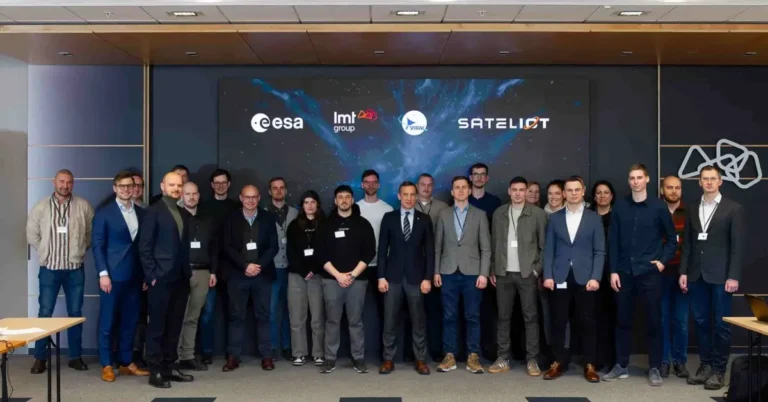
Latvian technology company LMT Group has announced a strategic 12-month development initiative in collaboration with the European Space Agency (ESA) to pioneer a new generation of universal IoT (Internet of Things) connectivity. The project aims to develop an IoT module that operates across mobile networks and satellite networks, enabling devices to remain connected almost anywhere.
While cellular networks cover most populated areas, oceans, deep forests, and rural agricultural lands remain dead zones for connectivity. In collaboration with ESA, Europe’s leading organization for space research, satellite systems, and space connectivity, LMT’s IoT team will develop a cost-effective hardware module and software suite to enable IoT devices to autonomously switch between terrestrial cellular networks and Non-Terrestrial Networks (NTNs). This dual-mode logic is engineered to provide continuous global coverage by allowing devices to transition between cellular and satellite links without user intervention or data loss.

Building on the technical foundation of LMT’s IoT Shortcut, one of the world’s smallest mobile data modules, the LMT IoT team will develop a dual-mode System-on-Module (SoM) to simplify space-based communication. To ensure these capabilities are accessible to European companies of all sizes, LMT IoT will also be developing a high-level Software Development Kit (SDK) that translates complex satellite modem controls into simple commands, making global coverage easier for developers to implement. The collaboration with ESA aims to advance the technology from a formulated concept (TRL 2) to a laboratory-validated proof of concept (TRL 3).
“Many devices remain too complex, expensive, or unavailable in the required market formats, especially for low-power IoT solutions. LMT is removing this exact barrier by developing a module that provides connectivity in cities, rural areas, and beyond traditional mobile coverage, without requiring two separate devices or complex configurations. This creates new opportunities for companies to participate in ESA and EU secure connectivity programs and allows LMT to take on a more significant role in the European space and telecommunications innovation ecosystem,” Ingmārs Pūķis, VP & Member of the Management Board at LMT.
Tapping into satellite IoT aligns with Europe’s next-generation connectivity plans. As a result of ESA’s CM25 decisions, Europe is investing €2.1 billion in satellite communication programmes to strengthen secure and resilient connectivity and to advance new satellite‑integrated 5G/6G technologies that reinforce Europe’s industrial autonomy. As a lead partner in cross-border 5G corridors, LMT offers the operational experience necessary to bridge terrestrial IoT with the satellite ecosystems envisioned by CM25.
“We are very pleased to see that LMT, as an innovative mobile network operator, is taking the initiative to integrate future NTN networks in its IoT service offering,” comments Frank Zeppenfeldt, who is looking after the project from the ESA side.
In the dual-mode satellite IoT project, the LMT IoT team and ESA will also be partnering with a Spanish company, Sateliot – the first LEO satellite operator providing global NB-IoT connectivity in line with 3GPP standards and 5G NTN roaming for telecom operators – and receiving knowledge support from the Ventspils International Radio Astronomy Centre.
“For Sateliot, this project is strategically important because it enables the development of a standardized 3GPP Rel-17 TN-NTN module, bridging two technologies that are individually at high TRL but have not yet been fully integrated into a seamless, market-ready dual-mode solution. By supporting the maturation of a unified terrestrial and satellite IoT ecosystem, Sateliot strengthens its position as a 5G NTN operator, accelerates device availability for its network, and reduces barriers for mass-market adoption of direct-to-satellite IoT services,” Joaquín Cruces, R&D Engineer at Sateliot.
With this project, LMT transitions to a global IoT-as-a-Service enabler. By lowering the barrier to entry for satellite technology, LMT and the ESA are ensuring that out-of-range becomes a thing of the past for the digital economy. Latvia’s participation in the ESA as an Associated Member State is ensured by the Ministry of Education and Science, creating new opportunities for companies and research institutions to develop innovative space technology projects.