

Signal

A new cross-industry consortium is forming to codify how trusted technology should be built, operated, and governed across borders. On February 13, 2026, fifteen companies spanning cloud, networks, semiconductors, software, and AI launched the Trusted Tech Alliance during the Munich Security Conference. The goal: define verifiable, provider-agnostic practices for a trustworthy technology stack—from connectivity and cloud infrastructure to chips, software, and AI—so customers and governments can rely on secure, resilient services regardless of where solutions are developed or deployed. Trust, sovereignty, and resilience are now gating factors for growth as AI scales and geopolitical risk reshapes supply chains.
Deutsche Telekom’s launch of seamless IoT roaming across terrestrial, GEO, and LEO networks signals a practical turning point for standards‑based satellite IoT at global scale. Multi‑orbit roaming blends the strengths of geostationary (always‑on footprint, predictable links) with low‑earth orbit (lower latency, better high‑latitude reach) and terrestrial cellular to keep devices online where traditional networks fall short. The service has been validated on Nordic Semiconductor’s nRF9151—billed as the first 3GPP‑compliant cellular IoT module to support terrestrial NB‑IoT/LTE‑M and NB‑NTN over both GEO and LEO—which matters for total cost of ownership and speed to scale.
Millicom and NJJ have jointly acquired Telefónica’s Chilean operations in a structure designed to capture upside while insulating Millicom’s balance sheet. Through a jointly controlled vehicle, NJJ holds 51% and Millicom 49% of nearly all of Telefónica’s interest in Chile, with Millicom operating the asset from day one despite its minority stake. The headline value is about $1.2 billion, reflecting a challenged but strategically important footprint in one of Latin America’s most advanced telecom markets. The transaction closed on February 10, 2026, and follows months of speculation that drew interest from other regional heavyweights, including América Móvil and Entel.
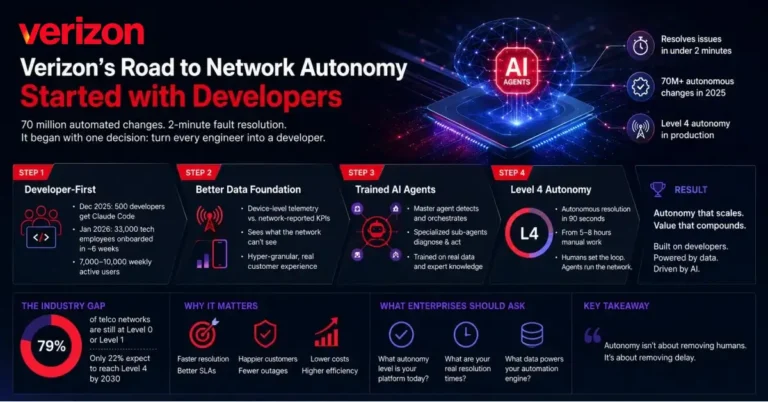
LG Uplus is moving from rule-based automation to closed-loop autonomy, using AI agents and digital twins to accelerate toward a fully autonomous network by 2028. Its core platform, the AI Orchestration Nexus (AION), is already automating repetitive operations and has contributed to a reported 70% reduction in customer complaints about network quality—an early signal that the approach is translating into measurable outcomes. The company plans to showcase these capabilities at MWC Barcelona 2026, underscoring growing operator interest in operational AI as 5G matures and traffic patterns become more volatile.
Imec is scaling its R&D footprint and inaugurating a NanoIC pilot line to accelerate sub‑2nm and 3D system innovation under a roughly €2.5 billion European semiconductor push. Imec, the Leuven-based semiconductor research hub, is expanding lab capacity and bringing a new NanoIC pilot line online to speed learning cycles for logic beyond 2nm and advanced 3D integration. The goal is clear: shorten the path from materials and device research to system‑level demonstrators that de-risk future foundry nodes and packaging flows. For vendors and operators, this is about getting sooner access to manufacturable building blocks—ultra‑efficient logic tiles, memory stacks, and optical I/O—that cut TCO and footprint across networks and data centers.
Microsoft’s AI QuickStart, backed by IMDA and UOB, aims to turn generative AI intent into production outcomes in weeks, not years. AI QuickStart targets “Digital Leaders” in Singapore—SMEs and larger non-ICT enterprises that have already built basic digital capabilities and can fund transformation—by offering a fast, structured path to deploy enterprise AI. Each engagement is designed to finish within three months with a cost cap of up to S$20,000 per project, covering cloud, compute, and professional services, which directly addresses executive concerns over unpredictable pilot spend and elongated proofs-of-concept.
Colombia has cleared a milestone consolidation: Tigo has taken operational control of Movistar, creating a second national-scale incumbent to challenge Claro. The Superintendence of Industry and Commerce (SIC) approved the integration through Resolution 94169 of 2025, capping months of scrutiny and pushback from rivals and ISPs. The merger compresses Colombia’s competitive field at a time when 5G rollouts, fiber densification, and cloud-native cores demand scale. It creates a stronger counterweight to Claro, but also raises real concerns about a two-horse race and the downstream effects on MVNOs, ISPs, and enterprise buyers.
ElevenLabs raised $500 million in Series D funding at an $11 billion valuation, led by Sequoia Capital with continued participation from Andreessen Horowitz and ICONIQ, and new backing from Lightspeed, Evantic Capital and BOND alongside existing investors. The company says it has surpassed key ARR milestones and reported strong enterprise adoption across sectors through 2025, with telecom emerging as a priority vertical as operators seek to modernize legacy IVR and contact center stacks. Conversational agents can replace keypad IVRs with natural dialogue that recognizes intent, confirms identity, retrieves context and executes actions across channels.
The merger creates a $1.25 trillion private giant that fuses launch, satellites, and AI, but the strategic logic goes beyond orbiting data centers. SpaceX brings rockets, Starship scale, and the world’s largest NGSO broadband network via Starlink. xAI brings models, AI R&D, and a brand in the hottest capital market category. Together, they present a single story to investors: own the stack from compute to constellation to connectivity, on and off Earth. Consolidation gives Musk freedom to reallocate cash flows and simplifies the roadshow pitch.
A long-term partnership between NVIDIA and Dassault Systèmes aims to make physics-grounded “world models” and virtual twins a mission-critical system of record for engineering, manufacturing, and the sciences. This collaboration moves beyond today’s project-level twin pilots toward industry-scale models that capture both geometry and behavior, validated against real physics and trusted industrial knowledge. The goal: use virtual environments not just to visualize, but to design, verify, and operate products and factories before steel is cut or code is deployed. The companies outlined a shared architecture spanning design, simulation, and operations.
New Delhi has unveiled a sweeping tax holiday to capture the next wave of AI and cloud build-outs, positioning India as a long-term base for exporting compute. Foreign providers that deliver cloud and data center services to customers outside India will pay zero corporate tax on those revenues through 2047, provided workloads run from facilities in India. The budget also introduces a 15% cost-plus safe harbor for Indian data center units serving related foreign parties, simplifying transfer pricing for global delivery hubs. For cloud providers, it strengthens the business case to place GPU clusters, storage, and interconnect in India to serve overseas demand, not just local workloads.
ServiceNow has named Anthropic’s Claude as the default model for its Build Agent and a preferred model across the ServiceNow AI Platform, signaling a shift from AI pilots to deeply embedded, production-grade automation. Embedding Claude into that fabric gives customers an on-ramp to agentic automation—systems that can reason over context, decide, and execute tasks—without stitching together point tools. Claude becomes the default model for ServiceNow Build Agent, an AI-assisted builder for apps and automations. Embedding Claude within the ServiceNow AI Platform enables access control, usage monitoring, and compliance aligned to enterprise policies. ServiceNow aims to cut implementation timelines for customers by roughly half by using Claude to accelerate configuration, adoption, and rollout.
Sponsored by Palo Alto Networks
⚡ Utilities ⏱ 8 min ✓ Free
This tool is built and hosted by TeckNexus.
Launch Tool →
Whitepaper
Neutral host, network slicing, and autonomous ground vehicles look like three unrelated topics — but they share the same hidden security risk. See what 100 airport deployments reveal about securing the components with the broadest reach across the network....
Palo Alto Networks
Whitepaper
Airports are deploying AI surveillance, biometrics, and autonomous vehicles faster than most networks can secure them. See what 100 real-world airport deployments reveal about the airside/landside security gap — and the 4-layer framework built to close it....
Palo Alto Networks
Scroll to Top