Private Network
Intelligence
Intelligence Journeys
Utilities Private Broadband Planning
AI Use Case Planning for Utilities

Investment

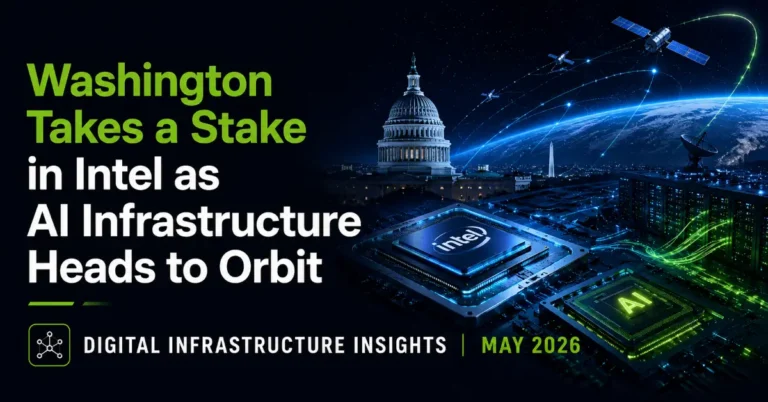
May 2026's roundup: the US government's 10% equity stake in Intel (now valued above $50B) underscores how strategic chip manufacturing has become, India and Vietnam both advance new chip fab and testing capacity, the AI chip supply chain keeps fragmenting beyond Nvidia, and Pixxel and Sarvam AI plan India's first orbital data center satellite.
SpaceX is evolving from a rocket company into a vertically integrated infrastructure conglomerate with direct implications for satellite connectivity, defense communications, AI, and enterprise network strategy. With a planned $2 trillion Nasdaq IPO targeting $75 billion in capital, over $6 billion in cumulative U.S. government contracts, and Starlink expanding as a tier-one connectivity layer, SpaceX is positioning itself as a direct competitor in telecom markets. Telecom operators and enterprise IT leaders must stress-test their non-terrestrial network strategies now, before IPO capital accelerates SpaceX's competitive timelines across every market it touches.
Eight French organisations — including Capgemini, Orange, EDF, Iliad and Scaleway — have formally united under the AION consortium to bid for an EU AI Gigafactory designation, backed by approximately €10 billion in committed investment. The bid targets EuroHPC's live call for proposals, closing June 23, 2026, and is designed to demonstrate France's ability to anchor the full AI value chain. For telecom and enterprise IT leaders, AION signals a structural repositioning of European operators as sovereign AI infrastructure enablers, not merely connectivity providers.

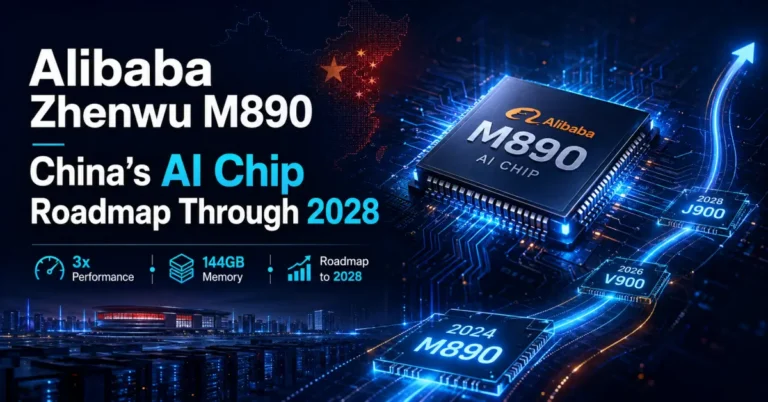
Alibaba's Zhenwu M890 AI accelerator, developed by chip unit T-Head, delivers approximately three times the performance of its predecessor and features 144GB of on-chip memory purpose-built for agentic AI workloads. Backed by a $53 billion infrastructure commitment and a published roadmap extending to the J900 chip in 2028, Alibaba is building sovereign AI infrastructure from silicon to software. With over 560,000 chips shipped to 400-plus customers across 20 industries, this is a commercially validated platform — not a prototype — signaling a maturing Chinese AI hardware ecosystem.
Verizon's 2026 Data Breach Investigations Report, based on analysis of more than 31,000 security incidents, finds that 31% of all breaches now originate from software vulnerability exploitation—surpassing stolen credentials as the leading initial access vector. Generative AI is accelerating this shift, with threat actors applying AI across an average of 15 distinct attack techniques. Ransomware remains pervasive, though ransom payments are declining. For telecom and enterprise IT leaders, the report signals an urgent need to treat vulnerability management as a real-time discipline and embed AI-native security tooling into defense operations.
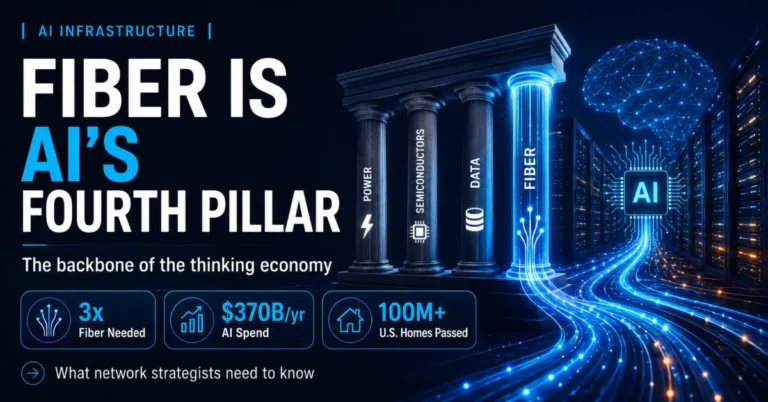
The Fiber Broadband Association's Fiber Connect 2026 conference repositioned fiber as a foundational prerequisite for AI infrastructure — not merely a consumer broadband conduit. With hyperscalers investing $370 billion annually in AI, the FBA projects demand for twice as many fiber route miles and three times total fiber deployed today. Over 100 million U.S. homes have now been passed with fiber, yet workforce shortages exceeding 200,000 workers and power constraints threaten deployment velocity precisely when AI-driven demand is accelerating fastest.
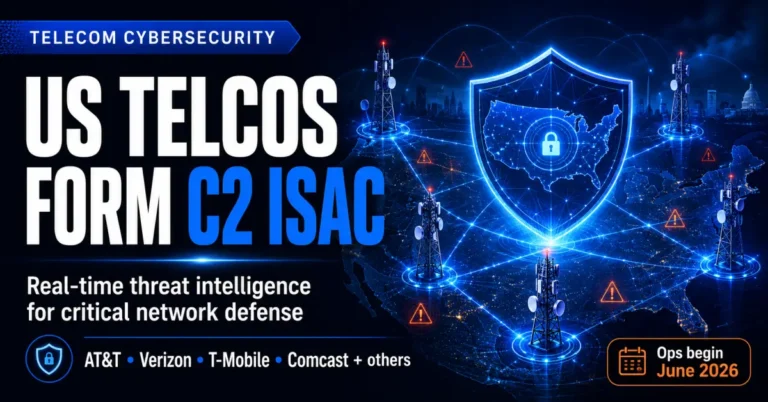
Eight of the most influential US telecommunications carriers — including AT&T, Verizon, T-Mobile, and Comcast — have established the Communications Cybersecurity Information Sharing and Analysis Center, known as C2 ISAC. Governed by the CISOs of each founding company and led by a director with CISA and FBI experience, C2 ISAC is designed to deliver real-time, actionable threat intelligence across competing carriers that collectively defend America's critical communications infrastructure. Operations are expected to begin in June 2026.
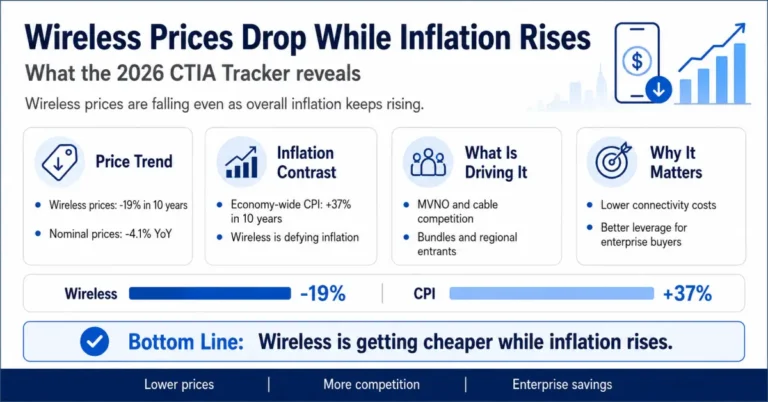
Wireless services are defying U.S. inflation trends in a way virtually no other sector is. According to CTIA's newly released More for Less: 2026 Wireless Affordability Tracker, nominal wireless prices have declined 4.1% over the past year and 19% over the past decade, while the economy-wide CPI rose more than 37% over the same period. Adjusted for inflation, postpaid unlimited plans are down roughly 10% year-over-year, and prepaid options have fallen more than 50% over five years. For enterprise decision-makers, this pricing trajectory represents a structurally favorable condition for mobile workforce and IoT connectivity planning.
T-Mobile and Ericsson are delivering measurable AI-native RAN results at commercial scale on a live 5G Advanced network. Ericsson's AI-native Scheduler with Link Adaptation replaces rule-based logic with a neural network that predicts RF conditions in real time, achieving close to 10 percent spectral efficiency improvement and up to 15 percent downlink throughput gains. Separately, Ericsson validated its Cloud RAN software running on NVIDIA AI infrastructure, enabling hardware-agnostic deployment. Together, these advances signal that AI-native networking is no longer theoretical — it is executing at national scale.
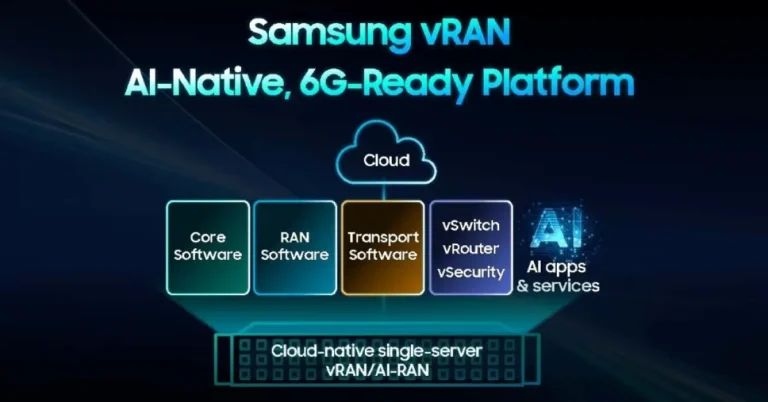
Samsung Electronics and Qualcomm Technologies have jointly validated Power Class 1 capability for 5G Fixed Wireless Access on a virtualized RAN architecture — a combination the industry has not demonstrated before. Testing showed up to ten times higher uplink throughput at the cell edge and up to 40% greater coverage range versus Power Class 1.5. With field trials already underway on a U.S. Tier-1 operator network and commercial availability targeted for 2027, this milestone signals a meaningful shift in uplink performance, coverage economics, and vRAN capability for operators and enterprise buyers alike.

Partner Hubs

Telco AI Agent Leadership

Telco AI Agent Leadership Landscape - Network Equipment Vendors
Network Equipment Vendor Report
How are Amdocs, Salesforce, Comarch, Totogi, Qvantel, Oracle and other OSS/BSS vendors deploying telecom AI agents?
OSS/BSS Vendor Report
How are Amdocs, Salesforce, Comarch, Totogi, Qvantel, Oracle and other OSS/BSS vendors deploying telecom AI agents?
System Integrator Report
Scroll to Top