Private Network
Intelligence
Intelligence Journeys
Utilities Private Broadband Planning
AI Use Case Planning for Utilities

Devices

Enterprises need indoor mobile coverage that works like the macro, integrates with private wireless, and sets a path to 5G and AI without ripping-and-replacing infrastructure. InfiniG’s Neutral Host as a Service turns a CBRS shared-spectrum deployment into an extension of public mobile networks using a 3GPP MOCN architecture. Employees, contractors, and visitors get native service from AT&T, T-Mobile, and Verizon on their existing SIMs—no apps, no plan changes. The Nokia RAN is 5G-ready out of the box, protecting investments as operators certify 5G Standalone and VoNR on neutral host. Radios and gateways are software-upgradable, so enterprises can deploy today for LTE and move to 5G without swapping hardware.
Amazon will acquire Globalstar to accelerate Amazon Leo’s direct-to-device (D2D) roadmap, secure midband MSS spectrum, and extend satellite coverage to smartphones and IoT beyond terrestrial reach. Amazon is acquiring Globalstar in a cash-and-stock deal valued at roughly $11.5 billion, with Globalstar shareholders able to elect $90 per share in cash or Amazon stock subject to a cash cap and proration. Closing is targeted after regulatory approvals and satellite milestones, with Amazon guiding to 2027. Amazon plans to deploy a next-generation D2D system starting in 2028, delivering voice, messaging, and data to unmodified mobile devices.
The Federal Communications Commission is advancing a proceeding that would prohibit US carriers from interconnecting with Chinese state-linked operators and from using facilities they own or operate, including data centers and points of presence. The proposal targets interconnection at meet-me rooms, cross-connects, and handoffs that underpin IP transit, voice interconnect, SMS hubs, and enterprise backhaul. The Commission is seeking comment on a ban and will take the item to a vote at its 30 April Open Meeting. Depending on the final order, potential outcomes range from mandatory disconnection to forced divestiture or transfer of affected facilities.
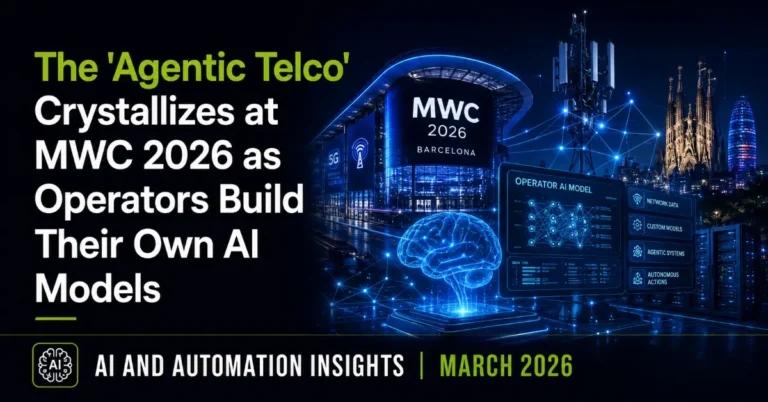
March 2026's roundup: GSMA, Google Cloud, Huawei, and AWS all converge on an "agentic telco" framing at MWC Barcelona, SoftBank and SK Telecom build proprietary telecom-specific AI models and infrastructure, and physical AI reaches airports, drones, and network edge sites — with AI-RAN and connectivity infrastructure covered separately in our companion Advanced Connectivity Insights, March 2026.
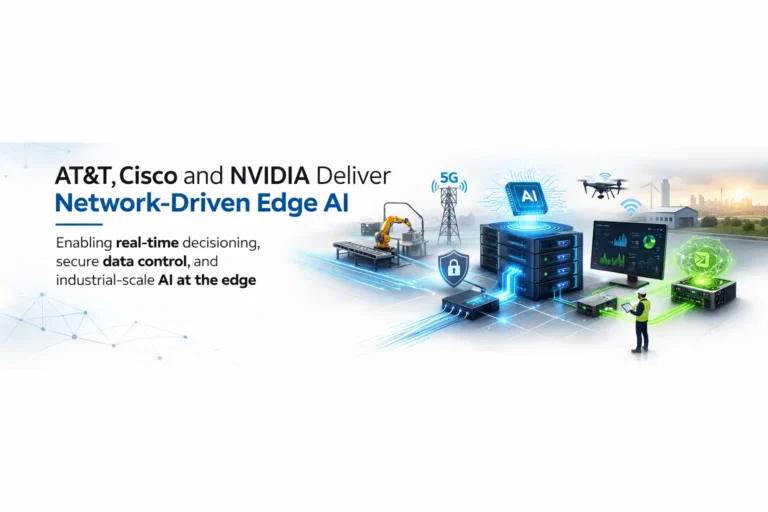
AT&T’s new collaboration with Cisco and NVIDIA signals a decisive shift from cloud-centric AI to network-driven edge intelligence for enterprise operations. Enterprises want real-time decisioning without shipping sensitive data to distant clouds, and operators need a scalable way to deliver it. By combining AT&T’s dedicated IoT core with Cisco’s mobility services platform and NVIDIA-powered AI infrastructure, the trio is packaging deterministic connectivity, near-device inference, and policy enforcement into a single, operator-grade platform. The promise: lower latency, tighter data control, and a path to production for AI at industrial scale.
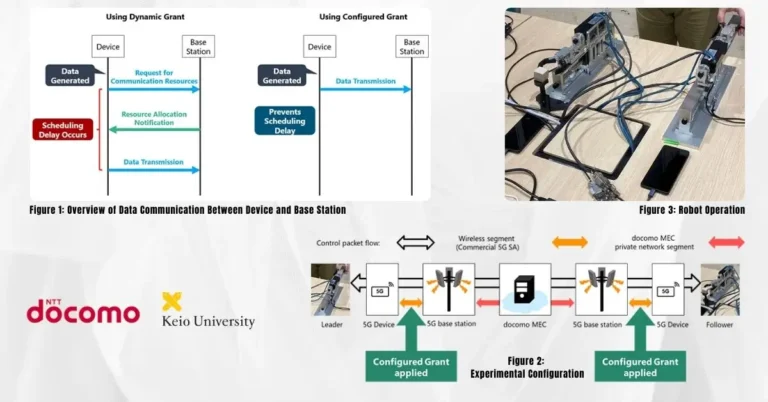
NTT DOCOMO and Keio University have validated that commercial 5G Standalone (SA) can stably support haptic-grade robot teleoperation using network slicing and configured grant—turning years of URLLC theory into practical results. By pairing 3GPP-configured grant scheduling with a low-latency slice and Keio’s Real Haptics technology, DOCOMO showed that public 5G SA can carry force and tactile feedback with the determinism required for safe, precise manipulation. The KPIs demonstrate material improvements in latency stability, force fidelity, and motion smoothness—indicators that the control loop is resilient enough for practical tasks.
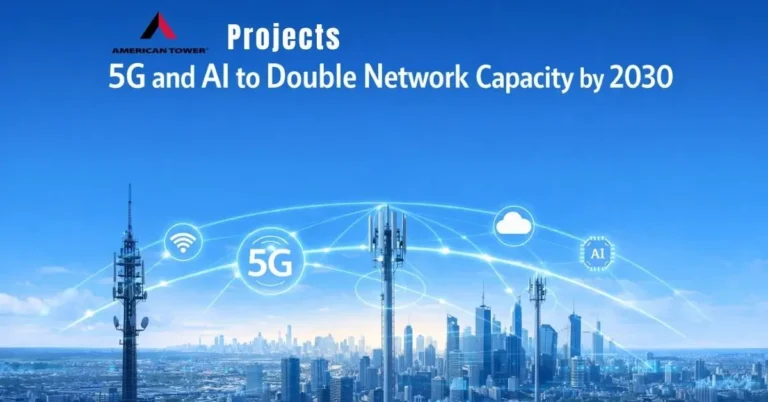
American Tower’s latest outlook puts a hard number on a trend most operators feel on the ground: the network needs to double by the end of the decade to absorb 5G, fixed wireless access, and AI-driven traffic. Mobile data growth remains the primary engine for new network investment. As 5G adoption scales and fixed wireless access expands, capacity pressure is shifting from coverage to throughput. The next leg comes from AI. New applications—from on-device inference to computer vision at the edge—demand more bandwidth, tighter latency, and stronger uplink. That profile is different from today’s downlink-heavy usage and will stress radios, backhaul, and site power.
A new collaboration between GSMA Foundry and Singapore’s National University Health System (NUHS) aims to operationalize connected health at scale, with Ericsson and Singtel anchoring the 5G foundation. Healthcare digitization has moved from pilots to production, but most sites still struggle with deterministic connectivity, secure data exchange and workflow integration. The program combines private 5G with digital twin, XR, IoT and ambient AI to improve outcomes and operational resilience across care pathways. Early focus areas include 5G-enabled remote surgical assistance with ultra-reliable, low-latency links; immersive XR training and simulation that compress learning curves; autonomous and semi-autonomous robotics for logistics and point-of-care tasks; and AI-guided imaging such as vein visualization.
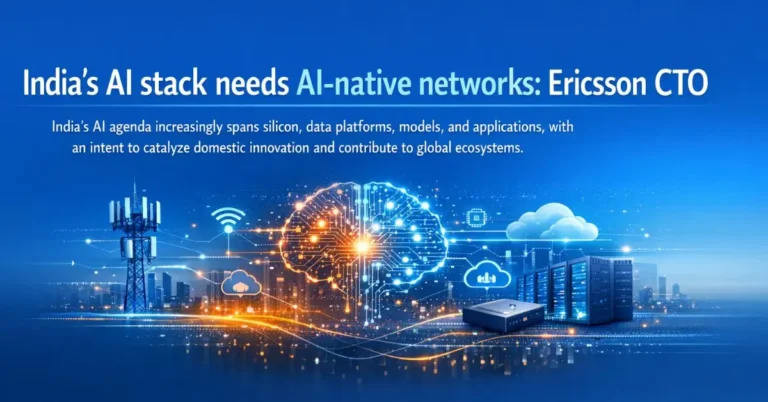
India’s AI agenda increasingly spans silicon, data platforms, models, and applications, with an intent to catalyze domestic innovation and contribute to global ecosystems. For telecom leaders, the message is clear: AI is not a bolt-on capability but a system-level transformation that touches RAN, core, transport, cloud, and the enterprise edge. The AI economy runs on connectivity—low-latency access to data, assured bandwidth, location-aware processing, and programmable control. The operators that can fuse connectivity, compute, and data into a cohesive platform will set the pace for India’s next wave of digital growth.
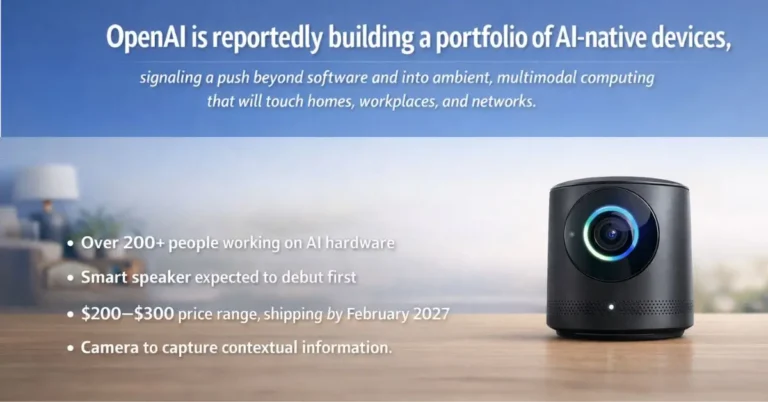
OpenAI is reportedly building a portfolio of AI-native devices, signaling a push beyond software and into ambient, multimodal computing that will touch homes, workplaces, and networks. Multiple reports indicate OpenAI has over 200 people developing a family of AI-enabled hardware, with a smart speaker expected to debut first. Early guidance points to a price in the $200–$300 range and a ship window no earlier than February 2027. The device is said to include a camera to capture contextual information about users and surroundings—an explicit bet on multimodal AI that fuses voice, vision, and environment for richer interactions.
Boldyn Networks is rolling out a neutral host 5G upgrade at Silverstone that shifts the circuit from seasonal stopgaps to a year-round, high-capacity mobile platform for fans, teams, and broadcasters. The architecture spans 25 locations, with 57 sectors engineered across 87 DAS zones to handle concentrated traffic and maintain performance under crowd pressure. The design anticipates surges in uplink and signaling, supports concurrent sessions at scale, and smooths throughput across hotspots. A permanent, multi-operator 5G foundation unlocks new revenue, better service metrics, and more efficient event delivery. When connectivity works, dwell time, spend, and satisfaction rise.

Partner Hubs

Telco AI Agent Leadership

Telco AI Agent Leadership Landscape - Network Equipment Vendors
Network Equipment Vendor Report
How are Amdocs, Salesforce, Comarch, Totogi, Qvantel, Oracle and other OSS/BSS vendors deploying telecom AI agents?
OSS/BSS Vendor Report
How are Amdocs, Salesforce, Comarch, Totogi, Qvantel, Oracle and other OSS/BSS vendors deploying telecom AI agents?
System Integrator Report
Scroll to Top