AI Agent Competitive
Intelligence
Intelligence Journeys
AI Use Cases for Utilities
Private Broadband for Utilities

Cybersecurity

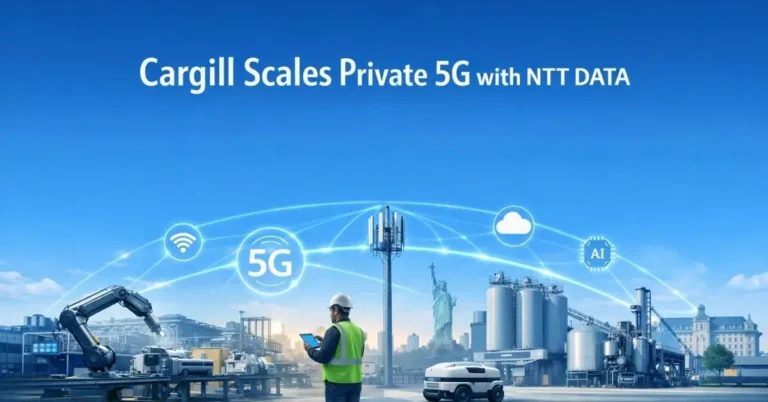
NTT DATA’s private 5G rollout across 50 Cargill facilities signals that industrial connectivity is moving from pilot projects to standardized, multi-site execution. NTT DATA has deployed private 5G at Cargill manufacturing and processing locations worldwide—mostly in the United States with live sites in Europe—enabling a connected workforce, robotics, and edge AI across plants that are often too large and complex for conventional Wi‑Fi or wired networks to cover reliably. Manufacturers are consolidating on common digital platforms and need predictable, low-latency wireless for operational data, mobile human–machine interfaces, and autonomous systems; private 5G—built on 3GPP standards with SIM-based security and policy-based QoS—offers deterministic performance at scale where legacy networks struggle.
Private LTE, 5G, and CBRS networks are becoming the backbone of industrial operations. This article maps private network security vendors to a Four Pillars framework—Core Controls, Device Visibility, Detection & Response, and Orchestration—revealing where structural gaps emerge in real-world industrial deployments. From slice isolation and SIM lifecycle governance to OT micro-segmentation and SOC integration, it explains why layered enforcement—not vendor breadth—determines private 5G security resilience.
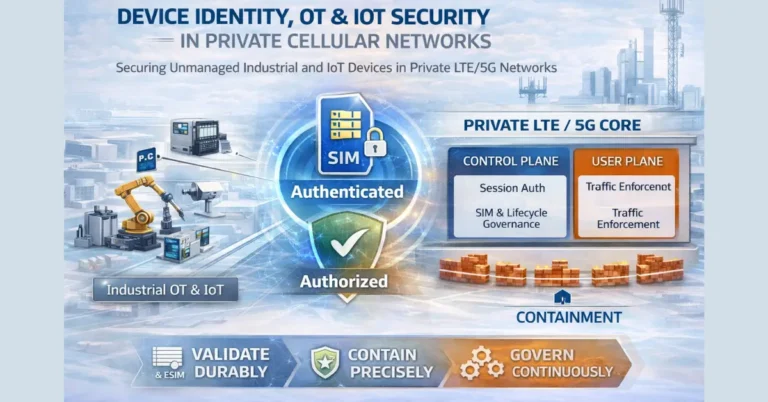
Private LTE and 5G networks strengthen authentication at the transport layer—but device identity, lifecycle governance, and OT/IoT realities determine whether containment holds. This in-depth guide explains SIM and eSIM authentication models, service-profile authorization, identity drift risks, industrial gateway mediation, and Zero Trust containment strategies across multi-site private cellular deployments.
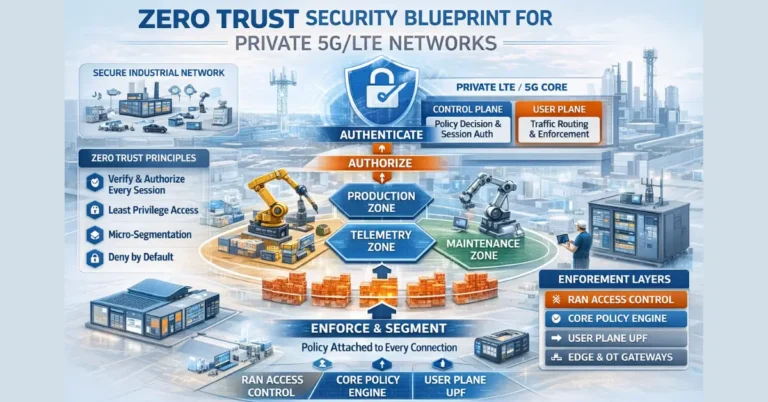
This Zero Trust security blueprint for Private LTE and 5G networks explains how session-based authorization, control-plane policy decisions, and user-plane enforcement create deterministic micro-segmentation across industrial and OT environments. Mapping private cellular architecture to NIST SP 800-207, the article details how operational zones, service profiles, and containment principles protect production-critical systems under mobility and scale.
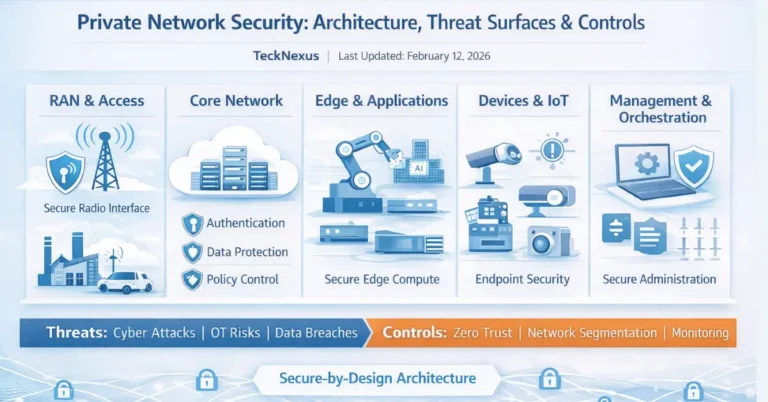
Private LTE and 5G networks introduce new security challenges as they become the foundation for industrial automation, critical infrastructure, and enterprise campuses. Unlike Wi-Fi and traditional IT networks, private cellular environments blend telecom infrastructure, IT systems, and operational technology, creating distinct threat surfaces across the RAN, core, edge, devices, and management planes. This article establishes a security-first architectural lens for private LTE/5G, explaining who needs it, where risks emerge, and what secure-by-design looks like before moving into Zero Trust and implementation frameworks.
Liberty Global and Google Cloud have signed a five-year agreement to deploy AI at scale across Liberty Global’s European footprint and to advance hybrid cloud, autonomous networks, and new go-to-market plays. The partnership spans roughly 80 million fixed and mobile connections across Liberty Global’s operating companies, including Virgin Media O2 in the UK, Telenet in Belgium, VodafoneZiggo in the Netherlands, Virgin Media in Ireland, and Sunrise in Switzerland. On the network side, the companies will co-develop AI-first programs aimed at reliability, security, scalability, and cost efficiency. Commercially, the parties will target SMEs with a joint portfolio that combines connectivity with cloud, cybersecurity, and AI services.
Boingo Wireless is integrating Globalstar’s XCOM RAN to accelerate private 5G across airports, stadiums, hospitals, convention centers, transit hubs, and military bases. Globalstar said Boingo will add XCOM RAN, a software-defined private 5G platform built around the Supercell architecture, to its private network portfolio. A highlighted approach is overlaying XCOM RAN on existing distributed antenna system (DAS) infrastructure to preserve DAS coverage advantages while boosting capacity and performance. Enterprises are moving beyond pilot projects to operational private 5G in high-traffic, RF-challenged environments. This aligns with rising demand for low-latency, secure connectivity for IoT, video, automation, and mission-critical operations.
ABB has unveiled Automation Extended, an evolution of its distributed control systems designed to let plants add digital capabilities without disrupting mission-critical operations. The program extends ABB’s established DCS portfolio—Ability System 800xA, Symphony Plus, and Freelance—by introducing a framework to layer analytics, AI, and IoT capabilities on top of existing control assets. The core promise is modernization without downtime: operators can keep trusted control systems running while progressively adopting new functionality. Security and interoperability are central themes, with ABB positioning an open, modular ecosystem that scales across industrial domains and preserves prior investments.
OneLayer wins “Excellence in Private Network Security” for its innovative platform providing device-level visibility, Zero Trust access control, and real-time threat detection across LTE and 5G enterprise environments. Purpose-built for private cellular networks, OneLayer enables IT and OT teams to secure and manage all connected assets—including non-cellular devices—through unified device identities and context-aware security.
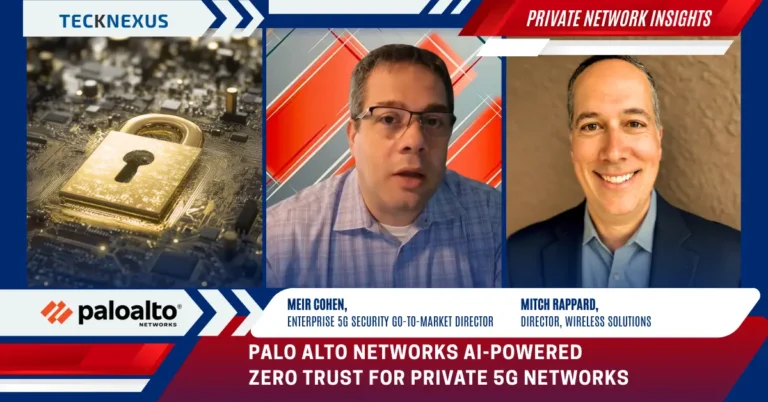
Palo Alto Networks wins “Excellence in Private Network Security” for its AI-powered Zero Trust platform securing private 4G and 5G networks. Built for mission-critical environments, the solution delivers end-to-end protection across core, edge, and cloud—enabling carriers, enterprises, and critical infrastructure operators to deploy private wireless networks securely, at scale, and with confidence.
The European Commission’s Digital Networks Act (DNA) is a sweeping proposal to harmonize telecom rules, catalyze next‑generation investment, and turn 27 national markets into a functional single market for connectivity. The DNA is timed to underpin an AI‑driven economy that depends on fiber, 5G/6G, and low‑latency cloud‑edge fabrics spanning borders. Longer licence durations and more flexible sharing are intended to reduce renewal risk and unlock investment in 5G densification and 6G prep. Mandatory national plans to phase out copper between 2030 and 2035 will free OPEX and energy, but require careful migration of regulated wholesale products, vulnerable users, and critical services.
Comcast is recasting how it engages consumers by rolling out Xfinity Membership, a loyalty experience that ties perks and rewards to broadband, mobile, and media usage while expanding its retail footprint with new Xfinity Stores in South DeKalb, Georgia, and Chehalis, Washington. The strategy is straightforward: keep customers longer by making Xfinity more valuable the more services they use. Xfinity Membership packages ongoing perks and periodic rewards across Comcast’s portfolio, aligning incentives to broadband, Xfinity Mobile (MVNO on Verizon’s network), and NBCUniversal’s media assets such as Peacock.

Partner Hubs

Download content, access intelligence tools, and hear from executives.

Partner Events

  • FutureNet Asia 2026
  • Network X Vienna 2026
Scroll to Top