AI Agent Competitive
Intelligence
Intelligence Journeys
AI Use Cases for Utilities
Private Broadband for Utilities

Cybersecurity

Enterprises are moving fast to private 5G to digitize operations, but the payoff only materializes if security scales with the new connectivity footprint. Private 5G brings deterministic wireless to factories, hospitals, ports, and energy sites, connecting robots, AGVs, cameras, and critical control systems. Security must follow identities and workloads, not subnets. Adopt a Zero‑Trust approach aligned to NIST SP 800‑207 with a single source of truth for identity and policy. Shift from perimeter controls to context-driven segmentation. Build on open standards and APIs to avoid lock‑in and simplify operations. Security must be foundational, measurable, and auditable from day one.
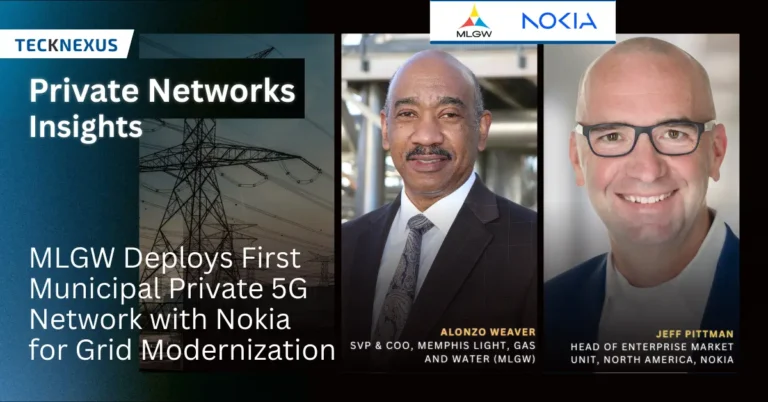
MLGW, in collaboration with Nokia, has launched the first full-scale, standalone private 5G network operated by a U.S. municipal utility. This network integrates electric, gas, and water services under a secure, real-time communications framework, boosting infrastructure modernization, cybersecurity, and operational resilience across Shelby County. The project sets a national precedent for grid modernization with private wireless.
As enterprises move from single-model chatbots to collaborative multi-agent systems, the economic and operational burden of reasoning at scale is becoming the dominant constraint. NVIDIA’s Nemotron 3 family introduces open models and tools designed to keep multi-agent systems fast, affordable and inspectable. The models use a hybrid latent mixture‑of‑experts design to activate only a fraction of parameters per token, combining it with a Mamba‑Transformer approach optimized for long sequences. Nemotron 3 Nano is a small, roughly 30B‑parameter model that activates up to 3B parameters per token, making it efficient for retrieval, summarization, assistants and software debugging.
3GPP has become the organizing framework for how public safety, utilities, transportation and enterprise security adopt LTE/5G for mission-critical communications (MCX). For mission-critical users, 3GPP’s scope includes capabilities such as push-to-talk, data and video designed for high availability, priority, pre-emption and end-to-end security. For agencies and enterprises, the value of 3GPP is practical: it lowers integration risk, clarifies feature expectations and aligns multi-year investment roadmaps. Standards are the foundation; operational reliability is the measure of success. 3GPP is the baseline for resilient, interoperable operations.
The FAA has tapped Peraton as prime integrator for a multi‑year modernization of the National Airspace System (NAS), setting in motion a telecom-heavy refresh of networks, radios, and control systems at national scale. The FAA selected Peraton, owned by Veritas Capital, as the single program integrator to manage an initial $12.5 billion upgrade of the aging U.S. air traffic control system. Officials are targeting a three-year execution window to cut outages, improve efficiency, and reinforce safety across the NAS, with additional funding in the $19–20 billion range likely required to fully complete the plan.
A landmark private 5G pilot at EMSTEEL with e& UAE signals how industrial networks in the region are evolving from connectivity add-ons to strategic infrastructure. The pilot delivers dedicated, high-speed wireless coverage across complex industrial spaces that are often hostile to traditional Wi‑Fi and public cellular. For manufacturers in the UAE, this is a meaningful milestone: it showcases a path to secure, deterministic wireless that can carry safety-critical and time-sensitive workloads on the shop floor. Private 5G gives factories a foundation to adopt connected worker tools, real-time quality control, AI-assisted operations, and digital twins without moving sensitive data off-site.
India’s Department of Telecommunications has ordered major messaging apps to implement continuous SIM binding and frequent web re-authentication to curb fraud, with compliance expected in early 2026. The directive applies to app-based communication platforms that use mobile numbers as identifiers, including WhatsApp, Telegram, Signal, Snapchat, ShareChat, JioChat, Josh, and regional players like Arattai. Apps must continuously verify that the SIM linked to the registered number is present and active on the device, not just at account setup. Additionally, web sessions (e.g., WhatsApp Web) must auto-logout every six hours, forcing users to re-link via QR code.
Nvidia used NeurIPS to expand an open toolkit for digital and physical AI, with a flagship reasoning model for autonomous driving and a broader stack that targets speech, safety, and reinforcement learning. Nvidia introduced DRIVE Alpamayo-R1 (AR1), an open vision-language-action model that fuses multimodal perception with chain-of-thought reasoning and path planning, aiming to push toward Level 4 autonomy in constrained domains. To lower adoption friction, Nvidia published the Cosmos Cookbook with step-by-step recipes for data curation, synthetic data generation, inference, and post-training workflows, enabling customization for diverse physical AI use cases.
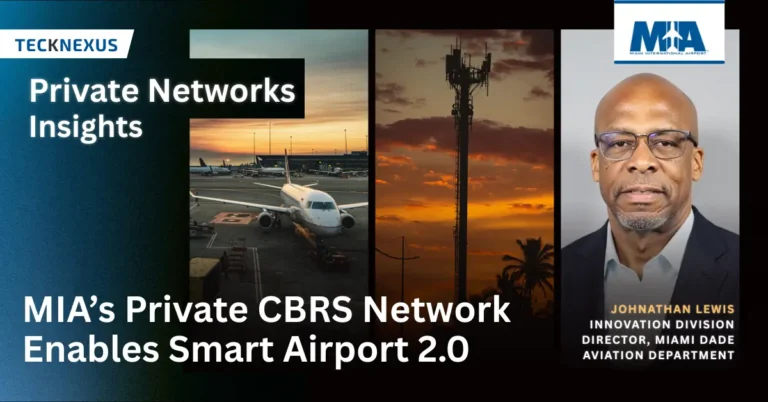
Miami International Airport (MIA) is transforming operations with its private CBRS network, central to its Smart Airport 2.0 strategy. The network enables secure, real-time automation across IoT devices, passenger services, and operational systems. From enhancing cybersecurity and reducing costs to monetizing connectivity for tenants, MIA demonstrates how airports can use private wireless to scale innovation efficiently and drive ROI.
Winner – Private Network Startups - Niral Networks, deploys private 5G and Edge AI network at GMR’s energy facility which faced critical connectivity and safety challenges. This air-gapped, industrial-grade solution supports plant automation, AI surveillance, and drone operations, offering high throughput, low latency, and centralized management across multiple sites.
Cisco’s intent to acquire Seattle-based NeuralFabric signals a decisive shift toward practical, domain-specific AI that meets real-world constraints around data, compliance, and infrastructure. Cisco plans to acquire NeuralFabric, an enterprise AI platform focused on building small language models (SLMs) from proprietary data with deployment across SaaS and on-premises environments. By focusing on SLMs trained on enterprise data and deployable in hybrid environments, Cisco aims to shorten time-to-value while keeping control where it belongs—inside the business. They reduce inference cost, improve latency, and can be deployed on-premises or at the edge—critical for sectors like telecom, financial services, and healthcare.
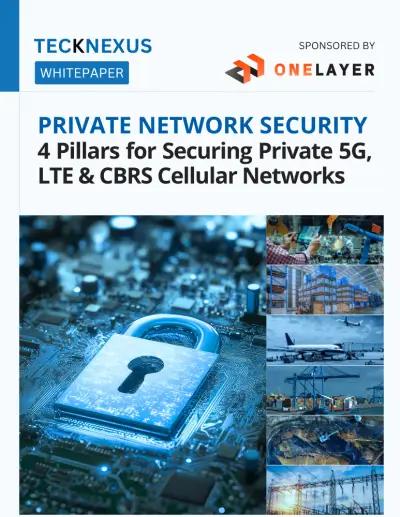
Private cellular networks are transforming industrial operations, but securing private 5G, LTE, and CBRS infrastructure requires more than legacy IT/OT tools. This whitepaper by TeckNexus and sponsored by OneLayer outlines a 4-pillar framework to protect critical systems, offering clear guidance for evaluating security vendors, deploying zero trust, and integrating IT, OT, and IoT under a unified, secure-by-design architecture.

Partner Hubs

Download content, access intelligence tools, and hear from executives.

Partner Events

  • FutureNet Asia 2026
  • Network X Vienna 2026
Scroll to Top