AWS

Anthropic’s latest financing round resets the competitive map for enterprise AI and raises the stakes for telecom, cloud, and large-scale IT buyers planning agentic automation. Anthropic closed a $30 billion Series G at a $380 billion post-money valuation, led by GIC and Coatue with participation from D. E. Shaw Ventures, Dragoneer, Founders Fund, ICONIQ, and MGX, alongside a broad cohort that includes Accel, General Catalyst, Jane Street, and the Qatar Investment Authority. The raise follows sustained commercial momentum and arrives as competitive intensity with OpenAI deepens, signaling that AI platform consolidation and scale economics will define the next phase of the market.
Amazon and Google currently lead the AI capex race, with Microsoft and Meta not far behind, and the prize is control over scarce compute, power, and network resources that define the next decade of cloud and AI services. For telecom and infrastructure players, the opportunity is immediate: deliver power-adjacent, fiber-rich, AI-ready capacity with speed and predictable SLAs. For enterprises, the mandate is pragmatic: secure capacity, design for portability across heterogeneous silicon, and enforce cost governance as inference scales. The winners will be those who pair aggressive buildouts with disciplined execution—turning record capex into durable platforms and customer outcomes.
Amdocs is launching aOS, an agentic operating system for telecom, to move CSPs from AI pilots to production-scale, cross-domain automation. Amdocs’ aOS targets that gap with a multi-agent architecture that automates complex workflows while keeping humans in the loop for policy and final decisions. At the foundation is a “Cognitive Core” that manages telco-specific knowledge, agent libraries, and guardrails. aOS pricing will lean on outcome-based SLAs, tying spend to measurable business impact such as resolution rates, handle-time reductions, activation velocity, or assurance KPIs. aOS is Amdocs’ bid to make agentic AI the connective tissue of telco operations.
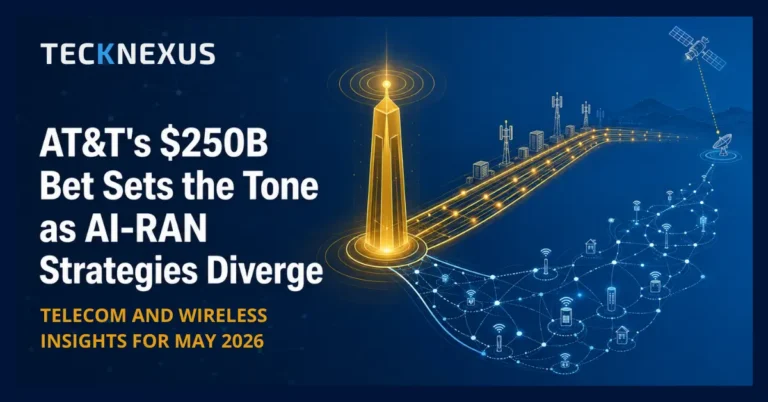
AT&T is deepening ties with Amazon by pairing its national fiber assets with AWS cloud and AI tooling while adding low Earth orbit connectivity from Amazon’s satellite network to fill coverage gaps for business customers. The collaboration has two pillars: cloud modernization on AWS and satellite-enabled reach via Amazon’s LEO network, with AT&T also supplying fiber capacity into AWS data centers to bolster high-performance infrastructure. Amazon’s LEO constellation will deliver fixed broadband connectivity for AT&T Business customers in areas where terrestrial options are limited, enabling primary service in hard-to-reach sites and resilient backup for SD‑WAN architectures.
The merger creates a $1.25 trillion private giant that fuses launch, satellites, and AI, but the strategic logic goes beyond orbiting data centers. SpaceX brings rockets, Starship scale, and the world’s largest NGSO broadband network via Starlink. xAI brings models, AI R&D, and a brand in the hottest capital market category. Together, they present a single story to investors: own the stack from compute to constellation to connectivity, on and off Earth. Consolidation gives Musk freedom to reallocate cash flows and simplifies the roadshow pitch.
Digipower X positions itself as a vertically integrated AI infrastructure operator combining Tier III-certified modular data centers with owned and controlled energy assets to compress deployment cycles. The company cites more than 200 MW currently online across a combined-cycle plant and three additional operational sites, development pathways for up to 1.5 GW over the next three years, and a letter of intent tied to a 1.3 GW power plant in West Virginia that is being evaluated as a long-term AI campus anchor, with additional scale targeted in North Carolina. Its AI-Ready Modular Solution (ARMS) aims to deliver Tier III modular capacity in roughly 180 days, emphasizing redundancy, energy optimization, and liquid-cooling readiness for high-density AI clusters.
NTT DATA and AWS have signed a multi-year strategic collaboration aimed at accelerating cloud modernization and responsible agentic AI adoption, with clear implications for APAC enterprises and telecoms. The agreement expands joint go-to-market and delivery across four pillars: AI-driven cloud transformation, industry cloud solutions, AI-enabled managed services and customer experience, and sovereign cloud for regulated workloads. NTT DATA has created a dedicated AWS Business Group with close to 11,000 AWS-certified experts and plans to certify nearly 10,000 more in three years. APAC boards want measurable AI outcomes, but legacy estates, data fragmentation, and compliance obligations slow progress.
Enterprises are moving fast to private 5G to digitize operations, but the payoff only materializes if security scales with the new connectivity footprint. Private 5G brings deterministic wireless to factories, hospitals, ports, and energy sites, connecting robots, AGVs, cameras, and critical control systems. Security must follow identities and workloads, not subnets. Adopt a Zero‑Trust approach aligned to NIST SP 800‑207 with a single source of truth for identity and policy. Shift from perimeter controls to context-driven segmentation. Build on open standards and APIs to avoid lock‑in and simplify operations. Security must be foundational, measurable, and auditable from day one.
As enterprises move from single-model chatbots to collaborative multi-agent systems, the economic and operational burden of reasoning at scale is becoming the dominant constraint. NVIDIA’s Nemotron 3 family introduces open models and tools designed to keep multi-agent systems fast, affordable and inspectable. The models use a hybrid latent mixture‑of‑experts design to activate only a fraction of parameters per token, combining it with a Mamba‑Transformer approach optimized for long sequences. Nemotron 3 Nano is a small, roughly 30B‑parameter model that activates up to 3B parameters per token, making it efficient for retrieval, summarization, assistants and software debugging.
Disney will invest $1 billion in OpenAI and become Sora’s first major content licensing partner, enabling fans to generate and share short videos that feature more than 200 characters and environments from Disney, Pixar, Marvel, and Star Wars. The agreement spans three years, excludes actor likenesses and voices, and extends to ChatGPT Images for IP‑compliant image generation. Disney will adopt OpenAI APIs across products and operations, including features for Disney+ and employee productivity, and may showcase select user creations on its streaming service. This agreement formalizes licensed synthetic media at scale and accelerates the convergence of UGC, premium IP, and AI tooling.
IBM has agreed to acquire Confluent for $31 per share in cash, signaling a decisive move to make real-time, governed data the backbone of generative and agentic AI across hybrid cloud environments. The transaction values Confluent at an enterprise value of roughly $11 billion, with closing targeted by mid-2026 pending shareholder and regulatory approvals. Together they aim to unify application, data, and AI pipelines across public clouds, private data centers, and edge locations—reducing integration friction and accelerating time to value for enterprise AI.
Amazon Web Services plans a sweeping expansion of classified and government cloud capacity to accelerate AI and high‑performance computing for U.S. agencies. AWS will invest up to $50 billion starting in 2026 to deliver purpose‑built AI and HPC infrastructure for federal customers. The buildout spans AWS Top Secret, AWS Secret, and AWS GovCloud (US) Regions. The expansion is designed to compress analysis timelines and enable AI‑assisted workflows across national security and civil missions. AWS is making a generational bet that AI and HPC, delivered inside accredited government regions at massive scale, will redefine how federal missions operate.
Sponsored by Palo Alto Networks
⚡ Utilities ⏱ 8 min ✓ Free
This tool is built and hosted by TeckNexus.
Launch Tool →
Whitepaper
Airports are deploying AI surveillance, biometrics, and autonomous vehicles faster than most networks can secure them. See what 100 real-world airport deployments reveal about the airside/landside security gap — and the 4-layer framework built to close it....
Scroll to Top