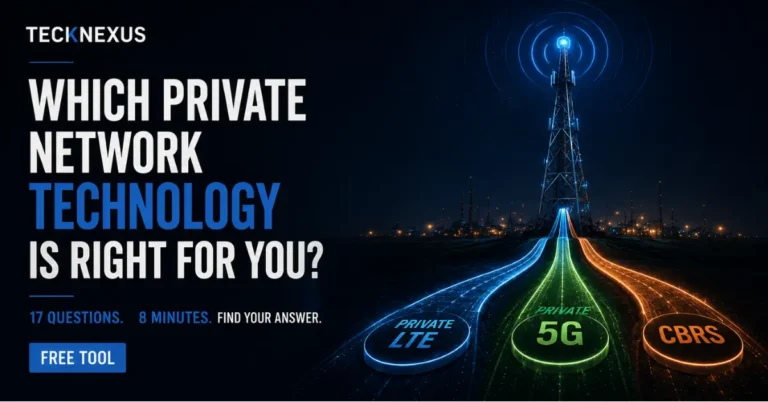
Get a consultant-grade technology recommendation from 17 questions across region, vertical, devices, spectrum, and commercial model — including what was ruled out and why.
You'll need: your site profile, device mix, and commercial preferences. Produces: a recommendation with rationale and vendor guidance, plus a PDF report.
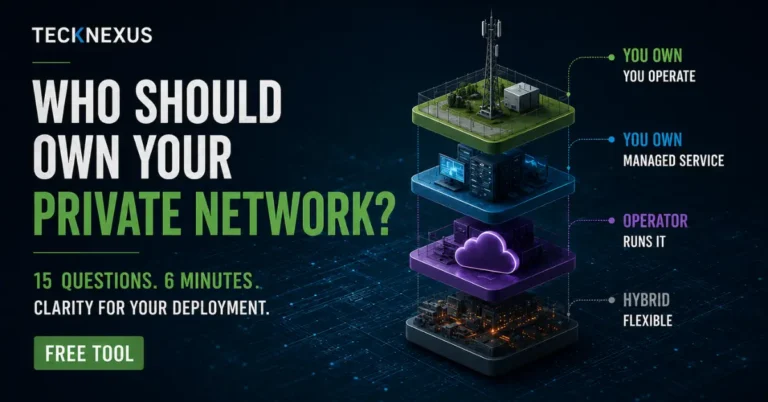
Determine the right deployment architecture — SNPN, enterprise RAN, managed breakout, or hybrid — from 15 questions.
You'll need: your operating-model preferences and data constraints. Produces: an architecture recommendation with responsibility matrix and vendor engagement sequence, plus a PDF report.
Build a structured, weighted vendor evaluation framework before you issue the tender - calibrated to your vertical, use cases, architecture, and procurement priorities.
You'll need: your vertical, use cases, architecture direction, and compliance requirements. Produces: a weighted scorecard, vendor question bank, red flags, proof points, and evaluation process guide.
Independent 5-year TCO comparison across Wi-Fi, CBRS, private LTE, and private 5G - hardware, installation, spectrum, management, and operating costs, calibrated by region and site type.
You'll need: your site count, region, and deployment environment. Produces: a side-by-side 5-year TCO comparison.
AI Data Center Interconnect (DCI) Bandwidth Planner
See what scale-up and scale-out bandwidth an AI deployment actually demands — before the RFP is written, based on published accelerator interconnect generations.
You'll need: your AI deployment scale assumptions. Produces: a DCI demand model by traffic pattern.
Benchmark your network security posture across threat awareness, architecture, detection and response, AI and automation, and governance - including signalling and inter-roaming threats.
You'll need: a picture of your current security operations. Produces: a 5-dimension maturity benchmark.
Benchmark your SIM provisioning, device lifecycle management, and operational readiness — and see exactly where automation would save the most time and cost.
You'll need: a picture of your current provisioning process. Produces: a maturity benchmark with an automation-savings view.
Compare total cost of ownership across private wireless connectivity options. Input operational parameters to model TCO over a multi-year period and identify the lowest-cost architecture for your environment.
Side-by-side comparison tool for private wireless technology options - LTE, 5G, Wi-Fi, and CBRS - across key performance, cost, and operational dimensions to support technology selection decisions.
Deployment-backed analysis of CBRS total cost of ownership across multiple industries. Provides real-world ROI benchmarks from live CBRS deployments — useful for validating business cases and comparing against vendor estimates.
Quick-estimate tool for private 5G deployment costs. Input site size, device count, and coverage requirements to get an indicative infrastructure cost range - useful for early-stage budget planning.
Estimate the sustainability impact of deploying private wireless — including energy efficiency gains, carbon reduction, and ESG reporting metrics - across industrial and enterprise environments.
Model the total cost of ownership of deploying Celona's 5G LAN solution versus existing Wi-Fi or wired infrastructure. Useful for enterprise and industrial sites evaluating CBRS-based private 5G.
Search US licensed spectrum availability by frequency, geography, and licensee. Essential for US-based private network spectrum planning and CBRS/PAL availability checks.
The Small Cell Forum DARTs calculator helps deployers evaluate and compare transport bandwidth requirements across Disaggregated RAN split architectures and deployment scenarios.
Compare on-premises infrastructure costs against AWS cloud deployment. Useful for modelling edge AI and private network core cloud migration scenarios.
Model infrastructure costs for on-premises vs Azure cloud. Relevant for enterprises evaluating hybrid private network and AI workload deployments on Azure edge.
Use structured tools built from real deployment evidence to select technologies, prioritise use cases, and build the business case — without weeks of research or expensive consulting.
📡For Vendors
Get found by the right buyers
Reach enterprise decision-makers at the moment they are evaluating. List your tools, co-develop assessments, or sponsor intelligence that positions you alongside credible, vendor-neutral content.
🔭For Telcos & Implementers
Stay ahead of buyer priorities
Understand what enterprise buyers are evaluating, where deployment decisions are heading, and how your deployment approaches align with what the market actually needs.
TeckNexus · Get Involved
Add Your Tool. Shape the Platform.
Whether you want to list a tool in our directory, co-develop an assessment, or discuss a sponsorship arrangement — fill in the form below to get started.
Enterprise private 5G networks face the same operational complexity as mobile networks, with far smaller teams. This analysis explains how enterprises can borrow from telco autonomy, including TM Forum autonomy levels, 3GPP intent-driven management and network analytics, Open RAN intelligence and zero-touch automation, and sets out a staged roadmap adapted to operational environments.
Alliance Corporation integrated six technology vendors, Moso Networks, Pente Networks, Global Telecom, Redtail Communications, Nightingale Security, and ESP, into a single private 5G network securing a 100,000-acre Rocky Mountain ranch, connecting AI-enabled cameras and autonomous drones on one infrastructure.
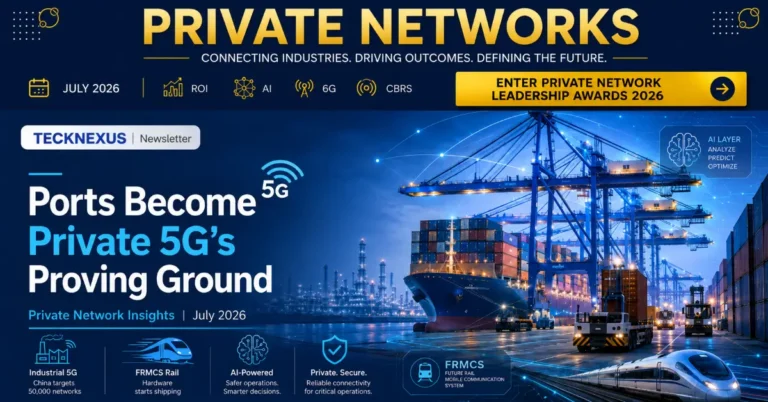
July 2026's roundup: ports deliver this month's deepest deployment evidence, China sets a 50,000-network industrial 5G target, FRMCS rail hardware starts shipping, and private networks add an AI layer across safety and heavy industry.
Deciding how to structure your private network deployment is as important as picking the technology. TeckNexus's free Architecture Selector asks 15 questions and tells you who should own what, where your data sits, and how to engage vendors — vendor-neutral and free.
The rebranding of O2 Daisy to O2 Business marks a strategic shift in UK enterprise technology. Following the August 2025 merger of Virgin Media O2's B2B division with Daisy Group, the combined entity now offers integrated connectivity, managed IT, and unified communications under a single brand. With 66 per cent of UK business leaders citing growing technology complexity and 30 per cent reporting rising costs as a result, O2 Business is positioning itself as a consolidated alternative to fragmented multi-supplier models — targeting mid-market and enterprise segments across commercial and public sector verticals.
A new alliance between SK Telecom (SKT), Arm, and Rebellions targets the fast-growing AI inference market with a server platform designed for sovereign AI and telecom-grade data centers. SKT will validate a new AI server that combines Arm’s AGI CPU—its first Arm-designed data center processor, based on Neoverse CSS V3—with Rebellions’ RebelCard inference accelerator in live AI data center environments. The partners will co-develop the full software stack, from firmware up, and test telco-specific models and large-scale workloads, including SKT’s proprietary foundation model, A.X K1. Industry focus is shifting from training to inference at scale, where energy, latency, and total cost of ownership (TCO) are decisive.
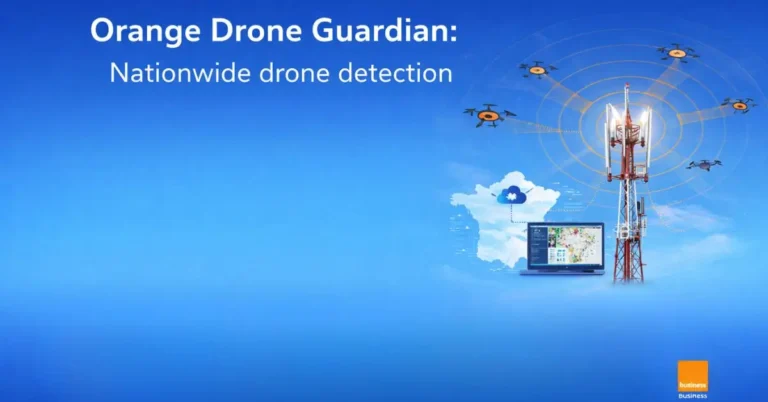
Orange Business has launched Orange Drone Guardian, a counter‑UAS service that turns telco infrastructure into a nationwide sensing fabric—arriving as drone activity, regulation, and critical-infrastructure risk converge. Orange is leveraging assets few others can: secure nationwide connectivity, cloud qualified to ANSSI’s SecNumCloud 3.2 standard, a domestic security operations capability, and a tower footprint via TOTEM’s 19,700 sites across France. The offer combines sensors, command‑and‑control software, secure cloud, and managed operations in a subscription bundle designed to scale and evolve. Delivered as a subscription, customers gain real‑time situational awareness without large upfront capex.
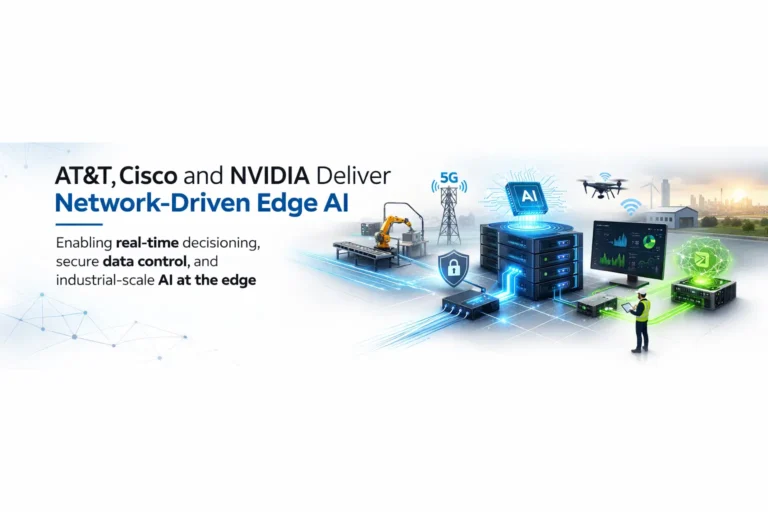
AT&T’s new collaboration with Cisco and NVIDIA signals a decisive shift from cloud-centric AI to network-driven edge intelligence for enterprise operations. Enterprises want real-time decisioning without shipping sensitive data to distant clouds, and operators need a scalable way to deliver it. By combining AT&T’s dedicated IoT core with Cisco’s mobility services platform and NVIDIA-powered AI infrastructure, the trio is packaging deterministic connectivity, near-device inference, and policy enforcement into a single, operator-grade platform. The promise: lower latency, tighter data control, and a path to production for AI at industrial scale.
AT&T’s five-year, $250 billion U.S. network commitment sets the tone for the next phase of fiber, 5G, and satellite convergence as traffic, AI workloads, and resilience requirements climb sharply. The 2026–2030 window aligns with the industry’s transition into 5G-Advanced (3GPP Release 18/19), the scaling of edge AI, and increased cloud traffic between homes, enterprises, and hyperscalers. Data growth is no longer linear, and the cost of downtime is rising. Large, front-loaded builds in fiber and 5G Radio Access Network (RAN), paired with new satellite overlays, are how national carriers will chase coverage, performance, and reliability targets simultaneously.
Frequently Asked Questions
About our tools, how they are built, and how to get involved.
TeckNexus Independent Tools
TeckNexus independent tools are assessments, selectors, ROI calculators, and AI prioritisation tools developed entirely by TeckNexus. The methodology, scoring logic, and outputs are owned by TeckNexus — no vendor funds, influences, or has visibility into individual results. They are free to complete. Accessing the full output and PDF report requires registration.
No. TeckNexus owns the methodology, scoring, and output logic for all independent tools. No vendor has paid to influence recommendations or results. If a vendor is referenced in an output — for example, as a category of solution — it is because the evidence supports it, not because of a commercial relationship.
Registration allows TeckNexus to generate and deliver a personalised PDF report, track your results if you return, and — with your permission — notify you of updated benchmarks or relevant intelligence. Registration is free. Your data is not shared with any vendor without your explicit consent.
Individual submission data is held by TeckNexus and not shared with any third party without your explicit consent. Aggregated and anonymised data may be used to produce industry benchmark reports. No personally identifiable information is included in any published output.
All tools labelled TeckNexus in the directory — including the Private Network Technology Selector, Private Network Architecture Selector, AI Use Case Prioritisers (Manufacturing, Mining, Ports, Airports, Utilities), and the Private Network ROI Calculators (Manufacturing, Mining). More tools are added regularly.
Co-Developed & Sponsored Tools
Co-developed tools are built by TeckNexus in partnership with an industry sponsor. The sponsor co-funds development and is clearly disclosed on the tool. TeckNexus owns the methodology, platform, and output logic — the sponsor does not influence scoring or results. These tools are free for users to complete.
Your contact details may be shared with the named sponsor — but only with your explicit consent at the point of form submission. Your results and individual response data are not shared. The consent step is clearly presented before submission.
No. Sponsorship funds the development and hosting of the tool — it does not influence the methodology, scoring, or outputs. TeckNexus retains full editorial control. Sponsored tools go through the same methodology review as independent tools.
Yes. TeckNexus works with vendors, operators, and industry bodies to co-develop tools that serve enterprise decision-makers. Use the partner enquiry form on this page to tell us what you have in mind — tool category, target vertical, and what you are trying to achieve. We will get back to you to discuss fit and next steps.
Third-Party Tools (Curated Directory)
Third-party tools are ROI calculators, TCO models, decision aids, and planning resources produced by vendors, operators, or industry bodies. They are included in the TeckNexus directory because they offer genuine utility to enterprise decision-makers — but they are clearly labelled as vendor-produced. TeckNexus curates the directory and does not endorse any individual tool or vendor.
Tools are assessed for relevance, utility, and credibility. We look for tools that offer meaningful input fields and substantive outputs — not marketing calculators with fixed results. Listing is not paid placement. Any vendor can submit a tool for consideration using the form on this page.
Standard directory listings are unpaid. TeckNexus does not accept payment to influence which third-party tools are listed or how they are described. Separate commercial arrangements exist for co-developed and sponsored tools, which are clearly labelled as such.
Use the tool submission form at the bottom of this page. You will need to provide tool details, vendor information, and confirm that you are authorised to submit on behalf of the organisation. TeckNexus reviews all submissions before listing.
Vertical Intelligence Platforms (Paid)
Each Vertical Intelligence Platform is a structured set of 25+ decision cards built from TeckNexus analysis of real enterprise private network deployments. They cover a specific industry — Manufacturing, Mining, Ports, Airports — and are organised into six sections: vertical overview, business priorities and use cases, private wireless strategy, proof and ecosystem, decision framework, and deployment readiness. They are updated continuously as new deployments emerge.
A subscription to one vertical gives you access to all 25+ decision cards for that industry, continuous updates as new deployments are analysed, and the ability to share access across your team. Each card is structured around a specific decision — use case selection, vendor shortlisting, deployment model, ROI prioritisation — so you can navigate directly to what you need.
A research report gives you a snapshot at a point in time. The Vertical Intelligence Platform is continuously updated and structured around decisions, not narrative. Instead of reading a 60-page PDF, you navigate directly to the card relevant to your current question — vendor selection, use case validation, deployment model — and get evidence-backed guidance without the research overhead.
No. Each vertical is subscribed to separately at $1,200 per year. This keeps pricing proportionate to what you actually need. If you require multiple verticals, contact us to discuss multi-vertical access.
Yes. Each vertical has a sample platform available — accessible from the tool cards on this page. The sample gives you a representative selection of decision cards so you can assess the depth and format before committing.
The platforms are built for enterprise technology and operations teams evaluating private network investment, vendors building go-to-market strategies for specific industries, and consultants or system integrators advising clients on deployment options. They are also used by telcos and managed service providers tracking enterprise buyer priorities by vertical.
Your Brand. Our Intelligence Tools.
Capture leads at the point of evaluation. Talk to Us →
Showing Slide 1 of 4: Private Network Innovation and Ecosystem Solutions
Scroll to Top
We use cookies to ensure that we give you the best experience on our website. If you continue to use this site we will assume that you are happy with it.OkPrivacy policy