Broadband

June 2026 showed agentic AI scaling from pilot to platform: industry-wide standards momentum, AI-RAN field trials from Nokia, Amdocs and KDDI, and fresh capital across data centers on three continents. This full roundup covers every deployment, partnership, funding round and governance move from the month, with tools to prioritise AI use cases and plan the network around them.
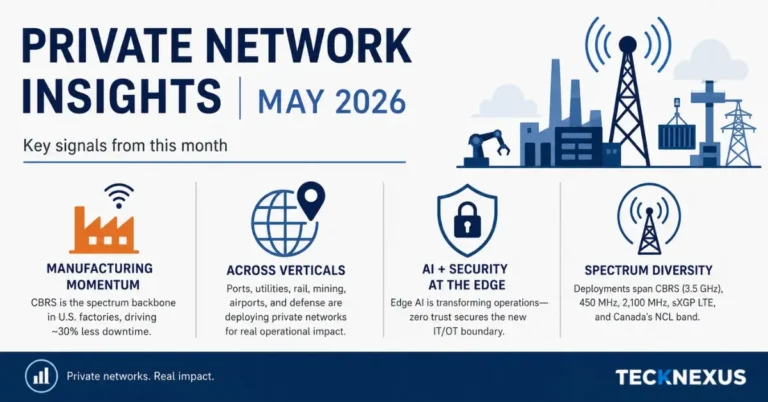
Private 5G became an industrial default in May 2026, with CBRS now the U.S. factory spectrum of record. This month's roundup spans deployments across manufacturing, ports, utilities, rail and defence — plus a deep utilities thread on grid AI and security — and what the shift means for buyers scoping spectrum, architecture and security.
Verizon One combines a mobile line and home internet service into a single $70/month all-in price. Here's a breakdown of what's included, why bundled convergence is becoming the industry's default strategy, and what the trend means for connectivity decisions beyond the household market.
SpaceX is evolving from a rocket company into a vertically integrated infrastructure conglomerate with direct implications for satellite connectivity, defense communications, AI, and enterprise network strategy. With a planned $2 trillion Nasdaq IPO targeting $75 billion in capital, over $6 billion in cumulative U.S. government contracts, and Starlink expanding as a tier-one connectivity layer, SpaceX is positioning itself as a direct competitor in telecom markets. Telecom operators and enterprise IT leaders must stress-test their non-terrestrial network strategies now, before IPO capital accelerates SpaceX's competitive timelines across every market it touches.
China Telecom, China Mobile, and China Unicom have each unveiled token-based service plans, ecosystem alliances, and commercial pricing structures that reframe what it means to be a telecom provider in the AI era. This is not a pilot program or a speculative roadmap. It is a structural shift in how network operators intend to generate revenue, compete for enterprise customers, and position themselves at the center of the AI economy — driven by a greater than 1,000-fold surge in daily token consumption across China between early 2024 and March 2026.
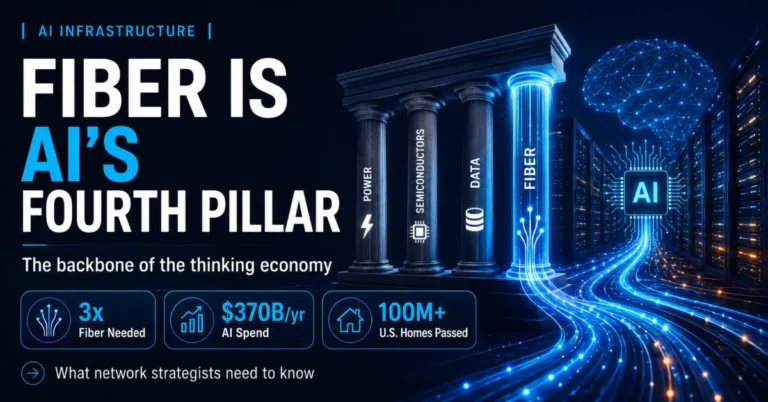
The Fiber Broadband Association's Fiber Connect 2026 conference repositioned fiber as a foundational prerequisite for AI infrastructure — not merely a consumer broadband conduit. With hyperscalers investing $370 billion annually in AI, the FBA projects demand for twice as many fiber route miles and three times total fiber deployed today. Over 100 million U.S. homes have now been passed with fiber, yet workforce shortages exceeding 200,000 workers and power constraints threaten deployment velocity precisely when AI-driven demand is accelerating fastest.
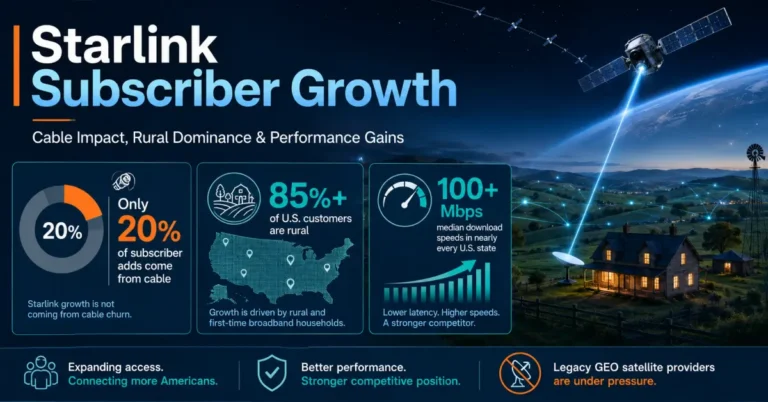
New research from New Street Research and Recon Analytics reveals that despite cable controlling roughly 60% of the US broadband market, only about 20% of Starlink's gross subscriber additions come from cable defectors. More than 85% of Starlink's US customer base is located in rural areas, and a significant share of its growth comes from first-time broadband subscribers. Meanwhile, Starlink's median download speeds now exceed 100 Mbps in nearly every US state, fundamentally shifting its competitive standing in the satellite and terrestrial broadband landscape.
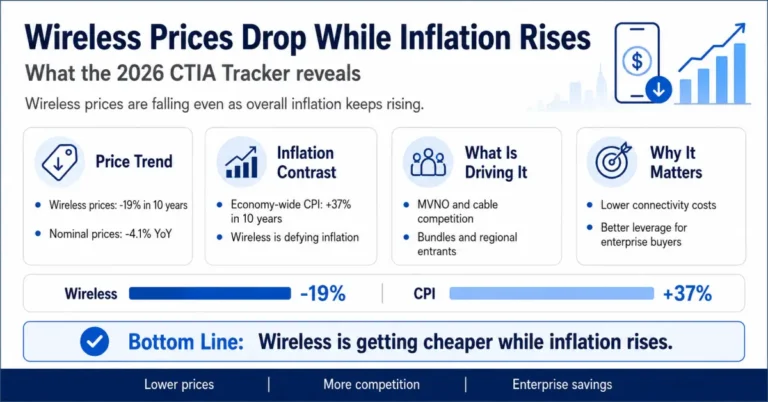
Wireless services are defying U.S. inflation trends in a way virtually no other sector is. According to CTIA's newly released More for Less: 2026 Wireless Affordability Tracker, nominal wireless prices have declined 4.1% over the past year and 19% over the past decade, while the economy-wide CPI rose more than 37% over the same period. Adjusted for inflation, postpaid unlimited plans are down roughly 10% year-over-year, and prepaid options have fallen more than 50% over five years. For enterprise decision-makers, this pricing trajectory represents a structurally favorable condition for mobile workforce and IoT connectivity planning.
Verizon has expanded its satellite asset fleet to 2,600 units in 2025, introducing a multi-orbit off-road trailer capable of switching between GEO and LEO connectivity. The carrier is also piloting permanent satellite backhaul at high-risk cell towers across Georgia, Florida, and the Carolinas. Through a $100 million partnership with AST SpaceMobile, Verizon is advancing direct-to-device satellite connectivity using standard smartphones. Satellite is positioned not as a replacement for fiber or 5G, but as a planned resilience layer and coverage extension tool for enterprise and public safety stakeholders.
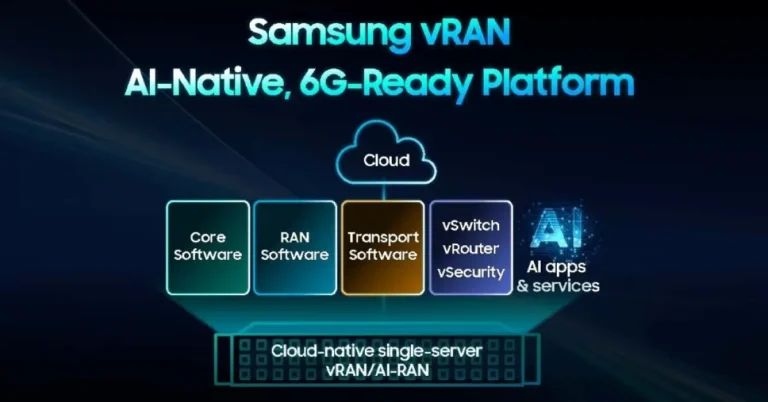
Samsung Electronics and Qualcomm Technologies have jointly validated Power Class 1 capability for 5G Fixed Wireless Access on a virtualized RAN architecture — a combination the industry has not demonstrated before. Testing showed up to ten times higher uplink throughput at the cell edge and up to 40% greater coverage range versus Power Class 1.5. With field trials already underway on a U.S. Tier-1 operator network and commercial availability targeted for 2027, this milestone signals a meaningful shift in uplink performance, coverage economics, and vRAN capability for operators and enterprise buyers alike.
T-Mobile CEO Srini Gopalan admitted during Q1 2026 earnings that its T-Satellite direct-to-device service is seeing far less usage than projected, largely because T-Mobile's terrestrial network leaves few coverage gaps for consumers. With 1.8 million free beta sign-ups failing to translate into strong paid engagement, and Apple's free Globalstar satellite messaging compressing the addressable market, T-Mobile is pivoting toward enterprise connectivity. Its new SuperBroadband offering pairs 5G with Starlink LEO broadband, targeting businesses in healthcare, retail, and energy that require resilient, always-on connectivity across distributed locations.
Verizon posted 55,000 postpaid phone net additions, a modest beat that underscores stabilizing consumer trends and stronger execution in premium plans and broadband cross-sell. The net add beat is small in absolute terms, but strategically important: it points to improving churn and a healthier mix of high-value subscribers after several quarters of intense promotional pressure. Management coupled the result with a constructive outlook characterized by service revenue resilience and disciplined capital intensity, hinting at a tighter or modestly raised full‑year guide. For a market still digesting 5G investment cycles, this steady footing matters more than splashy net‑add gains.

Your Brand. Our Intelligence Tools.

Capture leads at the point of evaluation. Talk to Us →

Sponsored by Palo Alto Networks
⚡ Utilities ⏱ 8 min ✓ Free
This tool is built and hosted by TeckNexus.
Launch Tool →
Whitepaper
This whitepaper explains how utilities can use secure AI-enabled private mobile networks to modernize operations, support distributed intelligence, improve resilience, and strengthen cybersecurity across critical infrastructure. It covers AI applications, private network advantages, zero trust principles, multilayered security architecture, and governance considerations for AI-ready utility environments....
Whitepaper
Non-terrestrial networks are rapidly evolving from experimental satellite systems into an increasingly important part of the global 5G connectivity landscape. This eBook, developed by Radisys in collaboration with TeckNexus, explores how 3GPP standardization, satellite architecture innovation, and software-driven network design are reshaping NTN deployment models. It examines the transition from...
Whitepaper
Private cellular networks are transforming industrial operations, but securing private 5G, LTE, and CBRS infrastructure requires more than legacy IT/OT tools. This whitepaper by TeckNexus and sponsored by OneLayer outlines a 4-pillar framework to protect critical systems, offering clear guidance for evaluating security vendors, deploying zero trust, and integrating IT,...
Scroll to Top