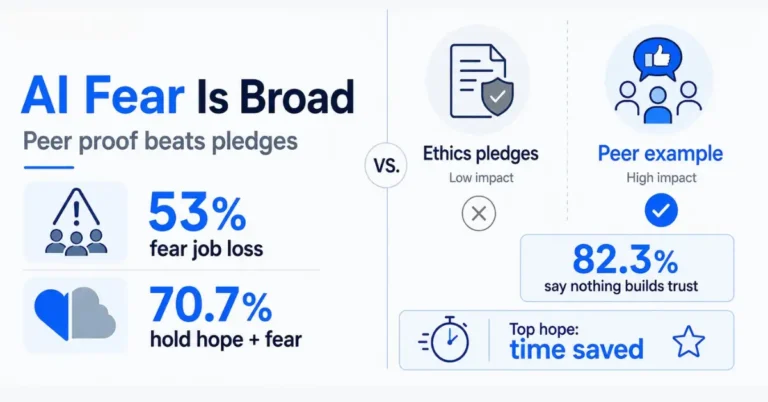
The data published in June 2026 makes that story difficult to sustain. A Reuters/Ipsos poll of 4,531 US adults, conducted over six days in early June, found that 53% of Americans fear AI will put them or someone in their household out of work. That figure was spread evenly across age, gender and education level — which is the part that should give pause to any organisation planning an AI deployment that touches people’s jobs. The worry is not concentrated in the demographics one might predict. It is not primarily older workers, or lower-educated workers, or workers in manual roles. It is broadly human.

More striking still is what a contemporaneous analysis from Recon Analytics, drawing on 137,448 survey responses across the first half of 2026, found when it separated fear from hope. Job loss was the single most commonly named fear among American adults, cited by 30.1%. And that fear barely moved based on who was answering: people who use AI every day and people who have never touched it carry almost exactly the same fears. Fear is not a knowledge deficit that exposure corrects. It is a stable condition, present across income, age, geography and usage level alike.

The AI workforce fear and hope: Two ledgers, not one
The Recon Analytics analysis makes a structural point that matters beyond the headline numbers. Most polling on AI forces respondents to choose between concern and excitement, which produces a single score that buries a more complicated reality. When fear and hope are measured independently, 70.7% of American adults are found to hold at least one specific fear and at least one specific hope simultaneously. They are not of one mind. They keep two ledgers at once, and the ledgers behave entirely differently.
The fear ledger is flat and nearly universal: 88.4% of adults name at least one concern. The three categories of worry are personal autonomy and privacy (78.4%), truth and trust (55.4%) and livelihood (34.3%). What is statistically notable is how little any of these figures vary. A household earning £20,000 and one earning £190,000 fear AI-driven job loss at essentially identical rates. Fear is not the variable that separates the adapters from the holdouts.
The hope ledger is where the country is actually splitting. Hope is unequal, sorted sharply by whether someone uses the technology. The share of Americans holding no hope for AI at all is more than ten times as high among people who have never used AI as among its heaviest users. And hope is not simply waiting to be unlocked by exposure to the tools: among never-users, the share holding no hope rose from 46.7% to 56.6% in ten months — nearly ten percentage points in less than a year. The pool of hardened sceptics is shrinking as the most persuadable people adopt AI, but the remaining pool is becoming more entrenched, not less.

The AI workforce reassurance trap
This is the dynamic that makes the conventional institutional response structurally mismatched to the problem. Responsible-AI statements, trust centres and ethics commitments are broadly aimed at the fear ledger: reducing the perceived risk of AI by demonstrating accountability and care. But fear is the ledger that is not moving. Over half of never-users say they would refuse AI even if it were guaranteed to be risk-free and built specifically for them. Among the hardened non-users, 82.3% report that nothing at all would build their trust in an AI tool. Reassurance reaches people who already hold hope and are likely to adopt AI on their own initiative. It does not move the people whose absence is defining the adoption gap, because risk was never their primary constraint.
Christine Rosen, writing in the National Review, articulates this directly: tech companies would be foolish to think they can resolve public unease through PR alone. The unease has deeper roots than messaging can reach. Framing the public’s concern as a communications failure is itself a misreading of what the data shows.
What the data shows instead is that the persuasion mechanism that does work is concrete and interpersonal. Being shown how AI helped a real person with a real task cuts the no-hope rate among hardened sceptics roughly in half. A recommendation from a family member, a friend or a coworker is the only trust lever that registers with the hardened. The industry’s most effective vehicle for reaching the reluctant is not its communications function. It is the people already inside the building who have found something useful in the technology and can speak to it honestly.
What the AI workforce fear is actually about
The Reuters/Ipsos poll recorded a macro context that sits behind the individual fear: in May 2026 alone, AI was attributed to more than 38,500 announced job cuts across the US, accounting for 40% of all cuts that month. Goldman Sachs has estimated AI is eliminating roughly 16,000 US jobs per month, with entry-level workers and younger cohorts absorbing the heaviest impact. Tech sector layoffs through May 2026 had already exceeded 115,000 — approaching the full-year total from 2025 — with major companies explicitly citing AI-driven efficiency as the driver.
The public’s concern about AI job displacement is not, in this context, a misapprehension to be corrected. It is a reasonable inference from observable events. The fear exists on a separate ledger from the hope precisely because both can be justified simultaneously: AI may save someone time and reduce their stress while eliminating a colleague’s role. Many of the 70.7% holding both fears and hopes simultaneously are not confused. They are accurately describing the technology’s actual character.
The most commonly held hope in the country, meanwhile, is not transformational. It is not curing disease, solving climate change or generating abundance. It is, at 31% of respondents, that AI will save people time and reduce stress. The public is not waiting to be sold a civilisational promise. It is waiting, more modestly, for something small that demonstrably works on a problem it actually has.
The enterprise implications of AI workforce tools adoption
For organisations deploying AI into existing workforces — whether in industrial settings, professional services, logistics, healthcare or any sector where AI tools are being rolled out to people who did not ask for them — the data reframes the task. AI adoption inside organisations is not primarily a communications problem. It is a change management problem, and the available evidence about what changes minds points away from the tools that institutional communications typically reaches for.
The headline implication: investment in responsible-AI pledges and safety documentation, while appropriate on governance grounds, should not be expected to move workforce adoption curves. The workers who are hardening against AI are not waiting for a safety commitment. They are waiting for a credible peer to show them something concrete that made a difference to a problem they recognise. That puts the real adoption leverage inside the organisation — in the early adopters who can speak honestly to their experience — rather than in any external message the organisation broadcasts about its AI values.
The urgency implication: the window for shifting the hardening cohort is not expanding. Among never-users, hopelessness has risen ten percentage points in ten months. The pool is shrinking as the persuadable adopt, but those who remain are becoming more difficult to reach, not less. Organisations that treat workforce AI adoption as something that will resolve itself as the technology improves are misreading both the trend and the mechanism.
None of this diminishes the legitimate workforce concerns that underlie the fear figures. In an environment where AI-related job cuts are running at 40% of all announced cuts in a single month, the fear of displacement is grounded in real events rather than exaggerated perception. The more useful framing for enterprises is to distinguish between the workers whose concerns are about specific job security risks — a question that demands honest operational answers, not communications management — and those whose reluctance is about unfamiliarity with tools that have not yet delivered anything tangible to them. The second group is reachable. The first group deserves a different conversation entirely.
| Related Tool
Evaluating AI use cases against your workforce’s readiness to adopt them? Workforce readiness is one of the dimensions that shapes whether an AI use case delivers its projected value or stalls at the proof-of-concept stage. The TeckNexus AI Use Case Prioritisers assess candidate AI applications across your specific vertical environment — covering strategic fit, operational readiness and expected value — so deployment decisions start from a structured analysis rather than the use cases that generate the most enthusiasm in vendor briefings. Run the AI Use Case Prioritiser for industry verticals. Explore all tools at tecknexus.com/intelligence/ → |