
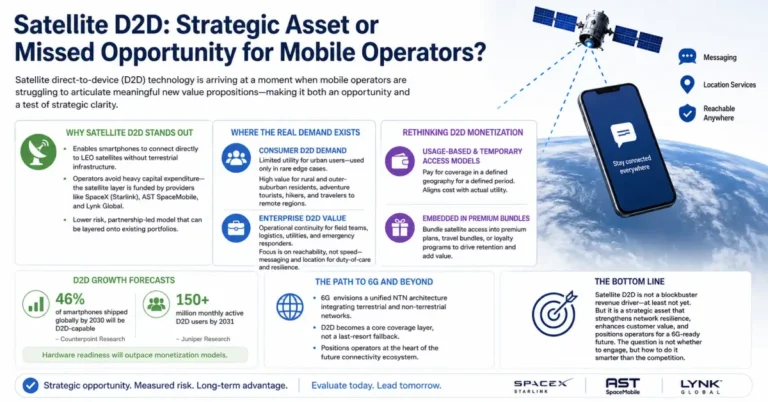
Satellite D2D: Strategic Asset or Missed Opportunity for MNOs?
Satellite D2D offers MNOs a rare, low-CapEx differentiator. But unlocking its value demands smarter monetization, targeted verticals, and a long-term NTN strategy.


Satellite D2D offers MNOs a rare, low-CapEx differentiator. But unlocking its value demands smarter monetization, targeted verticals, and a long-term NTN strategy.
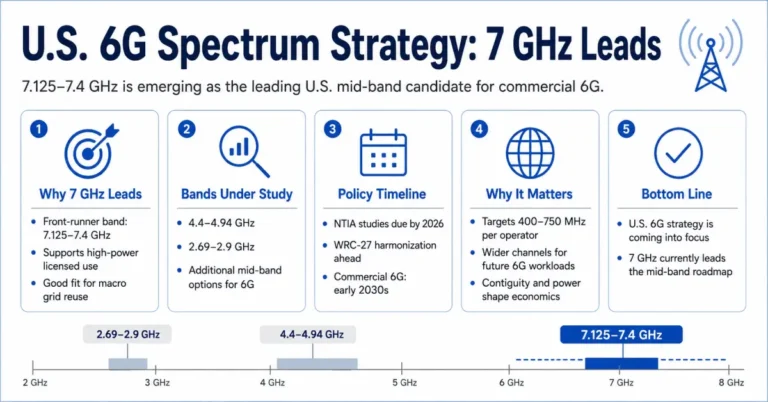
Washington and industry have synchronized timelines and targets to identify, clear, and harmonize the mid-band spectrum that will underpin commercial 6G deployments in the early 2030s. The Administration’s National Security Presidential Memorandum on 6G directs NTIA to reallocate 7.125–7.4 GHz for full‑power, licensed commercial use and to study federal relocation to 7.4–8.4 GHz where feasible; it also orders immediate feasibility studies in 2.69–2.9 GHz and 4.4–4.94 GHz. The 7.125–7.4 GHz range is the U.S. front‑runner for high‑power licensed 6G, with NTIA studying federal relocation to clear contiguous bandwidth and enable 400–750 MHz per operator in a single swath.

Map your private mobile network security gaps to real threat scenarios – Salt Typhoon, Volt Typhoon, AI data poisoning, rogue devices, unencrypted OT — with a prioritised action plan.
You’ll need: your security posture picture and OT environment basics.
Produces: a tiered score and prioritised action plan.
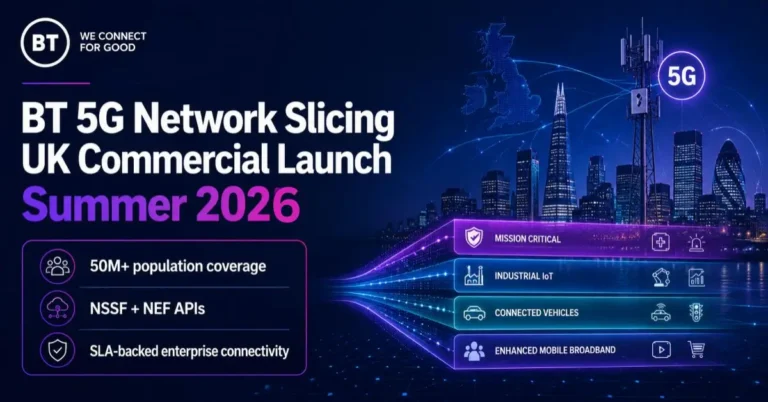
BT is set to launch commercial 5G network slicing services before the end of summer 2026, marking a significant milestone for the UK’s 5G Standalone market. Built on Ericsson’s dual-mode 5G Core and underpinned by dynamic slice selection via NSSF and programmable network access through NEF APIs, BT’s offer targets both enterprise and consumer segments. With 5G SA coverage already reaching 50 million people and a 90% population threshold defining national availability, BT is positioning slicing as a credible, SLA-backed connectivity service — not a proof-of-concept.

The NVIDIA-IREN partnership, announced May 7, 2026, commits both companies to jointly deploying up to 5 gigawatts of NVIDIA DSX-aligned AI factory infrastructure across IREN’s global data center pipeline. A five-year, $3.4 billion managed GPU cloud services contract anchors the deal, alongside a warrant granting NVIDIA rights to purchase up to 30 million IREN shares. The Sweetwater campus in Texas serves as the reference implementation for NVIDIA’s DSX architecture, signaling a new phase of vertically integrated, gigawatt-scale AI infrastructure planning that is reshaping competitive dynamics across hyperscalers, telecom operators, and enterprise IT.

Verizon has expanded its satellite asset fleet to 2,600 units in 2025, introducing a multi-orbit off-road trailer capable of switching between GEO and LEO connectivity. The carrier is also piloting permanent satellite backhaul at high-risk cell towers across Georgia, Florida, and the Carolinas. Through a $100 million partnership with AST SpaceMobile, Verizon is advancing direct-to-device satellite connectivity using standard smartphones. Satellite is positioned not as a replacement for fiber or 5G, but as a planned resilience layer and coverage extension tool for enterprise and public safety stakeholders.
Samsung Electronics and Qualcomm Technologies have jointly validated Power Class 1 capability for 5G Fixed Wireless Access on a virtualized RAN architecture — a combination the industry has not demonstrated before. Testing showed up to ten times higher uplink throughput at the cell edge and up to 40% greater coverage range versus Power Class 1.5. With field trials already underway on a U.S. Tier-1 operator network and commercial availability targeted for 2027, this milestone signals a meaningful shift in uplink performance, coverage economics, and vRAN capability for operators and enterprise buyers alike.

Deutsche Telekom’s transition from Ericsson to Mavenir as its primary 5G standalone core provider represents a fundamental rethinking of how Tier 1 operators architect and operate networks in the cloud-native era. Mavenir now carries all standalone 5G traffic in Germany, while Ericsson handles legacy 4G and non-standalone 5G. Driven by the Horizontal TelCo Cloud initiative, the shift has already produced measurable results including 65% energy savings in live testing and three commercial network slicing deployments, with Apple FaceTime set to leverage these capabilities at consumer scale via iOS 26.
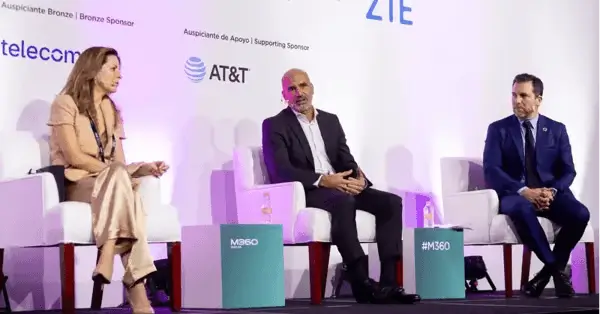
More than 70 CEOs, government authorities, and experts from across the region will be part of the agenda. London, May 5, 2026 – In the lead-up to the region’s biggest football event, Mexico City will also host one of the most important gatherings of the digital ecosystem: M360 LATAM, in partnership with the Latin American Congress of Digital Transformation (CLTD). Taking place on 13-14 May at the Hyatt Regency Mexico City in Polanco, online registration is free and open now. With a nod to the global football spotlight, M360 LATAM will explore “Strategies to Win in the Digital Era” through panels on