Telco and Tech News and Insights

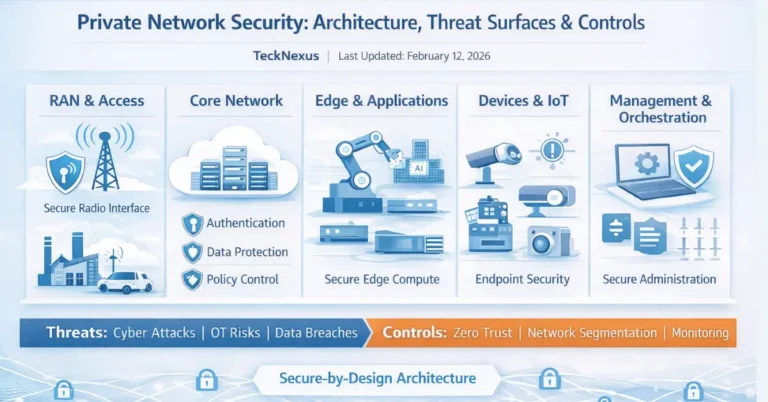
Private Network Security: Architecture, Threat Surfaces & Controls

Private Network Security: Architecture, Threat Surfaces & Controls

Private LTE and 5G networks introduce new security challenges as they become the foundation for industrial automation, critical infrastructure, and enterprise campuses. Unlike Wi-Fi and traditional IT networks, private cellular environments blend telecom infrastructure, IT systems, and operational technology, creating distinct threat surfaces across the RAN, core, edge, devices, and management planes. This article establishes a security-first architectural lens for private LTE/5G, explaining who needs it, where risks emerge, and what secure-by-design looks like before moving into Zero Trust and implementation frameworks.

Read More »
Singapore Thwarts UNC3886 Telco Attack, Boosting Telecom Security

Singapore Thwarts UNC3886 Telco Attack, Boosting Telecom Security

Singapore has confirmed an attempted cyber‑espionage campaign against its national telecom backbone, highlighting a rising class of APT activity aimed at network devices and virtualized cores rather than traditional IT endpoints. Singapore’s Cyber Security Agency (CSA) and Infocomm Media Development Authority (IMDA) disclosed that all four major operators—Singtel, StarHub, M1 and Simba Telecom—were targeted by UNC3886 in incidents last year. The threat actor gained limited access to segments of telco systems and exfiltrated a small volume of network‑related technical data. There was no service disruption, no personal data exposure and, critically, sensitive and segregated systems (including 5G networks) were not

Read More »
Nexstar–Tegna Merger: Trump Endorsement, FCC Hurdles

Nexstar–Tegna Merger: Trump Endorsement, FCC Hurdles

A surprise endorsement from President Trump has thrust Nexstar’s proposed takeover of Tegna back into the spotlight, with implications that cut across broadcast consolidation, streaming competition, and FCC ownership policy. After criticizing large media combinations late last year, the President is now urging regulators to approve Nexstar’s bid for Tegna, framing it as a way to bolster competition against national TV networks and Big Tech platforms. Regulatory outcomes hinge on how the FCC treats national reach limits, market overlaps, and public‑interest conditions. The combined footprint would touch a supermajority of U.S. TV households—well beyond today’s national audience reach cap absent

Read More »
Imec €2.5B semiconductor push: sub-2nm NanoIC pilot

Imec €2.5B semiconductor push: sub-2nm NanoIC pilot

Imec is scaling its R&D footprint and inaugurating a NanoIC pilot line to accelerate sub‑2nm and 3D system innovation under a roughly €2.5 billion European semiconductor push. Imec, the Leuven-based semiconductor research hub, is expanding lab capacity and bringing a new NanoIC pilot line online to speed learning cycles for logic beyond 2nm and advanced 3D integration. The goal is clear: shorten the path from materials and device research to system‑level demonstrators that de-risk future foundry nodes and packaging flows. For vendors and operators, this is about getting sooner access to manufacturable building blocks—ultra‑efficient logic tiles, memory stacks, and optical

Read More »
Virgin Media O2 Uses AI for Mobile Network Monitoring

Virgin Media O2 & Zinworks Uses AI for Mobile Network Monitoring

Virgin Media O2 has broadened its partnership with Zinkworks to deploy AI-driven monitoring and automation across its mobile footprint, designed to spot anomalies earlier, resolve incidents faster, and prevent customer-impacting outages. The rollout targets multiple network domains and operational workflows, advancing the operator’s move toward autonomous operations with engineers maintaining full oversight. The capabilities span radio access, core network systems, and network operations centers, combining real-time telemetry with intelligent automation. The stack runs on Google Cloud and taps services such as Vertex AI and Gemini to analyze patterns, orchestrate responses, and augment decision-making for operations teams.

Read More »
Deutsche Telekom Industrial AI Cloud in Munich

Deutsche Telekom Industrial AI Cloud in Munich

Deutsche Telekom and T-Systems have switched on a sovereign, NVIDIA-powered AI factory in Munich’s Tucherpark, positioning Germany as a serious contender in industrial AI infrastructure. The new facility brings nearly 10,000 NVIDIA Blackwell GPUs online, including DGX B200 systems and NVIDIA RTX Pro Server GPUs, delivering up to 0.5 exaFLOPS of AI compute for training, fine-tuning, and large-scale inference. Operated by T-Systems on German soil, the platform targets industry, research, startups, and the public sector with strict controls for data protection, security, and availability. Early customers include Agile Robots, which is combining vision, robotics, and foundation models, and PhysicsX, which

Read More »
Microsoft, IMDA AI QuickStart for Singapore enterprises

Microsoft, IMDA AI QuickStart for Singapore enterprises

Microsoft’s AI QuickStart, backed by IMDA and UOB, aims to turn generative AI intent into production outcomes in weeks, not years. AI QuickStart targets “Digital Leaders” in Singapore—SMEs and larger non-ICT enterprises that have already built basic digital capabilities and can fund transformation—by offering a fast, structured path to deploy enterprise AI. Each engagement is designed to finish within three months with a cost cap of up to S$20,000 per project, covering cloud, compute, and professional services, which directly addresses executive concerns over unpredictable pilot spend and elongated proofs-of-concept.

Read More »
Qualcomm hit by AI-driven smartphone memory crunch

Qualcomm hit by AI-driven smartphone memory crunch

An AI‑fueled land grab for advanced memory is squeezing supply for handsets, undercutting Qualcomm’s near‑term outlook even as end‑demand for premium Android devices improves. Memory suppliers are prioritizing high‑bandwidth memory (HBM) and DDR5 for AI accelerators and data center servers, diverting wafer capacity and capex away from mobile‑grade LPDDR5/5X and UFS storage. The result is a classic allocation cycle: supply chases the highest‑margin demand (HBM and enterprise SSDs), while downstream categories like smartphones and some edge devices face tighter availability and rising component costs. For Qualcomm, whose Snapdragon platforms anchor premium Android devices, the constraint limits upside volume and mix

Read More »
OpenAI Frontier: Enterprise AI Agent Management

OpenAI Frontier: Enterprise AI Agent Management

OpenAI introduced Frontier as an enterprise platform to build, govern, and monitor AI agents—positioning agent management as core infrastructure rather than a feature. Frontier is an end-to-end platform for creating and managing AI agents that can connect to external data and applications, execute tasks, and operate under enterprise controls. OpenAI is emphasizing an open architecture: organizations can manage agents built on Frontier and agents constructed with third-party frameworks.

Read More »

Partner Hubs

Download content, access intelligence tools, and hear from executives.

Partner Events

  • M360 ASEAN
  • FutureNet Asia 2026
  • Network X Vienna 2026
Scroll to Top