Telco and Tech News and Insights

KDDI & Nokia: Quantum-Safe Optical Transport for AI DCI

KDDI & Nokia: Quantum-Safe Optical Transport for AI DCI

KDDI and Nokia validated quantum-safe optical transport at KDDI’s new Sakai Data Center, a facility built to support real-time AI training, inference, and analytics. The demonstration used Nokia’s 1830 Photonic Service Switch with C+L band capabilities for capacity scaling and the 1830 Security Management Server for centralized key and policy control. The goal is clear: deliver high-throughput, low-latency, and line-rate encrypted data center interconnect (DCI) that is resilient against both today’s threats and tomorrow’s quantum-era risks. Encrypting at the optical layer removes the performance penalties of application or IP-layer encryption and avoids fragmenting security by workload.

Read More »
Infosys and Anthropic Claude: AI Agents for Telecom

Infosys and Anthropic Claude: AI Agents for Telecom

A new partnership between Infosys and Anthropic brings agentic AI into regulated, process-heavy industries, with telecom squarely in scope. Infosys will integrate Anthropic’s Claude models and Claude Code with its Topaz portfolio to build and operate enterprise-grade AI solutions across telecom, financial services, manufacturing, and software engineering. The collaboration emphasizes agentic AI—systems that can plan, call tools, and execute multi-step workflows with oversight—delivered with the controls, auditability, and policy enforcement that regulated sectors demand. Pairing Infosys’s domain depth with Claude’s reasoning and long-context capabilities gives operators a path to pragmatic automation that respects regulatory, safety, and transparency requirements.

Read More »
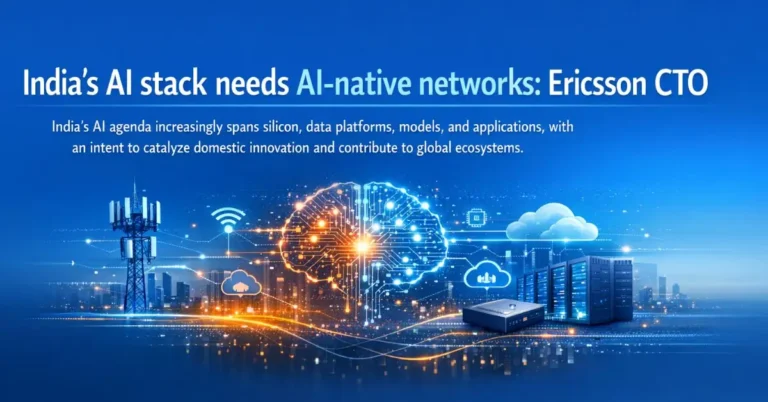
India’s AI stack needs AI-native networks: Ericsson CTO

India’s AI stack needs AI-native networks: Ericsson CTO

India’s AI agenda increasingly spans silicon, data platforms, models, and applications, with an intent to catalyze domestic innovation and contribute to global ecosystems. For telecom leaders, the message is clear: AI is not a bolt-on capability but a system-level transformation that touches RAN, core, transport, cloud, and the enterprise edge. The AI economy runs on connectivity—low-latency access to data, assured bandwidth, location-aware processing, and programmable control. The operators that can fuse connectivity, compute, and data into a cohesive platform will set the pace for India’s next wave of digital growth.

Read More »
OpenAI AI Devices: Multimodal Hardware Roadmap

OpenAI AI Devices: Multimodal Hardware Roadmap

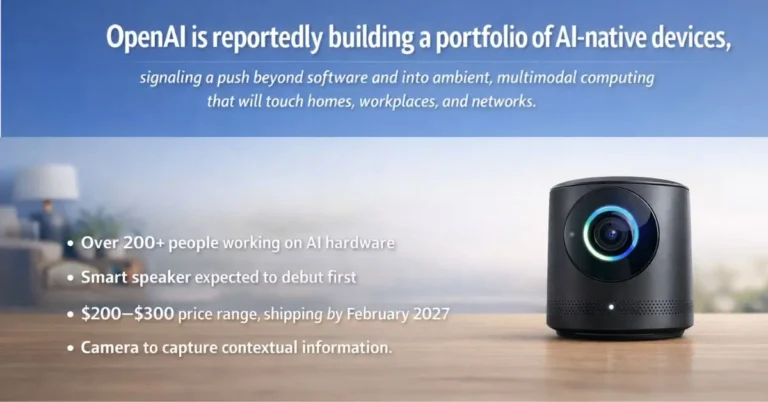
OpenAI is reportedly building a portfolio of AI-native devices, signaling a push beyond software and into ambient, multimodal computing that will touch homes, workplaces, and networks. Multiple reports indicate OpenAI has over 200 people developing a family of AI-enabled hardware, with a smart speaker expected to debut first. Early guidance points to a price in the $200–$300 range and a ship window no earlier than February 2027. The device is said to include a camera to capture contextual information about users and surroundings—an explicit bet on multimodal AI that fuses voice, vision, and environment for richer interactions.

Read More »
Ericsson and Mistral AI: Telco-Grade Network Automation

Ericsson and Mistral AI: Telco-Grade Network Automation

Ericsson and Mistral AI are aligning telecom-grade engineering with customizable foundation models to push AI deeper into network operations and RAN automation. The pairing marries Mistral AI’s fast-evolving model stack with Ericsson’s domain expertise across radio, cloud-native networking, and service management. For European operators, it signals a path to AI capabilities that respect data residency, security, and compliance expectations under the EU AI Act without ceding control to generic, hyperscaler-led platforms. The outcome operators want is simple: measurable gains in performance, efficiency, and resiliency with governance baked in.

Read More »

Private Network Security Ecosystem

Private LTE, 5G, and CBRS networks are becoming the backbone of industrial operations. This article maps private network security vendors to a Four Pillars framework—Core Controls, Device Visibility, Detection & Response, and Orchestration—revealing where structural gaps emerge in real-world industrial deployments. From slice isolation and SIM lifecycle governance to OT micro-segmentation and SOC integration, it explains why layered enforcement—not vendor breadth—determines private 5G security resilience.

Read More »
Monitoring, Assurance & Testing for Private LTE/5G

Monitoring, Assurance & Testing for Private LTE/5G

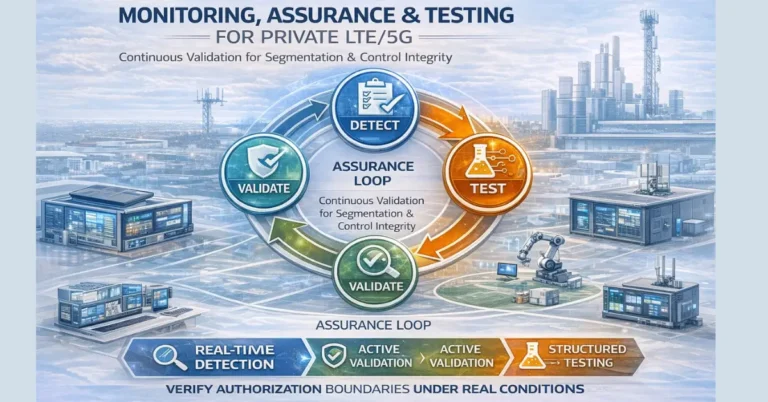
Private LTE and 5G security does not fail because of flawed architecture—it fails when enforcement controls degrade silently. This guide explains how enterprises implement continuous monitoring, assurance, and testing loops across control-plane signaling, user-plane routing, identity governance, and industrial OT environments. Learn how to validate segmentation integrity, detect policy drift, test Zero Trust enforcement, and produce audit-ready evidence across multi-site private cellular deployments.

Read More »
Device Identity, OT & IoT Security in Private Cellular Networks

Device Identity, OT & IoT Security in Private Cellular Networks

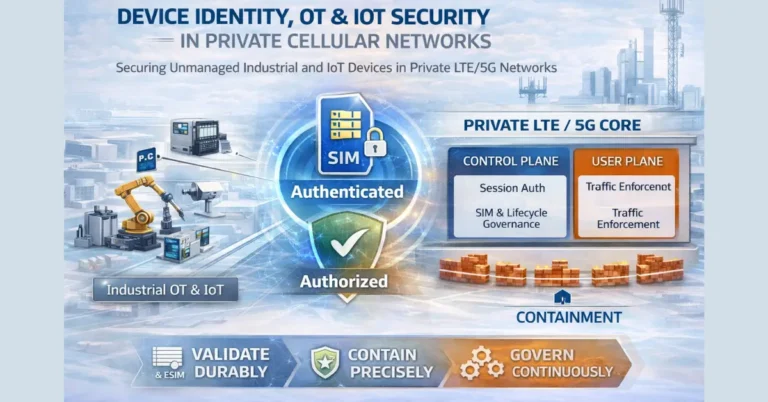
Private LTE and 5G networks strengthen authentication at the transport layer—but device identity, lifecycle governance, and OT/IoT realities determine whether containment holds. This in-depth guide explains SIM and eSIM authentication models, service-profile authorization, identity drift risks, industrial gateway mediation, and Zero Trust containment strategies across multi-site private cellular deployments.

Read More »
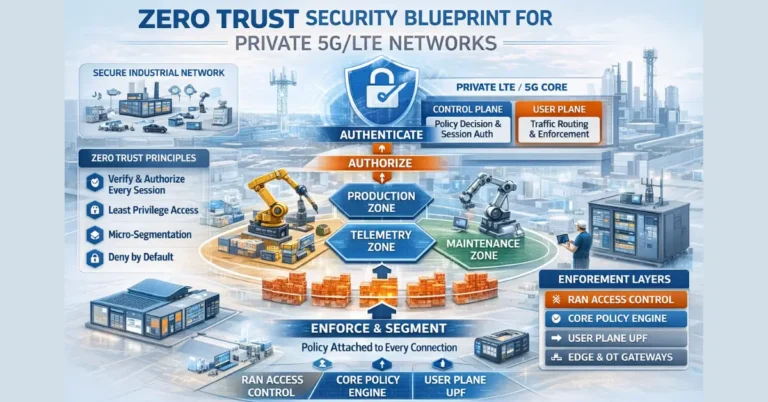
Zero Trust Security Blueprint for Private 5G/LTE Networks

Zero Trust Security Blueprint for Private 5G/LTE Networks

This Zero Trust security blueprint for Private LTE and 5G networks explains how session-based authorization, control-plane policy decisions, and user-plane enforcement create deterministic micro-segmentation across industrial and OT environments. Mapping private cellular architecture to NIST SP 800-207, the article details how operational zones, service profiles, and containment principles protect production-critical systems under mobility and scale.

Read More »
UK Online Safety Act: AI Chatbot Rules, Youth Social Media Curbs

UK Online Safety Act: AI Chatbot Rules, Youth Social Media Curbs

The UK government signalled a rapid escalation of online safety measures that will bring AI chatbots squarely under the Online Safety Act and could introduce an under‑16 social media ban as early as this year. Ministers plan to amend the Online Safety Act 2023 so one‑to‑one interactions with AI systems fall within scope of illegal and harmful content controls. The government wants providers of large language model (LLM) assistants and agentic chatbots to implement safety‑by‑design, including stronger filtering, red‑teaming, abuse detection, and rapid takedown procedures for sexualised or otherwise illegal outputs.

Read More »

Partner Hubs

Download content, access intelligence tools, and hear from executives.

Partner Events

  • M360 ASEAN
  • FutureNet Asia 2026
  • Network X Vienna 2026
Scroll to Top