5G and Public Safety – Top 10 Use Cases enabling First Responders to SAVE MORE LIVES

We all know how first responders — firefighters, law enforcement, and emergency medical service personnels risk their lives everyday, to save ours. They are the real heroes. And in times of global corona pandemic, we have come to appreciate their value even more.

Introduction: 5G and Public Safety – Transforming First Response Operations

In our rapidly evolving world, the role of first responders — firefighters, law enforcement officers, and emergency medical service personnel — has never been more critical. These brave individuals risk their lives daily to ensure our safety, a fact that has been highlighted during the global coronavirus pandemic. Their heroism is unquestionable, yet they face a significant challenge: accessing critical, real-time information in the field. This is where the transformative power of 5G technology comes into play.

5G Characteristics: Enhancing Real-Time Response Capabilities

5G, with its revolutionary characteristics, is set to redefine public safety and dramatically enhance the capabilities of first responders. Its high throughput capacity, capable of reaching up to 10 Gigabits per second, ensures the rapid transmission of large amounts of data. The ultra-low latency of as low as 1 millisecond, coupled with a high-reliability rate of 99.999% availability, enables real-time communication and decision-making. Furthermore, its ability to support massive connectivity, with 100 times more connected devices per unit area compared to 4G, and better user mobility at speeds up to 500 km/hour, greatly expands the operational scope of emergency services.
Top 10 Use Cases of 5G in Public Safety


1. Finding Missing Persons in Emergencies via 5G Enabled Drones

5G technology significantly enhances the capabilities of drones in search and rescue operations. These advanced drones, equipped with high-resolution cameras and real-time data processing, can cover vast areas quickly, identifying missing persons in emergencies with greater efficiency. The low latency and high-speed data transfer of 5G enable real-time image and video analysis, making it possible for rescue teams to receive instant updates and precise locations. This technology is particularly useful in challenging terrains or during adverse weather conditions, where traditional search methods are less effective.

2. Active Shooter Alert with Location & Weapon Info to First Responders

In critical situations like active shooter incidents, 5G can play a pivotal role in enhancing public safety. By integrating 5G with existing camera systems and artificial intelligence, it’s possible to quickly identify the location of the shooter, the type of weapon used, and the dynamics of the situation. This real-time information can be relayed to first responders, enabling them to respond more effectively and safely. Such systems can also help in crowd management and evacuation procedures, minimizing the risk to civilians and law enforcement personnel.

3. Delivering Medical Equipment to Remote Areas via 5G Enabled Drones

5G’s high bandwidth and low latency capabilities are revolutionizing medical aid delivery, especially in remote or inaccessible areas. Drones enabled with 5G can transport essential medical supplies, such as medications, vaccines, or even small medical equipment, to areas where traditional delivery methods are slow or impractical. This not only speeds up the delivery process but also ensures that communities in remote locations have access to critical healthcare supplies when needed.

4. Traffic Management for Emergency Vehicle Routing

5G technology can transform traffic management, especially for routing emergency vehicles during critical situations. With its ability to handle large volumes of data from various sources (like traffic cameras, sensors, and GPS systems), 5G can provide real-time traffic analysis, enabling the precise prediction of traffic patterns and the most efficient routes for emergency vehicles. This ensures quicker response times for ambulances, fire trucks, and police vehicles, potentially saving more lives.

5. Virtual Reality-Based Training for First Responders

Virtual reality (VR), powered by 5G, offers an innovative way to train first responders. By simulating real-world scenarios in a controlled, virtual environment, first responders can gain valuable experience without the risks associated with traditional training methods. The high-speed and low-latency of 5G ensure a seamless and realistic VR experience, enabling simultaneous training of multiple users

and fostering collaborative learning. This approach is cost-effective, reducing the need for physical resources and locations while preparing responders for a wide range of emergency scenarios.

6. Bomb or Abandoned Items Disposal via 5G Enabled Drones or Robots

The disposal of bombs or suspicious items is a high-risk task where 5G technology can offer significant safety benefits. Drones or remotely controlled robots equipped with 5G can approach and assess potentially dangerous objects from a safe distance. These devices can transmit high-definition images and data in real-time, allowing bomb disposal experts to make informed decisions without being in harm’s way. This remote approach minimizes the risk to human lives and can be instrumental in diffusing dangerous situations more safely and efficiently.

7. 5G Connected Ambulances with Remote Support from Doctors

5G connected ambulances are a leap forward in emergency medical services. These ambulances can transmit vital patient data, such as ECGs, imaging results, and real-time vital signs, to hospitals while en route. This allows doctors to remotely assess the patient’s condition, provide critical guidance to paramedics, and prepare for immediate treatment upon the patient’s arrival. The fast and reliable communication enabled by 5G ensures that the patient receives the best possible care from the moment of first response.

8. Providing Location Information in Building Collapses

In the aftermath of an earthquake or similar disaster, locating survivors trapped in collapsed buildings is a time-critical task. 5G technology can be utilized to trace the location of people before and after a collapse. By analyzing data from smartphones, wearables, and other devices within a building, responders can pinpoint the locations of individuals, aiding in efficient and targeted rescue operations. This technology can significantly reduce the time spent searching for survivors, thereby increasing the chances of saving lives.

9. Enforcing Curfew/Lockdown via 5G Enabled Drones or Robots

During situations requiring curfews or lockdowns, maintaining public order while minimizing risk to law enforcement personnel is crucial. 5G enabled drones or autonomous security robots can be deployed to monitor public spaces, ensuring compliance with curfew orders. They can provide real-time surveillance, crowd monitoring, and even communicate public safety messages. This approach reduces the need for physical presence of law enforcement officers, thereby decreasing the risk of confrontations and potential spread of contagions in cases of public health emergencies.

10. Wearables & Sensor-Based Detection of Chemical Weapons

In hazardous environments, such as chemical spills or warfare scenarios, the safety of first responders is paramount. Wearables and sensors connected through 5G networks can detect the presence of chemical agents, providing real-time data on the type and concentration of hazardous substances. This information is crucial for ensuring that responders wear appropriate protective gear and take necessary precautions. Additionally, these devices can continuously monitor the health and vitals of the responders, enabling immediate medical intervention if they are exposed to dangerous substances.

Conclusion: Empowering Heroes with Cutting-Edge Technology

The integration of 5G technology into public safety operations marks a pivotal shift in how first responders can approach and handle emergencies. By providing them with real-time data, enhanced communication capabilities, and advanced tools, 5G is not just a technological advancement; it is a lifeline that empowers our heroes to save more lives while reducing their own risk. As we continue to witness the rollout and expansion of 5G networks, the potential for further innovation in public safety is immense. The future is promising, with 5G acting as a critical ally in the relentless efforts of first responders to protect and serve communities across the globe.

Related Content

Tech News & Insight
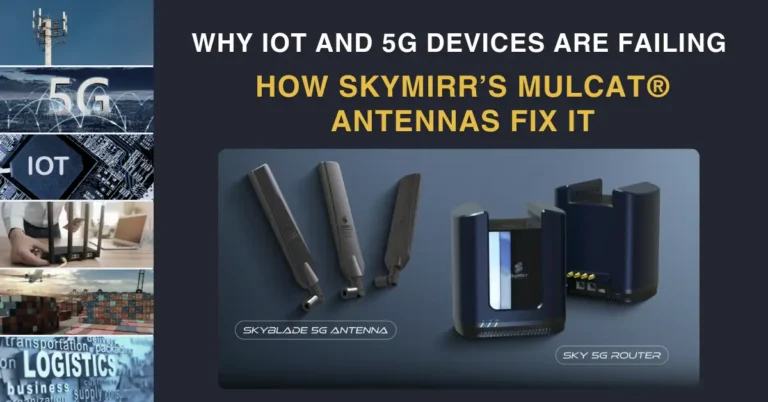
IoT and 5G devices are failing to meet performance expectations, often due to antenna inefficiencies and interference. Skymirr, founded by Eric Jo, tackles this with MuLCAT®, a proprietary antenna technology that delivers up to 2× the efficiency of conventional systems. Used in products like the Sky5G™ router, MuLCAT® eliminates antenna interference, boosts range, and enables real-world wireless reliability across IoT, fixed wireless, and logistics applications. By combining AI-driven RF design with an antenna-first approach, Skymirr is setting a new benchmark for wireless performance.

Tech News & Insight
IoT and 5G devices are failing to meet performance expectations, often due to antenna inefficiencies and interference. Skymirr, founded by Eric Jo, tackles this with MuLCAT®, a proprietary antenna technology that delivers up to 2× the efficiency of conventional systems. Used in products like the Sky5G™ router, MuLCAT® eliminates antenna interference, boosts range, and enables real-world wireless reliability across IoT, fixed wireless, and logistics applications. By combining AI-driven RF design with an antenna-first approach, Skymirr is setting a new benchmark for wireless performance.
Partner Event
Start: March 2, 2026
End: March 5, 2026
Venue: Fira Gran Via, Barcelona
Location: Barcelona
Partner Event
Start: March 2, 2026
End: March 5, 2026
Venue: Fira Gran Via, Barcelona
Location: Barcelona
Tech News & Insight
The telecom industry is evolving fast, driven by the rise of AI and real-time data demands. Telcos are moving from legacy connectivity models toward becoming AI-powered intelligence infrastructure providers. This transformation spans infrastructure modernization, distributed AI, operational automation, and monetization shifts, from selling bandwidth to delivering tailored digital experiences.
Tech News & Insight
The telecom industry is evolving fast, driven by the rise of AI and real-time data demands. Telcos are moving from legacy connectivity models toward becoming AI-powered intelligence infrastructure providers. This transformation spans infrastructure modernization, distributed AI, operational automation, and monetization shifts, from selling bandwidth to delivering tailored digital experiences.
Tech News & Insight
Latvian telco operator and mobile innovator LMT completes strategic pivot, transforming from telco operator to technology company – LMT Group. The transformation was kicked off at the launch of IoT Shortcut, the world’s smallest mobile data module for sensor equipment and LMT Group’s latest product. As explained by Ingmars Pukis, LMT’s VP & Member of the Management Board, LMT’s shift from telco into a broad-scope technology companies ecosystem has been driven by limited market opportunities, the team’s historical engineering DNA, and the introduction of 5G and its capabilities, among other factors. The Group now comprises several companies and branches, including LMT IoT, LMT Defence, LMT Systems, LMT Retail & Logistics, LMT Finance, LMT Innovations, and Santa Monica Networks.
Tech News & Insight
Latvian telco operator and mobile innovator LMT completes strategic pivot, transforming from telco operator to technology company – LMT Group. The transformation was kicked off at the launch of IoT Shortcut, the world’s smallest mobile data module for sensor equipment and LMT Group’s latest product. As explained by Ingmars Pukis, LMT’s VP & Member of the Management Board, LMT’s shift from telco into a broad-scope technology companies ecosystem has been driven by limited market opportunities, the team’s historical engineering DNA, and the introduction of 5G and its capabilities, among other factors. The Group now comprises several companies and branches, including LMT IoT, LMT Defence, LMT Systems, LMT Retail & Logistics, LMT Finance, LMT Innovations, and Santa Monica Networks.
Usecase
The Port of Tyne has deployed a private 5G network across its 620-acre site with support from BT and Ericsson. Leveraging edge computing, AI, and drones, the port has improved safety, operational agility, and data-driven decision-making, positioning itself as one of the UK’s most advanced smart ports.
Usecase
The Port of Tyne has deployed a private 5G network across its 620-acre site with support from BT and Ericsson. Leveraging edge computing, AI, and drones, the port has improved safety, operational agility, and data-driven decision-making, positioning itself as one of the UK’s most advanced smart ports.
Tech News & Insight
A new analysis of U.S. fixed wireless access shows subscriber momentum outpacing performance, a signal that capacity and management strategies are under pressure. Fixed wireless access from T-Mobile, Verizon, and AT&T added about 1.04 million net customers in Q3 2025, taking the U.S. FWA base to roughly 14.7 million. T-Mobile remains the U.S. FWA speed leader, posting a median download around 209 Mbps in Q3 2025. Median uploads dipped below 20 Mbps across providers, creating a hurdle for the FCC’s 100/20 benchmark. Urban FWA customers are more likely to meet the FCC’s 100/20 threshold than rural users due to radio geometry and site density.
Tech News & Insight
A new analysis of U.S. fixed wireless access shows subscriber momentum outpacing performance, a signal that capacity and management strategies are under pressure. Fixed wireless access from T-Mobile, Verizon, and AT&T added about 1.04 million net customers in Q3 2025, taking the U.S. FWA base to roughly 14.7 million. T-Mobile remains the U.S. FWA speed leader, posting a median download around 209 Mbps in Q3 2025. Median uploads dipped below 20 Mbps across providers, creating a hurdle for the FCC’s 100/20 benchmark. Urban FWA customers are more likely to meet the FCC’s 100/20 threshold than rural users due to radio geometry and site density.
Tech News & Insight
Across roughly 2,000 decision-makers in telecom, data center, and large enterprises, a strong majority doubts that existing infrastructure will keep up with AI’s next wave. In the US, most respondents expect network buildouts to lag AI investment and call out near-term priorities such as optimizing bidirectional data flows, expanding fiber capacity, enabling real-time training feedback, and placing low-latency compute closer to users. In Europe, most enterprise leaders say current networks are not ready for broad AI adoption; many already report latency, throughput, and resiliency pain as data demands rise. The common thread is clear: without accelerated modernization, networks risk becoming the bottleneck that constrains AI outcomes.
Tech News & Insight
Across roughly 2,000 decision-makers in telecom, data center, and large enterprises, a strong majority doubts that existing infrastructure will keep up with AI’s next wave. In the US, most respondents expect network buildouts to lag AI investment and call out near-term priorities such as optimizing bidirectional data flows, expanding fiber capacity, enabling real-time training feedback, and placing low-latency compute closer to users. In Europe, most enterprise leaders say current networks are not ready for broad AI adoption; many already report latency, throughput, and resiliency pain as data demands rise. The common thread is clear: without accelerated modernization, networks risk becoming the bottleneck that constrains AI outcomes.
Tech News & Insight
A European 6G-XR consortium led by Capgemini, Ericsson, i2CAT and Vicomtech demonstrated holographic calling and edge-anchored XR services on live standalone 5G, signaling how networks will evolve to support immersive collaboration at 6G scale. The team executed end-to-end trials of real-time holographic communication and distributed XR experiences spanning edge nodes across Barcelona and Madrid. To keep spatial media stable under cell load, the partners implemented proactive congestion detection and an on-demand quality mechanism that prioritizes holographic traffic. Notably, the consortium has referenced IMS Data Channel as a vehicle to anchor real-time holographic streams within operator service frameworks.
Tech News & Insight
A European 6G-XR consortium led by Capgemini, Ericsson, i2CAT and Vicomtech demonstrated holographic calling and edge-anchored XR services on live standalone 5G, signaling how networks will evolve to support immersive collaboration at 6G scale. The team executed end-to-end trials of real-time holographic communication and distributed XR experiences spanning edge nodes across Barcelona and Madrid. To keep spatial media stable under cell load, the partners implemented proactive congestion detection and an on-demand quality mechanism that prioritizes holographic traffic. Notably, the consortium has referenced IMS Data Channel as a vehicle to anchor real-time holographic streams within operator service frameworks.
Tech News & Insight
AI in telecom is often treated as a cost-saving tool. The leaders treat it as a business engine. Discover how AI at the heart of OSS reshapes operations, monetization, and customer engagement in one closed loop. Cutting costs with AI is easy. Compounding value with AI is hard. Learn how forward-looking operators embed AI into OSS to unlock sustained growth, resilience, and differentiation.
Tech News & Insight
AI in telecom is often treated as a cost-saving tool. The leaders treat it as a business engine. Discover how AI at the heart of OSS reshapes operations, monetization, and customer engagement in one closed loop. Cutting costs with AI is easy. Compounding value with AI is hard. Learn how forward-looking operators embed AI into OSS to unlock sustained growth, resilience, and differentiation.
Tech News & Insight
LG Electronics has won a CES 2026 Best of Innovation Award for its AI-powered in-vehicle experience, redefining how drivers and passengers interact with mobility through Affectionate Intelligence. The solution combines immersive displays, in-cabin sensing, and on-device AI to transform the vehicle cabin into a more intuitive, human-centered space.
Tech News & Insight
LG Electronics has won a CES 2026 Best of Innovation Award for its AI-powered in-vehicle experience, redefining how drivers and passengers interact with mobility through Affectionate Intelligence. The solution combines immersive displays, in-cabin sensing, and on-device AI to transform the vehicle cabin into a more intuitive, human-centered space.
Tech News & Insight
As enterprises move from single-model chatbots to collaborative multi-agent systems, the economic and operational burden of reasoning at scale is becoming the dominant constraint. NVIDIA’s Nemotron 3 family introduces open models and tools designed to keep multi-agent systems fast, affordable and inspectable. The models use a hybrid latent mixture‑of‑experts design to activate only a fraction of parameters per token, combining it with a Mamba‑Transformer approach optimized for long sequences. Nemotron 3 Nano is a small, roughly 30B‑parameter model that activates up to 3B parameters per token, making it efficient for retrieval, summarization, assistants and software debugging.
Tech News & Insight
As enterprises move from single-model chatbots to collaborative multi-agent systems, the economic and operational burden of reasoning at scale is becoming the dominant constraint. NVIDIA’s Nemotron 3 family introduces open models and tools designed to keep multi-agent systems fast, affordable and inspectable. The models use a hybrid latent mixture‑of‑experts design to activate only a fraction of parameters per token, combining it with a Mamba‑Transformer approach optimized for long sequences. Nemotron 3 Nano is a small, roughly 30B‑parameter model that activates up to 3B parameters per token, making it efficient for retrieval, summarization, assistants and software debugging.
Tech News & Insight
Orange has signed a binding agreement to buy Lorca’s remaining 50% stake in MasOrange for 4.25 billion euros in cash, targeting completion in the first half of 2026 subject to customary approvals. The agreement transitions MasOrange from a 50:50 joint venture to a wholly owned subsidiary of Orange, consolidating governance and simplifying decision-making across mobile, fixed, and converged operations in Spain. At closing, MasOrange is expected to be fully consolidated into Orange’s accounts, including MasOrange debt that Orange plans to refinance at or after completion, providing flexibility to optimize the capital structure and cost of capital.
Tech News & Insight
Orange has signed a binding agreement to buy Lorca’s remaining 50% stake in MasOrange for 4.25 billion euros in cash, targeting completion in the first half of 2026 subject to customary approvals. The agreement transitions MasOrange from a 50:50 joint venture to a wholly owned subsidiary of Orange, consolidating governance and simplifying decision-making across mobile, fixed, and converged operations in Spain. At closing, MasOrange is expected to be fully consolidated into Orange’s accounts, including MasOrange debt that Orange plans to refinance at or after completion, providing flexibility to optimize the capital structure and cost of capital.
Tech News & Insight
Google has introduced a sharply priced AI Plus subscription in India to push generative AI into the mass market and counter OpenAI’s ChatGPT Go. The AI Plus plan launches at ₹199 per month for new users for six months, then moves to ₹399 per month. The bundle raises usage limits for Gemini 3 Pro, unlocks video generation within Google’s apps, expands NotebookLM’s “deep research” capabilities, and adds 200GB of storage across Google Photos, Drive, and Gmail. Family sharing is included, signaling a household-centric growth strategy.
Tech News & Insight
Google has introduced a sharply priced AI Plus subscription in India to push generative AI into the mass market and counter OpenAI’s ChatGPT Go. The AI Plus plan launches at ₹199 per month for new users for six months, then moves to ₹399 per month. The bundle raises usage limits for Gemini 3 Pro, unlocks video generation within Google’s apps, expands NotebookLM’s “deep research” capabilities, and adds 200GB of storage across Google Photos, Drive, and Gmail. Family sharing is included, signaling a household-centric growth strategy.
Tech News & Insight
The latest 3GPP cycle consolidates 5G-Advanced (Release 18), sets the agenda for Release 19, and frames early 6G studies, with direct implications for operator investment, enterprise use cases, and vendor roadmaps. Release 18, the first phase of 5G-Advanced, is moving from standards completion into implementation, bringing carrier-grade enhancements in spectral efficiency, energy savings, and mobility performance. Release 19 now builds on these foundations, prioritizing further RAN efficiency, XR and video delivery at scale, richer analytics/exposure in the core (NWDAF, NEF/CAPIF), and enterprise-grade reliability across private and public networks.
Tech News & Insight
The latest 3GPP cycle consolidates 5G-Advanced (Release 18), sets the agenda for Release 19, and frames early 6G studies, with direct implications for operator investment, enterprise use cases, and vendor roadmaps. Release 18, the first phase of 5G-Advanced, is moving from standards completion into implementation, bringing carrier-grade enhancements in spectral efficiency, energy savings, and mobility performance. Release 19 now builds on these foundations, prioritizing further RAN efficiency, XR and video delivery at scale, richer analytics/exposure in the core (NWDAF, NEF/CAPIF), and enterprise-grade reliability across private and public networks.
Tech News & Insight
3GPP has become the organizing framework for how public safety, utilities, transportation and enterprise security adopt LTE/5G for mission-critical communications (MCX). For mission-critical users, 3GPP’s scope includes capabilities such as push-to-talk, data and video designed for high availability, priority, pre-emption and end-to-end security. For agencies and enterprises, the value of 3GPP is practical: it lowers integration risk, clarifies feature expectations and aligns multi-year investment roadmaps. Standards are the foundation; operational reliability is the measure of success. 3GPP is the baseline for resilient, interoperable operations.
Tech News & Insight
3GPP has become the organizing framework for how public safety, utilities, transportation and enterprise security adopt LTE/5G for mission-critical communications (MCX). For mission-critical users, 3GPP’s scope includes capabilities such as push-to-talk, data and video designed for high availability, priority, pre-emption and end-to-end security. For agencies and enterprises, the value of 3GPP is practical: it lowers integration risk, clarifies feature expectations and aligns multi-year investment roadmaps. Standards are the foundation; operational reliability is the measure of success. 3GPP is the baseline for resilient, interoperable operations.
Tech News & Insight
Disney will invest $1 billion in OpenAI and become Sora’s first major content licensing partner, enabling fans to generate and share short videos that feature more than 200 characters and environments from Disney, Pixar, Marvel, and Star Wars. The agreement spans three years, excludes actor likenesses and voices, and extends to ChatGPT Images for IP‑compliant image generation. Disney will adopt OpenAI APIs across products and operations, including features for Disney+ and employee productivity, and may showcase select user creations on its streaming service. This agreement formalizes licensed synthetic media at scale and accelerates the convergence of UGC, premium IP, and AI tooling.
Tech News & Insight
Disney will invest $1 billion in OpenAI and become Sora’s first major content licensing partner, enabling fans to generate and share short videos that feature more than 200 characters and environments from Disney, Pixar, Marvel, and Star Wars. The agreement spans three years, excludes actor likenesses and voices, and extends to ChatGPT Images for IP‑compliant image generation. Disney will adopt OpenAI APIs across products and operations, including features for Disney+ and employee productivity, and may showcase select user creations on its streaming service. This agreement formalizes licensed synthetic media at scale and accelerates the convergence of UGC, premium IP, and AI tooling.
Tech News & Insight
2025 has seen major telecom and tech M&A activity, including billion-dollar deals in fiber, AI, cloud, and cybersecurity. This monthly tracker details key acquisitions, like AT&T buying Lumen’s fiber assets and Google’s $32B move for Wiz, highlighting how consolidation is shaping the competitive landscape.
Tech News & Insight
2025 has seen major telecom and tech M&A activity, including billion-dollar deals in fiber, AI, cloud, and cybersecurity. This monthly tracker details key acquisitions, like AT&T buying Lumen’s fiber assets and Google’s $32B move for Wiz, highlighting how consolidation is shaping the competitive landscape.
Tech News & Insight
IBM has agreed to acquire Confluent for $31 per share in cash, signaling a decisive move to make real-time, governed data the backbone of generative and agentic AI across hybrid cloud environments. The transaction values Confluent at an enterprise value of roughly $11 billion, with closing targeted by mid-2026 pending shareholder and regulatory approvals. Together they aim to unify application, data, and AI pipelines across public clouds, private data centers, and edge locations—reducing integration friction and accelerating time to value for enterprise AI.
Tech News & Insight
IBM has agreed to acquire Confluent for $31 per share in cash, signaling a decisive move to make real-time, governed data the backbone of generative and agentic AI across hybrid cloud environments. The transaction values Confluent at an enterprise value of roughly $11 billion, with closing targeted by mid-2026 pending shareholder and regulatory approvals. Together they aim to unify application, data, and AI pipelines across public clouds, private data centers, and edge locations—reducing integration friction and accelerating time to value for enterprise AI.
Tech News & Insight
Reliance Jio’s path to a mid-2026 IPO is increasingly intertwined with the timing and magnitude of India’s next mobile tariff hike. Domestic brokers argue Jio has a tactical reason to push back on near-term tariff increases: hikes tend to accelerate Bharti Airtel’s revenue market share (RMS) gains more than Jio’s, narrowing the lead at the worst possible time for an IPO. Airtel has been the key beneficiary of previous price actions, chipping away at Jio’s RMS advantage by almost two percentage points since mid-2024. On current assumptions, Jio is informally pegged around $153 billion, implying an EV/EBITDA multiple near the low teens.
Tech News & Insight
Reliance Jio’s path to a mid-2026 IPO is increasingly intertwined with the timing and magnitude of India’s next mobile tariff hike. Domestic brokers argue Jio has a tactical reason to push back on near-term tariff increases: hikes tend to accelerate Bharti Airtel’s revenue market share (RMS) gains more than Jio’s, narrowing the lead at the worst possible time for an IPO. Airtel has been the key beneficiary of previous price actions, chipping away at Jio’s RMS advantage by almost two percentage points since mid-2024. On current assumptions, Jio is informally pegged around $153 billion, implying an EV/EBITDA multiple near the low teens.
Tech News & Insight
A strategic merger to accelerate standardized 5G NTN Cobham Satcom is merging its Network Division with Gatehouse Satcom to push 3GPP-based non-terrestrial networks from trials to scalable deployments. The combined entity will sit as a subsidiary within Cobham Satcom Group, led by Kenney Schmidt Christiansen, Gatehouse Satcom’s current CEO. Cobham Satcom will hold a majority stake and continue to serve maritime, government, and enterprise customers through its SAILOR, Sea Tel, EXPLORER, and TRACKER brands. The transaction requires standard regulatory approvals but positions both companies to offer an end-to-end 5G NTN platform spanning software, ground infrastructure, and terminals.
Tech News & Insight
A strategic merger to accelerate standardized 5G NTN Cobham Satcom is merging its Network Division with Gatehouse Satcom to push 3GPP-based non-terrestrial networks from trials to scalable deployments. The combined entity will sit as a subsidiary within Cobham Satcom Group, led by Kenney Schmidt Christiansen, Gatehouse Satcom’s current CEO. Cobham Satcom will hold a majority stake and continue to serve maritime, government, and enterprise customers through its SAILOR, Sea Tel, EXPLORER, and TRACKER brands. The transaction requires standard regulatory approvals but positions both companies to offer an end-to-end 5G NTN platform spanning software, ground infrastructure, and terminals.
Tech News & Insight
A potential take‑private of DigitalBridge by SoftBank would concentrate capital, power, and build capability at the precise chokepoints of the AI and telecom stack. The center of gravity in AI infrastructure has moved from buildings and GPUs to grid access, entitlements, and construction lead time. DigitalBridge controls rights to roughly 21 GW of power across its global portfolio—effectively a banked inventory of megawatts that can be turned into contracted capacity faster than new entrants can clear interconnection queues or procure transformers. This transaction is fundamentally about compressing multi‑year build timelines for AI factories into quarters.
Tech News & Insight
A potential take‑private of DigitalBridge by SoftBank would concentrate capital, power, and build capability at the precise chokepoints of the AI and telecom stack. The center of gravity in AI infrastructure has moved from buildings and GPUs to grid access, entitlements, and construction lead time. DigitalBridge controls rights to roughly 21 GW of power across its global portfolio—effectively a banked inventory of megawatts that can be turned into contracted capacity faster than new entrants can clear interconnection queues or procure transformers. This transaction is fundamentally about compressing multi‑year build timelines for AI factories into quarters.
Tech News & Insight
New data points to a step-change in cellular IoT adoption as 5G broadens into mid-tier and massive-scale use cases while 4G-era LPWA keeps expanding. Omdia forecasts cellular IoT connections to reach roughly 5.9 billion by 2035, driven by expanding addressable use cases across industrial automation, utilities, transportation, retail, and consumer-adjacent categories such as wearables. The growth profile is no longer tied only to premium 5G performance; instead, scaled adoption is coming from three complementary pillars: 5G RedCap for mid-tier performance at lower cost, 5G Massive IoT (evolving NB-IoT/LTE-M under a 5G core), and 4G LTE Cat-1bis for low-cost devices that still require voice or moderate throughput.
Tech News & Insight
New data points to a step-change in cellular IoT adoption as 5G broadens into mid-tier and massive-scale use cases while 4G-era LPWA keeps expanding. Omdia forecasts cellular IoT connections to reach roughly 5.9 billion by 2035, driven by expanding addressable use cases across industrial automation, utilities, transportation, retail, and consumer-adjacent categories such as wearables. The growth profile is no longer tied only to premium 5G performance; instead, scaled adoption is coming from three complementary pillars: 5G RedCap for mid-tier performance at lower cost, 5G Massive IoT (evolving NB-IoT/LTE-M under a 5G core), and 4G LTE Cat-1bis for low-cost devices that still require voice or moderate throughput.
Tech News & Insight
The administration plans an executive order to set a single national AI rulebook and override state-level frameworks, a move with immediate implications for telecom, cloud, and enterprise AI strategies. President Trump signaled he will sign an executive order establishing a uniform federal approach to AI governance that preempts state regulations. Reports indicate the order aims to reduce compliance friction by replacing diverse state rules with a lighter-touch national framework focused on competitiveness. State officials from both parties, safety advocates, and labor groups are preparing to fight the order, citing risks related to consumer harm, deepfakes, hiring bias, and child safety. On the other side, Silicon Valley leaders warn that 50-state compliance regimes could deter innovation and blunt national competitiveness.
Tech News & Insight
The administration plans an executive order to set a single national AI rulebook and override state-level frameworks, a move with immediate implications for telecom, cloud, and enterprise AI strategies. President Trump signaled he will sign an executive order establishing a uniform federal approach to AI governance that preempts state regulations. Reports indicate the order aims to reduce compliance friction by replacing diverse state rules with a lighter-touch national framework focused on competitiveness. State officials from both parties, safety advocates, and labor groups are preparing to fight the order, citing risks related to consumer harm, deepfakes, hiring bias, and child safety. On the other side, Silicon Valley leaders warn that 50-state compliance regimes could deter innovation and blunt national competitiveness.
Tech News & Insight
SCF (Small Cell Forum) has published a new report exploring how proven small cell design principles and open interfaces can help the ecosystem overcome some of the challenges facing emerging 5G Non-Terrestrial Networks (NTNs), particularly regenerative LEO satellite systems. The paper, Small Cells and Non-Terrestrial Networks: Common Challenges and Common Solutions, explains that although terrestrial and space-based networks operate in very different environments, they share several engineering and operational constraints, including strict SWaP (Size, Weight and Power) requirements. Compact and efficient radio designs, modular architectures and standardized interfaces are essential in both domains. SCF’s existing body of work provides a set of components and frameworks that can be reused or adapted for 5G NTN satellite payloads and hybrid terrestrial–satellite deployments.
Tech News & Insight
SCF (Small Cell Forum) has published a new report exploring how proven small cell design principles and open interfaces can help the ecosystem overcome some of the challenges facing emerging 5G Non-Terrestrial Networks (NTNs), particularly regenerative LEO satellite systems. The paper, Small Cells and Non-Terrestrial Networks: Common Challenges and Common Solutions, explains that although terrestrial and space-based networks operate in very different environments, they share several engineering and operational constraints, including strict SWaP (Size, Weight and Power) requirements. Compact and efficient radio designs, modular architectures and standardized interfaces are essential in both domains. SCF’s existing body of work provides a set of components and frameworks that can be reused or adapted for 5G NTN satellite payloads and hybrid terrestrial–satellite deployments.
Tech News & Insight
New consumer research commissioned by Viasat and executed by GSMA Intelligence signals that non-terrestrial networks (NTN) are becoming a mainstream buying factor for mobile subscribers. The survey of more than 12,000 smartphone users across 12 countries finds persistent coverage gaps: over a third of respondents lose basic cellular service multiple times per month. That pain point is translating into intent. Roughly six in ten consumers say they would pay extra for satellite-enabled connectivity on their phones, and nearly half indicate they would switch operators if out‑of‑coverage service were included in their plan. On average, those willing to pay would accept a 5–7% uplift on their current monthly bill, with outliers such as India approaching a 9% premium.
Tech News & Insight
New consumer research commissioned by Viasat and executed by GSMA Intelligence signals that non-terrestrial networks (NTN) are becoming a mainstream buying factor for mobile subscribers. The survey of more than 12,000 smartphone users across 12 countries finds persistent coverage gaps: over a third of respondents lose basic cellular service multiple times per month. That pain point is translating into intent. Roughly six in ten consumers say they would pay extra for satellite-enabled connectivity on their phones, and nearly half indicate they would switch operators if out‑of‑coverage service were included in their plan. On average, those willing to pay would accept a 5–7% uplift on their current monthly bill, with outliers such as India approaching a 9% premium.
Tech News & Insight
The Indian government has floated draft rules that refine how mobile operators can share spectrum, aiming to boost spectral efficiency and accelerate 5G expansion under the new telecommunications regulatory framework. The draft rules seek to formalize spectrum sharing under the new regime, giving operators a clearer pathway to pool or share spectrum holdings while ensuring compliance with license conditions. In practical terms, telcos would gain a more predictable mechanism to use underutilized spectrum, improve coverage, and optimize capacity without always resorting to new auctions or heavy capex.
Tech News & Insight
The Indian government has floated draft rules that refine how mobile operators can share spectrum, aiming to boost spectral efficiency and accelerate 5G expansion under the new telecommunications regulatory framework. The draft rules seek to formalize spectrum sharing under the new regime, giving operators a clearer pathway to pool or share spectrum holdings while ensuring compliance with license conditions. In practical terms, telcos would gain a more predictable mechanism to use underutilized spectrum, improve coverage, and optimize capacity without always resorting to new auctions or heavy capex.
Tech News & Insight
Work at local distribution points often triggers unintended service cuts, driving spikes in complaints, repeat truck rolls, and SLA penalties. By empowering on-site technicians to detect and remediate cuts instantly—rather than wait for back-office workflows—operators can compress mean time to repair, avoid secondary visits, and reduce inbound support volume. The result is fewer avoidable outages and a more predictable experience for consumers and businesses using fiber for VPN, SD-WAN, and cloud access. Previous collaboration (Lot 1) notified operators when their customers were impacted by nearby work, but the model was still largely reactive. Lot 2 integrates detection and authorization directly into technicians’ mobile tools.
Tech News & Insight
Work at local distribution points often triggers unintended service cuts, driving spikes in complaints, repeat truck rolls, and SLA penalties. By empowering on-site technicians to detect and remediate cuts instantly—rather than wait for back-office workflows—operators can compress mean time to repair, avoid secondary visits, and reduce inbound support volume. The result is fewer avoidable outages and a more predictable experience for consumers and businesses using fiber for VPN, SD-WAN, and cloud access. Previous collaboration (Lot 1) notified operators when their customers were impacted by nearby work, but the model was still largely reactive. Lot 2 integrates detection and authorization directly into technicians’ mobile tools.
Tech News & Insight
Switzerland’s SBB has deployed an Ericsson IMS/VoLTE platform that interworks with legacy GSM-R, delivering Europe’s first live bridge between public 4G voice and mission-critical railway communications. Ericsson and SBB completed a nationwide IMS/VoLTE integration that extends reliable voice communications across Switzerland’s 3,100 km rail network and removes dependency on public 3G roaming for coverage gaps outside GSM-R footprints. The IMS core integrates multi-supplier elements and preserves EIRENE features such as functional numbering, group calls, emergency stop calls, and onboard announcements, ensuring safety-critical behavior is maintained. It also demonstrates that mission-critical requirements can be met over modern IP telephony when engineered with the right interworking, governance, and testing.
Tech News & Insight
Switzerland’s SBB has deployed an Ericsson IMS/VoLTE platform that interworks with legacy GSM-R, delivering Europe’s first live bridge between public 4G voice and mission-critical railway communications. Ericsson and SBB completed a nationwide IMS/VoLTE integration that extends reliable voice communications across Switzerland’s 3,100 km rail network and removes dependency on public 3G roaming for coverage gaps outside GSM-R footprints. The IMS core integrates multi-supplier elements and preserves EIRENE features such as functional numbering, group calls, emergency stop calls, and onboard announcements, ensuring safety-critical behavior is maintained. It also demonstrates that mission-critical requirements can be met over modern IP telephony when engineered with the right interworking, governance, and testing.
Tech News & Insight
This dispute underscores the weakness of today’s data-sharing “plumbing.” Scraping is brittle, hard to audit, and raises legal risk. The industry will likely move toward standardized, consent-driven APIs that let customers securely share specific data fields for comparison and switching. Telecom can borrow from open banking: OAuth 2.0 and OpenID Connect flows, fine-grained scopes, auditable logs, and tokenized access with time limits. TM Forum Open APIs and carrier-to-carrier data-sharing frameworks could underpin such exchanges, while CTIA and GSMA initiatives provide governance. Done right, portability can be fast for consumers and compliant for operators.
Tech News & Insight
This dispute underscores the weakness of today’s data-sharing “plumbing.” Scraping is brittle, hard to audit, and raises legal risk. The industry will likely move toward standardized, consent-driven APIs that let customers securely share specific data fields for comparison and switching. Telecom can borrow from open banking: OAuth 2.0 and OpenID Connect flows, fine-grained scopes, auditable logs, and tokenized access with time limits. TM Forum Open APIs and carrier-to-carrier data-sharing frameworks could underpin such exchanges, while CTIA and GSMA initiatives provide governance. Done right, portability can be fast for consumers and compliant for operators.
Tech News & Insight
The FCC has approved AT&T’s agreement to acquire a portfolio of UScellular wireless spectrum licenses for $1.02 billion, advancing AT&T’s mid-band capacity strategy and reshaping competitive dynamics in U.S. 5G markets. The licenses span select UScellular markets, bolstering AT&T’s holdings in areas where UScellular has long operated, including rural and midwestern regions. With FCC consent in hand, the parties can proceed to closing market by market, subject to routine administrative steps and any local obligations. Mid-band spectrum remains the sweet spot for balanced capacity and coverage. This positions AT&T to better support RedCap devices, uplink-sensitive applications, and the early wave of 5G-Advanced features.
Tech News & Insight
The FCC has approved AT&T’s agreement to acquire a portfolio of UScellular wireless spectrum licenses for $1.02 billion, advancing AT&T’s mid-band capacity strategy and reshaping competitive dynamics in U.S. 5G markets. The licenses span select UScellular markets, bolstering AT&T’s holdings in areas where UScellular has long operated, including rural and midwestern regions. With FCC consent in hand, the parties can proceed to closing market by market, subject to routine administrative steps and any local obligations. Mid-band spectrum remains the sweet spot for balanced capacity and coverage. This positions AT&T to better support RedCap devices, uplink-sensitive applications, and the early wave of 5G-Advanced features.

Your Brand. Our Intelligence Tools.

Capture leads at the point of evaluation. Talk to Us →

Sponsored by Palo Alto Networks
⚡ Utilities ⏱ 8 min ✓ Free
This tool is built and hosted by TeckNexus.
Launch Tool →
Whitepaper
This whitepaper explains how utilities can use secure AI-enabled private mobile networks to modernize operations, support distributed intelligence, improve resilience, and strengthen cybersecurity across critical infrastructure. It covers AI applications, private network advantages, zero trust principles, multilayered security architecture, and governance considerations for AI-ready utility environments....
Palo Alto Networks
Whitepaper
Non-terrestrial networks are rapidly evolving from experimental satellite systems into an increasingly important part of the global 5G connectivity landscape. This eBook, developed by Radisys in collaboration with TeckNexus, explores how 3GPP standardization, satellite architecture innovation, and software-driven network design are reshaping NTN deployment models. It examines the transition from...
Whitepaper
Private cellular networks are transforming industrial operations, but securing private 5G, LTE, and CBRS infrastructure requires more than legacy IT/OT tools. This whitepaper by TeckNexus and sponsored by OneLayer outlines a 4-pillar framework to protect critical systems, offering clear guidance for evaluating security vendors, deploying zero trust, and integrating IT,...

It seems we can't find what you're looking for.

Featured Content

Article & Insights
Article & Insights
Article & Insights
Article & Insights
Article & Insights
Article & Insights
Article & Insights
Article & Insights
Article & Insights
Article & Insights
Article & Insights
Article & Insights
Article & Insights
Article & Insights
Article & Insights
Article & Insights
Scroll to Top