Private Network
Intelligence
Intelligence Journeys
Utilities Private Broadband Planning
AI Use Case Planning for Utilities

GPU

Samsung and NVIDIA are scaling a 25-year alliance into an AI-driven manufacturing platform that fuses memory, foundry, robotics and networks on a backbone of accelerated computing. Samsung plans to deploy more than 50,000 NVIDIA GPUs to infuse AI across the company’s manufacturing lifecycle—from chip design and lithography to equipment operations, logistics and quality control. The “AI factory” is designed as a unified, data-rich fabric where models continuously analyze and optimize processes in real time, shrinking development cycles and improving yield and uptime. The scope goes beyond semiconductors to include mobile devices and robotics, signaling a company-wide digital transformation anchored in accelerated computing.
SoftBank and NVIDIA have validated a fully software-defined, GPU-accelerated AI-RAN that delivers 16-layer massive MU-MIMO outdoors—an inflection point for vRAN performance, Open RAN scalability, and AI-native RAN design. SoftBank’s AI-RAN product, AITRAS, executed the entire 5G physical layer on NVIDIA GPUs at the Distributed Unit and demonstrated stable 16-layer multi-user MIMO downlink in an outdoor trial at NVIDIA’s Santa Clara campus. The system connected to O-RAN-compliant radios via Split 7.2x and achieved roughly three times the spectral efficiency and throughput of a conventional 4-layer setup while maintaining per-user rates under high load. The field results show that software-only massive MIMO on GPUs can meet macro-radio conditions without bespoke silicon.
A renewed, three-year collaboration between Magic Leap and Google signals a pragmatic path to AI-capable AR glasses that prioritize visual quality, comfort, and manufacturability. Magic Leap is pivoting from building end-user headsets to becoming an ecosystem partner, offering waveguides, optics, device services, and manufacturing know-how to companies pursuing glasses form factors. The companies are aligning around Android XR, positioning the prototype showcased on stage at the Future Investment Initiative in Riyadh as a reference for future designs. The prototype highlights advances in see-through clarity, low-power displays, and an industrial design that approximates everyday eyewear.
Qualcomm is moving from mobile NPUs into rack-scale AI infrastructure, positioning its AI200 (2026) and AI250 (2027) to challenge Nvidia/AMD on the economics of large-scale inference. The company is translating its Hexagon neural processing unit heritage—refined across phones and PCs—into data center accelerators tuned for inferencing, not training. AI200 and AI250 will ship in liquid-cooled, rack-scale configurations designed to operate as a single logical system. Qualcomm is leaning into that constraint with a redesigned memory subsystem and high-capacity cards supporting up to 768 GB of onboard memory—positioning that as a differentiator versus current GPU offerings.
SoftBank has reportedly approved the final $22.5 billion tranche of a planned $30 billion commitment to OpenAI, tied to the AI firm’s shift to a conventional for‑profit structure and a path to IPO. The investment completes a massive $41 billion financing round for OpenAI that began in April, making it one of the largest private capital raises in tech history. This funding and restructuring signal faster enterprise AI adoption, heavier infrastructure demand, and new platform dynamics that will ripple across networks, cloud, and edge. OpenAI is pushing deeper into enterprise tools, security features, and domain‑specific assistants.
Nokia delivered a stronger-than-expected third quarter, with comparable operating profit reaching €435 million against consensus of about €342 million. Group net sales rose 12% to €4.83 billion, above forecasts, driven by Optical Networks and cloud-related demand tied to AI data centers. The stock jumped double digits intraday and added billions in market value, reflecting newfound confidence after a challenging first half. The recovery now is concentrated in network infrastructure rather than mobile RAN, underscoring where customers are actually spending to handle AI-era traffic patterns. Nokia nudged its full-year operating profit outlook to €1.7–2.2 billion, with a reporting change related to scaling down passive venture investments partly in play.
A new partnership between Palantir and Lumen Technologies signals a shift from internal AI pilots to packaged enterprise services delivered over a telecom-grade edge and network footprint. Palantir will provide its Foundry and Artificial Intelligence Platform (AIP) as the data and decisioning layer for Lumen’s enterprise AI offerings, which Lumen plans to deliver on top of its edge computing nodes, broadband infrastructure, and managed digital services. The companies position this as a multi-year, strategic collaboration focused on operational AI use cases, not just experimentation. While exact terms were not disclosed, multiple reports indicate Lumen’s total spend could exceed $200 million over several years.
The G4 family is built on NVIDIA RTX PRO 6000 Blackwell Server Edition GPUs and targets high-throughput inference, visual computing, and simulation. Each VM can be configured with 1, 2, 4, or 8 GPUs, delivering up to 768 GB of GDDR7 memory in total. Fifth-generation Tensor Cores introduce FP4 precision to drive efficient multimodal and LLM inference, while fourth-generation RT Cores double real-time ray-tracing performance over the prior generation for photorealistic rendering. Google cites up to 9x throughput over G2 instances, positioning G4 as a universal GPU platform spanning AI inference, content creation, CAD/CAE acceleration, and robotics simulation.
Snap has opened its first open-prompt AI image Lens, Imagine, to all U.S. users, signaling a new phase in mainstream generative experiences inside the camera. Imagine Lens lets users write a short prompt and instantly transform a selfie or create an image from scratch, then share it in chats, Stories, or off-platform. The capability was previously limited to Lens+ and Snapchat Platinum subscribers. Camera-native generative features at social scale change traffic patterns, compute placement, and safety obligations for platforms and networks. Provenance standards such as C2PA content credentials are becoming table stakes for enterprise integrations and advertiser trust.
Netflix is expanding generative AI across recommendations, ads, and production workflows, signaling how big media will operationalize AI at scale without replacing human creativity. The company highlighted recent use in final footage, de-aging in a new film, and pre-visualization for set and wardrobe design. This is not about automating storytelling; it is about compressing timelines, lowering iteration costs, and enabling more variants for testing and localization. Expect AI to touch asset creation, trailer and thumbnail generation, dubbing and subtitling, quality control, and promotional creative — all tied to measurable uplift in engagement and ad yield.
Arm and Meta have inked a multi-year partnership to scale AI efficiency from hyperscale data centers to on-device inference, aligning Arm’s performance-per-watt strengths with Meta’s AI software and infrastructure stack. Meta plans to run its ranking and recommendation workloads on Arm Neoverse-based data center platforms as part of an ongoing infrastructure expansion. The companies are co-optimizing AI software components—spanning compilers, libraries, and frameworks like PyTorch, FBGEMM, vLLM, and the ExecuTorch runtime—so models can execute more efficiently on Arm CPUs in the cloud and on Arm-based devices at the edge. The work includes leveraging Arm’s KleidiAI optimizations to improve inference throughput and energy efficiency, with code contributions flowing back to open source.
Apple’s new M5 chip is a material step in local AI compute that will ripple into enterprise IT, developer tooling, and edge networking strategies. M5 is built on a third‑generation 3‑nanometer process and reworks Apple’s GPU as the center of gravity for AI. The 10‑core GPU adds a dedicated Neural Accelerator in every core, pushing peak GPU compute for AI to more than four times M4. Unified memory bandwidth jumps to 153 GB/s, and configurations with up to 32 GB allow more and larger models to remain entirely on device. On‑device inference is moving from nice‑to‑have to default, driven by privacy, latency, and cost.

Partner Hubs

Telco AI Agent Leadership

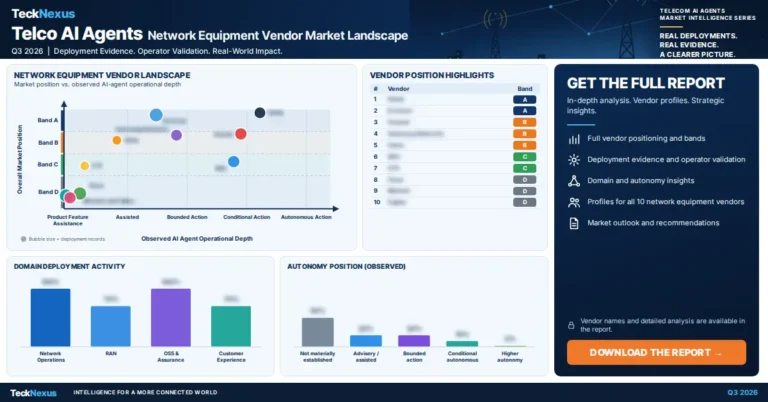
Telco AI Agent Leadership Landscape - Network Equipment Vendors
Network Equipment Vendor Report
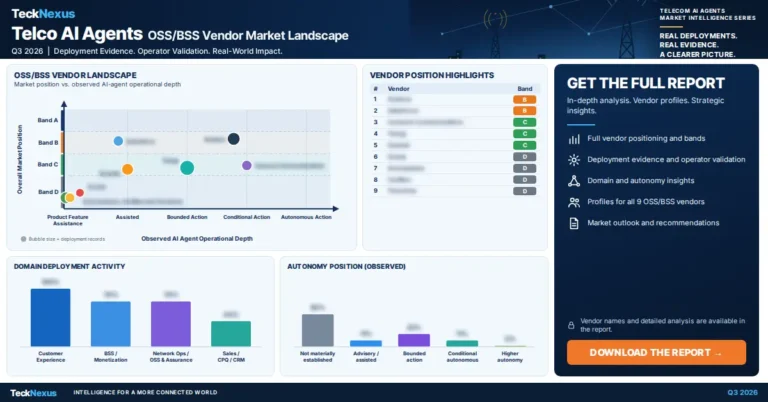
How are Amdocs, Salesforce, Comarch, Totogi, Qvantel, Oracle and other OSS/BSS vendors deploying telecom AI agents?
OSS/BSS Vendor Report
How are Amdocs, Salesforce, Comarch, Totogi, Qvantel, Oracle and other OSS/BSS vendors deploying telecom AI agents?
System Integrator Report
Scroll to Top