T-Mobile

T-Mobile's Dynamic CX applies AI to its Self-Organizing Network architecture, scanning public data sources - event schedules, ticketing platforms, social activity — to anticipate high-density demand before it strains the network. Launching ahead of the 2026 FIFA World Cup across eleven U.S. host cities, the capability shifts network management from reactive triage to proactive resource allocation. Opensignal data from February through May 2026 already shows T-Mobile leading mobile experience metrics in all eleven markets, a baseline Dynamic CX is engineered to sustain under peak load conditions.
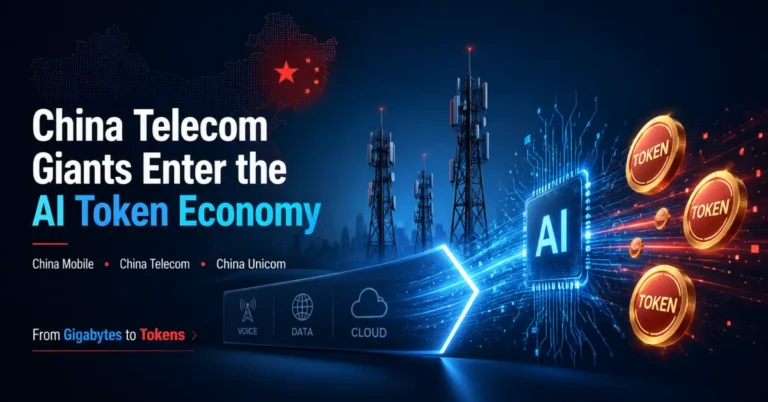
China Telecom, China Mobile, and China Unicom have each unveiled token-based service plans, ecosystem alliances, and commercial pricing structures that reframe what it means to be a telecom provider in the AI era. This is not a pilot program or a speculative roadmap. It is a structural shift in how network operators intend to generate revenue, compete for enterprise customers, and position themselves at the center of the AI economy — driven by a greater than 1,000-fold surge in daily token consumption across China between early 2024 and March 2026.
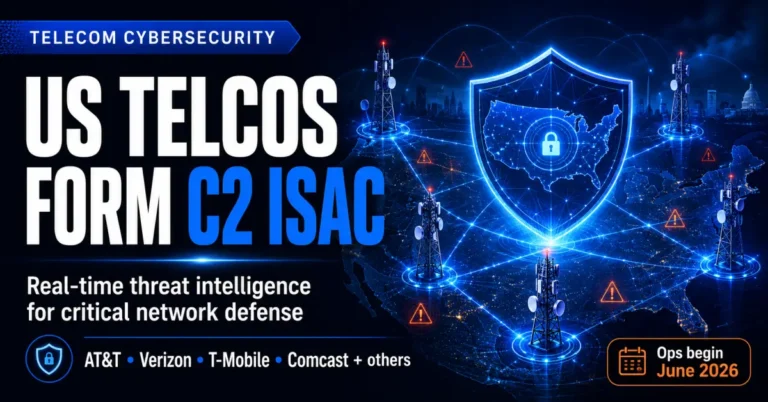
Eight of the most influential US telecommunications carriers — including AT&T, Verizon, T-Mobile, and Comcast — have established the Communications Cybersecurity Information Sharing and Analysis Center, known as C2 ISAC. Governed by the CISOs of each founding company and led by a director with CISA and FBI experience, C2 ISAC is designed to deliver real-time, actionable threat intelligence across competing carriers that collectively defend America's critical communications infrastructure. Operations are expected to begin in June 2026.
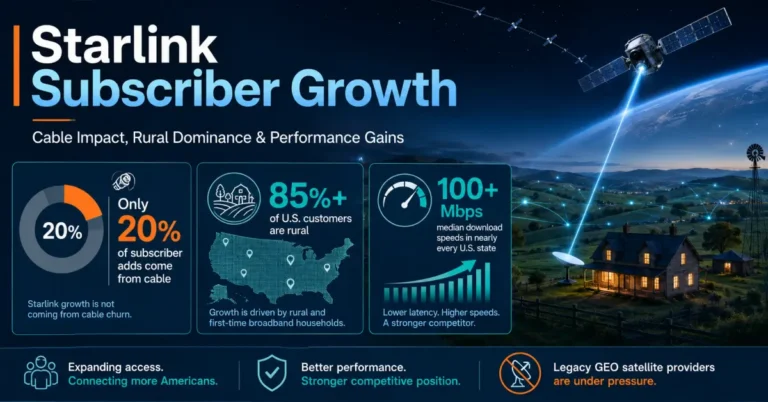
New research from New Street Research and Recon Analytics reveals that despite cable controlling roughly 60% of the US broadband market, only about 20% of Starlink's gross subscriber additions come from cable defectors. More than 85% of Starlink's US customer base is located in rural areas, and a significant share of its growth comes from first-time broadband subscribers. Meanwhile, Starlink's median download speeds now exceed 100 Mbps in nearly every US state, fundamentally shifting its competitive standing in the satellite and terrestrial broadband landscape.
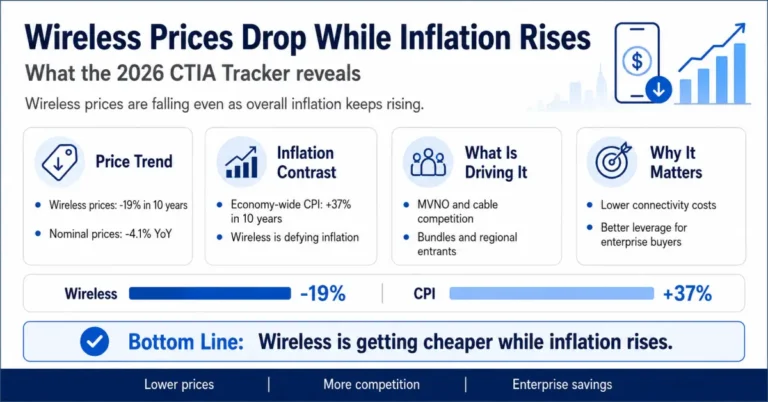
Wireless services are defying U.S. inflation trends in a way virtually no other sector is. According to CTIA's newly released More for Less: 2026 Wireless Affordability Tracker, nominal wireless prices have declined 4.1% over the past year and 19% over the past decade, while the economy-wide CPI rose more than 37% over the same period. Adjusted for inflation, postpaid unlimited plans are down roughly 10% year-over-year, and prepaid options have fallen more than 50% over five years. For enterprise decision-makers, this pricing trajectory represents a structurally favorable condition for mobile workforce and IoT connectivity planning.
T-Mobile and Ericsson are delivering measurable AI-native RAN results at commercial scale on a live 5G Advanced network. Ericsson's AI-native Scheduler with Link Adaptation replaces rule-based logic with a neural network that predicts RF conditions in real time, achieving close to 10 percent spectral efficiency improvement and up to 15 percent downlink throughput gains. Separately, Ericsson validated its Cloud RAN software running on NVIDIA AI infrastructure, enabling hardware-agnostic deployment. Together, these advances signal that AI-native networking is no longer theoretical — it is executing at national scale.
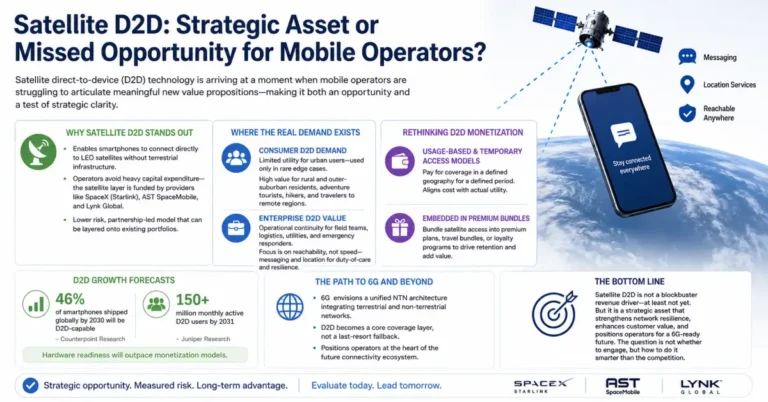
Satellite D2D offers MNOs a rare, low-CapEx differentiator. But unlocking its value demands smarter monetization, targeted verticals, and a long-term NTN strategy.
Verizon has expanded its satellite asset fleet to 2,600 units in 2025, introducing a multi-orbit off-road trailer capable of switching between GEO and LEO connectivity. The carrier is also piloting permanent satellite backhaul at high-risk cell towers across Georgia, Florida, and the Carolinas. Through a $100 million partnership with AST SpaceMobile, Verizon is advancing direct-to-device satellite connectivity using standard smartphones. Satellite is positioned not as a replacement for fiber or 5G, but as a planned resilience layer and coverage extension tool for enterprise and public safety stakeholders.
T-Mobile Czech Republic's Technology Innovations Day 2026 delivered live operational proof that 5G Standalone architecture is no longer a roadmap item. Running entirely on 5G SA infrastructure at the Magenta Experience Center in Prague, demonstrations spanned autonomous robotics, tele-surgery with military hospitals, AI-powered AR wearables, live field broadcasting, and quantum state transfer over existing fiber. For enterprise decision-makers evaluating private network investments or industrial automation strategies, the event confirmed that 5G SA now meets the reliability, latency, and isolation requirements of mission-critical operations across multiple verticals.
T-Mobile CEO Srini Gopalan admitted during Q1 2026 earnings that its T-Satellite direct-to-device service is seeing far less usage than projected, largely because T-Mobile's terrestrial network leaves few coverage gaps for consumers. With 1.8 million free beta sign-ups failing to translate into strong paid engagement, and Apple's free Globalstar satellite messaging compressing the addressable market, T-Mobile is pivoting toward enterprise connectivity. Its new SuperBroadband offering pairs 5G with Starlink LEO broadband, targeting businesses in healthcare, retail, and energy that require resilient, always-on connectivity across distributed locations.
T-Mobile has inked two 50/50 fiber joint ventures to accelerate FTTP reach, add multi-gig capacity, and broaden its multi-access broadband portfolio. T-Mobile will partner with Oak Hill Capital to combine GoNetspeed and Greenlight Networks into a single platform and, in a separate JV, team with infrastructure investor Wren House to acquire i3 Broadband. Collectively, the platforms target about 1.8 million passings by the end of 2026—roughly 1.3 million from GoNetspeed/Greenlight and 500,000 from i3 Broadband—expanding T-Mobile’s ability to sell T-Fiber by T-Mobile alongside its leading 5G fixed wireless access (FWA) offering.
Deutsche Telekom is weighing a structural overhaul that would collapse its 53% ownership of T-Mobile US into a single, unified company spanning both sides of the Atlantic. Reports indicate Deutsche Telekom is exploring an all-stock transaction in which a new holding company would acquire both Deutsche Telekom and T-Mobile US, with current shareholders of each ending up as owners of the combined entity. The new group could pursue dual listings in the U.S. and Europe, eliminating today’s parent–subsidiary setup and aligning governance, strategy, and capital allocation under one roof.

Your Brand. Our Intelligence Tools.

Capture leads at the point of evaluation. Talk to Us →

Sponsored by Palo Alto Networks
⚡ Utilities ⏱ 8 min ✓ Free
This tool is built and hosted by TeckNexus.
Launch Tool →
Whitepaper
This whitepaper explains how utilities can use secure AI-enabled private mobile networks to modernize operations, support distributed intelligence, improve resilience, and strengthen cybersecurity across critical infrastructure. It covers AI applications, private network advantages, zero trust principles, multilayered security architecture, and governance considerations for AI-ready utility environments....
Whitepaper
Non-terrestrial networks are rapidly evolving from experimental satellite systems into an increasingly important part of the global 5G connectivity landscape. This eBook, developed by Radisys in collaboration with TeckNexus, explores how 3GPP standardization, satellite architecture innovation, and software-driven network design are reshaping NTN deployment models. It examines the transition from...
Whitepaper
Private cellular networks are transforming industrial operations, but securing private 5G, LTE, and CBRS infrastructure requires more than legacy IT/OT tools. This whitepaper by TeckNexus and sponsored by OneLayer outlines a 4-pillar framework to protect critical systems, offering clear guidance for evaluating security vendors, deploying zero trust, and integrating IT,...
Scroll to Top

Map your security gaps to real threat scenarios – including Salt Typhoon, Volt Typhoon, AI data poisoning, rogue devices, and unencrypted OT traffic.

Take the free 8-minute assessment built for utility operators evaluating AI-enabled private mobile networks. Get a readiness score across five critical domains, see where your gaps are, and receive a prioritized action plan for what to fix first.

Free • 8 minutes • Built for private network security