BT

June 2026 showed agentic AI scaling from pilot to platform: industry-wide standards momentum, AI-RAN field trials from Nokia, Amdocs and KDDI, and fresh capital across data centers on three continents. This full roundup covers every deployment, partnership, funding round and governance move from the month, with tools to prioritise AI use cases and plan the network around them.
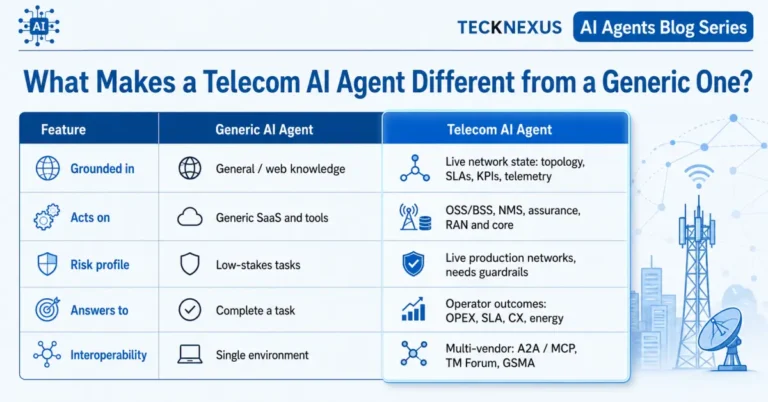
Telecom AI agents share the same anatomy as any AI agent - but grounding, systems, stakes, goals, and multi-vendor interoperability set them apart. Here are the five differences that matter, plus how to evaluate an agent before you trust it on a live network.
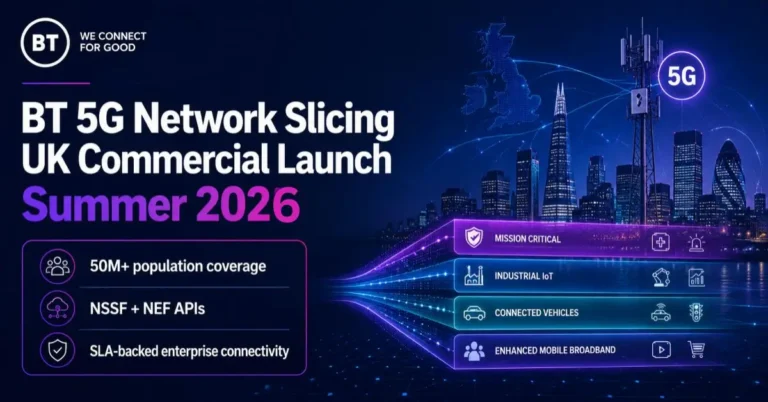
BT is set to launch commercial 5G network slicing services before the end of summer 2026, marking a significant milestone for the UK's 5G Standalone market. Built on Ericsson's dual-mode 5G Core and underpinned by dynamic slice selection via NSSF and programmable network access through NEF APIs, BT's offer targets both enterprise and consumer segments. With 5G SA coverage already reaching 50 million people and a 90% population threshold defining national availability, BT is positioning slicing as a credible, SLA-backed connectivity service — not a proof-of-concept.
The rebranding of O2 Daisy to O2 Business marks a strategic shift in UK enterprise technology. Following the August 2025 merger of Virgin Media O2's B2B division with Daisy Group, the combined entity now offers integrated connectivity, managed IT, and unified communications under a single brand. With 66 per cent of UK business leaders citing growing technology complexity and 30 per cent reporting rising costs as a result, O2 Business is positioning itself as a consolidated alternative to fragmented multi-supplier models — targeting mid-market and enterprise segments across commercial and public sector verticals.
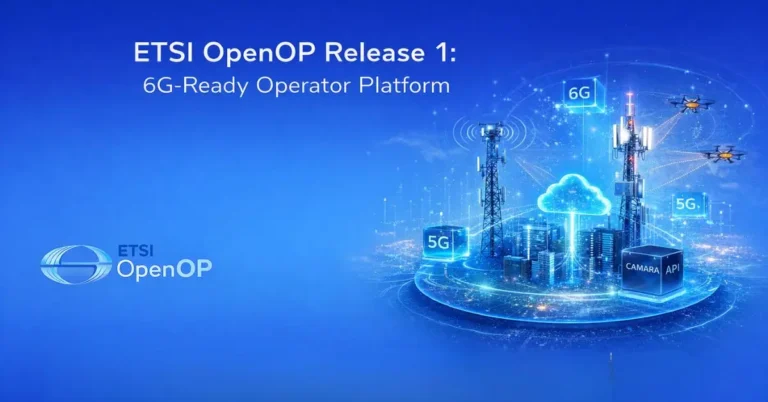
ETSI has introduced OpenOP Release 1 as an open-source operator platform for telco cloud, designed to standardize capability exposure and federation at the edge while creating a practical bridge from 5G-Advanced to early 6G experimentation. Networks are becoming software-first and distributed, but operators still face fragmented exposure of network capabilities and inconsistent approaches to multi-operator edge. OpenOP targets this gap with a standards-aligned, open implementation that lets developers consume telecom capabilities via CAMARA APIs and deploy applications across federated edge zones. Release 1 provides a working, end-to-end baseline with integrated components for exposure, orchestration, federation, and AI-assisted intent, suitable for hands-on testing and integration.

The Port of Tyne has deployed a private 5G network across its 620-acre site with support from BT and Ericsson. Leveraging edge computing, AI, and drones, the port has improved safety, operational agility, and data-driven decision-making, positioning itself as one of the UK’s most advanced smart ports.
UK regulator Ofcom has opened formal investigations into BT (including EE) and Three after nationwide voice service outages this summer impaired access to other networks and to emergency services. BT notified Ofcom of a software-related failure that disrupted interconnect voice services to and from the EE mobile network on 24–25 July 2025. During the incident, many BT and EE customers could not complete mobile calls to other networks or reach emergency services. Three separately reported a UK-wide disruption to voice services on 25 June 2025, which also affected some customers’ ability to contact emergency services.
A UK tribunal has allowed a major consumer case to proceed against the country’s biggest mobile operators over alleged overcharging after device loans were repaid. The Competition Appeal Tribunal has certified a collective action alleging that Vodafone, BT’s EE, Virgin Media O2, and Three UK continued to bill customers for handsets after the device portion had been paid off. Claims tied to losses before October 2015 were dismissed as out of time, but post-2015 allegations will go to trial. The ruling does not determine liability; it sets the scope and allows disclosure and trial preparation.
BT Group and its consumer brand EE plan to offer a Starlink-powered home broadband product focused on underserved locations where fixed-line build is constrained by terrain, sparsity, or cost. The service targets “ultrafast” downlink performance, with Starlink capable of delivering up to roughly 280 Mbps and latency in the low tens of milliseconds. Commercial availability is slated for the second half of 2026, giving BT time to industrialise ordering, installation, support, and integration into its existing product catalogue and systems. LEO fills the last 1–5% gap where full fibre is slow or uneconomic to reach.
BT is pressing ahead with cost-cutting as it confronts sharper broadband competition, softer device demand, and structural declines in legacy services. BT reduced its total workforce by about 6% in the first half of its financial year, down to roughly 111,000 employees from 116,000 at the start of the period. The group reported around £250 million in additional annualized cost savings, bringing cumulative savings to about £1.2 billion across the first 18 months of the program and reaffirming a target of £3 billion in annual savings. Group revenue for the six months to September 30 declined about 3% year over year to £9.8 billion. Openreach’s broadband base contracted, with approximately 242,000 fewer broadband customers in Q2 FY25.
October’s job-cut announcements surged, with AI and cost control reshaping staffing plans across technology and adjacent sectors. Planned layoffs spiked to roughly 153,000 in October, up more than 180% from September and about 175% from a year ago, according to the latest Challenger job-cuts tally. Year-to-date announcements for 2025 have crossed 1.09 million, the highest October-through-period since the pandemic shock of 2020 and above comparable 2009 levels. The cuts reflect a pivot from growth-at-any-cost to profitability, with AI rebalancing roles and budgets across the stack. Across reasons given, cost reduction led by a wide margin, and AI adoption was the second-largest driver, underscoring both macro pressure and structural transformation.
AWS experienced a major outage centered on its US-EAST-1 region in Northern Virginia, triggering cascading failures across dozens of cloud services and dependent applications worldwide. The incident began in the early hours of Monday and was initially mitigated within a few hours, though residual errors and recovery backlogs persisted through the morning in US-EAST-1. Engineering updates point to a DNS resolution problem affecting a key database endpoint (DynamoDB) alongside internal network and gateway errors in EC2, which then propagated across dependent services such as SQS and Amazon Connect. When a foundational component like DNS or an internal networking fabric falters, service discovery and API calls fail in bulk.

Your Brand. Our Intelligence Tools.

Capture leads at the point of evaluation. Talk to Us →

Sponsored by Palo Alto Networks
⚡ Utilities ⏱ 8 min ✓ Free
This tool is built and hosted by TeckNexus.
Launch Tool →
Whitepaper
This whitepaper explains how utilities can use secure AI-enabled private mobile networks to modernize operations, support distributed intelligence, improve resilience, and strengthen cybersecurity across critical infrastructure. It covers AI applications, private network advantages, zero trust principles, multilayered security architecture, and governance considerations for AI-ready utility environments....
Whitepaper
Non-terrestrial networks are rapidly evolving from experimental satellite systems into an increasingly important part of the global 5G connectivity landscape. This eBook, developed by Radisys in collaboration with TeckNexus, explores how 3GPP standardization, satellite architecture innovation, and software-driven network design are reshaping NTN deployment models. It examines the transition from...
Whitepaper
Private cellular networks are transforming industrial operations, but securing private 5G, LTE, and CBRS infrastructure requires more than legacy IT/OT tools. This whitepaper by TeckNexus and sponsored by OneLayer outlines a 4-pillar framework to protect critical systems, offering clear guidance for evaluating security vendors, deploying zero trust, and integrating IT,...
Scroll to Top