






What Is the WhatsApp Travel eSIM and Why Does It Matter?
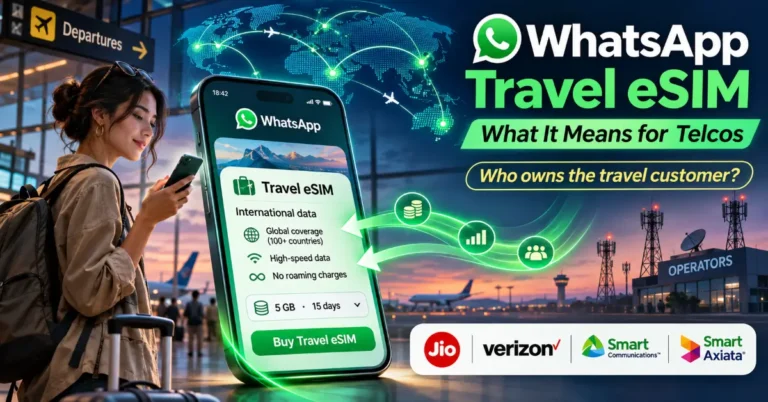
WhatsApp has announced a Travel eSIM feature that will let users buy and install an international data eSIM inside the app in a few taps, while keeping their existing WhatsApp number. Operator and eSIM partners include Jio, Smart Axiata, Smart Communications and Verizon. The rollout starts soon in select countries, with pricing and markets still to be confirmed, and it places Meta directly in the path of the roaming revenue operators have long relied on.

For more than a decade, the relationship between telecom operators and WhatsApp has been defined by substitution. The app replaced SMS, then international calling, then a large share of the voice minutes that once underpinned mobile revenue. The Travel eSIM announcement, published on WhatsApp’s blog on 26 November 2026, adds a new chapter. This time WhatsApp is not replacing an operator service. It is reselling one, with operators as willing partners.
That shift is subtle but important. The question is no longer whether over-the-top apps compete with telcos for communication services. It is who owns the moment a customer decides to buy connectivity, and the answer increasingly sits inside an app the customer already has open.
How the WhatsApp Travel eSIM Works Inside the App
WhatsApp’s own announcement is brief, but the experience has been visible in Android test builds and app teardowns in the days around launch. Based on that early build, the purchase flow follows a familiar e-commerce pattern compressed into a handful of screens:
- Open the Travel eSIM screen from account settings and search for a destination, or browse by Popular, Countries, Regional and Global.
- Compare the plans offered for that destination, switching between unlimited plans and fixed data allowances of different durations.
- Tap to buy, then review a summary showing the destination, plan details and total price.
- Install the eSIM, ideally over Wi-Fi before departure. Installation takes seconds and the profile sits on the phone without being switched on.
- Activate on arrival. Code strings found in the app indicate the plan clock starts only when the phone connects in the destination country.
Two design choices stand out. First, the eSIM profile is installed once and then reused, with a new plan bought for each trip, which removes the friction of scanning a fresh QR code every time. Second, the app is being built to manage the lifecycle after purchase, including showing which plans are active, expired or still holding data, and sending low-data and expiry alerts. That turns a one-off transaction into an ongoing account relationship, held by WhatsApp.
Usual device conditions apply. The handset must support eSIM and be carrier-unlocked, and the in-app installation relies on the phone’s built-in eSIM provisioning. The Android flow is the one shown so far, with iOS support described as planned.
WhatsApp Travel eSIM: What Is Confirmed and What Is Still Planned
Coverage of the launch has mixed official statements, beta findings and speculation, so it is worth separating them clearly. The table below sets out the status of each element as of 29 November 2026.
| Element | Status | Detail |
| Feature announcement | Confirmed | Announced on the WhatsApp blog on 26 November 2026 as a way to buy and install a data eSIM for international travel without leaving the app |
| Named partners | Confirmed | Jio, Smart Axiata, Smart Communications and Verizon, plus unnamed others; early coverage of the in-app experience also lists 1Global |
| Number continuity | Confirmed | Users keep their registered WhatsApp number; the eSIM supplies data only |
| Rollout | Planned | Starting soon in select countries; users will see the option in the app when it reaches them |
| Launch markets | Not disclosed | No country list published |
| Pricing and plan sizes | Not disclosed | Prices visible in test builds are placeholders, not final |
| Platforms | In development | Android flow seen in testing; iOS support described as planned |
| Lifecycle management | In development | Plan history, low-data warnings and expiry alerts found in app code, not yet live |
The honest summary is that the strategic intent is clear, while the commercial terms are not. WhatsApp has not said how revenue is split with partners, which partner serves which destinations, or whether the plans will undercut existing travel eSIM pricing.
Why This Matters: The WhatsApp Travel eSIM Moves the Front Door
The technical foundation for this feature has existed for years. A WhatsApp account is tied to a verified phone number, not to the SIM delivering data. Travellers have long kept WhatsApp on their home number while a local SIM or third-party eSIM carried the traffic. What changes now is not the plumbing but the point of sale.
Today, a traveller who wants an eSIM usually has to discover a provider, download a separate app, create an account, enter payment details and follow installation instructions. Each step loses a share of potential buyers, which is why many people still default to their home operator’s roaming pass or an airport kiosk. WhatsApp collapses discovery, payment and installation into the app with arguably the widest reach of any consumer software, used by more than three billion people every month according to Meta.
Three consequences follow from that change in distribution:
- The identity layer separates from the access layer. The customer’s number, contacts, chats and groups remain anchored to WhatsApp, while the network supplying data can change trip by trip. The access network becomes a component chosen on the customer’s behalf.
- Distribution power shifts to the platform. Whoever controls the storefront shapes which operator is shown, how plans are ranked and how the product is described. That is a role app stores and search engines already play in other categories.
- Data on travel intent moves too. Knowing where and when a customer is about to travel is valuable commercial insight. In this model, that signal is generated inside WhatsApp first.
Telecom analysts were quick to frame the move as another example of operators handing value to an over-the-top player, with the app becoming the customer’s front door and the operator a supplier behind it. That reading captures the risk. It also understates why operators chose to take part.
Why Operators Signed Up for the WhatsApp Travel eSIM
Each named partner brings something distinct to the programme, and each has a rational reason to be inside the tent rather than outside it.
Jio: scale and a home-market advantage
India is one of the largest outbound travel markets in the world and among WhatsApp’s biggest user bases. Jio’s participation gives WhatsApp a partner with deep operational experience in high-volume digital activation and an international roaming footprint spanning more than 160 countries. For Jio, being the operator behind a WhatsApp purchase keeps an Indian traveller’s spend within its ecosystem even when they buy through a third-party interface.
Verizon: global wholesale reach
Verizon brings a long history of international roaming agreements and eSIM orchestration across partner networks. Inbound and outbound travel connectivity through a platform with WhatsApp’s reach is a natural extension of that wholesale capability, and it gives Verizon a presence in a channel it could not easily build alone.
Smart Communications and Smart Axiata: Southeast Asian anchors
Smart Communications in the Philippines and Smart Axiata in Cambodia serve markets where WhatsApp and messaging-led commerce are central to everyday digital life, and where overseas workers and regional tourism drive heavy cross-border data demand. Partnering early positions both operators as preferred local networks for travellers arriving in their markets.
The broader logic is that travel eSIM revenue is already moving away from traditional roaming. Juniper Research expects more operators to launch their own travel eSIM services through 2026 precisely to defend that revenue. For an operator, selling wholesale capacity through a channel with billions of users can be a more effective defence than waiting for travellers to find a branded app. The trade-off is the customer relationship: the operator earns on the data, while WhatsApp holds the interface that drives the next purchase.
How the WhatsApp Travel eSIM Will Affect Telecom Operators: Short Term and Long Term
Not every operator is affected the same way. Partner operators gain a new sales channel. Operators outside the programme face a new competitor at the exact moment their customers decide how to stay connected abroad. And the effects in the first year or so will be quite different from those that build up over several years.
Short-term impact: the next 12 to 18 months
In the near term, the effects will be real but contained. The feature launches in select countries only. It needs an unlocked, eSIM-capable phone, and it covers mobile data rather than the traveller’s home voice and SMS. Within those limits, operators should expect the following:
- New wholesale volume for partners. Jio, Verizon, Smart and the other partners gain access to travellers they would not reach through their own apps. This is incremental revenue, much of it from customers of other operators.
- Pressure on roaming pass revenue in WhatsApp-heavy markets. Daily and weekly roaming passes are among operators’ most profitable add-ons. Every traveller who buys data in WhatsApp is a pass that is not sold, even though the customer keeps their home subscription.
- Faster pricing comparison. Once plan prices are shown next to the chat window, travellers will compare them with their home operator’s roaming charges. Operators whose roaming prices look high by comparison will feel pressure to cut them or to include travel data in their plans.
- Home SIMs stay active. Most travellers will keep their home line switched on for calls, SMS and one-time passcodes from banks. So operators keep the subscriber, and the voice and messaging roaming that comes with them, for now.
- Questions about customer support. When a WhatsApp-bought eSIM fails to connect, it may not be clear to the customer who to call. Home operators may receive some of those calls without earning anything from the sale.
Long-term impact: three to five years
The bigger effects come from the pattern this sets, not from travel data revenue itself. If buying connectivity inside a platform becomes normal, several changes follow:
- Partial churn instead of lost subscribers. The customer stays on the operator’s books, but more of their connectivity spend goes elsewhere. Industry analysts call this partial churn. Standard churn metrics do not show it, which makes ARPU and spend per customer more important measures than subscriber counts.
- Operators become suppliers to platforms. When a platform owns the storefront, it decides how plans are ranked, presented and priced, and it sees the data showing who is about to travel. Over time, the platform can ask for better wholesale terms, and operators’ margins on the data they supply may shrink.
- The model could extend beyond travel. Travel data is a useful test product, but the same mechanics could apply to domestic top-ups, second lines or connectivity for wearables and other devices. None of these has been announced. If any of them appear, the pressure would move from roaming revenue to core mobile revenue.
- Distribution becomes a business in its own right. Operators with strong wholesale and eSIM provisioning capabilities can serve many platforms at once, not just WhatsApp. For them, distribution through platforms becomes a growth business, not a threat.
- Weaker brand recognition. A traveller who buys data through WhatsApp may not notice which network carried it. The ‘Powered by’ wording found in the app’s code suggests partners may be named, but how much of the operator’s brand the customer actually sees will be a key point in future negotiations.
The table below summarises how the effects are likely to differ by operator type and time horizon. These are TeckNexus projections based on how the feature has been described so far, not reported outcomes.
| Time horizon | Partner operators | Non-partner operators |
| Short term (12 to 18 months) | New wholesale revenue and access to travellers from other operators; low cost to acquire them | Fewer roaming pass sales in WhatsApp-heavy markets; pressure to cut roaming prices; home subscribers are kept |
| Long term (3 to 5 years) | Growth in revenue sold through platforms; risk of thinner margins as the platform gains negotiating power | Partial churn and lower ARPU; less ownership of the customer relationship if platform sales expand beyond travel |
How Operators Can Respond to the WhatsApp Travel eSIM
Operators have time to adapt, because the rollout is gradual and commercial terms are still emerging. These are the practical options:
- Price roaming as a convenience, not a penalty. Including travel data in premium plans, or matching the prices of eSIM specialists, removes the main reason customers look elsewhere.
- Match the buying experience. A travel pass bought in a few taps in the operator’s own app, or switched on automatically when the customer lands, competes on the same convenience WhatsApp offers.
- Negotiate platform deals that keep the relationship. Operators that partner with platforms can ask for visible branding, shared customer data and ways to offer customers their own plans when they return home.
- Sell what platforms cannot. A home number that keeps working, voice and SMS for banking passcodes, and support from a known provider are advantages only the home operator has.
- Treat wholesale travel as a growth business. Operators with strong roaming agreements and eSIM provisioning can supply WhatsApp and other platforms, earning revenue from travellers who were never their own customers.
What the WhatsApp Travel eSIM Means for Independent eSIM Providers
The specialist travel eSIM segment, built by brands such as Airalo, Holafly, Ubigi, Nomad and Saily, grew by solving the very friction WhatsApp now aims to remove. Their strengths remain significant: broad destination catalogues, transparent price comparison, dedicated support and multi-country plans refined over several years.
WhatsApp’s entry does, however, change the competitive frame in three ways. It raises the baseline for convenience, since a purchase that never leaves a familiar app sets a new expectation. It brings first-time eSIM buyers into the category at scale, people who may never have searched for a travel eSIM provider. And it signals that distribution, rather than network access, is becoming the decisive asset in the market.
WhatsApp is not the first consumer app to try this. Truecaller launched a travel eSIM in May 2026 across 29 markets inside an app used by more than 500 million people a month, with plans from 1 GB over seven days to 20 GB over 30 days. Some providers already sell and manage eSIMs entirely through WhatsApp chat as a channel. What sets the new announcement apart is that the messaging platform itself is now the merchant, with operators supplying the connectivity directly.
Impact is also likely to vary by geography. WhatsApp is the default messaging app across much of Europe, Latin America, India and Southeast Asia, but plays a smaller role in markets such as the United States, where iMessage and native SMS remain dominant. The feature’s effect on travel eSIM share will be strongest where WhatsApp is already the centre of digital life.
The Bigger Picture: WhatsApp Travel eSIM and Platform-Led Connectivity
Viewed alongside Meta’s wider strategy, the Travel eSIM is less a travel feature than a commerce experiment. WhatsApp has spent several years building payments, business messaging and catalogues into the app. Connectivity is a near-perfect test product: it is digital, delivered instantly, bought repeatedly by frequent travellers and needed at a predictable moment in the customer journey.
If the model works, the same mechanics could extend further. Domestic top-ups, second-line numbers, connectivity for companion devices or bundles sold through business accounts would all fit the pattern. None of these has been announced, and it would be premature to treat them as roadmap. They do illustrate why operators across the industry will be watching the take-up closely.
There is also a regulatory dimension. Selling connectivity, even as a reseller, brings platforms closer to telecom rules on consumer protection, number and identity verification, lawful intercept arrangements and licensing, which differ market by market. Working through licensed local operators such as Jio and Smart is one practical way to navigate that complexity, and it may partly explain why the rollout is starting with select countries rather than globally.
WhatsApp Travel eSIM by the Numbers
The figures below give context for the size of the opportunity WhatsApp is stepping into.
- 3 billion+: WhatsApp monthly users, as disclosed by Meta in its Q1 2025 results.
- US$1.8 billion: travel eSIM package revenue forecast for 2025, up from US$989 million in 2024, according to Juniper Research’s Travel eSIM Market 2025-2030 study.
- 85%: the year-on-year growth in travel eSIM revenue implied by that forecast, driven by lower costs than traditional roaming.
- 29 markets: the launch footprint of Truecaller’s travel eSIM in May 2026, the closest precedent for a mass-market consumer app entering the category.
- 4 named partners: Jio, Smart Axiata, Smart Communications and Verizon, confirmed in WhatsApp’s announcement, with more to follow.
What Comes Next for the WhatsApp Travel eSIM
The announcement answers the question of what happened. Whether it reshapes the market will depend on details that WhatsApp has not yet published. These are the signals worth tracking over the coming months:
- Pricing relative to roaming and specialists. Convenience wins first-time buyers, but price decides repeat purchases.
- Launch markets and order of rollout. Whether WhatsApp leads with India, Southeast Asia, Europe or the US will reveal where it sees the strongest demand.
- iOS availability. Reach across both major mobile platforms is essential for the feature to scale.
- Partner expansion. Additional operators joining would confirm that telcos see the platform as a channel worth backing.
- Operator responses. Expect more operators to sharpen their own travel eSIM offers, bundle them into home plans or seek similar platform partnerships.
Whatever the commercial outcome, the direction is clear. Connectivity is becoming something customers buy where they already spend their time, rather than something they seek out from a network. For operators, the strategic choice is no longer whether to work with platforms like WhatsApp, but on what terms, and how much of the customer relationship they keep when they do.
For more analysis like this, subscribe to the TeckNexus Newsletter, explore our 2027 programs, or partner with us to share your perspective and generate leads.