How Druid’s Edge-Based Raemis™ Architecture Supports Low-Latency and OT Use Cases

How does Druid’s edge-based Raemis architecture support low-latency performance and enable use cases like automation, IoT telemetry, and push-to-talk communications in the port?

Speaker: Fergal Concannon (Druid Software)

At the port, we’ll start with Push-to-Talk (PTT). This operates across our Raemis™ core, which is tightly integrated with Push-to-Talk solutions. We’ve completed deep integrations with several MCX PTT providers and have extensive experience in this space. We fully understand their requirements, which gives our partners—like LMT—the flexibility to use the MCX solution that best fits their needs, with full confidence that, with Druid’s support, it will work reliably at all times.

On the operational technology (OT) side, we have a strong understanding of how OT systems function within port environments. We’re familiar with the types of equipment in use, the operational requirements, and how these systems impact broader intermodal logistics—not just within the port, but across connected supply chains.

A key aspect of our approach is making customers comfortable using our network as part of their critical operations. We speak the language of these industries and design accordingly.

Our platform also supports advanced functions, such as running Layer 2 over 5G, which many others cannot easily do. This capability, along with our deep focus on industrial environments, enhances overall port operations.

Over time, the efficiencies will continue to grow as the port becomes more data-driven and operationally optimized. Ensuring that terminal operating systems are always visible and accessible to staff on the ground—without any interruption—is absolutely critical, and our architecture makes that possible.

Your Brand. Our Intelligence Tools.

Capture leads at the point of evaluation. Talk to Us →

Sponsored by Palo Alto Networks
⚡ Utilities ⏱ 8 min ✓ Free
This tool is built and hosted by TeckNexus.
Launch Tool →
Whitepaper
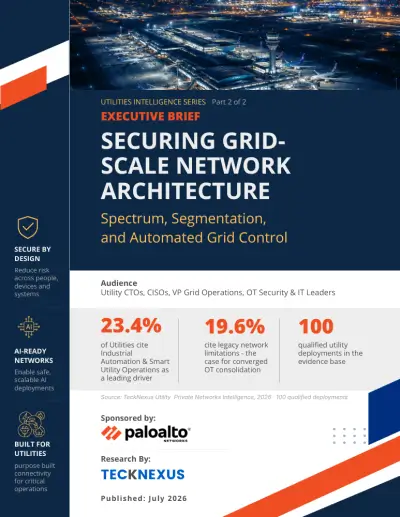
This whitepaper explains how utilities can use secure AI-enabled private mobile networks to modernize operations, support distributed intelligence, improve resilience, and strengthen cybersecurity across critical infrastructure. It covers AI applications, private network advantages, zero trust principles, multilayered security architecture, and governance considerations for AI-ready utility environments....
Whitepaper
Non-terrestrial networks are rapidly evolving from experimental satellite systems into an increasingly important part of the global 5G connectivity landscape. This eBook, developed by Radisys in collaboration with TeckNexus, explores how 3GPP standardization, satellite architecture innovation, and software-driven network design are reshaping NTN deployment models. It examines the transition from...
Whitepaper
Private cellular networks are transforming industrial operations, but securing private 5G, LTE, and CBRS infrastructure requires more than legacy IT/OT tools. This whitepaper by TeckNexus and sponsored by OneLayer outlines a 4-pillar framework to protect critical systems, offering clear guidance for evaluating security vendors, deploying zero trust, and integrating IT,...

Feature Your Brand in Upcoming Magazines

Showcase your expertise through a sponsored article or executive interview in TeckNexus magazines, reaching enterprise and industry decision-makers.

Private Network Solutions - TeckNexus

Subscribe To Our Newsletter

Scroll to Top

Map your security gaps to real threat scenarios – including Salt Typhoon, Volt Typhoon, AI data poisoning, rogue devices, and unencrypted OT traffic.

Take the free 8-minute assessment built for utility operators evaluating AI-enabled private mobile networks. Get a readiness score across five critical domains, see where your gaps are, and receive a prioritized action plan for what to fix first.

Free • 8 minutes • Built for private network security