

AI Agent Competitive
Intelligence
Intelligence
Private Network
Intelligence
Intelligence
Intelligence Journeys
Utilities Private Broadband Planning
AI Use Case Planning for Utilities
Intelligence Tools
By Tool Type
▼
By Industry
▼
Access Type
▼
Monthly Trackers
▼
Resources
▼
Technology Hubs
▼
Partner Hubs
▼


Security
Network and connectivity security spans the technologies and practices that protect networks, devices, and data from a growing range of threats — from supply-chain and signaling attacks to threats against private networks, IoT, and critical infrastructure. As networks become more software-defined, distributed, and open, the attack surface expands, and security shifts from a perimeter model toward zero-trust, identity-based, and AI-assisted defense. For operators and enterprises, security is now central to private networks, 5G standalone, edge, and IoT decisions rather than an afterthought. Regulation and nation-state activity have raised the stakes further. This channel covers security across telecom and enterprise connectivity — private and public network security, zero trust, IoT and OT, and the threats shaping the landscape — with analysis aimed at teams securing modern, distributed networks against evolving risk.
- Tech News & Insight
- September 24, 2026
- Canio Campaniello
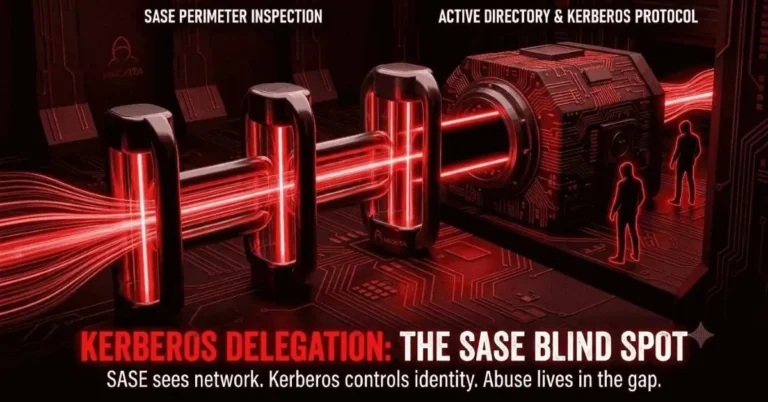
SASE architectures secure the network edge, but attackers rarely need to touch the edge once they're inside. Kerberos delegation abuse lets adversaries move laterally through fully "zero-trust" networks without triggering a single perimeter alert.
- Tech News & Insight
- September 3, 2026
- Hema Kadia
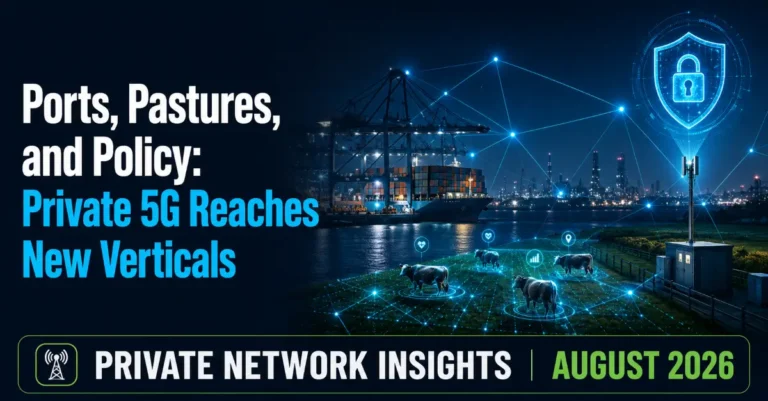
August 2026's roundup: Santos and Valenciaport advance port deployments while JNPA moves toward spectrum leasing, private 5G reaches a livestock farm in West Sussex and an enterprise HQ via Comcast, and security shifts from a vendor feature into a named line in national policy - from the UK NCSC's collaboration call to Brazil's auction-embedded network obligation.
- Tech News & Insight
- August 31, 2026
- Hema Kadia
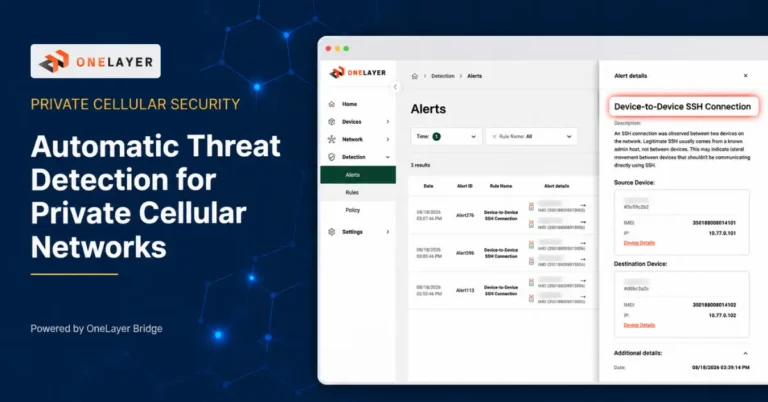
OneLayer has turned four real-world attack patterns, including the December 2025 Polish power plant breach, into automatic detections inside OneLayer Bridge. See how the platform catches SIM spoofing, rogue modems, and unauthorized device connections before they become incidents, and check your own network's posture with TeckNexus's free OneLayer assessment tools.
- Tech News & Insight
- August 27, 2026
- Hema Kadia
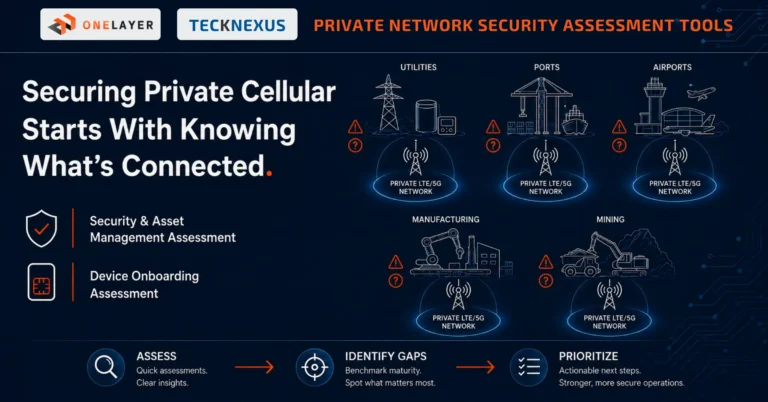
New interactive tools help critical infrastructure operators assess security, visibility & device-management maturity as threats target connected infrastructure.
- Tech News & Insight
- August 25, 2026
- Hema Kadia
Glide.id's MagicalAuth, launched in public beta with AT&T, T-Mobile US, and Verizon, replaces SMS one-time passcodes with hardware-rooted authentication anchored in the SIM or eSIM itself, verified through open network APIs. TeckNexus examines how this differs structurally from SMS OTP, why the three-carrier coverage threshold matters, and why the underlying infrastructure is likely to become directly relevant to enterprise IoT and OT device identity verification, even though today's launch is consumer-facing.
- Tech News & Insight
- August 24, 2026
- Hema Kadia
Lockheed Martin's upcoming 5G drone detection service on Verizon's network, and AT&T's cloud-managed Video Intelligence platform, both point at physical security AI capabilities moving from owned, standalone systems toward managed services delivered over carrier 5G networks. TeckNexus examines what that delivery shift means for procurement decisions at airports, ports, and utilities — and where the dependency trade-offs sit relative to standalone systems.
- Tech News & Insight
- August 23, 2026
- Hema Kadia
A coalition of more than 120 organisations, including Nvidia, Cisco, and CrowdStrike, has proposed a standardised framework for documenting and sharing AI agent security and operational incidents — modelled on existing incident-reporting standards in cybersecurity and aviation. TeckNexus examines what the framework would standardise, what those established precedents suggest about whether it can achieve broad, honest participation, and why it matters as a concrete due-diligence tool rather than an abstract governance principle.
- Tech News & Insight
- August 22, 2026
- Hema Kadia
Honeywell's publicly stated framework for deploying AI agents in industrial operations draws a specific, actionable line: bounded autonomy for well-defined, repeatable tasks with deterministic outcomes, human oversight for ambiguous or safety-critical decisions. TeckNexus examines the named use cases — from sensor fault handling to shift handovers — and the OT security posture Honeywell treats as inseparable from granting agents real execution authority, as a starting framework for industrial buyers prioritising their own agentic AI roadmap.
- Tech News & Insight
- August 22, 2026
- Hema Kadia
As utilities scale private LTE, 5G, and industrial IoT across operational technology environments, the attack surface is scaling with them. TeckNexus examines the security gap documented across the sector this August, the UK NCSC's identity-based access recommendations, and what a Tampa Electric private LTE deployment — combining Ericsson's connectivity, OneLayer's security layer, and Burns & McDonnell's integration work — shows about what a properly resourced approach actually looks like in practice.
- Tech News & Insight
- August 21, 2026
- Hema Kadia
Ooredoo Group and Indosat Ooredoo Hutchison have each launched a branded Zankore GPU-as-a-Service platform in Southeast Asia, targeting 1 gigawatt of AI capacity with Nvidia and Nokia as technical partners. TeckNexus examines the capital structure behind the build, why telecom operators are a plausible GPU-as-a-Service provider in under-served regional markets, and the network-compute bundling trade-off buyers should think through before this kind of vendor relationship reaches their own procurement conversations.
- Tech News & Insight
- August 18, 2026
- Hema Kadia
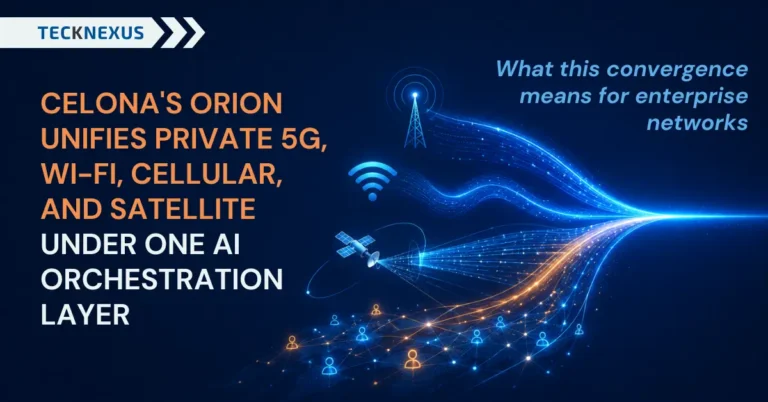
Celona's launch of Orion — unifying private 5G, Wi-Fi, public cellular, and satellite under a single deterministic fabric with an added AI orchestration layer — is a useful case study in where converged wireless architecture is heading. TeckNexus examines why multi-technology convergence is a meaningful architectural advance, what Orchestrator AI can add across a converged network, and the single-vendor subscription bundling model Celona has built around it.
Frequently Asked Questions
What’s the biggest emerging security risk for telecom networks right now?
Quantum computing’s eventual ability to break current encryption standards is the dominant emerging concern, often described through the framing of ‘harvest now, decrypt later,’ where adversaries collect encrypted data today, intending to decrypt it once sufficiently powerful quantum computers exist in the future. This matters particularly for telecom given how much sensitive data flows across networks protected by encryption standards quantum computers could eventually defeat. Alongside this longer-term quantum concern, the more immediate, near-term risk involves the expanded attack surface created by 5G’s heavy reliance on cloud-native, virtualized infrastructure and exposed APIs, which gives attackers considerably more potential entry points than older, more closed network architectures presented.
Are telecom networks actually doing anything about quantum threats yet, or is it theoretical?
It’s moving from theoretical to practical. Thales demonstrated that existing deployed 5G SIM and eSIM cards can be upgraded to quantum-safe protection without service disruption, proving that mobile networks can evolve their security through crypto agility rather than requiring an entirely new generation of hardware. Operators including BT, SK Telecom, Orange, and Deutsche Telekom are running live quantum-safe networking trials, with Deutsche Telekom specifically demonstrating quantum teleportation over a meaningful distance of commercial fiber in early 2026. These aren’t purely academic exercises; they represent genuine, if still early, steps toward preparing live commercial telecom infrastructure for the eventual quantum threat.
What is post-quantum cryptography (PQC), and is there a deadline for adopting it?
Post-quantum cryptography, commonly abbreviated PQC, refers to encryption algorithms specifically designed to resist attacks from future quantum computers, in contrast to the encryption algorithms most networks currently use, which quantum computers are expected to eventually break. Regulatory pressure is real and increasingly specific: the NSA’s CNSA 2.0 standard mandates quantum-safe algorithms for new national security system acquisitions by January 2027, and the European Commission is pushing critical infrastructure sectors, including telecom, toward post-quantum readiness by 2030. These deadlines, while initially focused on government systems, are widely expected to influence broader commercial telecom security planning timelines as well, since telecom is frequently classified as critical national infrastructure.
Is AI making telecom networks more or less secure?
It cuts both ways. On the defensive side, AI dramatically speeds up threat detection by spotting unusual patterns across enormous volumes of network traffic far faster than manual monitoring, and it increasingly powers automated incident response. On the risk side, AI agents given meaningful operational access to network systems represent a genuinely new kind of attack surface; if an agent’s decision-making can be manipulated, or its access misused, the consequences could be more severe than a typical software vulnerability, since the agent is specifically designed to take autonomous action on live infrastructure rather than simply process and report information.
Are 5G networks more vulnerable than older networks, or more secure?
5G’s expanded use of cloud-native, virtualized infrastructure and exposed APIs creates a larger attack surface than older, more closed network architectures, since there are simply more distinct software components and potential entry points for an attacker to target. At the same time, 5G’s architecture also enables faster patching, since updating virtualized software is generally quicker than physically replacing hardware, network slicing isolation, which can contain a security incident within one affected slice, and AI-based monitoring capabilities that weren’t practically possible on older, less data-rich legacy hardware. The honest assessment is that 5G is both more exposed in certain ways and better equipped to detect and respond to threats quickly in others.
What is ‘harvest now, decrypt later,’ and why does it matter even before quantum computers are powerful enough to break encryption?
‘Harvest now, decrypt later’ describes a strategy where an adversary intercepts and stores encrypted data today, even without the current ability to break that encryption, specifically betting that future quantum computers will eventually be powerful enough to decrypt it retroactively. This matters even before such quantum computers actually exist, because any sufficiently sensitive data encrypted today using standard, currently-vulnerable algorithms could theoretically be exposed years from now once quantum decryption capability matures, meaning organizations handling especially long-lived sensitive data face exposure risk regardless of how far away the quantum threat currently seems. This is precisely why regulators are pushing for PQC adoption now, well before quantum computers are actually capable of breaking current encryption.
What role do network APIs play in expanding or reducing telecom security risk?
Network APIs, which let third-party developers access specific carrier capabilities like location data or SIM status, introduce both new monetization opportunities and new security considerations operators need to manage carefully. Each exposed API represents a potential new entry point that needs rigorous authentication and monitoring, since a poorly secured API could potentially expose sensitive subscriber data to unauthorized parties. At the same time, well-designed network APIs can actually improve security in certain ways, for instance by giving banks access to fraud-prevention signals like SIM swap detection. The net security impact of network APIs ultimately depends heavily on how rigorously operators implement access controls and ongoing monitoring.
How are telecom operators securing IoT devices specifically, given how many are deployed?
Securing the enormous number of IoT devices connected to telecom networks presents distinct challenges compared to securing a smaller number of more capable, actively managed devices like smartphones. Operators increasingly rely on network-level security measures, like specialized IoT-focused firewalls and traffic monitoring tuned to detect unusual behavior, rather than depending entirely on each individual device having strong built-in security, since many IoT devices have limited processing power for running sophisticated security software directly. Some operators also offer dedicated, isolated network slices specifically for IoT traffic, helping contain the potential impact if a vulnerability in one device category is exploited, preventing that compromise from spreading into the rest of the network.
Security in Private 5G Networks: A Practical Guide for Enterprises
As enterprises move deeper into digital transformation, private 5G has emerged as a pragmatic answer to a specific problem: how to deliver controlled, reliable, and secure wireless connectivity where public networks fall short. Unlike public 5G, a private network is built around the needs of a single organization, offering tailored capacity, customization, and coverage in environments that defeat conventional wireless.
That value is clearest in demanding settings. Industrial operations that depend on low-latency machine-to-machine communication, and businesses spread across large campuses, both gain from a network they own and control.
But control cuts both ways. The same architecture that makes private 5G powerful also makes security a first-order design question rather than an afterthought. In a threat landscape that grows more sophisticated each year, securing a private 5G deployment is not a feature to bolt on later. It is part of the build.
The right approach is grounded and comprehensive. It accounts for the current threat environment, the vulnerabilities inherent to the technology, and the critical business functions the network supports. For most enterprises, the real question is not whether to adopt private 5G, but how to stand up a security posture that is resilient, adaptable, and matched to the risks this technology introduces.
Is Private 5G the Most Secure Option?
Security is the headline advantage cited for private 5G, but the honest answer is more nuanced than "yes." Private 5G is not automatically the most secure connectivity option in every dimension. What it offers is the strongest balance of security, flexibility, and scale, which is why it fits enterprises that need both protection and reach.
What makes private 5G secure
The security of private 5G starts with its architecture. In its most secure form, the network is fully isolated from the public network, hosted and managed on-site, and operated entirely by the enterprise. That isolation removes the network from the open internet and the vulnerabilities that come with it. On top of it, private 5G layers advanced encryption, strict access controls, and close monitoring of network traffic. Together these create a framework that is far less exposed to unauthorized access and external threats. Network slicing adds another dimension. By carving the network into separate virtual segments, each with its own security policy, an enterprise can match controls to the sensitivity of the data flowing through each slice.
What are the Best Practices for Securing Enterprise Private 5G?
- Strong private 5G security comes from layering deliberate practices on top of the network’s built-in features. Enterprises should start by building security directly into the network architecture. This begins with strict access control, including SIM-based authentication paired with role-based access, so only authorized users, devices, and applications can connect. Advanced encryption should be applied to data at rest and in transit, supported by disciplined encryption key management. Network slicing can further strengthen security by creating separate, secure virtual networks for different operations, teams, or use cases. Regular audits and ongoing compliance checks are also essential to ensure the network continues to meet relevant industry standards and regulatory requirements. In addition, 5G-specific security controls should be integrated with the enterprise’s existing security infrastructure, with careful planning around the unique requirements of private 5G environments.
- Effective private 5G security also depends on how threats and people are managed. Enterprises should deploy advanced threat detection capabilities to identify breaches or abnormal behavior early, and they should support those tools with a clear incident response plan that enables teams to act quickly when an issue occurs. Staff training is equally important. Employees and operational teams need to understand 5G security protocols, device access rules, and incident escalation processes. Security awareness should become part of normal operations, not an occasional training exercise. Enterprises should also work closely with service providers, technology vendors, and system integrators under a clear shared-responsibility model, so every party understands its obligations and meets the enterprise’s security standards.
- Organizations should also recognize the limits of private 5G’s “secure by design” foundation. Private 5G is not immune to attack, and built-in security should be treated as a starting point rather than a complete defense. A strong posture requires additional layers, including continuous monitoring, real-time threat detection, and an end-to-end view across every component of the network. This is especially important at the points where IoT, OT, and enterprise IT systems intersect. Regular software updates and patching are non-negotiable, as outdated systems can quickly become weak points. Physical security also matters, particularly for network equipment located in Radio Access Network areas, edge sites, and other operational environments.
- Private 5G gives enterprises a level of control that public networks cannot provide, and that control is the source of both its security advantages and its responsibilities. The technology is not secure by default in every dimension, but with isolation, encryption, slicing, continuous monitoring, and a disciplined operational posture, it can deliver a strong combination of security, flexibility, and scalability. For enterprises weighing connectivity options, the question is less about whether private 5G can be secure and more about whether the organization is ready to build, operate, and maintain the security posture that makes it so.
How it compares to other options
A fair comparison puts private 5G alongside private LTE, Ethernet, and WiFi rather than against public 5G alone:
| Feature | Private 5G | Private LTE | Ethernet (Wired) | WiFi |
|---|---|---|---|---|
| Isolation | Full isolation possible | Full isolation possible | Inherently isolated | Shared medium, less isolated |
| Encryption | Advanced encryption | Less advanced than 5G | Depends on protocol | Less robust |
| Access control | SIM-based authentication | SIM-based authentication | Physical and protocol-based | SSID and password |
| Network control | Full on-site control | Full on-site control | Full control, limited flexibility | Less control, more exposure |
| Network slicing | Supported | Not supported | Not applicable | Not supported |
| Edge computing integration | Seamless, enhances security | Possible, less integrated | Possible, can be very secure | Less integrated |
| Traffic monitoring | Easier, software-defined | Harder than 5G | Easier, fixed pathways | Harder |
| Attack surface | Reduced by isolation | Reduced by isolation | Minimal, no wireless access | Larger, wireless access |
| Physical security | High, controlled environment | High, controlled environment | Very high, hard to tap | Lower, easier to intercept |
| Scalability | High, with slicing | Scalable, no slicing | Limited | Scalable but less secure |
The table makes the trade-off clear. Ethernet is exceptional on physical security and isolation, but it cannot match private 5G for flexibility, mobility, or scale, particularly when supporting large fleets of IoT devices and mobile users. Private LTE is secure but lacks 5G capabilities like network slicing. WiFi is convenient and widely deployed, but its shared medium leaves it more exposed to interference and eavesdropping.
No single option wins on every axis. The right choice depends on what the enterprise needs to protect and how dynamic its environment is. For organizations that need strong security without sacrificing scale and mobility, private 5G is usually the best fit.




Telco AI Agent Leadership

