Spectrum

Search US licensed spectrum availability by frequency, geography, and licensee. Essential for US-based private network spectrum planning and CBRS/PAL availability checks.
Runaway AI training demand is pushing data center fabrics past their limits, making optical networking the bottleneck to unlock GPU-scale performance and efficiency. Scale-up connects more GPUs within a box or across tightly coupled racks to form supernodes with ultra-low-latency fabrics. A new forecast from Goldman Sachs positions optical networking as the next mega-trend in AI infrastructure, with spend growing an order of magnitude as clusters densify. CPO—integrating optical engines with switch ASICs or accelerators—features prominently in the growth outlook. Expect a technology mix that also includes pluggable 800G/1.6T optics and emerging Linear Pluggable Optics (LPO) to reduce DSP power at short reaches.
The Fiber Broadband Association's Fiber Connect 2026 conference repositioned fiber as a foundational prerequisite for AI infrastructure — not merely a consumer broadband conduit. With hyperscalers investing $370 billion annually in AI, the FBA projects demand for twice as many fiber route miles and three times total fiber deployed today. Over 100 million U.S. homes have now been passed with fiber, yet workforce shortages exceeding 200,000 workers and power constraints threaten deployment velocity precisely when AI-driven demand is accelerating fastest.
Wireless services are defying U.S. inflation trends in a way virtually no other sector is. According to CTIA's newly released More for Less: 2026 Wireless Affordability Tracker, nominal wireless prices have declined 4.1% over the past year and 19% over the past decade, while the economy-wide CPI rose more than 37% over the same period. Adjusted for inflation, postpaid unlimited plans are down roughly 10% year-over-year, and prepaid options have fallen more than 50% over five years. For enterprise decision-makers, this pricing trajectory represents a structurally favorable condition for mobile workforce and IoT connectivity planning.
T-Mobile and Ericsson are delivering measurable AI-native RAN results at commercial scale on a live 5G Advanced network. Ericsson's AI-native Scheduler with Link Adaptation replaces rule-based logic with a neural network that predicts RF conditions in real time, achieving close to 10 percent spectral efficiency improvement and up to 15 percent downlink throughput gains. Separately, Ericsson validated its Cloud RAN software running on NVIDIA AI infrastructure, enabling hardware-agnostic deployment. Together, these advances signal that AI-native networking is no longer theoretical — it is executing at national scale.
Washington and industry have synchronized timelines and targets to identify, clear, and harmonize the mid-band spectrum that will underpin commercial 6G deployments in the early 2030s. The Administration’s National Security Presidential Memorandum on 6G directs NTIA to reallocate 7.125–7.4 GHz for full‑power, licensed commercial use and to study federal relocation to 7.4–8.4 GHz where feasible; it also orders immediate feasibility studies in 2.69–2.9 GHz and 4.4–4.94 GHz. The 7.125–7.4 GHz range is the U.S. front‑runner for high‑power licensed 6G, with NTIA studying federal relocation to clear contiguous bandwidth and enable 400–750 MHz per operator in a single swath.
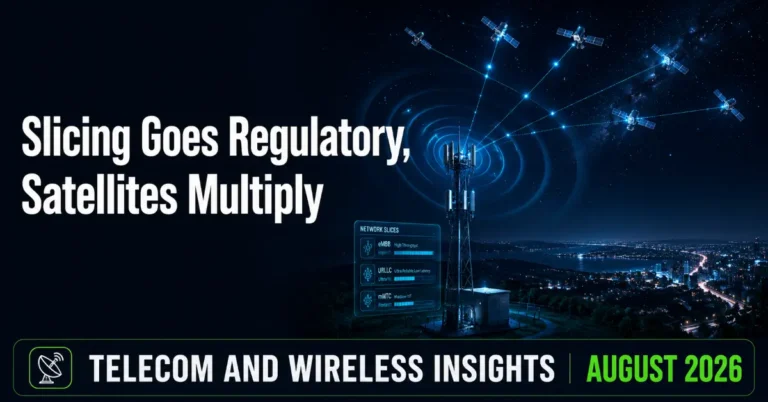
Verizon has expanded its satellite asset fleet to 2,600 units in 2025, introducing a multi-orbit off-road trailer capable of switching between GEO and LEO connectivity. The carrier is also piloting permanent satellite backhaul at high-risk cell towers across Georgia, Florida, and the Carolinas. Through a $100 million partnership with AST SpaceMobile, Verizon is advancing direct-to-device satellite connectivity using standard smartphones. Satellite is positioned not as a replacement for fiber or 5G, but as a planned resilience layer and coverage extension tool for enterprise and public safety stakeholders.
T-Mobile CEO Srini Gopalan admitted during Q1 2026 earnings that its T-Satellite direct-to-device service is seeing far less usage than projected, largely because T-Mobile's terrestrial network leaves few coverage gaps for consumers. With 1.8 million free beta sign-ups failing to translate into strong paid engagement, and Apple's free Globalstar satellite messaging compressing the addressable market, T-Mobile is pivoting toward enterprise connectivity. Its new SuperBroadband offering pairs 5G with Starlink LEO broadband, targeting businesses in healthcare, retail, and energy that require resilient, always-on connectivity across distributed locations.
Verizon posted 55,000 postpaid phone net additions, a modest beat that underscores stabilizing consumer trends and stronger execution in premium plans and broadband cross-sell. The net add beat is small in absolute terms, but strategically important: it points to improving churn and a healthier mix of high-value subscribers after several quarters of intense promotional pressure. Management coupled the result with a constructive outlook characterized by service revenue resilience and disciplined capital intensity, hinting at a tighter or modestly raised full‑year guide. For a market still digesting 5G investment cycles, this steady footing matters more than splashy net‑add gains.
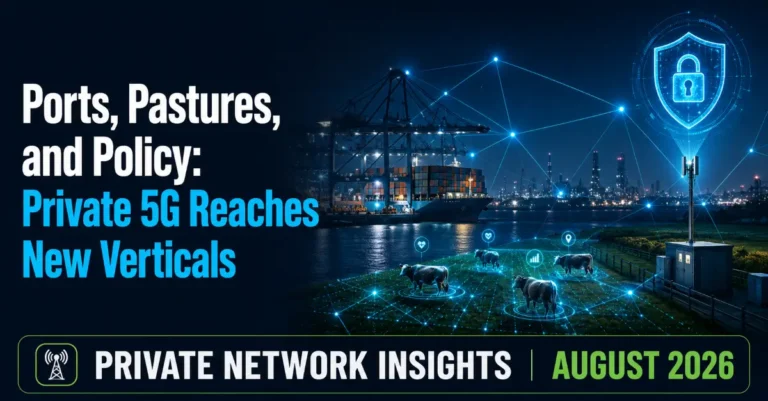
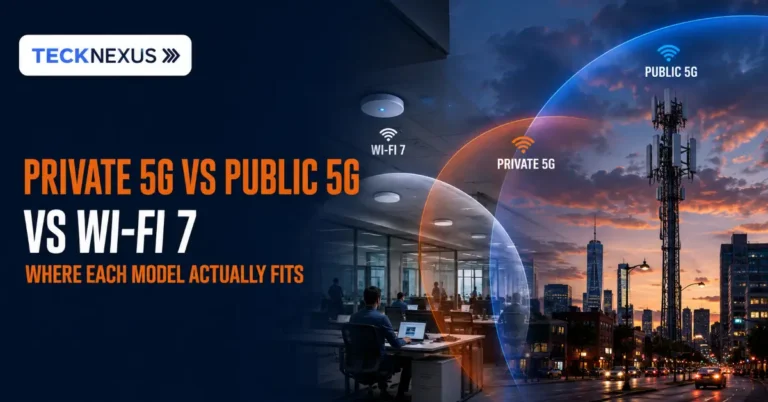
P‑CAL’s secure mesh provided resilient communications across a complex yard, validating control loops and telemetry in the presence of interference, variable traffic density and human activity. As deployments scale, many terminals will adopt hybrid connectivity: private 5G for wide‑area mobility and interference resilience, Wi‑Fi/Wi‑Fi 6E/7 for indoor assets, and mesh for redundancy in hard‑to‑reach zones. This mirrors global port trends, where operators are rolling out private 5G to support autonomous trucks, AI‑driven analytics, drones and mobile cranes. Expect edge compute (MEC) on‑premises to host perception, fleet orchestration and video intelligence with strict latency and data‑sovereignty requirements.
Deutsche Telekom is weighing a structural overhaul that would collapse its 53% ownership of T-Mobile US into a single, unified company spanning both sides of the Atlantic. Reports indicate Deutsche Telekom is exploring an all-stock transaction in which a new holding company would acquire both Deutsche Telekom and T-Mobile US, with current shareholders of each ending up as owners of the combined entity. The new group could pursue dual listings in the U.S. and Europe, eliminating today’s parent–subsidiary setup and aligning governance, strategy, and capital allocation under one roof.
Sponsored by Palo Alto Networks
⚡ Utilities ⏱ 8 min ✓ Free
This tool is built and hosted by TeckNexus.
Launch Tool →
Whitepaper
Airports are deploying AI surveillance, biometrics, and autonomous vehicles faster than most networks can secure them. See what 100 real-world airport deployments reveal about the airside/landside security gap — and the 4-layer framework built to close it....
Scroll to Top