Intelligence Journeys
AI Use Cases for Utilities
Private Broadband for Utilities

Qualcomm

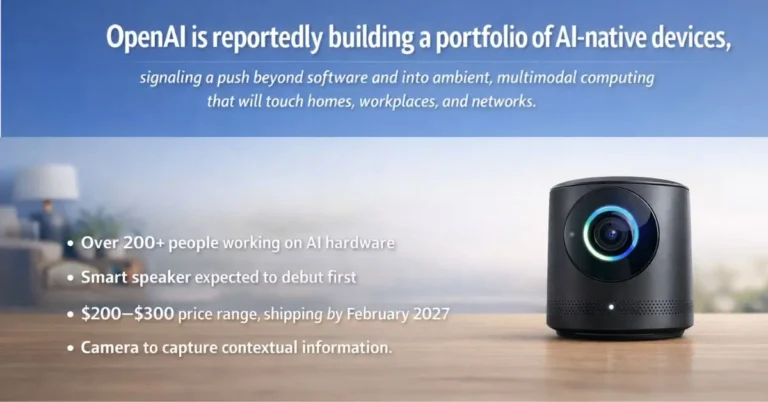
OpenAI is reportedly building a portfolio of AI-native devices, signaling a push beyond software and into ambient, multimodal computing that will touch homes, workplaces, and networks. Multiple reports indicate OpenAI has over 200 people developing a family of AI-enabled hardware, with a smart speaker expected to debut first. Early guidance points to a price in the $200–$300 range and a ship window no earlier than February 2027. The device is said to include a camera to capture contextual information about users and surroundings—an explicit bet on multimodal AI that fuses voice, vision, and environment for richer interactions.
An AI‑fueled land grab for advanced memory is squeezing supply for handsets, undercutting Qualcomm’s near‑term outlook even as end‑demand for premium Android devices improves. Memory suppliers are prioritizing high‑bandwidth memory (HBM) and DDR5 for AI accelerators and data center servers, diverting wafer capacity and capex away from mobile‑grade LPDDR5/5X and UFS storage. The result is a classic allocation cycle: supply chases the highest‑margin demand (HBM and enterprise SSDs), while downstream categories like smartphones and some edge devices face tighter availability and rising component costs. For Qualcomm, whose Snapdragon platforms anchor premium Android devices, the constraint limits upside volume and mix in the near term.
The latest 3GPP cycle consolidates 5G-Advanced (Release 18), sets the agenda for Release 19, and frames early 6G studies, with direct implications for operator investment, enterprise use cases, and vendor roadmaps. Release 18, the first phase of 5G-Advanced, is moving from standards completion into implementation, bringing carrier-grade enhancements in spectral efficiency, energy savings, and mobility performance. Release 19 now builds on these foundations, prioritizing further RAN efficiency, XR and video delivery at scale, richer analytics/exposure in the core (NWDAF, NEF/CAPIF), and enterprise-grade reliability across private and public networks.

2025 has seen major telecom and tech M&A activity, including billion-dollar deals in fiber, AI, cloud, and cybersecurity. This monthly tracker details key acquisitions, like AT&T buying Lumen’s fiber assets and Google’s $32B move for Wiz, highlighting how consolidation is shaping the competitive landscape.
New data points to a step-change in cellular IoT adoption as 5G broadens into mid-tier and massive-scale use cases while 4G-era LPWA keeps expanding. Omdia forecasts cellular IoT connections to reach roughly 5.9 billion by 2035, driven by expanding addressable use cases across industrial automation, utilities, transportation, retail, and consumer-adjacent categories such as wearables. The growth profile is no longer tied only to premium 5G performance; instead, scaled adoption is coming from three complementary pillars: 5G RedCap for mid-tier performance at lower cost, 5G Massive IoT (evolving NB-IoT/LTE-M under a 5G core), and 4G LTE Cat-1bis for low-cost devices that still require voice or moderate throughput.
A high-stakes policy fight has emerged in India over the 6 GHz band, pitting global device and cloud ecosystems against mobile operators over whether the band should power unlicensed Wi‑Fi or licensed mobile (IMT) networks. Apple, Amazon, Cisco, Meta, HP, and Intel have jointly urged India’s regulator, TRAI, to reserve the full 6 GHz range for Wi‑Fi, arguing the band is not technically or commercially ready for IMT and that unlicensed use will deliver immediate, widespread capacity benefits. Reliance Jio, Bharti Airtel, and Vodafone Idea have countered that delicensing upper 6 GHz would permanently foreclose India’s option to deploy wide‑area licensed broadband in prime mid‑band spectrum.
Policy choices over the next two years will set the capacity ceiling for 6G-era services through the 2030s. Mobile traffic is overwhelmingly urban, concentrated in a small fraction of national land areas and rising fastest in very dense zones. The GSMA’s new Vision 2040 analysis concludes these levers will not keep pace with demand growth on their own. The modeling indicates countries will need, on average, 2–3 GHz of total mid-band assigned for mobile by 2035–2040 to meet peak urban demand; higher-demand markets trend toward 2.5–4 GHz. Crucially, about 2 GHz needs to be operational by 2030 to avoid early congestion as 6G arrives.
India’s 5G market has entered a scale phase, with momentum pointing to more than a billion subscribers and deeper network modernization over the next six years. Ericsson’s latest Mobility Report projects over 1 billion 5G subscriptions in India by end-2031, representing about 79% of the country’s mobile base. Average mobile data usage per active smartphone in India stands near 36 GB per month and is forecast to approach 65 GB per month by 2031. Two demand-side levers stand out: affordable 5G devices and expanding Fixed Wireless Access (FWA), accelerating mainstream adoption and opening a credible substitute to wired broadband in underserved areas.
Nvidia’s latest quarter signals that AI infrastructure spending is not cooling and is, in fact, broadening across clouds, sovereigns, and enterprises. Nvidia delivered $57 billion in revenue for the quarter, up more than 60% year over year, with GAAP net income reaching $32 billion; the data center segment accounted for roughly $51.2 billion, dwarfing gaming, pro visualization, and automotive combined. Management guided next-quarter sales to about $65 billion, exceeding consensus by several billion and underscoring that supply remains tight for cloud GPUs even as deployments ramp across hyperscalers, GPU clouds, national AI initiatives, and large enterprises.
Qualcomm is moving from mobile NPUs into rack-scale AI infrastructure, positioning its AI200 (2026) and AI250 (2027) to challenge Nvidia/AMD on the economics of large-scale inference. The company is translating its Hexagon neural processing unit heritage—refined across phones and PCs—into data center accelerators tuned for inferencing, not training. AI200 and AI250 will ship in liquid-cooled, rack-scale configurations designed to operate as a single logical system. Qualcomm is leaning into that constraint with a redesigned memory subsystem and high-capacity cards supporting up to 768 GB of onboard memory—positioning that as a differentiator versus current GPU offerings.
Snap has opened its first open-prompt AI image Lens, Imagine, to all U.S. users, signaling a new phase in mainstream generative experiences inside the camera. Imagine Lens lets users write a short prompt and instantly transform a selfie or create an image from scratch, then share it in chats, Stories, or off-platform. The capability was previously limited to Lens+ and Snapchat Platinum subscribers. Camera-native generative features at social scale change traffic patterns, compute placement, and safety obligations for platforms and networks. Provenance standards such as C2PA content credentials are becoming table stakes for enterprise integrations and advertiser trust.
Unlike metaverse-era headsets that leaned on entertainment and novelty, Galaxy XR makes Google’s Gemini the front door to the interface. In demos, Gemini orchestrated windows in a spatial workspace, answered context-aware questions, and invoked creative tools like Veo for AI-generated video. That tight AI integration is the strategic wedge: Samsung and Google position XR as a bridge to slim, everyday AI glasses developed with eyewear brands Warby Parker and Gentle Monster. The message to developers and enterprises is clear—design for multimodal AI agents first; the form factor will shrink later.

Partner Hubs

Download content, access intelligence tools, and hear from executives.

Partner Events

  • M360 ASEAN
  • FutureNet Asia 2026
  • Network X Vienna 2026
Scroll to Top