Japan

Fujitsu is expanding its strategic collaboration with NVIDIA to deliver a full-stack AI infrastructure that pairs domain-specific AI agents with high-performance compute for enterprise and industrial use. The companies will co-develop an AI agent platform and a next-generation computing stack that tightly couples Fujitsu’s FUJITSU-MONAKA CPU series with NVIDIA GPUs using NVIDIA NVLink-Fusion. On the software side, Fujitsu plans to integrate its Kozuchi platform and AI workload orchestrator (built with Fujitsu AI computing broker technology) with the NVIDIA Dynamo platform.
Hitachi has launched a global AI Factory built on NVIDIA’s reference architecture to speed the development and deployment of “physical AI” spanning mobility, energy, industrial, and technology domains. Hitachi is standardizing a centralized yet globally distributed AI infrastructure on NVIDIA’s full-stack platform, pairing Hitachi iQ systems with NVIDIA HGX B200 platforms powered by Blackwell GPUs, Hitachi iQ M Series with NVIDIA RTX 6000 Server Edition GPUs, and the NVIDIA Spectrum-X Ethernet AI networking platform. The environment is designed to run production AI with NVIDIA AI Enterprise and support simulation and physically accurate digital twins using NVIDIA Omniverse libraries.
Wayve’s end-to-end driving AI is now running in Nissan Ariya electric vehicles in Tokyo, marking a pragmatic step toward consumer deployment in 2027. The test vehicles combine a camera-first approach with radar and a lidar unit for redundancy, aligning with Japan’s dense urban environment and complex traffic patterns. The initial commercial target is “eyes on, hands off” Level 2 driver assistance, with drivers remaining responsible and ready to take over. Nvidia has signed a letter of intent for a potential $500 million investment in Wayve’s next funding round, reinforcing the compute-intensive nature of the program.
KDDI’s move to enable satellite data on recent iPhones via “au Starlink Direct” is a meaningful step toward resilient, nationwide connectivity that blends terrestrial and non-terrestrial networks. KDDI now supports satellite data communication on all models of iPhone 13 through iPhone 17, plus iPhone Air—21 models in total, so consumers and field teams can use essential apps when they are outside cellular coverage. The satellite layer augments KDDI’s 5G/4G LTE footprint; combined, the operator aims to cover virtually all of Japan’s geography, not just its population centers. Notably, the service is available to au subscribers and customers of other carriers.
SoftBank has validated a multi‑cell, end‑to‑end 5G link via a high‑altitude platform payload, marking a concrete step toward stratospheric coverage that works with standard smartphones. In a June field trial over Hachijō Island, Japan, SoftBank mounted a newly developed payload on a light aircraft at 3,000 meters to emulate a High Altitude Platform Station (HAPS) operating around 20 kilometers. The system stitched a millimeter‑wave feeder link at 26 GHz from a ground gateway to the aircraft with a sub‑2 GHz service link at 1.7 GHz from the aircraft to handsets, completing an end‑to‑end path through the 5G core.
MATRIXX Software introduces dynamic billing support for satellite and non-terrestrial network (NTN) services, enabling telecom operators to expand coverage, monetize emerging LEO partnerships, and unify revenue management. The platform supports flexible commercial models, powering growth in underserved regions and across consumer, enterprise, and wholesale markets.
Explore the transformative journey as Cisco, Mitsui, and KDDI unite to deploy Private 5G technology, ushering in a new era for Japan's manufacturing landscape. This collaboration aims to enhance operational efficiency, safety, and innovation through the power of advanced Private 5G networks, marking a significant leap towards the realization of smart factories.
Discover the future of hybrid work with 5G Windows 11 PCs enabled by SoftBank, T-Mobile, Telia, Ericsson, Microsoft, and Thales, offering seamless connectivity and automated eSIM management.
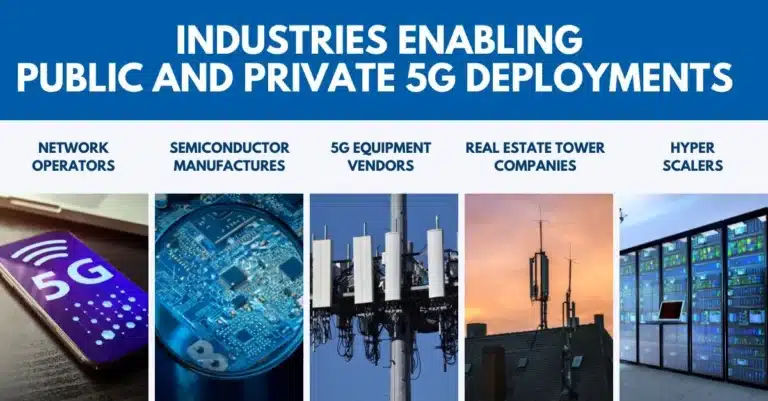
Investors seeking to maximize their profits from the potential of 5G should consider a multi-pronged approach and invest in companies that provide 5G network equipment, tower infrastructure, semiconductors, and hyperscalers as well as 5G mobile network operators. Here are the top companies across the sectors that are leading global public/private network rollouts.
The report entitled "5G Infrastructure Market" analyzes the global, regional and local market based on communications infrastructure, core network technology networks, the network infrastructure, frequency of operation, end-use, and region. The report offers thorough analysis of the market's historical and projected size, along with a trend analysis. 
5G and 6 GHz Spectrum Use at the Heart of Upcoming APT Conference taking place next month in Brisbane. The meeting's main focus is to decide on the future use of the 6 GHz spectrum band for 5G services, setting the stage for a strategic and economical 5G rollout across Region 3 nations.
CBRS Private Network Dramatically Improved Wireless Communications Along Remote Areas of I-70

Your Brand. Our Intelligence Tools.

Capture leads at the point of evaluation. Talk to Us →

Sponsored by Palo Alto Networks
⚡ Utilities ⏱ 8 min ✓ Free
This tool is built and hosted by TeckNexus.
Launch Tool →
Whitepaper
This whitepaper explains how utilities can use secure AI-enabled private mobile networks to modernize operations, support distributed intelligence, improve resilience, and strengthen cybersecurity across critical infrastructure. It covers AI applications, private network advantages, zero trust principles, multilayered security architecture, and governance considerations for AI-ready utility environments....
Whitepaper
Non-terrestrial networks are rapidly evolving from experimental satellite systems into an increasingly important part of the global 5G connectivity landscape. This eBook, developed by Radisys in collaboration with TeckNexus, explores how 3GPP standardization, satellite architecture innovation, and software-driven network design are reshaping NTN deployment models. It examines the transition from...
Whitepaper
Private cellular networks are transforming industrial operations, but securing private 5G, LTE, and CBRS infrastructure requires more than legacy IT/OT tools. This whitepaper by TeckNexus and sponsored by OneLayer outlines a 4-pillar framework to protect critical systems, offering clear guidance for evaluating security vendors, deploying zero trust, and integrating IT,...

It seems we can't find what you're looking for.

Scroll to Top

Map your security gaps to real threat scenarios – including Salt Typhoon, Volt Typhoon, AI data poisoning, rogue devices, and unencrypted OT traffic.

Take the free 8-minute assessment built for utility operators evaluating AI-enabled private mobile networks. Get a readiness score across five critical domains, see where your gaps are, and receive a prioritized action plan for what to fix first.

Free • 8 minutes • Built for private network security