AI Agent Competitive
Intelligence
Intelligence Journeys
AI Use Cases for Utilities
Private Broadband for Utilities

Huawei

The Federal Communications Commission is advancing a proceeding that would prohibit US carriers from interconnecting with Chinese state-linked operators and from using facilities they own or operate, including data centers and points of presence. The proposal targets interconnection at meet-me rooms, cross-connects, and handoffs that underpin IP transit, voice interconnect, SMS hubs, and enterprise backhaul. The Commission is seeking comment on a ban and will take the item to a vote at its 30 April Open Meeting. Depending on the final order, potential outcomes range from mandatory disconnection to forced divestiture or transfer of affected facilities.
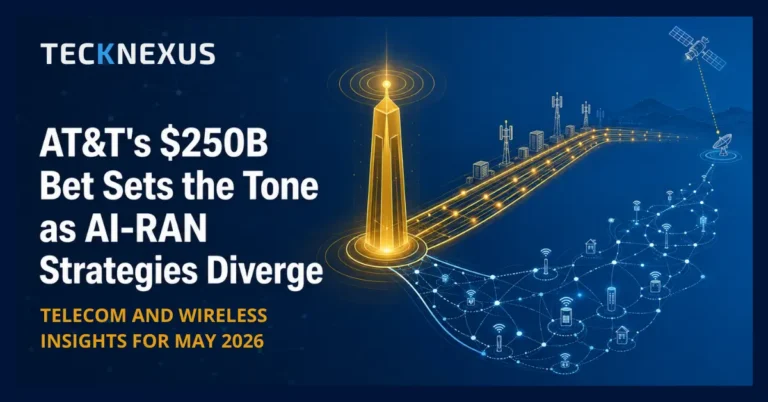
March 2026's inaugural roundup: AT&T commits $250B to fiber, 5G, and AI-era infrastructure through 2030, Ericsson and Nokia diverge on AI-RAN strategy at MWC Barcelona, 6G's roadmap firms up around a 2029 target, and satellite direct-to-device edges toward commercial launch.
March 2026's roundup: GSMA, Google Cloud, Huawei, and AWS all converge on an "agentic telco" framing at MWC Barcelona, SoftBank and SK Telecom build proprietary telecom-specific AI models and infrastructure, and physical AI reaches airports, drones, and network edge sites — with AI-RAN and connectivity infrastructure covered separately in our companion Advanced Connectivity Insights, March 2026.
Live Streamed on Tues, 3 Mar at 09:30 - 11:00 CET

How will the AI systems we build today define technology, society, and humanity tomorrow? From advanced chip architectures and global networks to generative coding and the next frontier of digital identity, this session brings together pioneering leaders shaping both the systems, and the consequences of the AI world being built today.
Private LTE, 5G, and CBRS networks are becoming the backbone of industrial operations. This article maps private network security vendors to a Four Pillars framework—Core Controls, Device Visibility, Detection & Response, and Orchestration—revealing where structural gaps emerge in real-world industrial deployments. From slice isolation and SIM lifecycle governance to OT micro-segmentation and SOC integration, it explains why layered enforcement—not vendor breadth—determines private 5G security resilience.
Ericsson is signaling a strategic shift toward defence, mission-critical, and AI-era network architectures as traditional RAN spending stays flat. Management expects the global RAN market to remain flat in 2026, sustaining a multi-year trend that now pegs annual spend at roughly the low-$30 billions. Ericsson is building for a traffic mix shift where AI applications push uplink throughput and latency to the forefront. Defence, utilities, transport, and public safety are moving from proprietary systems to standards-based 3GPP networks.
SkyMirr’s Sky5G Wireless Router being named a CES 2026 Innovation Awards Honoree signals that antenna-first design is emerging as a decisive lever for 5G customer-premises equipment performance and reliability. The Consumer Technology Association’s awards program recognizes design and engineering that materially advances user outcomes, and SkyMirr’s selection draws attention to a core differentiator: its MuLCAT (Multi-Layer Coupling Controlled Antenna Technology) architecture. Rather than treating the antenna as a downstream component, MuLCAT integrates a multi-layer coupling approach to increase isolation, broaden usable bandwidth, and suppress interference in compact enclosures.
Enterprises adopting private 5G, LTE, or CBRS networks need more than encryption to stay secure. This article explains the 4 pillars of private network security: core controls, device visibility, real-time threat detection, and orchestration. Learn how to protect SIM and device identities, isolate traffic, secure OT and IoT, and choose the right vendors for a robust private network security strategy.
Nokia delivered a stronger-than-expected third quarter, with comparable operating profit reaching €435 million against consensus of about €342 million. Group net sales rose 12% to €4.83 billion, above forecasts, driven by Optical Networks and cloud-related demand tied to AI data centers. The stock jumped double digits intraday and added billions in market value, reflecting newfound confidence after a challenging first half. The recovery now is concentrated in network infrastructure rather than mobile RAN, underscoring where customers are actually spending to handle AI-era traffic patterns. Nokia nudged its full-year operating profit outlook to €1.7–2.2 billion, with a reporting change related to scaling down passive venture investments partly in play.
After two years of decline, telecom equipment spending is edging back into positive territory with early signs of a broad-based rebound. Dell’Oro Group’s preliminary data indicates worldwide telecom equipment revenues across six tracked sectors rose 4% year over year in the first half of 2025, with markets outside China up a stronger 8%. The rebound was not limited to a single pocket of spend, but three areas led the gains: mobile core networks, optical transport, and service provider routers and switches. By contrast, RAN remains comparatively muted in many markets as 5G macro buildouts mature.
The CPU roadmap is strategically important because AI clusters depend on balanced CPU-GPU ratios and fast data pipelines that keep accelerators fed and utilized. Even as GPUs carry training and inference, CPUs govern input pipelines, feature engineering, storage I/O, service meshes, and containerized microservices that wrap models in production. More cores and threads at competitive power envelopes reduce bottlenecks around feeder tasks, scheduling, and data staging, improving accelerator utilization and lowering total cost per token or inference. In this lens, a 256-core Arm-based Kunpeng in 2028 would directly affect how much AI throughput Ascend accelerators can sustain per rack.
Fresh off its merger, VodafoneThree has locked in eight-year vendor deals with Ericsson and Nokia to underpin a £11 billion UK network build that is front-loaded for rapid 5G Standalone coverage gains. VodafoneThree selected Ericsson and Nokia as primary technology partners for one of the largest privately funded mobile infrastructure programs in Europe, with contracts collectively valued at over £2 billion. In year one, close to three quarters of the population are targeted for access to its fastest 5G services, rising to about 90% population coverage on 5G Standalone by year three and reaching roughly 99.95% by 2034 under a regulated, fully funded build plan.

Partner Hubs

Download content, access intelligence tools, and hear from executives.

Partner Events

  • FutureNet Asia 2026
  • Network X Vienna 2026
Scroll to Top