

Partner Hubs

The next evolution of Ciena’s DCOM: OOB management for diverse data center needs
2027 Intelligence Programs

Ericsson

Lyttelton Port Company (LPC) introduced a private 5G network with 2degrees and Ericsson Enterprise Wireless Solutions to improve safer, more resilient port operations across difficult “metal canyon” container lanes and wide outdoor yards. The deployment supports asset tracking, job dispatch, safety alarms, and video streaming, with Ericsson Cradlepoint routers on straddle carriers using private 5G as primary and 2degrees’ public mobile network as backup. With 434,000 containers handled in FY2025, LPC is also planning next steps like wind/stormwater sensors and drone inspections feeding AI tools.
A new collaboration between GSMA Foundry and Singapore’s National University Health System (NUHS) aims to operationalize connected health at scale, with Ericsson and Singtel anchoring the 5G foundation. Healthcare digitization has moved from pilots to production, but most sites still struggle with deterministic connectivity, secure data exchange and workflow integration. The program combines private 5G with digital twin, XR, IoT and ambient AI to improve outcomes and operational resilience across care pathways. Early focus areas include 5G-enabled remote surgical assistance with ultra-reliable, low-latency links; immersive XR training and simulation that compress learning curves; autonomous and semi-autonomous robotics for logistics and point-of-care tasks; and AI-guided imaging such as vein visualization.
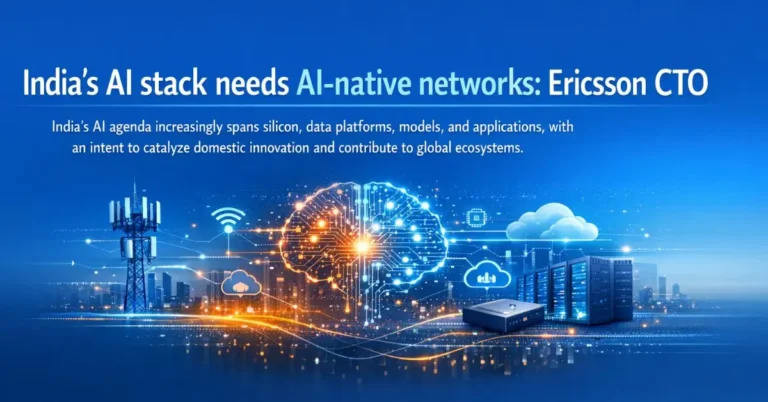
India’s AI agenda increasingly spans silicon, data platforms, models, and applications, with an intent to catalyze domestic innovation and contribute to global ecosystems. For telecom leaders, the message is clear: AI is not a bolt-on capability but a system-level transformation that touches RAN, core, transport, cloud, and the enterprise edge. The AI economy runs on connectivity—low-latency access to data, assured bandwidth, location-aware processing, and programmable control. The operators that can fuse connectivity, compute, and data into a cohesive platform will set the pace for India’s next wave of digital growth.
Ericsson and Mistral AI are aligning telecom-grade engineering with customizable foundation models to push AI deeper into network operations and RAN automation. The pairing marries Mistral AI’s fast-evolving model stack with Ericsson’s domain expertise across radio, cloud-native networking, and service management. For European operators, it signals a path to AI capabilities that respect data residency, security, and compliance expectations under the EU AI Act without ceding control to generic, hyperscaler-led platforms. The outcome operators want is simple: measurable gains in performance, efficiency, and resiliency with governance baked in.
Private LTE, 5G, and CBRS networks are becoming the backbone of industrial operations. This article maps private network security vendors to a Four Pillars framework—Core Controls, Device Visibility, Detection & Response, and Orchestration—revealing where structural gaps emerge in real-world industrial deployments. From slice isolation and SIM lifecycle governance to OT micro-segmentation and SOC integration, it explains why layered enforcement—not vendor breadth—determines private 5G security resilience.
2027 Intelligence Programs
Scroll to Top
TECKNEXUS MWC BARCELONA 2027
MWC27 EXECUTIVE INSIGHTS PROGRAM

Industry voices. Ideas that move.

SIX MAGAZINES. SIX BIG CONVERSATIONS.
EDITION 01 Networks as Platforms
EDITION 02 AI in the Real World
EDITION 03 The Intelligent Enterprise
EDITION 04 The Future of AI
EDITION 05 Securing the Digital Future
EDITION 06 The Next Frontier

Ways to Participate

Contributed Article Complimentary for eligible MWC sponsors
Sponsored Article & Executive Q&A
Executive Video Interview