Private Network
Intelligence
Intelligence Journeys
Utilities Private Broadband Planning
AI Use Case Planning for Utilities

Devices

Arm has expanded its Flexible Access licensing model to include its Armv9 edge AI platform, lowering the cost and friction for OEMs and startups to develop on-device AI at scale. The platform combines the ultra‑efficient Arm Cortex‑A320 CPU with the Arm Ethos‑U85 NPU, enabling on‑device inference for models with roughly billion‑parameter complexity while maintaining tight power budgets. Security is a first‑class feature set, with architectural protections such as Pointer Authentication, Branch Target Identification, and Memory Tagging to harden critical software at the edge. Availability is staged: Cortex‑A320 will enter Flexible Access in November 2025, followed by Ethos‑U85 in early 2026.
Apple’s new M5 chip is a material step in local AI compute that will ripple into enterprise IT, developer tooling, and edge networking strategies. M5 is built on a third‑generation 3‑nanometer process and reworks Apple’s GPU as the center of gravity for AI. The 10‑core GPU adds a dedicated Neural Accelerator in every core, pushing peak GPU compute for AI to more than four times M4. Unified memory bandwidth jumps to 153 GB/s, and configurations with up to 32 GB allow more and larger models to remain entirely on device. On‑device inference is moving from nice‑to‑have to default, driven by privacy, latency, and cost.
Verizon and AST SpaceMobile have advanced their partnership into a definitive commercial agreement to deliver space-based cellular coverage in the United States starting in 2026. The agreement enables Verizon subscribers to connect “when needed” to AST SpaceMobile’s low Earth orbit (LEO) satellites using standard, unmodified phones. AST says service will focus on coverage gaps across the continental U.S., and will extend Verizon’s premium 850 MHz low-band spectrum into remote areas. AST highlights successful space tests as proof points and positions the network for both commercial and government use.
India Mobile Congress 2025 in New Delhi framed a clear ambition: scale domestic innovation, shape 6G, and turn telecom into a larger engine of GDP growth. Leaders underscored a whole-of-government approach, with multiple ministries backing IMC and the Department of Telecommunications and the Cellular Operators Association of India co-hosting. India’s telecom and digital sector is estimated to contribute roughly 12–14% to GDP today. Leaders at IMC projected this could reach about 20% by the mid-2030s if India scales advanced connectivity, software-led services, and domestic manufacturing. India’s 6G push was tied to a potential GDP uplift exceeding a trillion dollars by 2035.
SafetyCase—Orange Business’s portable emergency telecoms unit—now bonds terrestrial access with OneWeb’s LEO satellite backhaul to keep voice, data, and video online when fixed and mobile networks fail. The move adds low-latency satellite links from a European operator to a solution already engineered and built in France, aligning with sovereignty and continuity mandates across the EU. The target users include first responders, public safety agencies, local authorities, operators of vital importance (OVIs), and essential enterprises. LEO adds a robust, geographically independent path that supports modern, IP-based coordination tools—push-to-talk over LTE/5G (MCX), live video, GIS—and does so with the latency profile field teams require.
Intel detailed its first client and server products on the new 18A process, positioning the company for AI PCs and power‑efficient cloud at a time when onshore manufacturing and TCO matter more than ever. Intel previewed Core Ultra series 3 “Panther Lake,” its first client SoC line on 18A, with a multi‑chiplet design that blends new performance and efficient cores with an upgraded Arc GPU and dedicated AI acceleration across the CPU, GPU, and NPU. On the server side, Intel previewed “Clearwater Forest,” branded Xeon 6+, its next‑gen E‑core product built on 18A and targeted for launch in the first half of 2026.
Qualcomm is acquiring Arduino to anchor an end-to-end developer funnel from hobbyist prototypes to commercial robots and industrial IoT systems. As part of the announcement, Arduino introduced the Uno Q, a new board priced around $45–$55 featuring Qualcomm’s Dragonwing QRB2210 processor that runs Linux alongside Arduino tooling and supports vision workloads. By meeting developers at the prototyping bench and offering an upgrade path to production-grade SoCs and modules, Qualcomm aims to convert experimentation into long-term silicon design wins. The Arduino tie-up broadens access to Qualcomm compute for small teams while reinforcing an ecosystem play that spans on-device AI, connectivity, and lifecycle operations at the edge.
India is poised to greenlight commercial satellite communication services once TRAI issues final pricing for satellite spectrum use and associated charges. The communications minister indicated the policy and licensing groundwork for satellite broadband is largely complete, with two GMPCS licenses issued and one additional letter of intent granted. The final trigger is the Telecom Regulatory Authority of India’s decision on spectrum pricing and usage fees for satcom bands. After that, operators can commence rollouts—initially for enterprise and backhaul, then for consumer broadband in selected markets. Bharti-backed Eutelsat OneWeb and Reliance Jio’s satellite unit are positioned to move early, with constellation capacity and gateways progressing.
The new AT&T IoT Marketplace turns complex IoT procurement and lifecycle management into a catalog-driven digital experience that aims to speed revenue and reduce operational friction for enterprises and partners. AT&T, working with Ericsson, introduced a digital eCommerce platform that unifies how IoT services are discovered, configured, contracted, provisioned, and billed. The Marketplace is powered by Ericsson’s Digital Experience Platform alongside its Catalogue Manager and Order Care components. AT&T reports it has cut the time it takes to order certain fleet management services from hours to minutes, an indicator of the step-change in operational efficiency the Marketplace is designed to deliver.
At India Mobile Congress 2025, Jio framed a broad agenda that ties devices, networks, AI skills, and safety into a national-scale digital strategy. The message from Jio’s chairman was clear: India’s telecom flywheel now spans the full value chain, from semiconductors and device platforms to fraud management and the next wave of 6G research. Telcos are shifting from pure connectivity to platform businesses that bundle devices, cloud access, security, and AI services. JioPC is positioned as an “AI-ready” computer that turns any screen into a managed endpoint, delivered through a subscription model.
Vodafone Idea (Vi) used India Mobile Congress 2025 to unveil Vi Protect, a network-integrated, AI-powered security suite aimed at stopping spam calls, fraudulent messages, and fast-moving cyber threats for both consumers and businesses. By moving detection into the network rather than relying on over-the-top apps, Vi is positioning security as a core service-level capability with lower latency, broader coverage, and tighter control. Unlike app-only caller ID and spam filtering, Vi Protect runs at the DNS, SMS, and voice gateway layers, combining AI models, web crawlers, and subscriber feedback loops. The operator says its systems have already intercepted more than 600 million scam and spam attempts.
Deutsche Telekom has launched a first in Europe: seamless eSIM profile transfers across Android and iOS, removing long-standing friction when customers switch devices or platforms. Customers on Deutsche Telekom can now move their mobile subscription as an eSIM from Android to iOS and vice versa without a carrier app, QR code, or paperwork. The transfer process is initiated in the settings of the new device and handled natively by the operating system, which detects the previous phone and orchestrates the migration. Deutsche Telekom validates device, tariff, and user eligibility in the background, then authorizes the transfer, preserving the phone number and plan.
TECKNEXUS PRIVATE NETWORKS
Congratulations to the 2026 Award Winners
Explore the Winners →

Partner Hubs

Telco AI Agent Leadership

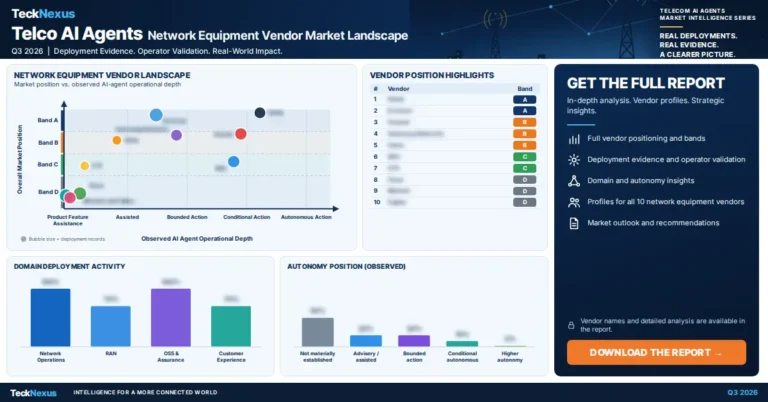
Telco AI Agent Leadership Landscape - Network Equipment Vendors
Network Equipment Vendor Report
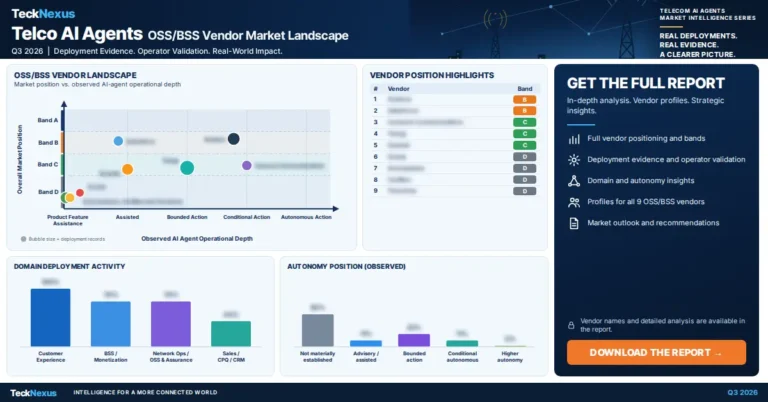
How are Amdocs, Salesforce, Comarch, Totogi, Qvantel, Oracle and other OSS/BSS vendors deploying telecom AI agents?
OSS/BSS Vendor Report
How are Amdocs, Salesforce, Comarch, Totogi, Qvantel, Oracle and other OSS/BSS vendors deploying telecom AI agents?
System Integrator Report
Scroll to Top