

AI Agent Competitive
Intelligence
Intelligence
Private Network
Intelligence
Intelligence
Intelligence Journeys
Utilities Private Broadband Planning
AI Use Case Planning for Utilities
Intelligence Tools
By Tool Type
▼
By Industry
▼
Access Type
▼
Monthly Trackers
▼
Resources
▼
Technology Hubs
▼
Partner Hubs
▼


Home » Satellite & NTN » Page 11
Satellite & NTN
Satellite and non-terrestrial networks (NTN) extend connectivity beyond the reach of ground-based infrastructure, using low-earth-orbit constellations, geostationary satellites, and high-altitude platforms. A major shift is the integration of satellite directly into cellular standards, enabling direct-to-device services that let ordinary phones connect via satellite where there is no terrestrial coverage. NTN is increasingly viewed not as a competitor to mobile networks but as a complement — filling coverage gaps, adding resilience, and supporting IoT and emergency communications. For operators and enterprises, satellite partnerships and spectrum are becoming strategic. This channel covers satellite and NTN developments — constellations, direct-to-device, standards integration, and operator partnerships — with analysis of how non-terrestrial connectivity is moving from niche to a mainstream layer of the connectivity landscape, and where the business case genuinely holds.
- Article & Insights
- January 29, 2024
- Hema Kadia

Uncover how satellites are redefining the role of traditional cell towers, enhancing mobile communication, and bridging the gap in global connectivity.


Explore the key benefits and insights offered by 'The Evolution of 5G Spectrum' whitepaper, providing a deep dive into the spectrum needs and strategies for 5G-Advanced and 6G technologies. Understand the challenges and solutions in spectrum management and the role of emerging technologies in shaping future mobile networks.
- News
- January 16, 2024
- News Feed

John Deere partnered with SpaceX to provide cutting-edge satellite communications (SATCOM) service to farmers, utilizing the Starlink network. This will allow farmers facing rural connectivity challenges to fully leverage precision agriculture technologies. making them more productive, profitable, and sustainable in their operations as they continue to provide food, fuel, and fiber for their communities and a growing global population. The SATCOM solution will connect both new and existing machines through satellite internet service and ruggedized satellite terminals. This will fully enable technologies such as autonomy, real-time data sharing, remote diagnostics, and more.
- Article & Insights
- January 15, 2024
- Hema Kadia
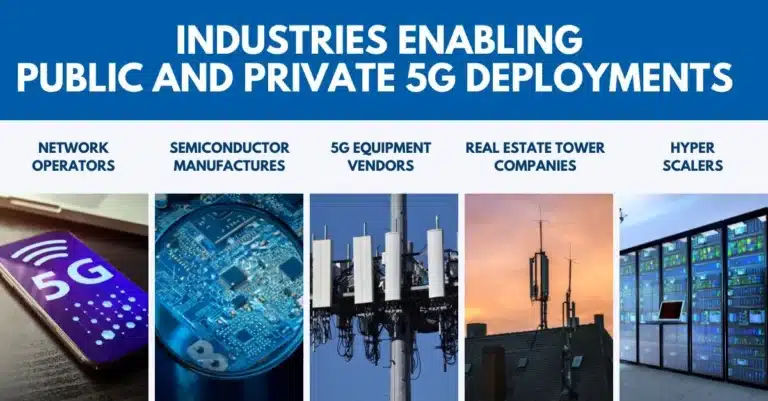
Investors seeking to maximize their profits from the potential of 5G should consider a multi-pronged approach and invest in companies that provide 5G network equipment, tower infrastructure, semiconductors, and hyperscalers as well as 5G mobile network operators. Here are the top companies across the sectors that are leading global public/private network rollouts.
- News
- January 10, 2024
- News Feed

Discover Iridium Communications' Project Stardust, an initiative offering standards-based IoT and Direct-to-Device service via its operational LEO satellite network. Learn about its impact on 5G and IoT sectors.

Explore the latest advancements in 5G-Advanced with the '3GPP Technology Trends' whitepaper. Discover how innovations like the Metaverse, RedCap devices, JCAS, and Ambient IoT are shaping the future of telecommunications. Gain insights into the integration of AI/ML in 5G networks and the transition towards 6G.
- Podcast
- December 13, 2023
- 5G Guys

In this 5G Guys podcast episode, Wayne and Dan welcome TJ Maan from Samsung to discuss Fixed Wireless Access (FWA). TJ explains what FWA is and its benefits over traditional wireline broadband delivery technologies, noting its speed, reliability, and...
- News
- November 30, 2023
- News Feed

This article delves into the recent Ericsson Mobility Report, highlighting the robust growth of 5G technology with predictions of over 5.3 billion subscriptions by 2029 and a significant increase in average data usage per smartphone.
- News
- November 16, 2023
- News Feed

The White House released a National Spectrum Strategy developed in coordination with the National Telecommunications and Information Administration (NTIA) and the Federal Communications Commission (FCC). President Biden released a Presidential Memorandum, establishing spectrum policy and a process for resolving spectrum-related conflicts. This plan earmarks over 2,700 megahertz of airwaves for exploration and potential utilization in both the private sector and federal agencies.
- News
- November 16, 2023
- Hema Kadia

Explore the Orange Satellite Internet, powered by Nordnet. This service ensures high-speed broadband access across all of France, bridging the digital divide with state-of-the-art satellite technology.
- News
- November 16, 2023
- News Feed

Intellian Technologies and Marlink have extended their strategic alliance for an additional five year. Intellian is set to persist in providing Marlink's end users with hybrid connectivity terminals. This collaboration will encompass the co-development of products for hybrid connectivity, utilizing Geostationary Orbit (GEO), Medium-Earth Orbit (MEO), and Low-Earth Orbit (LEO) networks. Additionally, Marlink will maintain access to necessary capacity.
Frequently Asked Questions
What is a Non-Terrestrial Network (NTN)?
NTN refers to connectivity delivered via satellites, high-altitude platforms, or other non-ground-based infrastructure, working alongside, not instead of, traditional cell towers to extend coverage to places terrestrial networks don’t reach. The concept has been formally incorporated into 3GPP’s mobile network standards specifically to ensure satellite-based connectivity can integrate technically with standard cellular networks, rather than existing as a completely separate, incompatible system. This standardization matters because it means NTN connectivity can, in principle, work seamlessly alongside regular cellular service, allowing a device to fall back to satellite coverage automatically when terrestrial signal isn’t available, rather than requiring users to manually switch between two entirely separate systems.
What are the different types of NTN?
- Satellite networks: These networks use satellites in orbit around the Earth to transmit and receive signals and include geostationary and Low Earth orbit (LEO) satellite networks
- Balloon networks: These networks use balloons that are floated high in the stratosphere to transmit and receive signals. They can be used for applications such as providing internet access in remote or hard-to-reach areas, as well as for remote sensing and scientific research.
- High-altitude platform stations (HAPS): These networks use aircraft or airships that fly at high altitudes, such as the stratosphere, to transmit and receive signals. They can be used for similar applications to balloon networks, and they also have the added advantage of mobility.
- Drone networks: These networks use drones, which are also referred to as unmanned aerial vehicles (UAVs), to transmit and receive signals. They can be used for a wide range of applications, such as providing internet access in remote or hard-to-reach areas, remote sensing, scientific research, and commercial uses like delivery and inspection.
- Stratospheric platform stations (SAPS): This network uses a platform stationed in the lower part of the stratosphere, such as a blimp, that can relay communications between ground and satellites or between ground and another SAPS.
- Laser Communications: This network uses a laser to transmit data between two points. This technology is still in development, but it has great potential to provide high-bandwidth, low-latency communications.
Is satellite internet going to make cell towers obsolete?
No. The industry consensus treats satellite and direct-to-device connectivity as a complementary layer that extends coverage to remote and underserved areas, not a replacement for dense terrestrial 5G networks in cities and suburbs where ground infrastructure remains far more efficient at handling large volumes of simultaneous users. Terrestrial cell towers can support vastly more simultaneous connections and far higher data throughput per user within a given area than current satellite technology can practically deliver, making satellite connectivity better suited for filling coverage gaps, like remote rural areas, maritime and aviation routes, or emergency situations where terrestrial infrastructure has failed.
What is direct-to-device (D2D) satellite connectivity?
Direct-to-device, often abbreviated D2D, lets ordinary smartphones connect directly to satellites for basic connectivity, such as text messaging and, increasingly, voice or limited data service, without needing a separate, dedicated satellite terminal or specialized hardware beyond what’s already built into many recent smartphone models. This represents a significant technical advance over older satellite phone technology, which required bulky, dedicated devices. Large satellite operators, including SpaceX’s Starlink, are positioning D2D as a broader connectivity layer that could eventually extend beyond emergency and remote-area use cases into more general-purpose coverage, though this more expansive vision remains considerably further from current commercial reality than basic emergency messaging service.
Why is satellite connectivity becoming a bigger topic in telecom circles in 2026?
Large satellite operators entering the connectivity market with very large addressable market projections are raising substantial industry questions about spectrum ownership, infrastructure economics, and how traditional telecom operators and satellite providers will share or compete for the same customers going forward. SpaceX’s Starlink, for instance, has framed its total addressable market across AI, connectivity, and space-enabled infrastructure as enormous, positioning direct-to-device satellite connectivity as a potential global connectivity layer. This scale of ambition has prompted genuine strategic concern within the traditional telecom industry about longer-term competitive dynamics and what role established carriers will play as satellite capabilities continue advancing rapidly.
How does NTN fit into 6G plans?
Standards bodies are explicitly designing 6G to include seamless integration between terrestrial and satellite networks as a core capability, aiming to close coverage gaps as a fundamental design goal rather than treating satellite as a bolt-on afterthought added after the main standard is already finalized. This reflects lessons learned from how NTN support was added to 5G somewhat later in that standard’s development process, with 6G planning intended to incorporate satellite integration considerations from earlier on. The explicit goal is a future network where a device can move seamlessly between terrestrial and satellite coverage without users needing to think about which type of connectivity they’re actually using.
What’s the difference between low-earth-orbit, medium-earth-orbit, and geostationary satellites for connectivity purposes?
Low-earth-orbit, or LEO, satellites orbit much closer to Earth than older satellite generations, typically a few hundred miles up, which significantly reduces signal delay, or latency, making LEO constellations considerably more suitable for real-time applications like voice calls than earlier satellite generations were. Medium-earth-orbit satellites sit considerably farther out and are less commonly used for the consumer broadband and direct-to-device connectivity currently generating the most attention. Geostationary satellites orbit much farther from Earth, remaining fixed relative to a specific ground point, useful for certain broadcast applications but introducing meaningfully higher latency, generally making them less suitable for interactive connectivity compared to LEO constellations.
Do existing smartphones actually support satellite connectivity today, or is special hardware required?
A growing number of recent smartphone models do support some form of satellite connectivity natively, generally for specific, limited use cases like emergency messaging when no cellular signal is available, rather than full general-purpose satellite data service. This built-in support typically depends on having a relatively recent device with a modem chipset specifically designed to support satellite frequencies, meaning older devices generally cannot access these features even through a software update. As direct-to-device satellite services continue expanding beyond basic emergency messaging toward more general data and voice capability, broader satellite support is expected to become a more standard smartphone feature over time, similar to how 5G modem support gradually became standard.
What regulatory and spectrum challenges does satellite connectivity raise for traditional telecom operators?
Spectrum that terrestrial carriers have historically used exclusively may need to be shared or coordinated with satellite operators offering direct-to-device service using similar or overlapping frequencies, raising technical interference concerns and complex regulatory coordination questions that vary by country. There are also competitive and regulatory fairness questions, since satellite operators offering connectivity services may not be subject to the same licensing requirements or local infrastructure investment expectations that traditional terrestrial carriers face in a given country, potentially creating an uneven competitive playing field regulators are still actively working through. These unresolved questions are part of why traditional operators have approached large-scale satellite providers with a mix of cautious partnership interest and genuine competitive concern.




Telco AI Agent Leadership

