
TeckNexus Awards
News & Insights ↗
Intelligence Tools
By Tool Type
▼
By Industry
▼
Access Type
▼
Tool Source
▼
Intelligence Platform
Paid
Intelligence Hub
▼
Monthly Insights
▼
Resources
▼
Channels
▼
Partner Channels
▼


Devices
Devices span the hardware that connects to networks — smartphones, modules, routers, customer-premises equipment, IoT sensors, and increasingly AI-capable endpoints. Device capability is a frequently overlooked constraint on network performance: the bands, features, and chipsets a device supports determine which 5G or 5G-Advanced features users can actually access, even within strong coverage. New categories such as reduced-capability (RedCap) devices, fixed wireless access units, and satellite-capable phones are expanding where and how networks reach users. For operators and enterprises, device strategy shapes everything from spectrum value to private-network design and IoT scale. This channel covers the device ecosystem — chipsets, form factors, and the new classes of connected hardware — with analysis of how device evolution enables or limits network capability across consumer, enterprise, and industrial deployments.
- News
- January 15, 2024
- News Feed
Explore the latest rumors surrounding the iPhone 16 and iPhone 16 Plus, focusing on their RAM upgrade and 5G capabilities. Discover what changes and what stays the same in Apple's newest models.
- Article & Insights
- January 15, 2024
- Hema Kadia
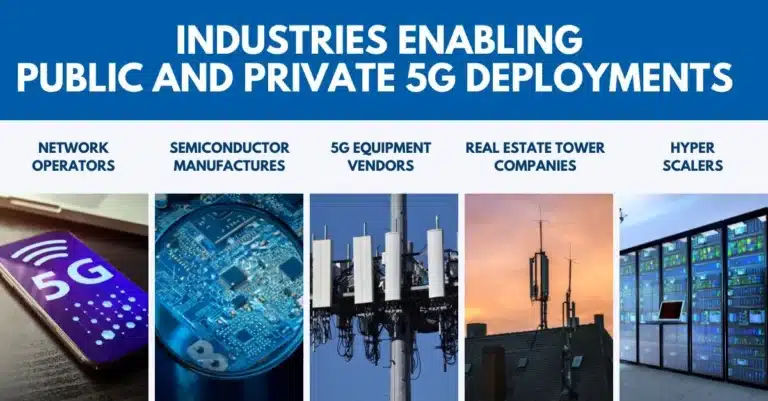
Investors seeking to maximize their profits from the potential of 5G should consider a multi-pronged approach and invest in companies that provide 5G network equipment, tower infrastructure, semiconductors, and hyperscalers as well as 5G mobile network operators. Here are the top companies across the sectors that are leading global public/private network rollouts.
- News
- January 10, 2024
- News Feed

Discover Iridium Communications' Project Stardust, an initiative offering standards-based IoT and Direct-to-Device service via its operational LEO satellite network. Learn about its impact on 5G and IoT sectors.
- Podcast
- December 11, 2023
- Hema Kadia

Watch John Deere's innovative shift to private 5G networks in an interview with Jason Wallin. Learn about their strategies to overcome connectivity challenges in manufacturing, enhance operational efficiency, and implement robust security measures.
- News
- November 30, 2023
- News Feed

This article delves into the recent Ericsson Mobility Report, highlighting the robust growth of 5G technology with predictions of over 5.3 billion subscriptions by 2029 and a significant increase in average data usage per smartphone.
- Article & Insights
- November 30, 2023
- Pritesh Patel

Whether you're a novice or an expert in cloud computing, the AWS Re: Invent conference offers insightful and useful knowledge. The conference is a event for anybody wishing to stay up to date on the newest trends and advancements in cloud computing, with its focus on innovation, networking, and education.
- Podcast
- November 29, 2023
- 5G Techritory

A special 5G Techritory Podcast episode for our Latvian listeners!
Telecoms, connected devices, and other technologies processes generate an ever-increasing amount of data and increasingly depend on them. The value of smooth data flow and secure use by various parties is widely recognized.
- Podcast
- November 22, 2023
- 5G Techritory
With the exponential growth of IoT devices expected to reach 27 billion by 2025, the risks associated with their implementation have become increasingly critical. In this session, experts in the field will provide valuable insights into the future of cyber security in IoT and discuss effective strategies for mitigating the risk factors. Discover the latest advancements in IoT security technologies, threat landscape assessments, and best practices for ensuring the confidentiality, integrity, and availability of IoT ecosystems.
- Article & Insights
- November 15, 2023
- Hema Kadia

The mobile phone industry is undergoing a transformation, with emerging technology enabling direct communication between standard mobile phones and satellites. With regulatory changes, international partnerships, and new technological standards, mobile devices will soon boast enhanced satellite connectivity. Companies like SpaceX and Apple are diving deep into the race to provide extensive satellite communication, partnering with T-Mobile and Globalstar, respectively. As the competition intensifies, companies are pushed to innovate or risk becoming obsolete.
- Article & Insights
- November 15, 2023
- Hema Kadia

The age of connectivity we live in is marked by an explosion in smart devices and data consumption, underpinned by rapid urbanization and technological innovations. This necessitates superior communication infrastructure, especially with the rise of 4K/8K video streaming, online gaming, VR/AR, and shifts in work culture prompted by COVID-19. Despite 4G/LTE networks serving us till now, they lack in terms of speed and latency for present needs. Ensuring low-latency is paramount for real-time communications, particularly in sectors like autonomous vehicles, healthcare, and finance. Integrating terrestrial networks (like 5G) with non-terrestrial networks (like satellites) presents a solution, but is challenged by technical, regulatory, and economic factors. Future advancements in satellite communication, including improved payloads and next-gen constellations, look promising. The synergy between 5G and satellite networks will shape the future of global connectivity.
- News
- October 25, 2023
- News Feed

Edzcom and OMRON partner to revolutionize Industry 4.0 through seamless 5G connectivity and advanced automation. This collaboration promises enhanced operational efficiency, real-time safety prioritization, and end-to-end data encryption for optimal automation benefits. Edzcom and OMRON are at the forefront of revolutionizing manufacturing through seamless connectivity integrated into Autonomous Mobile Robotics (AMR).
Frequently Asked Questions
What counts as a ‘device’ in this category, beyond smartphones?
It spans smartphones, tablets, wearables like smartwatches and fitness trackers, mobile hotspots, IoT sensors deployed across industries from agriculture to manufacturing, connected vehicles, fixed wireless access routers used for home and business broadband, and increasingly, AI-capable hardware designed to run machine learning models directly on the device. Each device category has different priorities: a smartphone needs to balance performance, battery life, and broad consumer features, while an industrial IoT sensor might prioritize extremely low power consumption and a multi-year battery life over raw performance, and an enterprise device built for a private 5G network might prioritize certified protocol compatibility and ruggedized durability over consumer-friendly design.
Why does device support matter for new network technologies like 5G Standalone or network slicing?
Even if a network supports a capability, like dynamic network slicing or a specific 5G Standalone feature, customers can’t actually use it unless their device’s chipset, modem, and software also support that capability, which often lags meaningfully behind network rollout. Chipset manufacturers need time to design, test, and certify support for new network features, and device manufacturers then need to integrate those chipsets into actual products and release them to market, a process that can take a year or more after a network feature first becomes available. Device readiness is frequently the real bottleneck determining how quickly new network capabilities translate into a noticeably different experience for everyday users.
What’s driving demand for ruggedized or purpose-built enterprise devices?
Standard consumer smartphones are generally designed for everyday consumer environments and aren’t built to handle the physical conditions, security requirements, or specific network protocols many enterprise and industrial deployments require. Manufacturing floors, mining operations, ports, and outdoor industrial sites often expose devices to dust, moisture, extreme temperatures, and physical impact that consumer-grade hardware isn’t rated to withstand reliably over time. Beyond physical ruggedness, enterprises increasingly need devices specifically certified to work with private 5G network protocols, dedicated security requirements, or specialized application software, creating a distinct market for ruggedized, enterprise-focused devices from manufacturers who specialize in industrial and field-service hardware.
How is AI changing what we expect from connected devices?
Devices are increasingly expected to run AI processing locally, known as on-device inference, rather than sending every request to a cloud server for processing. This reduces latency, since results don’t need to travel to a distant data center and back, and it can improve privacy, since sensitive data doesn’t necessarily need to leave the device at all. However, on-device AI requires meaningfully more capable chipsets than older devices needed, since running AI models locally demands processing power and memory simpler, lower-cost devices may not have. This is driving tighter coordination between chipset makers, device manufacturers, and network operators.
Why do some phones get 5G features faster than others, even on the same network?
Even on the same underlying network, different phones can support meaningfully different real-world 5G performance because of differences in their specific modem chipsets, the particular frequency bands those chipsets support, and how well each device’s software has been optimized to take advantage of available network features. A phone with a more advanced or recently released modem might support carrier aggregation across more frequency bands simultaneously, or be certified for 5G Standalone features that an older or lower-cost device’s modem simply can’t process, even if both phones are technically labeled as 5G phones. Marketing labels alone don’t guarantee equivalent performance.
What’s the difference between a consumer device and an IoT device in terms of design priorities?
Consumer device design generally prioritizes a balance of performance, battery life, screen quality, and broad appeal, with relatively frequent product refresh cycles to stay competitive in a crowded market. IoT device design tends to prioritize very different things: extremely low power consumption to support battery life measured in years, low manufacturing cost to make large-scale deployment of thousands or millions of units economically viable, and a narrow, specific function rather than broad general-purpose capability. An IoT sensor monitoring soil moisture in agriculture doesn’t need a high-resolution display; it needs to reliably transmit a small amount of data for years on a single battery charge.
How long does it typically take for a new network capability to reach mainstream devices?
The timeline varies considerably, but it’s common for a meaningful gap, often a year or more, to exist between when a network feature first becomes technically available and when it reaches a meaningful share of mainstream devices in active use. Flagship devices released around the same time as a new network capability typically support it fastest, since manufacturers often coordinate development timelines with major network milestones. Mid-range and budget devices generally lag further behind, both because manufacturers prioritize newer chipsets in premium products first, and because many consumers keep mid-range and budget devices for longer before upgrading.
What role do device makers play in network standards development?
Device makers, particularly major chipset manufacturers like Qualcomm and MediaTek, participate directly in standards bodies such as 3GPP, contributing technical expertise and influencing which features make it into a given network generation’s specifications. This involvement matters because standards need to reflect what’s actually feasible to build into real hardware within a reasonable cost and power budget, not just an idealized technical capability no chipset could practically support. Device makers also often run early interoperability testing with network equipment vendors before a standard is finalized, helping ensure compatible devices can realistically follow soon after a standard is specified.