Industry Intelligence
Intelligence Journeys
AI Use Cases for Utilities
Private Broadband for Utilities
Intelligence Tools
By Tool Type
▼
By Industry
▼
Access Type
▼
Tool Source
▼
Intelligence PlatformPaid
▼
Monthly Tracker
▼
Resources
▼
Technology Hubs
▼
Partner Hubs
▼

Metaverse
The metaverse refers to persistent, immersive virtual and augmented environments where people interact, work, and transact, often delivered through VR and AR. For telecom, its significance lies less in consumer hype and more in the demanding connectivity it requires — high bandwidth, low latency, and edge processing — which makes it a stress test for 5G, edge, and future networks. Enterprise and industrial variants, sometimes called the industrial metaverse, overlap with digital twins, simulation, and connected operations. After inflated early expectations, attention has narrowed to use cases with clear value and realistic network requirements. This channel covers the metaverse where it intersects networks: the connectivity, edge, and device foundations immersive experiences depend on, and the enterprise and industrial applications most likely to move from concept to deployment, with a grounded view of timelines.
- Article & Insights
- November 3, 2023
- Hema Kadia

Metaverse has been gaining traction in recent years, and it’s becoming increasingly important for businesses to be aware of. But what is the Metaverse? In this blog post, we’ll take a deep dive into this concept and explore its history and how it is evolving with related technologies. We’ll also discuss Metaverse challenges.
- News
- October 30, 2023
- Hema Kadia

India is getting ready for a big 5G tech change and will need 22 million trained people by 2025.
- Article & Insights
- August 1, 2023
- Hema Kadia
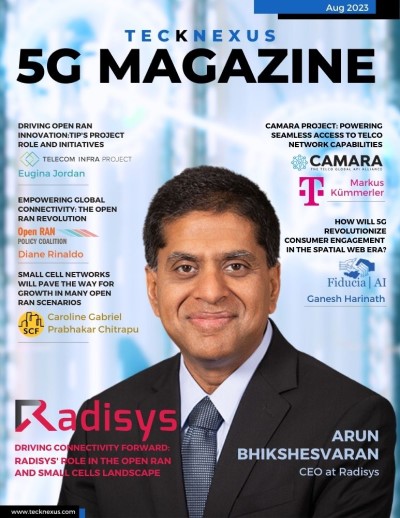
Welcome to our latest edition - a deep dive into the technological marvels of Open RAN and 5G. Join us as we unravel insider insights from Radisys Corporation's CEO, explore the transformative CAMARA project, and highlight pioneering entities like the Telecom Infra Project, Small Cell Forum, and Open RAN Policy Coalition. Delve into the future of consumer engagement in the Spatial Web era and discover the intersection of AI, AR, VR, and edge computing. We invite you to explore, question, engage and help shape our shared digital future. Welcome to the discourse. Happy reading!
- Article & Insights
- August 1, 2023
- Hema Kadia

In this article, we delve into the transformative potential of 5G in the Spatial Web era. With fascinating insights into the convergence of 5G, AI, AR, VR, and NFTs, we illuminate how these technologies are reshaping the retail industry and consumer engagement at large. As the global Spatial Web market surges towards an estimated value of $30.7 billion by 2025, we dissect the pivotal role of 5G and telcos in meeting the heightened demands of this digital revolution. Explore this riveting piece for a deep understanding of the future of consumer interaction in the evolving Spatial Web landscape.
- Partner Event
- June 23, 2023
- Hema Kadia

Event Start Date: 9th Oct, 2023
Event End Date: 11th Oct, 2023
Location: Madrid, Spain
- News
- May 22, 2023
- TeckNexus Editorial
Meta Platforms is in negotiations with Magic Leap for a possible long-term collaboration. While this partnership could aid Meta's metaverse goals, Magic Leap's waveguide technology, despite its flaws, is regarded as valuable. This comes as Meta continues investing in the metaverse despite investor dissatisfaction, and as it strives to reduce reliance on Chinese manufacturing.
- News
- April 28, 2023
- Hema Kadia

T-Mobile US has chosen nine start-ups to participate in its annual Accelerator Programme, which this year aims to foster innovative 5G experiences for sports and live events.
- Podcast
- April 4, 2023
- 5G Techritory
Keeping up with the pace of innovations and new technologies has proven to be quite a challenge for lawmakers and regulators. While the physical and digital worlds can be difficult to regulate, another challenge is looming on the horizon – the metaverse. In this session, you will hear how these experts approach the technologies on a local and regional level so that they don’t hinder advancement but rather provide a benefit for society.
- News
- March 14, 2023
- Hema Kadia

As part of its plan for broader cost cuts, Meta Platforms Inc., the parent company of Facebook, is contemplating different divestiture options for Kustomer, the customer service software firm it acquired for $1 billion in 2020. Meta has not yet finalized its decision but is considering either spinning off the business or attempting to sell it, according to a source familiar with the matter.
- News
- March 3, 2023
- Hema Kadia

The 5G Future Forum (5GFF) will lead a first-in-the-world demonstration that is expected to change the evolution of music collaboration. Using the 5GFF Edge Discovery Service (EDS) API, which enables devices to identify and connect to the Mobile Edge Compute (MEC) site providing the lowest latency closest to them, the performance will showcase the value of the interoperability of the EDS API, leveraging Open Sesame's audio platform to sync guitar players across New York, USA (Verizon), Toronto, Canada (Rogers), and London, England (Vodafone).
- News
- March 3, 2023
- Hema Kadia

Metaverse experts argued the potential of the sector goes beyond providing new revenue opportunities, claiming it opened the door to societal benefits by promoting collaboration and allowing people to redefine themselves completely.
Frequently Asked Questions
What does ‘the metaverse’ actually mean in a telecom context?
In a telecom context, the metaverse generally refers to persistent, interconnected virtual or mixed-reality environments accessed through AR/VR devices or screens, where the technical demands on the underlying network, rather than the specific consumer platform or experience, are what matters most. Rather than being a single product, it represents a future demand driver for very high and consistent bandwidth, ultra-low latency, and significant edge computing capacity, since truly immersive, responsive shared virtual experiences with many simultaneous users push network requirements further than most current applications. For telecom planners, the metaverse concept is useful primarily as a forward-looking stress test for network capacity and architecture decisions, rather than something with an established, single technical specification the way 5G or Wi-Fi does.
Is metaverse hype dying down, or is it still a meaningful trend for telecom?
Consumer enthusiasm for standalone metaverse platforms, particularly the kind of fully immersive virtual worlds prominently marketed in the early 2020s, has cooled noticeably compared to that initial peak, with several high-profile metaverse-focused products failing to attract the sustained mainstream user numbers early projections anticipated. However, the underlying technical requirements driving metaverse interest, immersive AR/VR, real-time 3D rendering, low-latency networking, and edge computing, remain genuinely relevant and are increasingly discussed under other labels like spatial computing or immersive experiences rather than the specific word metaverse. In that sense, the technology trajectory hasn’t reversed so much as the marketing language describing it has shifted toward more grounded, specific use cases.
What network capabilities would a true metaverse experience require?
Persistent, responsive shared virtual worlds supporting many simultaneous users interacting in real time would need extremely low latency to prevent motion sickness, desynchronization between users, and a generally unconvincing sense of shared presence. High and consistent bandwidth would be required to support high-resolution visuals and real-time data exchange between potentially large numbers of simultaneous participants in the same virtual space. Significant edge computing capacity would be needed to render and synchronize experiences physically close to users rather than relying entirely on a distant centralized cloud, since the latency penalty of round-tripping every interaction to a faraway data center would be incompatible with a genuinely responsive, shared real-time experience at meaningful scale.
How does network slicing relate to metaverse-style applications?
A dedicated, low-latency network slice could, in theory, guarantee the consistent performance immersive shared experiences need, similar to how slicing is already used commercially for applications like cloud gaming. A network slice tailored for a metaverse-style application could prioritize the specific combination of low latency and guaranteed bandwidth that experience requires, even during periods of broader network congestion, rather than competing for capacity with all other general network traffic on a best-effort basis. That said, large-scale commercial metaverse-specific network slicing remains more conceptual than common today, since the broader metaverse application category itself hasn’t reached the scale of established commercial use cases like cloud gaming.
What’s the difference between ‘the metaverse’ and ordinary online multiplayer games or virtual worlds?
Ordinary online multiplayer games and existing virtual worlds already share several technical characteristics with metaverse visions: persistent virtual environments, real-time interaction between many simultaneous users, and a need for responsive, low-latency networking. What more expansive metaverse concepts typically add, at least in their more ambitious framing, is interoperability across different platforms and experiences, more immersive access through AR/VR hardware rather than a traditional screen and controller, and a broader vision encompassing not just gaming but socializing, working, and shopping within a unified persistent virtual space. In practice, the distinction is often more conceptual and marketing-driven than a precise technical line, since many existing online games already deliver much of what metaverse discussions describe.
Why did major tech companies pull back on metaverse investment after the initial hype?
Several major technology companies significantly reduced public investment and messaging around dedicated metaverse platforms after initial products failed to attract the scale of active, paying users that ambitious early projections anticipated, while the substantial ongoing costs of building and maintaining sophisticated virtual world infrastructure continued regardless of user adoption. The rise of generative AI as a dominant industry narrative and investment priority starting around 2023 also redirected significant corporate attention, talent, and capital away from metaverse-specific projects toward AI development, which offered more immediate, demonstrable business applications. This doesn’t mean the underlying immersive technology research stopped, but the specific framing and standalone commercial push branded explicitly as the metaverse lost considerable momentum.
What metaverse-adjacent use cases have actually found practical traction?
Several metaverse-adjacent use cases have found genuine, if less headline-grabbing, practical traction outside the original consumer virtual-world framing. Enterprise applications like virtual collaboration spaces for remote teams, immersive training simulations for industries like manufacturing and healthcare, and virtual product design and architectural walkthroughs have found steadier, more grounded adoption than consumer-facing social metaverse platforms. Cloud gaming, which shares significant technical overlap with metaverse infrastructure requirements like low latency and edge computing, has continued growing as an established, well-defined commercial category in its own right. These more specific applications have generally proven more durable than the broader, more abstract vision of a unified consumer metaverse.
How does edge computing specifically support metaverse-style experiences?
Edge computing supports metaverse-style experiences by handling computationally intensive rendering and real-time data synchronization physically close to users, rather than requiring every interaction to travel to a distant centralized cloud data center and back. This is particularly important for maintaining a convincing sense of shared presence among multiple users interacting in the same virtual space simultaneously, since even modest added latency from a distant data center could create a noticeable lag between when one user acts and when others perceive that action. By processing this work at edge locations closer to users, telecom operators can support more responsive, immersive experiences on lighter, less powerful client hardware than would otherwise be required.